Charles A.
Warner
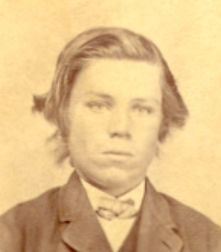 Charles A. Warner, fifth of the five children of John Warner
and Marancy Alexander, was born on the Fourth of July, 1853 in Winslow, Stephenson County, IL. It is
uncertain what his middle initial stood for. Logic would suggest it was Aaron after his grandfather Aaron
Warner or Alexander after his mother’s maiden name, but simply having the “A” appear in records is
genealogically intriguing, because it means he had some sort of middle name, and that goes against
the pattern. Thus far no sources whatsoever show middle names in the cases of Charles’s siblings and
parents.
Charles was only four and a half years old when his father died. As the littlest of the children, his
life was both the most affected and least affected by this tragedy. Most, in the sense that he barely had
the chance to know his father, and was half an orphan very early in his life, and least, because he had
no obligation to “step up” and fulfill a more mature role. That is in sharp contrast to the eldest of
his brothers, John, who went to work at the tender age of eleven to support the household. It also is
unlike the situation faced by his lone sister Minta, who at thirteen was surely obliged to act at times
as a surrogate mother for the youngest boys -- Fred, Clifford, and Charles -- while Marancy took
advantage of whatever meager income-producing opportunities were available to widows.
When Charles was nine, his mother married Nicholas Balliet, a neighbor who had recently lost his second
wife. But by then, Charles had spent half his lifetime without a father, and Nicholas would perish within
a few years (perhaps even within a matter of months), so Charles must have come of age with the notion
implanted that he would have no male mentor to lay out a path for him. Instead he would have to trail-blaze.
His first big step occurred when he was still in his early teens. He accompanied neighbor Charles Miller
Macomber and the latter’s wife and five children as they made an attempt to establish themselves on a farm
in Nebraska. The acreage in question lay a little to the west of the Missouri River in the Sheridan
Township portion of Washington County, more specifically between the small communities of Blair and Fort
Calhoun. Charles (meaning Charles Warner) worked for the Macombers as a hired hand. This took up a year
and a half of his young life, a span that might have been twice that or more except that
the Macombers decided Nebraska wasn’t to their liking after all, and reversed course. They would not try
again. Winslow was home, they decided, and that was that, long-term. The timing of their departure was
either 1869 or the early portion of 1870. The return journey occurred in either the latter part of 1870
or some point in 1871.
When the Macombers reestablished themselves in Winslow, they did so on rented acreage, the family having
sold their original homestead to finance the Nebraska experiment. Charles probably ceased working for
them at this juncture, and even if he did continue to do so, he did not live with them, but instead
moved back in with his mother. Tempting though it might be to characterize this as a retreat, as in
tucking himself under his mother’s skirts in failure, it was the opposite. By the early 1870s, his mother
needed him. She had no other children available to live with her. The 1870 census confirms the only
occupant of her home at that point aside from the lady herself was Clifford. (In this same census,
Charles is enumerated in Nebraska with the Macombers in Sheridan Township.) By no later than 1872,
Clifford was gone as well, having chosen to join the large migration of folk from Winslow and nearby
communities to Butler County, NE. That group included many members of the extended family of Fred
Warner’s bride Penina Shreckengost. Clifford would go on to marry Penina’s younger sister Ella Andora
Shreckengost.
Marancy was able to stay in place for a few years thanks to Charles’s contribution as man-of-the-farm.
She surely appreciated the way in which the circumstances left her free to take her time to decide
what sort of life she would assume now that she was done raising all of her offspring. She was just
entering her fifties and was not yet ready to be a crone sitting in a rocking chair on a porch waiting
for the Grim Reaper to come calling. In pondering her situation, she decided that the original Warner
homestead had become a burden. It could instead be an asset. Accordingly, in 1875 she sold the land to
the Macombers, who were more than happy to seize the opportunity to resume being property owners of
Winslow, bringing to a close their temporary status as renters. (The Macombers would proceed to live
on the former Warner homestead for decades to come, their presence eventually representing such a
constant in the history of Winslow that neighbors tended to forget the family had ever been based on
a different farm during the pioneer era, or that they had been entirely absent from the community for
a year and a half.)
The sale of the land meant Marancy and her boy needed a place to stay. In the short term, this was no
problem. John Warner was well able to help out in that regard. In 1869 John had wed Nellie Martin, the
daughter of Nathaniel Martin, one of the wealthiest men in the immediate area around Winslow. Nathaniel
did not live in Winslow itself but instead a mile to the north across the Wisconsin-Illinois state
boundary in a small village named for him, i.e. the community was named Martin. (In the late 1880s the
name would evolve into Martintown.) There Nathaniel operated his large sawmill and flour mill,
businesses that had made him so prosperous he had instigated a policy of giving eighty acres of land
to each of his offspring -- to the sons when they turned twenty-one and to the daughters when they
became wives. John and Nellie had long since taken up residence on the eighty acres Nellie had received
by means of this dowry arrangement. The parcel was located just north of the village of Martin itself.
Marancy and Charles accepted John’s hospitality. The 1875 Wisconsin state census confirms this,
showing Marancy and Charles in quarters of their own on John and Nellie’s land.
Charles’s twenty-first birthday arrived in 1876 and at about that point he began putting into action
the life plan he had concocted for himself. The transaction that had led to the Macombers acquiring
the deed to the old Warner homestead appears to have been at least in part a trade for title to the
land in Washington County, NE. Charles had already put his blood and sweat into that soil, and he
was willing to do so again for his own gain, as his own boss. Off he went. Marancy probably came
with him. He would have viewed it as his obligation to provide for her, and certainly he would have
found it extremely useful to have her help. Nonetheless from the moment he took up residence in
Nebraska once again he must have already been anticipating acquiring a bride with whom he would
share his new home.
He already had a prospective wife in mind. She was Mary Elizabeth Maurer, someone with whom he had
grown up. Mary, born 24 March 1851 in Clinton County, PA, had come to Winslow in the early 1850s with
parents Daniel Maurer and Martha Brownlee and older siblings Anderson and Isabella. She and Charles
were married 26 November 1878 in Fremont, Dodge County, NE. Despite being a bit beyond the boundaries
of Washington County, Fremont was one of the nearest major towns to the farm, and therefore was one of
the closest places where a justice of the peace was available.
Charles had land. He had a spouse. It was time to found a family. Mary became pregnant at once, giving
birth to first child Laura Isabelle Warner in the late summer of 1879, a short nine months after the
wedding. The one element needed to make the couple’s sense of security complete was to have additional
kinfolk around them. This was easier said than done. Mary’s parents and siblings did not wish to say
farewell to northern Illinois. Meanwhile Charles’s older brothers were well situated. However, there
was one last possibility. Minta Warner had wed John Ladd, Jr. back in 1872. They had so far been living
a somewhat transient existence, never staying long in any one place. When Charles made an overture to
them, the Ladds proved to be amenable to the idea of relocating to Nebraska, especially so given that
their two kids, John Warner Ladd and Kate Ladd, were reaching school age and could benefit from having
a steady home and a consistent peer group of other children.
The Ladds picked a spot that was also within the bounds of Sheridan Township. While it was not adjacent
to Charles and Mary’s farm, it was close enough that the two couples and their kids could easily get
together for holidays and Sunday picnics, and Marancy could migrate back and forth between the two
residences, lending a hand variously to either her daughter or her daughter-in-law, while at the same
time avoiding the negative aspects of “always being there” when either of the two young couples craved
some privacy.
Both families remained on these Washington County farms for five years. During this period, Charles and
Mary made up for their somewhat late start as husband and wife, becoming parents of not only Laura
Isabelle, but two more daughters, Alta Araminta and Edna. Given that John Warner Ladd and Kate Ladd
were by then old enough that they did not require as much supervision, Marancy increased her focus
upon Charles and Mary’s little ones.
The five years just mentioned represent a successful period for the two households. The gamble of
dedicating themselves to fresh territory rather than cleaving to known places and conditions seemed
to have paid off. The nation had finally shrugged off the economic malaise of the 1870s. The
development of eastern Nebraska was proceeding steadily. An omen of even better times was that
Minta became pregnant again in the autumn of 1883. She and John had hoped to add to their family for
many years and for it to finally happen now as Minta approached forty years old was not only joyful,
but a cause for relief. Nevertheless, despite the comparatively rosy picture, the two families
decided they might be able to do even better elsewhere. They brought to a close the Washington
County chapter of their lives. They continued to be Nebraskans, but in 1884, they moved a bit
farther west and north to Knox County. Quite a number of other families of northeastern Nebraska
were making their own plans to homestead in Knox County. The Ladds and the Warners apparently did
not want to miss out on the chance to do be a part of the wave.
The two parcels the family members acquired, each comprising a traditional size of 160 acres, lay
within an undeveloped portion of Miller Township about eight miles west and one mile north of the
hamlet of Creighton. One reason settlers in general had developed an enthusiasm for the region was
that Creighton, founded in 1871, now had access to the national railroad grid. A rail line and depot
had become a fixture of the community in 1881, ensuring that local residents could count on rail
transportation should they need to bring in major goods and equipment at affordable prices. Moreover,
crops and livestock raised on area farms would have a way to reach better-paying urban customers.
Added to these happy
prospects were the personal circumstances. In contrast to the logistics in play in Washington County,
this time the two farms were literally next to one another. That meant the two families could position
their homes in close proximity and enjoy the advantages that came with that. Among the benefits was
the greater degree of safety. Also, extra hands were available at short notice to help out with tasks
or advice. But one of the greatest advantages was that the arrangement saved money. The two sets of
owners were able to build one large barn along the boundary line. They could combine paddocks,
henhouses, pig sties, the forge, and a play area for the children. Also they did not have to go
to the trouble of digging two wells. They could excavate just one, making sure it was deep enough
and fine enough to serve the needs of both households. They knew that to be savvy with their initial
expenditures might be the very thing that would allow them to prosper, or even to survive.
At the time of their 1884 arrival, Charles and Mary and Minta and John appear to have been unshaken by
doubts -- prepared to make the gamble that they would thrive in Knox County. It could be said that they
viewed their newly chosen spot as having the potential to be their generation’s Winslow, to be the place
they finished raising their broods and probably the place where they would grow old together. They
could not have anticipated the degree to which that projection was optimistic. As it worked out, they
were confronted by such a series of challenges it must have seemed as though the families were cursed.
One particular way in which their fortitude was tested should be mentioned before all others: The
weather. The two couples probably thought they had what it took to cope with the winters of Nebraska, no
matter how brutal. While in Washington County they had lived through the winter of 1880/81. More than
one account written by journalists as it was happening, and more than one memoir account written in
retrospect, fell back on this characterization: “It was as bad as it could possibly be.” Snow arrived
early and lay heavy on the northern Nebraska landscape. Thousands of cattle perished, unable to dig
down far enough to get at a sufficient amount of grass, unable at times even to make it through the
thick drifts toward the piles of supplemental hay their owners had left out for them.
Surely it would not be that bad again, thought the Warners and Ladds. Or at least, not any time soon, and
surely not with any regular frequency. But the winter of 1880/81 was not the worst of that decade. That
one year may indeed have been triggered by fluke conditions, but the game changed. In 1883, the Krakatoa
volcano in Indonesia went off in a spectacular fashion. Naturally no one in Nebraska witnessed that event.
After all, it happened on the other side of the world. But the volcano spewed so much ash that skies were
darkened over the entire planet for multiple years. One of the consequences of the diminished sunlight was
that Nebraska suffered further devastating winters through the remainder of the 1880s. In addition,
there were specific incidents such as the Schoolhouse Blizzard of January, 1888, which still holds the
record for the deadliest winter storm in American history. The event affected not only the Great Plains
region in general, but was especially severe in northeastern Nebraska.
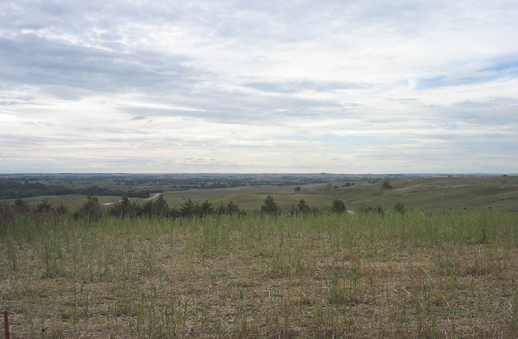
This photograph taken by Gayle Neuhaus 16 September 2013 shows the modern-day view westward from
Section 18 of Miller Township. Irrigation adds to the greenness, but the summer rains of Knox County
are usually sufficient to stave off the “yellow ocean of grass” effect found farther west in the Great
Plains. It is a view not unlike what the Warners and Ladds would have seen in the 1880s, prior to the
onset of the five-year drought. It does not show the land that made up the homesteads themselves. The
camera would have had to be pointed straight down to capture that. Instead the vantage shows the
landscape the family members would have seen if they had stood at the very western edge of their
property and gazed beyond the bounds of Miller Township into neighboring Logan Township.
Alas, the bitterly chill conditions represented only the first type of weather ordeal the Warners and
Ladds had to endure. Back in the Winslow area, summers could sometimes have dry spells, but eventually
rain would come. Not so in Nebraska, where the rainless periods could stretch on and on and the crops
in the ground would not simply suffer, they would die. In 1890, a severe drought arrived that would
blight the region for a full five years. By the time it ended, half of the settlers who had poured
into the state during the decade of the 1880s with the intention of homesteading had fled. Most did not
return.
Among those who gave up were Minta and John Ladd. By 1895, they’d had enough. They transferred title of
their land to Charles and Mary, which is to say, Charles and Mary now owned a spread of 320 acres.
Presumably there was some exchange of actual money, but it wouldn’t have been much because neither
family had any reserves of cash. A more likely arrangement is that Charles and Mary assumed whatever
debts were secured against the Ladd property so that Minta and John could have a clean slate as they
proceeded into the next phase of their lives.
The fact that Minta and John chose to bail out is not to suggest they were people of weak character.
The decision was based upon factors more nuanced than that. The “Knox County curse” was not limited
to bad weather. It was also made up of personal tragedies. Minta and John had been hit by one of these
immediately upon coming to Knox County. Ira Earl Ladd, the baby Minta and John had waited so long to
have, was born that summer of 1884. And he was not “right.” Whether due to difficulties during labor
or due to congenital factors, Ira’s brain did not function as it should have. His mental acuity was
profoundly compromised. He had such trouble learning he would never go to school nor learn to read
and write. He was thoroughly dependent upon his parents and other family members. He would never
“get better.” He would go on to survive only to age thirty-one, and would spend the final portion of
his life in a mental institution. Minta and John would have had to possess super-human natures in
order to continue to try to make a go of it by farming while simultaneously providing for their
special-needs son. It is something of a miracle they managed to do so for a decade in the face of
vicious winters, searing droughts, and the economic stress of the Panic of 1893.
Charles and Mary had a similar sort of personal tragedy beset them in the early years of the
Knox County sojourn. They, too, had to devote themselves to caring for a developmentally-ravaged
child. The critical difference is that in their case, the situation did not saddle them with a
burden that would remain a part of their daily lives for good, which is what ultimately happened
to Minta and John. The whole episode took less than five months to play out from start to finish.
In the spring of 1888, approximately a year and a half after the couple had welcomed their fourth
child, Sibyl Bertha Warner, into the world, Mary gave birth for a fifth time. Unlike Sibyl, who
was a healthy, thriving child, the new baby was even worse off than little Ira. Family letters do
not describe all that was wrong and in that era, such things as death certificates were not
bureaucratically required, so today no surviving medical documentation exists that might shine a
light on the details. Suffice it to say, it was so obvious to her parents that she was not going
to thrive that they did not give her a name. Or at least, no name has survived. Correspondence
written by Sibyl in the 1960s simply refers to her as “my baby sister.” Her gravestone describes
her only as Infant of C.A. and M.E. Warner. In point of fact, she survived nearly five months,
but apparently that was not long enough to make Charles and Mary act. Perhaps they did not want
to assign a name for fear it would serve to sharpen their grief. (More about the poor child
and about the cemetery where she was interred can be found on the page devoted to her. Click on
“Infant Girl Warner” at the bottom of this page to go to it.)
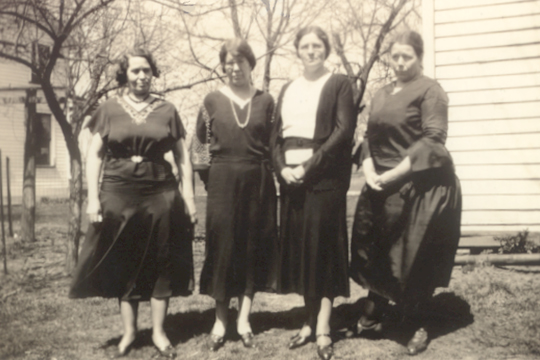
The four surviving daughters of Charles A. Warner and Mary Elizabeth Maurer in the 1930s. By
the time this was taken it was rare for all four to be in the same place at the same time. From
left to right, Edna, Alta, Sibyl, and Laura.
For all the hardship described above, the years Charles spent in Knox County contained joyful
occasions, contained satisfactions, contained accomplishments to be proud of. Without question
this period could be characterized as the prime of his life, assuming one defines “prime of life”
as the portion of a lifetime when an individual is engaged in worthwhile endeavors that create
a legacy. His existence in that time and that place was imbued with a sense of purpose. He worked
his land, raised his daughters, helped -- as he would have viewed it -- carve a zone of
civilization out of territory rescued from savages.
Bit by bit, beginning in 1884, the farm developed. And bit by bit, the surroundings transformed.
Charles and Mary’s first home was a dugout, meaning it was created by digging down four to six
feet into the ground and then using blocks of cut sod to raise the walls to full height.
Only later would this dwelling be replaced by one of wood-frame construction. The timing of that
transition is no longer known but local history sources confirm 1888 was the year that Miller
Township could boast of a wood-frame-construction schoolhouse. (John Warner Ladd and Kate Ladd
were teenagers by then, but Charles and Mary’s girls would go on to spend quite a few school
terms within those walls.) In 1891, Miller Township gained its first actual village. It was
called Winnetoon. It was a few miles to the northeast and Charles and Mary continued to favor
Creighton as the place where they would go for supplies, social events, and official business,
but the existence of Winnetoon was a sign the isolation and austerity of the pioneer days was
coming to an end.
While the bad years, weatherwise, were very bad indeed, the locality had the potential to treat the
family well, and sometimes did. The landscape of the homesteads was gently rolling in such a way as
to provide relief from the prairie wind. Summer thunderstorms typically kept the vista green even
in August and September. Merriman Creek ran through the acreage. The stream flowed efficiently
along a deep channel -- this was appreciated by Charles and his sister, both of whom had grown up
with the sluggish creeks of the Winslow area, alternately having to contend with flooding and
then with wetlands whose stagnant waters nurtured malarial mosquitoes. They would also have been
thankful not to be faced with clearing their land to make it ready for cultivation -- at least not
to the degree their father had been forced to deal with the timber on the Winslow homestead in the
early 1840s.
Among the blessings Charles received was that he survived to see the eldest members of the next
generation slip into adulthood and begin stretching their wings. In 1891, his niece Kate Ladd wed
her beau Charles Monroe Davey and went to live with him in Creighton. The following year his nephew
John Warner Ladd established himself as a farmer in his own name on rental land a mile or two to the
west in Logan Township. And toward the end of the decade his own daughter Laura became a
schoolteacher. Yet all in all, Charles was cheated of the opportunity to “be there” for events and
transitions he would certainly have wanted to witness if he could have. Unfortunately for him, he
was subject not only to the “Knox County” curse, but was also a victim of the immediate-family
affliction of short lifespan. No child of John Warner and Marancy Alexander would live to be a
white-haired eightysomething-year-old leisurely savoring a brimming trove of memories. Charles
exited ahead of any of them, surviving barely more years than his father had.
One difference between his own death and his father’s is that Charles at least had some inkling
that it was about to happen. He developed pain in his abdomen. This went on long enough and severely
enough that, upon the advice of his local physician, he made his way to the medical college in
Omaha. Unfortunately there was little to be done. Charles died 2 April 1898 at the facility. The
cause -- presumably determined via an autopsy -- was cancer of the stomach. (It is worth pointing
out that in that era, “stomach cancer” was a catch-all sort of diagnosis and medical professionals
today might well have characterized the cause in a more specific way.)
Charles’s body was shipped by rail to Creighton, destined for interment at Olcott Cemetery, the
small graveyard that served Miller Township from the early 1880s through the year 1920. (The site
lay about a mile south of the Warner homestead.) The funeral, officiated by Reverend Wesley Nye,
was held at ten in the morning on Tuesday, the fifth of April. Given the financial pressure the
family was under -- after all, the main breadwinner had just perished -- Mary did not requisition
a headstone. Nor did she do so three years later when Marancy passed away. However, both graves are
next to that of the infant who died in 1888. The substantial headstone erected shortly after that
little one’s death serves now in the 21st Century to pin down the location of the Warner family
plot should anyone want to visit and pay their respects.
Though deprived of Charles while only in her own
forties, Mary did not become a wife again. She was a child of pioneers and in her own adult life had
been a pioneer herself. She was not scared to fend for herself. In fact, she seemed to prefer to be
mistress of her own destiny. This stay-in-the-face-of-grief philosophy remained true of her even as she
lost the companionship, assistance, and advice of not only of Marancy but of Minta and John Ladd. For
Minta, the loss of her mother was a sort of “last straw” that removed any remaining loyalty she might
have felt toward Knox County. She embraced the option of starting over elsewhere. She and John did so
by relocating in 1902 to Hot Springs, SD, where the couple believed they might be able to call upon
medical professionals who could guide them in caring for Ira. Kate Ladd Davey and her family accompanied
them, and then after a year or two went on to Spokane, WA. Therefore, from 1902 onward, the only family
members toughing it out in Miller Township with Mary were her own daughters. The only other local family
connection to speak of was in the person of John Warner Ladd, but even in his case, the bond was
expressed in a less immediate way, because in 1902, John ceased farming. As a consequence, was no
longer near at hand in Logan Township. Instead he became a merchant in Creighton. While this means he
was still able to help his kinfolk on the homestead on special occasions, he was not routinely available
as he had previously been.
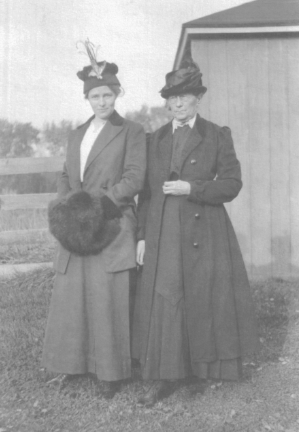 At the outset of this widow-farmer phase, Mary may
have regarded her primary role in life as being
a provider for her daughters, but that could not have been her only motivation, because she remained in
place long after she no longer had to shoulder that burden. Progressively Mary’s daughters became more
independent, and the way they did so could not be characterized as tentative. In the short term, all
four of them became schoolteachers, and they all did so while still in their teens. This erased any
need for Mary to pay their way; in fact, it meant they could do the reverse if necessary. They had
salaries; they could if need be make contributions to the household funds. Meanwhile they variously
began forging their individual destinies. Alta took the lead. Like the others, her first teaching
assignments were, if not in Knox County, at least in northeastern Nebraska, but beginning in 1908 she
was to be found at far greater distances -- in South Dakota, in Montana, and even in Washington state.
Laura, calling a semi-permanent hiatus to her own teaching gigs, moved to the heart of South Dakota in
1908 to become a homesteader in her own right, and not long after, she became a wife. Edna meanwhile
took the unique step among her sisters and became a wife quite early on, as in before she turned
twenty. At the end of 1902 she wed a local fellow, Clark Bonge, and they established themselves as
a farming couple just to the east of the Warner homestead. Even Sibyl was out of the house
relatively soon, though she came back during breaks between school terms.
In 1911, Sibyl had emerged from pharmacy shcool in Fremont and her time there would in turn soon
lead to her marriage to William Lovett. It was the empty-nest moment for Mary. She absolutely could
have walked away from the homestead at that point; however, she did not. She apparently believed in
the place, after all, and believed it was her mission to keep it functioning. Instead of departing,
she kept at it. This was no small challenge. She was no longer young. She was adamant, though, and
when her eldest saw that she was determined, she chose to help. Laura was now married to Bert
Dibble and they had land in South Dakota to tend to. Nevertheless the couple chose to move in
with Mary and assist her, leaving it to Bert’s relatives to look after the South Dakota property.
Laura and Bert did not have children. That factor was probably critical to their choice to
temporarily relocate. Remarkably, they did so not just for one growing season or two, but for
five years altogether.
By the time the 1916 harvest was complete, The Widow Mrs. Warner was half a year beyond the classic
retirement age of sixty-five. (The photo at left shows her as she looked during that juncture of
her life, i.e. the mid-1910s. It was taken in early 1913 in Fresno County, CA when she, accompanied
by Sibyl, went to visit her brother-in-law John Warner and his family.) And indeed, Mary was at
last willing to accept that it was time to bow out. Moreover, she did not do so halfway by leaving
farming but continuing to physically inhabit the same landscape. Instead, she returned to northern
Illinois. Her siblings had remained in the family home near Winslow throughout the decades that Mary
was in Nebraska. Parents Daniel and Martha had died early in the 20th Century (at very advanced
ages). Anderson Maurer was still keeping the farm going, though by then was doing so at times as an
absentee landlord while renting or leasing the acreage to others. (For example, in a 1917 farmer’s
directory the tenant working the land was Clarence Wales. This individual was a brother of Ethel
Wales, who was the recent widow of Claude Earl Bucher. Claude Earl Bucher was a nephew of Mary’s
sister-in-law Nellie Martin Warner, wife of John Warner.) At the point when Mary arrived, Anderson,
a childless widower, was sharing a home in Nora, Jo Daviess County with his spinster sister
Isabella, better known as Belle. Belle had never experienced a time living apart from Anderson.
Now Mary was there as well.
Anderson died in February, 1917. By then Belle was not in good shape either. She lasted less than
four additional years, passing away on Christmas Eve, 1920. Mary was the only heir, so at that
point she owned the Nora residence. This would be her main base for the remainder of her life.
That said, on at least three occasions she was elsewhere. The first of those stretches was
substantial -- she spent over a year with her daughter Laura. Laura’s husband Bert had died in
an accident and Mary was concerned that her child should not be left all alone on the South
Dakota homestead until she was thoroughly over her phase of grief. (Given that Mary was
simultaneously going through her own grief over the loss of her sister, the emotional support was
undoubtedly mutual.) Then at the end of the 1920s, Mary spent several weeks with Edna and then a
similar span with Alta while recovering from an illness.
As mentioned above, Mary never did become a wife for a second time, but in 1926 or 1927, she
did receive a proposal. The overture came from David M. Balliet, the step-brother of Charles.
David’s wife of sixty years, the former Nancy Reber, had recently died. David came calling at
Mary’s door, apparently wanting to follow through on an interest that had stirred back in the
1860s, when he and Mary had both been teenagers and neighbors in Winslow. Mary’s girls took a
dim view of such a prospective union -- David had already turned eighty, and Mary was no spring
chicken. Mary does not seem to have hesitated to reject the offer. David returned to his home
in Waterloo, IA, found a lady who did want to be his missus, and finished his life there. If
the concern of the girls was that they did not wish their mother to be widowed again, the
refusal contained an irony, because David would live to age ninety-two -- Mary was
four-and-a-half years in her grave by the time he passed away.
The 1930 census confirms Mary was still in Nora, and still at that juncture was the sole occupant
of her home, though as mentioned, she had already been obliged to temporarily abandon the place due
to health, and though she usually remained at home after that, was frequently looked in on by
Edna, who lived somewhat nearby in Rockford, IL or by Alta, who was about the same distance away in
Davenport, IA. Furthermore, Alta had a habit of spending part or even all of her summers in Nora.
Mary finally passed away 25 April 1933 in Nora, having survived Charles by thirty-five years. Her
grave can be found at Rock Lily Cemetery in Winslow amid those of her parents and siblings. She had
come full circle, becoming part of the very earth on which she had skipped and played during
childhood, despite the many years she had lived in other places.
Children of Charles A. Warner
with Mary Elizabeth Maurer
Laura Isabelle
Warner
Alta Araminta
Warner
Edna
Warner
Sibyl Bertha
Warner
Infant
Girl Warner
For genealogical details, click on
each of the names.
To return to the Warner/Alexander Family main page, click here.