Edna Warner
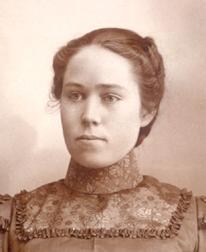 Edna Warner, the third of the five daughters of Charles A. Warner
and Mary Elizabeth Maurer, was born 11 February 1883 on the family farm near Blair, Washington County,
NE. Unlike her sisters, she does not seem to have had a middle name; certainly no source includes a
middle name -- aside from her practice of using Warner as a middle name after she was married -- nor
any middle initial. She would go on to have no lasting memory of that farm inasmuch as the big move to
Knox County, NE took place when she was just a year old.
As described in her father’s biography, the family faced extraordinary challenges in making a go of it
on their new homestead in Knox County’s Miller Township -- “family” meaning not only Edna and her
parents and sisters Laura, Alta, and Sibyl and grandmother Marancy Alexander Warner, but also Edna’s
father’s sister Minta and her husband John Ladd, Jr. and their kids, who established themselves upon
an adjacent parcel at the same point in 1884. The weather assaulted them in the form of uncommonly
cold winters replete with life-threatening blizzards, and with summer droughts that persisted year
after year for half a decade. Naturally those conditions had a negative effect on crop yield, be it
from late plantings to fields becoming desiccated to locust swarms devouring grain before it could be
harvested. These issues were so profound the income from the good years -- of which there were all too
few -- was not enough to make up the difference. Add to that the personal tragedies -- the loss of Edna’s
youngest and unnamed baby sister, born in the spring of 1888 and placed in her grave at the end of
summer, and also her first cousin Ira Earl Ladd, afflicted from his 1884 birth onward with severe
mental deficiency. For Edna, luxury was a concept defined in only the most mundane of ways. For
example, when she began first grade, she had the privilege of doing so in a schoolhouse of wood-frame
construction. The school that had previously served their portion of Miller Township had been made of
sod walls -- just like the home in which Edna spent much of her childhood -- and the new structure
had only gone up in 1888.
The times were so bad Edna’s aunt and uncle felt they could not hold on to their homestead, and some
time in the early or mid-1890s they gave it over to Edna’s parents -- probably for little actual money
but rather with the understanding that Charles and Mary would assume the tax burden and other debts
associated with the Ladds’ 160 acres. Then in 1898, to add insult to injury, Edna’s father died. Not
only was this a huge emotional blow, but it meant the household economic straits were even more dire.
All four (remaining) daughters of Charles and Mary responded in the most practical way they could.
There weren’t a lot of career options available to women in general and that was especially true of
the local area, but the one obvious exception for ladies of good moral standing was to become
teachers in the same sort of rural schoolhouses in which the Warner girls had received their own
education. Without exception Laura, Alta, Edna, and finally Sibyl did precisely that. In more than
one instance their initial gigs were so local they could continue to live at home. This saved the
cost of boarding-house fees, creating savings that allowed them to better support their mother and
grandmother.
The 1900 census shows that Edna was not yet a teacher. She was barely seventeen years old. In point
of fact she would pursue the occupation for only a brief interval -- perhaps even as brief as a
single term. Instead, she did something unprecedented: She got married. To become a wife before
turning twenty was a standard sort of development for most any woman of her generation and the
generations before her, but with the exception of her grandmother Marancy, it was not true
of the females of Edna’s own immediate family. Her mother had not wed until
nearly twenty-eight. The same was true of her aunt Minta. Her mother’s sister Belle Maurer had not
wed at all. None of her sisters had taken a stroll to the altar as of 1902 and ultimately none of
them would come near to following Edna’s example of doing so at such an early point in life. Alta
would remain single for good, Laura would wait until age thirty and Sibyl would nearly reach
twenty-seven before she became a bride. But Edna decided she would embrace the traditional woman’s
role of wife, mother, and homemaker. The wedding took place at the Warner homestead on New Year’s
Eve, the last day of the year 1902.
Edna’s groom was Clark Ferdinand Bonge, whose family had settled in Knox County shortly before the
Warners arrived. (To this day there are Bonge family members in the vicinity, perhaps some on the
original homesteads.) Clark, born 7 October 1881 in Bloomington, IL, was slightly more than a year
older than Edna and so their period of schooling had overlapped. After that the pair had ample
opportunity to cross paths because Clark had become a farm hand for his brother Charles, whose
land was situated in close proximity to the Warner farm. Clark was therefore very much a known
quantity in terms of suitors, and Enda very much a known quantity to not just Clark but his whole
family. This boded well. The couple rapidly produced two children, Willard and Gladys. The former
was born precisely ten months after the wedding, a fact that means when Edna made her choice to
become a wife, she had not done so as an emergency step designed to preserve her reputation.
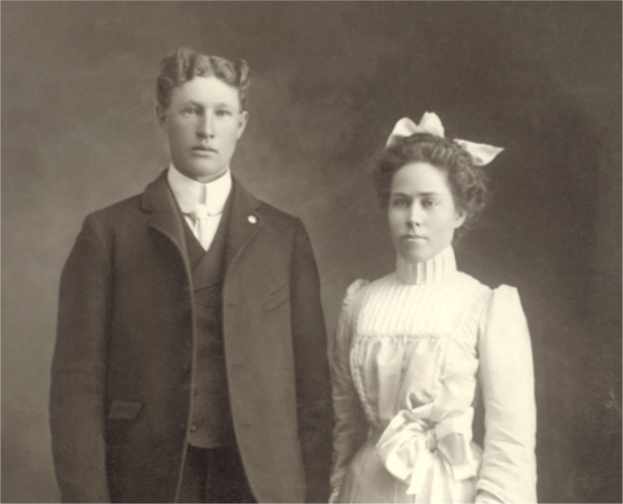
The wedding portrait of Clark Ferdinand Bonge and Edna Warner.
For the first small fragment of their married life, Clark and Edna were based on the farm of
Clark’s aforementioned brother Charles, but the newlyweds were eager to have their own place and
managed to purchase a homestead sooner rather than later -- perhaps even while they were still
newlyweds. This was perhaps less of an accomplishment than it would seem. So many pioneer farms in
the area had failed and/or been abandoned. Clark and Edna would not have needed much of a down
payment in order to obtain theirs. The challenge was making a living from it. Fortunately the
first ten to twelve years of the Twentieth Century were kinder to Knox County farm families than
the 1880s and 1890s had been. Edna and Clark’s parcel was in Section 19, right next to Section 18
where the Warner farm was. This was not only familiar territory but meant that little Willard and
Gladys had regular contact with their grandmothers and their surviving grandfather. For a time,
things were as close to as good as they could have been.
The financial prospects dimmed as the 1910s went on, though. All across America small family
farms were becoming unprofitable. Largescale competitors had too many ways to distribute seasonal
yields to the marketplace, be it by railroad car or motorized trucks on increasingly better
roads, not to mention that foreign producers could now get their output into U.S. ports in record
time thanks to larger and faster modern ships. The effect was at its worst when the inventory in
question consisted of easily-grown and widely available commodities such as the wheat, corn, and
hay grown in Nebraska.
In 1917, Edna’s mother decided she wanted to go to live with her elderly brother and sister in
northern Illinois. She had kept the double-sized homestead in production for nearly twenty years
after being widowed. Now she gave it over to Edna and Clark. This means the young couple had
triple the acreage from which to try to earn a living. In some ways this sort of bounty was
the only way they might have a chance of keeping their operation viable. Another advantage they
had was that food shortages in Europe due to World War I ensured that price levels for commodities
were high -- at least for the time being. On the downside, Edna and Clark had to end up with a
decent yield per acre, which was easier said than done in the face of not only the usual obstacles
of wind, rain, and temperature but also a shortage of manpower with so many young American men
off in Europe as soldiers. Edna and Clark did their best and stayed on course through 1917,
1918, and 1919, but then they were forced to take a hard look at their prospects. The war was
over. Soon the world would be experiencing a level of agricultural over-supply that had not
existed for several years. An act of Congress in 1919 guaranteed a subsidized per-bushel figure
for wheat, but only for that calendar year. Edna and Clark knew they could not count on farm
income to get them through the year 1920. They had to explore new ways of paying the bills.
For the first time, the couple ventured outside of Knox County. They moved to Norfolk, Madison
County, NE. While this was barely three-dozen miles southeast of Creighton, it was a world away
in terms of social environment. Edna and Clark and their kids were creatures of a profoundly
rural upbringing and now here they were in a town. If an upwind neighbor lit a cigarette, they
would smell it. If the people living across the street argued, they would hear the upraised
voices. In Knox County, they had been property owners on land nestled among other Bonge and
Warner farms; in Norfolk they were renters. And if those changes weren’t enough to adjust to,
even the household dynamics were new, because Clark was often gone from home not just for the
length of a workshift but for days at a stretch as he attempted to make a living as a
travelling salesman hawking motor oil and related petroleum products. Edna contributed to the
finances only in the sense that the couple took on a lodger -- a middle-aged fellow named
Frank Brooks. She was no longer a farm wife taking care of innumerable details that, while
they constituted stress of a sort, nevertheless involved the application on her part of her
wits and her experience. Her successes in dealing with the responsibilities had boosted her
self-esteem.
The pressures of the relocation manifested in the form of friction between husband and wife.
The couple divorced in the year 1920 or 1921. In taking that step, Edna was once more charting
a course unlike any ever pursued by the females of her close family. None of them had ever
gone through a divorce. For that matter, in that era not all that many American women of any
family group took such a step, in part because many states had laws that stood in the way
of dissolving a marital union but also because it “just wasn’t done.” Edna however was not
intimidated by the legal process nor by the prospect of living an independent life, especially
not with her youngest child having reached her mid-teens.
After parting ways with Edna, Clark continued to be based in Norfolk. In addition to sales
work and farm labor, he spent a period employed by Chicago and Northwestern Railway Company.
Some time before 1930 he wed Anna Mattie Smith, the former wife of William Almon Young, with
whom she’d had six kids. At least two of those kids, Zella and Bernice Young, were still around
when Clark became part of the household. In the 1930s this new marriage also faltered. Now twice
divorced, and probably deservedly so, Clark left the region in favor of Los Angeles County, CA. He
died there 4 May 1947.
As for Edna, she had the example of her mother, who had continued year after year to try to
make the homestead profitable, and had done so without the involvement of a husband. Edna
decided to make one last attempt to do the same. A letter written by her sister Sibyl to their
first cousin Bert Warner dated 29 January 1922 states that Edna had “the home farm” and was
intending to resume farming it. And indeed, she gave it a go, somehow keeping up the effort
to cultivate crops from the acreage though the years 1922, 1923, 1924, and 1925.
For four decades, Knox County had found ways to fail the Warners. Edna came to the decision she
would no longer let it do so to her. Perhaps the only two reasons she managed to summon the
willpower to eke out an existence there all the way to the mid-1920s were 1) Willard and Gladys
still had a bit more growing-up to do, and 2) she could count on the comforting presence of her
first cousin John Warner Ladd, the closest thing Edna had to a brother. But the latter’s butcher
shop and ice business in the village of Winnetoon was failing and he and his wife Betty were
privately admitting the time was approaching when they would have to pick up stakes and try to
support themselves elsewhere. And indeed, in 1927 they moved to Twin Falls, ID. Edna was
aleady gone by then. She had made her decision. Knox County was now a thing of her past.
However, for a brief interval, she did not vacate the state of Nebraska entirely. She became a
clerk in Omaha. Willard became a laborer at C.G. Johnson Boiler Company. They were joined there
by Louise Bonge, second wife of Charles Bonge, who brought along her juvenile sons Charles and
Russell Bonge. Louise handled the bulk of the cooking and housework. (Clark’s brother meanwhile
was seldom there, if at all, while working as a travelling salesman. Husband and wife may even
have been estranged at that point, though if so, they eventually reconciled.) Having
familiar faces around surely helped Edna adjust to the transition she was making.
In 1927, Edna moved to Rockford, IL, again with Willard in tow. This put her much nearer her mother,
who was then based in Nora, IL -- forty miles away -- but the main motivation was that Rockford
was a place where it was possible for a divorcée to make a living and was a spot suitable to
putting some emotional distance between herself and her former life. She began supporting herself
as a cook in a restaurant, her first position being at the Blackhawk Café. She and Willard
resided at 705 Green Street in 1927, and the following year began a multiple-year occupation of
328 S. Court Street. In both instances, the dwellings were rentals.
Edna’s mother reached eighty years old in the spring of 1931. As she became more frail, Edna
made regular visits. However, she did not go so far as to move in with her elderly parent, who
died in early 1933. Mary’s obituary describes Edna as a resident of Rockford and a 1934 city
directory confirms she was still in Rockford at that point, many months after the death had occurred,
employed by Home Grocery and residing at 2004 Latham (another rental). By 1935, though, she did
move to Nora, and apparently into her mother’s old place, though not as sole owner of the title. It
appears that either she only inherited a quarter of the ownership along with her three sisters, or
otherwise the entire house had been purchased years earlier from their mother by Alta. Given that
Alta was working and living in Davenport, IA, she did not need the place as her own residence.
Edna became the lady of the manor -- but by at least partially renting, not owning.
The Great Depression and the years of World War II scarcely let Edna prosper but by means of
three primary methods, she managed to get by: 1) Willard and Gladys both moved back in with
Edna, having each gone through intervals of independence, and the wages from their employment
eased the financial strain; 2) for one last stretch before reaching retirement age, Edna
resumed doing restaurant work, including as a manager as the 1940s progressed; and 3) Edna once
again took in lodgers. One of the latter was an elderly widow, Charlotte Bray, who had been one
of Mary Maurer Warner’s close neighbors.
Toward the end of her life, Edna’s sister Alta became frail enough so as not to want to tough it
out on her own in Davenport, so she moved in with Edna and her kids in Nora. Soon, though, Alta
was admitted to a convalescent hospital, where she died in 1962. Laura had already passed away
in 1948. Sibyl followed in 1968, leaving Edna as the last survivor of her generation of the
Warner-Maurer family. She only lasted a year more, perishing 25 March 1969. She was still a
resident of Nora, having lived there a total of 34 years, verging on longer than she had lived
in Knox County, NE.
About Edna's children:
Willard Warner Bonge had a number of jobs during his working life. Eventually he acquired a
limestone quarry and sold lime for agricultural use. He was sixty-five when his mother died, and
it is possible he had remained under her roof in one way or another for every one of those years.
It may have briefly been otherwise during a fragment of the Rockford years. The only other possible
time was if he perhaps preceded her in moving to Omaha. He survived to the ripe old age of
ninety-two, passing away in 1996 in Nora. He was not entirely alone during those final decades. In
Edna’s fading years, after she had become less able to keep up with the cooking and laundry, she
had hired a woman named Edith as a live-in housekeeper. Edith continued to serve in this capacity
after Edna’s death. Though Willard did not marry her, she was the closest thing he had to a wife.
She was very small in stature and was often called “Little Edith.”
Gladys Mary Bonge may have come along with her mother when she established herself in
Rockford, but if so, did not do so with any intention of staying. Gladys was already in her twenties
by then, and was ready to expand her horizons. It is quite possible she had already set off on her
own in 1925 or 1926. She does appear in the 1927 Rockford city directory with the same address as
her mother, but this may have a case of maintaining a mailing address while actually spending the
majority of her time elsewhere. And in this instance, the “elsewhere” is remarkable. Gladys was a
dancer in a chorus line. She appears to have kept up this occupation for half a decade, perhaps
more. This of course means that on any given day or week or month she was not to be found in
Rockford but in larger cities such as Chicago or in theatrical venues across the upper Midwest as
part of touring companies. Her agent and manager was Milt Schuster. This is the same person as
Milton Schuster (1883-1975), perhaps best known for his career as not only a talent scout and
agent but also producer of various stage productions of the so-called Vaudeville circuit,
particularly in Chicago and Milwaukee and the Ohio Valley. He also had a lesser-profile career in
Hollywood. An issue of Billboard magazine from the late 1920s specifically mentions Gladys
as one of the dancers he had secured a gig for with Johnny Burton’s traveling revue. This was a
stage show composed of skits, comedy monologues, dance routines, and musical numbers. A one-reel
movie of the best bits from the 1927 tour was released to movie theaters in 1928. If any copies
of that movie survive (alas, not a likely possibility at this juncture), then viewers of the 21st
Century might still be able to see Gladys in her glory days.
Upon retiring from her entertainment career, Gladys returned to the sphere of her mother, perhaps
at first in Rockford, but at an address separate from her mother and brother. Soon after Edna
moved to Nora, Gladys joined her there, and this time, shared the home. She soon, and perhaps
precipitously, married Nora garage mechanic Charles Stich, son of farmer Matthew Stich and his
wife, Lena Altenburg. The union endured only a short time, and was definitely over by no later than
1940. It may have ended in an annulment rather than a divorce -- certainly Gladys resumed using the
last name Bonge, or perhaps never stopped doing so. Perhaps needing to put some distance between
herself and Charles, inasmuch as the Stiches and Bonges lived right next to one another in Nora,
Gladys returned to Rockford in the early 1940s, this time for good. She went on to a long-term
stretch of employment as an assembler at Wood & Brooks Company, a firm specializing in piano keys
and more generally in the “piano action” portions of pianos, organs, and similar musical instruments.
It is safe to say her working life there was much less colorful than the one she had pursued in her
twenties. Gladys did not marry a second time and so was single almost her entire life. She died 28
May 1976 in Nora. (Charles Stich committed suicide 30 January 1957 by shooting himself in his
barn.)
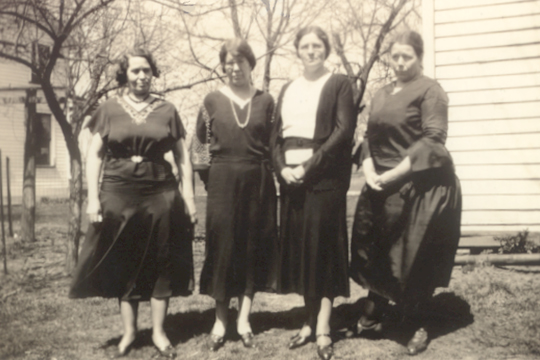
The four surviving daughters of Charles A. Warner and Mary Elizabeth Maurer in the 1930s. By the time
this was taken it was rare for all four to be in the same place at the same time. From left to right,
Edna, Alta, Sibyl, and Laura.
To go back one generation to Edna’s father’s biography, click here. To
return to the Warner/Alexander Family main page, click here.