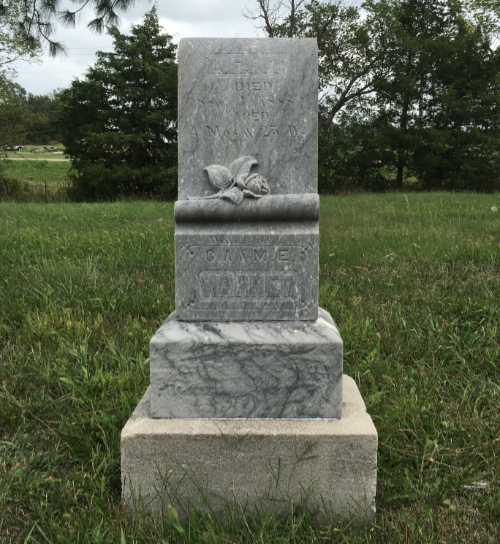
Infant Girl Warner
This website was created to describe the family of John Warner and Marancy Alexander and provide those of us living in the 21st Century with an opportunity to become familiar with the ancestral couple and their children, grandchildren, and great-grandchildren. That goal is largely out of reach when it comes to any sort of meaningful glimpse of the half-dozen or so individuals who died extremely young. That certainly applies here to the case and person of Infant Girl Warner. Still, it wouldn’t be right to ignore her entirely. She existed. She has her story, brief as it is.
Infant Girl Warner was the last of the five children of Charles A. Warner and Mary Elizabeth Maurer. She was born 9 April 1888 in Knox County, NE, probably on the farm of her parents in Miller Township. The word “probably” is inserted because there remains a possibility Mary was brought “to town” while in labor in order to have the assistance of a doctor or midwife, and “town” would in this case be the village of Creighton, eight miles east and one mile south of the farm. The birth was a highly anticipated event. Having over the years been blessed by the arrivals of four daughters, Charles and Mary were undoubtedly looking forward to greeting a son. However, they were no different than so many other parents in that the number one item on their wish list was that their baby would be healthy. They did not get this wish. The child was not healthy at all. Just what the issue was is not provided by any surviving source, but it must have been severe, and moreover, it was immediately obvious it was severe. From the moment she emerged from the womb, it was apparent she would die during her infancy.
Charles and Mary had already endured so much in the four years since they, along with Charles’s sister and brother-in-law, Minta and John Ladd, had founded their twin homesteads. They had cut their way into the prairie to make their sod-dugout houses. They had plowed and planted their fields, put up a barn (or two), dug at least one well, chased off coyotes. They had done everything including humble but necessary tasks from the erecting of outhouses to the stringing of clotheslines. Even in the calendar year 1888 they had made it through one hell of a test, one which would have claimed their lives if they had failed it. On the twelfth of January, Nebraska and the whole region around it was hit by the Schoolhouse Blizzard, an event so severe it still holds the record as the world’s deadliest winter storm with an estimated death toll of 235. (Unofficial estimates put this figure as high as a thousand.) The thermometer temperatures went down in some places to forty below. That does not count the windchill effect, and the winds in question blew at hurricane strength. The snowfall came to be measured in feet, not inches. The Warner and Ladd homesteads were located along a swath of the Upper Plains that endured the very worst the cold front had to offer. The following anecdote exemplifies how bad the local conditions were even as early as an hour or two into the phenomenon: In Plainview, only twenty-five miles south of Creighton, Lois Royce, a nineteen-year-old teacher, found herself trapped with three of her students in her schoolhouse. By 3pm, they had run out of heating fuel. Her boarding house was less than a hundred yards away, so she attempted to lead the children there. However, visibility was so poor the group became lost. The children -- two 9-year-old boys and a 6-year-old girl -- froze to death. Miss Royce survived, but her feet were frostbitten and had to be amputated.
The Warner and Ladd families made it through the storm alive. They had built their homes so well the walls and roofs fended off even such an assault as that described above. They had made sure to purchase enough coal for their stove. If the storm could be characterized as a trial, they passed that trial through a mix of foresight, grit, and and perseverence. Surely if any couple deserved to catch a break, it was Charles and Mary Warner. Instead, three months later, Fate said, “No, you don’t deserve good luck. This is how you will be treated.” It is fair to say the cruelty was so hard a blow the couple did not completely make peace with their loss. They had to insulate themselves from their grief, even if only in a symbolic way. The balm they chose was not to name their doomed infant. They had probably had a name in mind for the son they anticipated, and had probably come up with a girl name “just in case.” But while the little thing clung to life, she was just “the baby.” The designation “Infant Girl Warner” is off course not her name; it is just a genealogical placeholder label -- something to put in family-tree databases. When spoken of by the family members who had directly known her (on the rare occasions when they spoke of her at all), she was referred to in a variety of ways. For example, in 1960s correspondence, her sister Sibyl Warner Lovett referred to her as “my baby sister.”
One does have to wonder, though, that they kept to this choice throughout the rest of the spring and summer. Because we are not talking about a stillbirth or a premature infant that only managed to breathe for an hour or so. Infant Girl Warner clung to life and ultimately reached twenty-one weeks of age. Almost five months. Still -- no name assigned. To this day, her headstone identifies her only as “Infant Dau. of C.A. & M.E. Warner.”
As momentary as her presence on this Earth was, Infant Girl Warner did leave a legacy of sorts. When she finally gave up her struggle on the third of September, 1888, the event presented Charles and Mary with a decision they had not previously had to consider -- where would members of their family be laid to rest, not just in this instance, but going on through the years? Not back in Winslow. That was too far away. Creighton? That was a viable choice, but there was one other cemetery in the running, one so close to the twin homesteads that if any members of the family, even the older children, wanted to place flowers on the grave of their loved one, they could walk there and walk back in less than an hour.
Said graveyard was a mile south of the Warner and Ladd farms. It had been established by Samuel and Jane Ausman, immigrants from Canada who had come to Knox County in the late 1870s and lost their eighteen-year-old daughter Evaline in the spring of 1881. By 1888 the corner of the Ausman homestead that contained Evaline’s grave had gone on to become the resting place of a handful of other deceased residents of Miller Township, not just members of the Ausman family. Now those few were joined by Infant Girl Warner.
Early in the 1890s, the Ausmans decided they’d had enough of Nebraska, but before selling their homestead, Samuel and Jane set aside two acres, half of it so that a Methodist preacher, D.T. Olcott, could build the church he had been wanting to erect in the area west of Creighton. The other acre was earmarked for continuing burials in what would now officially be a public cemetery. By arranging matters that way, Evaline Ausman’s still-grieving parents could have some assurance their beloved daughter’s resting place would continue to be maintained well into the future.
The reverend followed through, and built his church, which came to bear his name. As one might expect, the graveyard became known as Olcott Cemetery. For a time, the interments grew in number, averaging about one per year over the stretch from 1888 to 1920. The tally now, speaking historically, stands at forty, with about three-quarters of those burials dating from after the Ausmans moved away. That is a number easily exceeding the level that would have occurred had Samuel and Jane not taken the steps they did. Eventually, though, no matter that their plan was solid and well-intentioned, local habits changed. By the 1920s, coffins and their contents were no longer moved about using wagons or pack animals or litters carried by pallbearers. They were transported by motorized vehicles. Given those circumstances, anyone based in Miller Township found it simple to forego burial at Olcott in favor of the Creighton city cemetery. Moreover, the church burned down and was not rebuilt. The graveyard somewhat literally faded away, vanishing beneath the shade of its cedar trees and engulfed by overgrown lilac bushes.
The all-but-forgotten burial ground emerged from the shrubs and weeds in 1985 thanks to a deliberate effort on the part of local volunteers. The site has since been kept in good condition. The crew’s efforts revealed only twenty-two headstones. Twenty-two is of course not the same as forty. The lower number may reflect theft or vandalization over the span from 1920 to 1985, but in fact, a number of the graves never had headstones. And here is where we come to the “legacy” aspect of Infant Girl Warner’s story, because two of the graves that do not have markers to denote their placement are those of Charles A. Warner and his mother, Marancy Alexander Warner Balliet. When Charles died young in 1898, there went the family breadwinner, and moreover this loss came after some very lean years -- a period so difficult it had already caused the Ladds to sell their acreage. Mary had loved her husband deeply, but she knew he would not have wanted to pay a stonecutter when the very same funds were needed to buy seed or farm tools or fuel for the winter. Or for that matter, pay the doctors who had tried to save his life. When Marancy died in 1901, the situation was no better. And so now, if a family member wants to pay respects to them at their final place of repose, the only straightforward means that visitor has to determine where to stand and bow their head is to venture over to the spot where Infant Girl Warner’s headstone stands, a good two dozen paces to the east of any other surviving memorial feature. The family trio is there, together at rest.
To go back one generation to Infant Girl Warner’s father’s biography, click here. To return to the Warner/Alexander Family main page, click here.