Alta Araminta Warner
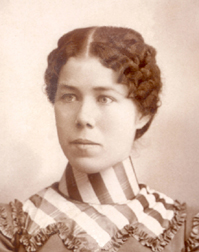 Alta Araminta Warner, the second of the five daughters of Charles
A. Warner and Mary Elizabeth Maurer, was born 1 August 1881 on the family farm near Blair, Washington
County, NE. Her middle name was derived from her father’s sister, and it was a particularly appropriate
honor because her aunt -- better known as Minta -- was a near-at-hand presence throughout her childhood
and was one of the three main female caregivers whose examples shaped her own behavior, the other two
being her own mother and her paternal grandmother, Marancy Alexander Warner Balliet.
Alta never married. It is bluntly obvious her spouselessness was a choice. Within her era and within
her generation, this may have simply meant she treasured her independence and wanted to forge a life for
herself that did not depend upon a man. Yet it is fair to wonder if she might have been gay. One has only
to contrast her story with those of her sisters to see why this possibility must be considered. While
said sisters all -- like Alta -- exhibited the tendency to be self-reliant or even downright bold about
accomplishing things for themselves, all of them nevertheless became wives. Edna and Sibyl became mothers
as well, and Laura is known to have chosen childlessness only because she feared her severe asthma would
kill her and result in any offspring she had being left without a mother at too early a point in life.
There is absolutely no indication in family writings nor in Alta’s paper trail to suggest a romantic
connection to a man. Neither is there any indication of a romantic connection to a woman, but this is
harder to assess. In her era, to openly declare herself to be a lesbian would have a career-ending move.
She was a teacher. No educational institution would have been willing to take the heat from the public
by including a known homosexual on their faculty.
Alta was a product of the pioneer phase of northeastern Nebraska. It is fair to say the harshness of the
environment in which she was raised served as a crucible that forged the most characteristic aspects of
her character: resilience, decisiveness, and fearlessness. Though to be sure, these traits also arose
from the influence of the family members around her, including the three female role models mentioned
above.
Alta was part of a relocation in 1884 of her parents, her sisters Laura and Edna, and her grandmother
Marancy from the farm in Washington County to a new homestead in Miller Township, Knox County, NE.
Coming with them were extended family members consisting of Minta and her husband John Ladd, and their
two school-aged kids, John Warner Ladd and Kate Ladd. During Alta’s infancy and toddlerhood, these
relatives had been based on their own Washington County farm, but somewhat at a distance. By contrast,
in Knox County the two households lived on adjacent parcels, the houses only a few dozen steps apart,
sharing the same yard and probably the same barn, well, and other infrastructure. These circumstances
significantly reduced the degree of isolation. Alta could count on the assistance and security wrought
by the company of not just her parents and grandmother, but two additional adults and two significantly
older cousins.
Alta might have found it hard to trust the world at large to give her a fair shake if not for that
foundation of nurturance and support, because for the entire span of her childhood from age three to
age seventeen, the double-household family cluster was hit by one major challenge and/or gut punch
after another. No sooner had they arrived in Knox County than the Ladd family become burdened in an
unforseen way by the birth of the third and by far the most junior of Minta and John’s three kids -- Ira
Earl Ladd. Ira was profoundly disabled in terms of mental capacity, and perhaps had physical limitations
as well. He would remain unable to read and write for his entire time on Earth. He would never be
capable of living an independent life. He could not be left without supervision. As a result, much
of Minta and John’s attention was consumed by caring for Ira. Naturally the extended family assisted
with this effort and by virtue of that, Alta learned early what it was like to be responsible for
the guidance of -- and even the physical safety of -- someone younger and less capable than she was.
This experience undoubtedly helped prepare her for the responsibilities she would shoulder in her
adult life as a teacher.
In terms of hardships, the weather was a major culprit. Time after time during the 1880s the
temperature dropped precipitously during the winter months, in part due to the volcanic ash in
the upper atmosphere following the massive 1883 eruption of the island of Krakatoa in Indonesia.
One particularly frightful episode was the so-called Schoolhouse Blizzard of January, 1888, that
might have cost the Warners and Ladds their lives if they had not made sure to keep plenty of
fuel on hand, and had they not had the good sense to huddle in their homes and avoid the outdoors
until the fierce conditions subsided. Then for five years running in the early 1890s, a severe
drought ruined one harvest after another. The onslaught, combined with the economic hurdles
caused by the Panic of 1893, led to Minta and John Ladd giving up on their homestead. Their 160
acres became part of the Warner holdings.
Weather-related ordeals were however not the experiences with the most lingering impact. After all,
every year winter always gave way to warmer months. As for the drought, even that came to an end
in the mid-1890s. Family members were always in the position to tell themselves “next year will be
better.” Not so with personal tragedies. Those could not be shrugged off. There were three particularly
bitter instances of that sort of heartache during the years Alta was growing up. First was that Ira
Ladd’s condition never truly did get better. Second was the outright loss of a new member of the
family. In 1886 the Warner household had welcomed the birth of Sibyl Bertha Warner. While this was a
joyous event and supplied Alta with another sister to enjoy for the whole of her lifetime, it was
followed in 1888 by another birth. Unlike Sibyl, the new baby was not at all healthy, and in fact
was so afflicted that it was obvious she would die in infancy -- so obvious her parents could not
bear to go as far as giving her a name. Somehow she clung to life for five months, but then as
expected, reached the limit of her stamina. She was buried late that summer in the little graveyard
that had been established several years earlier by the Ausman family, neighbors who lived a mile
south of the Warner-Ladd homesteads.
Finally, in 1898, the third of the tragedies struck. Alta’s father passed away of stomach cancer.
This not only meant the survivors were deprived of someone they loved, it was also a shock to the
ability to pay debts and purchase vital goods, because the household breadwinner was no longer
contributing. Fortunately -- if one can use the term “fortunately” here -- Laura had obtained a
“rural school” credential to teach school, and had income to help out her widowed mother (not to
mention her widowed grandmother as well). Alta was about to turn seventeen and soon was following
her older sister’s example. This would be a watershed moment in terms of the course her life took,
because she would be employed in the field of education from that point until she was an old lady
and chose to retire. This was a unique choice among the children of Charles Warner and Mary Maurer.
Laura would teach off and on for a number of years, but she did not make a career of it. Nor did
Edna -- in fact Edna may have spent no more than a single term at the head of a classroom before
becoming the wife of Clark Bonge, a Miller Township neighbor. Sibyl would teach even fewer years
than Laura before going off to pharmacy college, and then marrying budding pharmacist William
Lovett.
At first, Alta’s assignments were close to home -- so close, in fact, that she was able to continue
living at the homestead, which had the benefit that she did not have to pay to lodge elsewhere and so
her contributions to the family funds were accordingly greater. The 1900 census confirms she was still
in place there. However, step by step Alta’s world expanded, in keeping with her mother’s decreasing
dependency upon her assistance. In 1901, Marancy passed away. By 1903 Edna had left to live with
Clark. By 1906 a series of good harvests and good prices for crops had done much to put Mary
on a solid footing. That same year, Sibyl turned twenty. Alta no longer had to worry about her loved
ones in the way that had once been true. At some point, probably already by 1906, she became based
in Creighton, the village eight miles east and one mile south of the Warner homestead. The phrase
“based in” is used intentionally because she may not have “resided” there in the normal sense. She
just needed a place to come back to. During school terms she boarded temporarily near her
workplaces. Her quarters in Creighton are likely to have been within the home of her first cousin
John Warner Ladd and his wife Betty. John was by that point a thriving businessman in the
community.
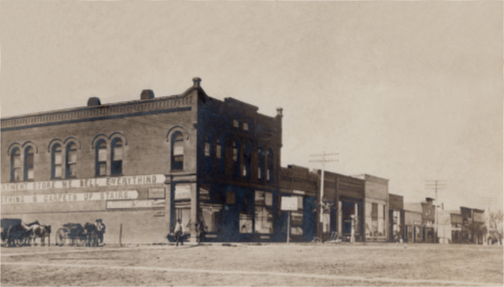
A view of Creighton, NE taken from the postcard Alta’s sister Sibyl sent 29 March 1909 to cousin Bert
Warner of Fresno County, CA. This is how the community’s main street appeared back when Alta was still
returning home in the summer between her early Twentieth-Century teaching gigs. The family farm was off
in the direction shown in the righthand portion of the scene. The prominent building in the lefthand
portion housed the Malm & Warner general store. Sibyl thought Bert would get a kick out of seeing the
store, even though the co-proprietor of the establishment was a Warner who was entirely unrelated and
was based in Creighton by happenstance.
Alta had reached the point where teaching assignments were not just “to help out” and as reflected
upon above, they were certainly not something she pursued while waiting for a man to propose to her.
She became dedicated to the profession. As part of that, she wanted her circumstances -- her stature
among her colleagues -- to become more significant. The first way she demonstrated she was ready for
such advancement was to accept assignments across the nation, including locales that were downright
remote. The gigs might have daunted a young woman raised in a city or who hailed from a long-civilized
region, but for Alta, rustic circumstances and isolation were not intimidating. When she had started
school in Miller Township, the schoolhouse had been literally just a hole in the ground -- a sod-wall
structure like the family dwellings her father and uncle had built upon arriving in Knox County. It
was not until 1888 that Miller Township had been able to boast of a wood-frame schoolhouse.
The 24 December 1908 edition of the Nebraska State Journal mentions that Alta had returned home
to Creighton for the holidays from her teaching job in Surprise, NE. That small town was in Butler
County, the same county where her uncles Fred Warner and Clifford Warner had settled in the early
1870s. Neither lived there anymore -- Fred in fact was nearly a decade deceased by then -- and the
reason for accepting a position there would not have been because of family presence. It was purely a
career move. Alta was now no longer teaching a handful of students of many different grades in a
building with just one classroom. The place featured additional classrooms, multiple teachers, and
a substantial student body.
That said, the Butler County job was still quite modest. To do more, Alta had to do something about
her training level. The first step was to obtain a serious set of academic credentials, a goal she
appears to have embarked upon in the year 1909. She proceeded to earn a Bachelor of Science degree
from Fremont College in eastern Nebraska, not far from her place of birth, then did did post-graduate
study at Columbia University in New York City. Also she received some sort of instruction via the
University of Colorado, as indicated on a 1922 résumé. Obviously when Alta decided to rake in a
sheaf of diplomas, she didn’t kid around.
For the next decade her employment situations were increasingly higher profile, but certainly they also
constituted the obligatory phase of “paying her dues” and were not what she could have chosen if she’d
had the clout, job history, and/or connections to arrange otherwise. First and foremost among the compromises
was that she did not always get first-choice opportunities and instead simply accept what was offered,
making sure not to complain. In the early 1910s, after leaving New York, she taught somewhere in Montana.
For the 1914-15 academic year, her job was at South Ward School in Chehalis, WA. Next was a position at
Lincoln School in Watertown, SD. Alta seems to have embraced these experiences as “youthful adventures”
-- she was still in her thirties -- but there is plenty of indication she appreciated not only workplace
stability but also wanted to be able to check in on her mother at far more regular intervals. Some time
not long after her mother decided to leave Nebraska and retire to Nora, IL -- doing so in either 1916 or
1917 -- Alta began treating her mother’s home as her official place of residence with the intent of
never being more than a daytrip away from her surviving parent by either automobile or train.
 To realize that ambition, Alta understood that she needed to
bring even more qualifications to bear. She
dealt with that need by pursuing a credential through Gregg School. That institution was a business
college co-founded by the inventor of shorthand and it was at that time the premier institution from which
to learn not just secretarial skills, but how to teach secretarial skills. The expertise Alta gained
there meant her subsequent career was concentrated upon the teaching of courses in business subjects, and
in particular, stenography. She graduated in March, 1919. (It is not clear whether she was enrolled at
the actual school in Chicago or if she completed her coursework remotely.)
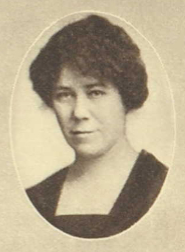
By 1920, Alta was on the faculty of Davenport High School in
Davenport, Scott County, IA. (The photo at right is from the 1922 yearbook of that institution.)
The 1920 census shows her lodging in a private family residence along with a handful of other young career
women. The 1925 state census and 1930 federal census also show her in boarding-house circumstances. In the
summers, as mentioned, she treated her mother’s home in Nora as her base. That doesn’t mean she would linger
there throughout the summer; in fact, during those months she tended to be found in places far from Iowa and
Illinois. Alta engaged in a great deal of travel, often to foreign destinations, as is made clear by
surviving ship manifests and port-of-entry records. An example is the manifest of the Mauretania,
aboard which Alta crossed the Atlantic from Cherbourg to New York City when returning from a summer-of-1926
trip to France.
Davenport was an auspicious place to be a female teacher. In 1872, Phebe Sudlow had been appointed the
principal of Davenport High School. Sudlow was the first female to reach such a post in the history of the
United States. Sudlow might well have been Alta’s personal role model. And even before Alta had been born,
the site of Davenport had played a role in her destiny. It was there that Chief Keokuk and General Winfield
Scott had signed the treaty ending the Black Hawk War of 1832. The resolution of the two Black Hawk Wars
was critical to the opening of northwestern Illinois to white settlement. Without that development, Alta’s
grandparents John and Marancy Warner would not have settled in Winslow in 1840, nor would Daniel Maurer
and Martha Brownlee have come in the 1850s, and without the occurrence of those two journeys, Alta’s
parents would never have met.
Without question, Alta can be viewed as a career success. Posterity has even provided us with an
objective measure of that distinction. Because the Davenport school system was supported by local
tax revenue, the salaries of all public school teachers were published each year in the local
newspaper as part of the disclosure of the wages paid to all city and county employees from the mayor
on down to the janitors. While Alta was not paid exorbitantly -- teaching being one of the notoriously
underpaid professions in our sociey, then and now -- she earned the industry standard at a time when
females often were short-changed compared to their male colleagues. Alta probably did not mind that
her pay level was a matter of public record. She knew she was earning benchmark amounts that ensured
other teachers and administrators would be fairly compensated for their own labor.
Alta remained based in Davenport at least through the end of the 1940s, but after her retirement she made
Nora her home -- she had perhaps inherited her mother’s house, and if not, purchased it either from her
mother directly or from the estate (i.e. buying out her three sisters). As Alta was closing in on her
eightieth birthday, her health took a turn for the worse, requiring her to move into the Rockford Nursing
Home in Nora. She passed away there after a year-and-a-half convalescence. The date of death was 29 July
1962, three days prior to what would have been her 81st birthday. According to a family genealogical note,
her remains were interred at Rock Lily Cemetery in Winslow. That note is not correct, though it is easy to
understand why someone would make the mistake, given that Rock Lily is the resting place of her mother,
her grandfather John Warner, Sr., and her great-grandparents Joseph Alexander and Olive Littlefield.
However, the actual burial, undoubtedly arranged by her sister Edna, took place at Elmwood Cemetery,
one of the graveyards that serves the community of Nora. (It also serves the town of Warren, IL). Edna
herself would later be buried there, as would both of her children.
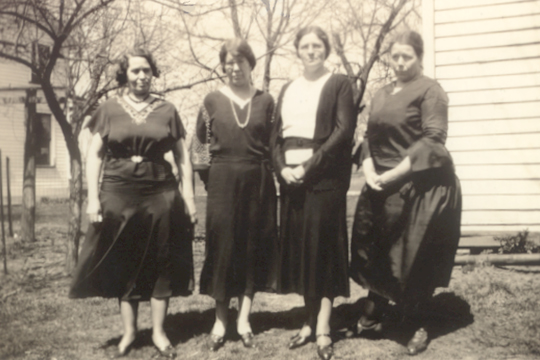
The four surviving daughters of Charles A. Warner and Mary Elizabeth Maurer in the 1930s. By the time
this was taken it was rare for all four to be in the same place at the same time. From left to right,
Edna, Alta, Sibyl, and Laura.
To go back one generation to Alta’s father’s biography, click here. To
return to the Warner/Alexander Family main page, click here.