Laura Isabelle Warner
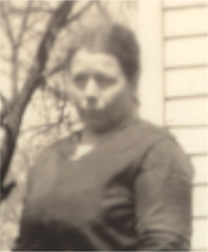 Laura Isabelle Warner was born 21 August 1879 on the family
farm in Sheridan Township, Washington County, NE near the town of Blair. She was named for her
mother’s sister Isabella Maurer and like her aunt was sometimes known within the family as Belle.
However, public records and most references to her in correspondence by in-laws show she herself
preferred Laura.
The farm had only recently been established at the time of her birth and as the eldest of her parents’
offspring, her sheer existence was not only a manifestation of Charles and Mary’s affection for one
another, but a sign of their intention to pour their money, effort, and hope into a particular
place. And yet for some reason, the couple chose to move on after only five years. They had to that
point given it their all, toughing things out through a bitterly cold winter in 1880, coping with the
effects of the era’s corrupt national politics, and becoming parents of two more daughter, Alta
Araminta Warner and Edna Warner, born in 1881 and 1883 respectively. But in spite of all they had
achieved, they declined to remain where they were as they proceeded into the second half of the
decade. And so in 1884 they moved northward and slightly westward to Knox County, NE, settling on a
previously undeveloped 160-acre patch of ground in Miller Township.
Alta and Edna were so young at the time of the move they came of age with few if any memories of
where they had spent the first small fragment of their lives. Laura’s youngest sister, Sibyl Bertha
Warner, born in 1886, would have no direct experience of the place at all. Of the children of Charles
and Mary Warner it was only Laura, who was on the verge of turning five years old at the time of the
relocation, who could lay claim to recalling a time when the family had been based somewhere other
than Knox County. Laura was therefore also the one member of her generation who could later recount
from a first-person perspective the entire Knox County chapter of her father’s abbreviated life.
In terms of landscape, climate, and local culture, the circumstances greeting the family were nearly
identical to what they had known, but one aspect represented a substantial shift in their daily
routine. The new homestead of Charles and Mary lay side by side with another 160-acre parcel
belonging to Charles’s sister Minta and her husband John Ladd, Jr., along with their pre-adolescent
children John Warner Ladd and Kate Ladd. Also on hand was grandmother Marancy Alexander Warner.
These relatives had spent the same five years in Sheridan Township, but their farm had been situated
far enough away that getting together required hitching a team to a wagon and carving out a chunk of
a day to make the round trip, not something either household would do on a every-day basis. In Knox
County they lived side-by-side, sharing a yard and infrastructure such as a barn, a well, paddocks,
and children’s-play areas. Meals could be communal if desired. It is true that the conditions were
extremely rustic. The walls of the houses were made of sod bricks. Taking care of one’s personal
comfort could involve a nocturnal amble on a packed-dirt path to an outhouse while coyotes out on
the nearby prairie offered up a wildlife serenade. Nevertheless there was a coziness and a sense of
security, a direct benefit of having additional kinfolk near at hand. And for Laura, there was
excitement of getting to begin school and interact with children other than her own close relations
For all the aforementioned coziness and sense of security, the Knox County years brought a dreadful
set of shocks and ordeals. Weather was one of the big culprits in this respect. The massive eruption
of the island of Krakatoa in Indonesia had taken place in 1883. For years afterward, the skies around
the entire planet were dimmed due to the volcanic ash in the upper reaches of the atmosphere, and as
a result of the reduced sunlight, winter conditions were exaggerated so much that the horrific winter
of 1880 became, in retrospect, a standard that Nebraska seemed to be aspriring to. Among the worst
incidents was the so-called Schoolhouse Blizzard of January, 1888, during which visibility was measured
in inches and the cold was so intense that if a person stepped outside, a case of frostbite would be
one of the more fortunate of the possible consequences. The only reason the Warners and the Ladds did
not perish is that they remained tucked in their semi-subterranean houses huddled by their stoves,
saved by their prudent stockpiling of sufficient fuel.
Prudent measures were not enough to combat another weather-related ordeal. A severe drought began in
1890 and it did not let up for five years. By the time reasonable amounts of rain began falling again,
one local family after another had already headed off to other parts of the nation where they hoped to
have better luck bringing in successful harvests. Among those who decided to surrender were Minta and
John Ladd. The couple did linger in Knox County for a few more years, but not as farm owners. They
handed their deed over to Charles and Mary, whose homestead thereby doubled to 320 acres. The
arrangement was a gamble on the latters’ part. Yes, Charles and Mary stood to reap a greater
monetary reward if things went well, but in the short term, they were paying double taxes and
shouldering twice the load of other types of debt.
Minta and John’s decision to bail out was influenced in part by the burden represented by their youngest
child, Ira Earl Ladd, born in 1884 just after the families had arrived in Knox County. Ira was severely
mentally handicapped and had to be supervised at all times. The Warner household also experienced the
heartache of a less-than-robust child, but in their case, the burden was temporary. Mary gave birth in
the spring of 1888 to a fifth daughter, but the baby’s health was so compromised that even though the
little being managed to cling to life for five months, she was never given a name.
The bad fortune reached a crescendo with the death of Laura’s father from stomach cancer in 1898. Not only
was this a severe blow in emotional terms, it deprived Laura and her sisters and mother and grandmother
of the main breadwinner of the family. One of the consequences of that factor was the postponement of
the moment when Laura would set off on her own to begin an independent life. Instead, she felt obliged
to stick around. At the time of the tragedy she was already at least a year into a career as a
schoolteacher. She’d been saving her money but now her mother needed whatever Laura could contribute.
The same obligation fell upon each of Laura’s sisters. Each of them followed her example and became
schoolteachers at the earliest possible juncture.
The 1900 census is a window into the circumstances at the homestead. All of the girls are shown still
living with Mary (and with Marancy). Alta by then was teaching, and is shown as having spent more months
employed than Laura. This flip-flop statistic is an indication how much Laura was needed right where
she was. She was in 1900 the only occupant of the home who was both more than twenty and yet younger
than middle-aged. Her strong back and her veteran understanding of farmwork and her grown-woman savvy
were essential to her family’s needs, even if it meant skipping a term she might have otherwise spent
in front of pupils, and even if it meant missing out on the wages she might have earned doing so.
The year 1901 brought more sorrow and loss. Marancy Alexander Warner Balliet died. Minta and John Ladd
(with Ira) moved hundreds of miles westward to Hot Springs, SD. Laura’s cousin Kate Ladd and the latter’s
husband, Charles Davey, along with their three-year-old son Harry Allen Davey, also departed in favor
of Hot Springs, and after a few more years, went on to Spokane, WA. Discouraging as those developments
were, once the shock eased, things improved -- and they kept improving in a steady fashion. Alta began
to make strides as a schoolteacher; she would eventually have a remarkable career as an educator. Edna,
after doing her own teaching for a term or two, married Clark Bonge in 1902 and they soon were farming
and raising a family just east of the Warner homestead. Meanwhile Laura’s “big brother” John Warner
Ladd went into business in Creighton, first employed as a liveryman, then becoming a livery stable
owner/proprietor, and only a couple of years later, changing course and becoming the owner/proprietor
of a butcher shop and ice supply house. He quickly grew to be viewed as one of the community’s thriving
merchants, and as an example to be admired. Harvests were finally good for multiple years running.
Eventually Laura was liberated from the fear that keeping the farm going amounted to an impossible
struggle. Moreover, her mother became able to fully carry the burden. The matron was no longer tied up
with either childrearing or taking care of an elderly mother-in-law. Once Sibyl acquired her license
as a schoolteacher, Mary had no dependents per se. Laura was at last free to “just be Laura.”
 Fending for herself does not seem to have been a
prospect Laura found intimidating. When she made the jump, she jumped high. In 1908, she homesteaded
near Midland, SD. She did so as a single
woman and under her own name. (Other women of her generation were more circumspect and either used
masculine-sounding versions of their names or had male relatives serve as figurehead owners.) However,
Laura was not like her sister Alta, who resolutely carried on as a solo act throughout life. Laura was
open to the prospect of being a wife. Finally, in 1909, just after she had turned thirty years old, she
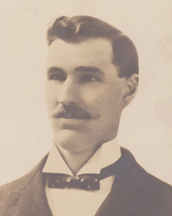
did indeed become one. The man making an honest woman of her was James Delbert Dibble, son of Henry
Monroe Dibble and Sarah Elizabeth Cunningham. He was known as Bert. (That is him in the image shown
at right. The photo was taken in the year 1900, well before Laura knew him, much less had chosen him as
her spouse.) A native of the McLean/DeWitt-county area of Illinois (i.e. Clinton, IL), Bert had been
partly raised in Bates County, MO prior to the untimely death of his father. Given that he was ten years
older than Laura, he had had time enough to do a little of this and that before meeting her. Among his
early occupations was schoolteacher, which may account for how the pair came to know one another. The
wedding took place 1 September 1909 in Rapid City, Pennington County, SD. This was a convenient venue
for the relatives to reach by train. Laura’s mother and sisters came up from Creighton, and Bert’s
kinfolk from DeWitt County.
Once she became a wife, Laura joined Bert on the land he owned. She had never done much with her own
homestead, so it made sense for the couple to live on the more developed property. (Both of the parcels,
originally within Stanley County, would be designated part of Haakon County in 1914 when Stanley County
was reduced in size, losing portions of its territory to Jackson County and Haakon County.) The new
couple settled in for a couple of years, but then spent a sojourn of five years, from 1911 through 1916,
based mostly in Creighton. The series of reasonable harvests in the early part of the century had not
been as dependable in the early 1910s, and moreover, prices for farm commodities were not as robust as
they had been. Not to mention that with Sibyl’s departure, Mary was lonely. So Laura and Bert looked
after the healthy-but-aging lady, to see if their effort and presence could make a difference. And it
did, for those few years. With Mary’s decision to retreat back to Illinois, Laura and Bert came back
to Haakon County.
Bert’s homestead, about a mile north of the small community of Hartley, was grouped with others belonging
to his close family members. Early in the marriage he and Laura acquired the land belonging to his sister
Josephine, who had died in 1909, and in 1919 they also bought out the piece owned by his elderly mother.
Other relatives continued to own adjacent parcels, and in fact some area acreage is still (current as of
2013) owned by a set of grand-nephews. Bert raised livestock while Laura continued -- with occasional
hiatuses -- to be a teacher. The pair did not produce offspring. This appears to have been a deliberate
choice. Laura certainly had reasons aplenty -- she and Bert were a little old to begin the process, the
local enonomy was not robust, and she was probably worried that she might die before the kids were grown,
forcing them to go through the same anguish she had. The latter concern -- about her own mortality -- was
certainly justified. She was severely asthmatic, and she well knew that a bad episode could progress into
bronchitis and then into pneumonia. She had been fortunate enough to have dealt with each crisis as it had
arisen, but she feared she might not be so lucky in the future. In that pre-antibiotic era, pneumonia was
often fatal.
As it turned out, it was Bert who would expire prematurely. He perished in a wagon accident, which happens
to have been how his own father had died back in 1882. The journal of his brother-in-law Bernard Murphy
(husband of Bert’s younger sister, Viola Ruth Dibble) preserves details about the tragedy. Later Bernard’s
son Bernard Delbert Murphy would write an account of the incident, calling upon a mixture of personal
memory, his father’s journal, and the spoken recollections of his grandmother Sarah Cunningham Dibble
Gambrel. Here is what he wrote:
 “My Uncle Bert, who had remained in South Dakota, was
seriously injured in an accident on the road from his ranch home to Philip on 7 December 1920, as he was
hauling a consignment of hogs to town in a large wagon with a four-horse team. During the trip harness
trouble developed, and Bert walked out on the tongue of the wagon to inspect the situation. The squealing
hogs and the presence of the man on the wagon tongue frightened the horses and they bolted, throwing Bert
to the ground, where the wagon wheels ran over him. Sometime later that day a traveler came upon him and
took Bert to a doctor in Philip, where he was given first aid. Since there was no hospital there, he was
placed aboard the caboose on the Chicago and Northwestern local freight to Pierre, but he died en route
in the early hours of 8 December. A telegram to our home arrived by a railroad call boy named Dave Conroy
that morning, and by noon my grandmother had boarded the Illinois Central passenger train to South Dakota
via Freeport, Illinois, to bury her son in the Masonic Cemetery in Philip.”
Laura was left a widow at only forty-one. Her grief must have been profound enough that her mother judged
that Laura should not be left unaccompanied at home, and so Mary moved in and stayed for more than a year.
However, in the long run Laura carried on with the sort of fortitude typical of her. By 1923, after a
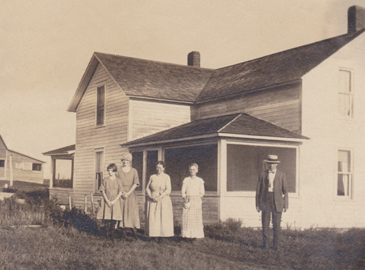
lengthy probate, the ranch was placed solely in her name. (Shown at left is a scene that features Laura
at her home on that ranch in 1923. She is the center person of the five people shown. On the far left is
Bert’s niece Sarah Elizabeth Murphy, then about eleven years old, standing beside her mother, Bert’s sister
Viola Ruth Dibble Murphy. The mature woman to the right of Laura is a neighbor. On the far right is Bert’s
brother-in-law Bernard Murphy.) The acreage was more than enough to provide her with an adequate living
and cover the cost of hired laborers. She probably no longer worked as a teacher, though she did serve on
the local board of education (perhaps at the urging of her sister Alta, a big advocate of the notion that
more women should occupy positions of importance in the nation’s educational system). She had so little
need now for her original homestead that she increasingly treated it as more of a burden than an asset.
Finally in calendar year 1934 she did not even bother to pay her taxes on it. The land was auctioned off
at the end of 1935. No individuals wanted it, so Haakon County assumed ownership.
At the very end of the 1920s, Clarence Newt Davis began working at, and living upon, Laura’s ranch as her
new farm hand. Eventually a romance bloomed between the two, leading to the end of her widowhood. The wedding
took place 12 December 1935. C.N., as he was usually known, had been born 6 June 1890 in Holt County, NE,
where he had stayed well into adulthood. The marriage to Laura was his first. They of course had no children
given Laura’s age as a bride. The couple spent the first eight or so years of their union living on the
ranch. (This tally does not include the six years they spent there together prior to becoming husband and
wife.) Shortly after becoming Mrs. Davis, Laura became the postmistress of Hartley, a position she kept for
seven years. In early March, 1944, she and C.N. sold the ranch to a Mr. Glen Parsons and moved to Iowa, where
Laura could be closer to her sister Alta in Davenport. However, the greater humidity aggravated her asthma,
so in 1948 the couple decided to return to Haakon County. They purchased Hartley’s general store and post
office. Laura had reached her late sixties and was no doubt thinking in terms of a livelihood that would
allow her to be an owner and supervisor rather than a shift worker. She did not get any real opportunity to
settle into her role, however, because she caught a case of measles that, given her lung problems, proceeded
into a case of pneumonia that she could not withstand. She perished 21 April 1948 at the nearest hospital to
her home, which was in the town of Philip. (The timing is ironic. Laura had managed to shake off various
infections for nearly seventy years without the benefit of antibiotics, only to die at a point when the
first major one, penicillin, had finally become widely available.) Her remains were buried in the Masonic
cemetery in Philip (meaning she was probably buried with or next to Bert Dibble).
Given that C.N. Davis was eleven years younger than Laura, he survived her. He did not remain in Hartley but
moved right away to Sioux City, IA. (His departure, among other things, meant there was no one left to tend
to Hartley’s post office, and it ceased to exist.) Less than nine months after Laura’s death, he wed subsequent
wife Rose Annie Jacobson, maiden name Blair. He was her husband for twenty-six years, i.e. much longer than he
had been Laura’s husband. He passed away 26 April 1975 in Sioux City. His widow, Rose, died in 1998 in Fresno,
CA at the impressive age of ninety-nine, having survived C.N. almost as long as he had survived Laura.
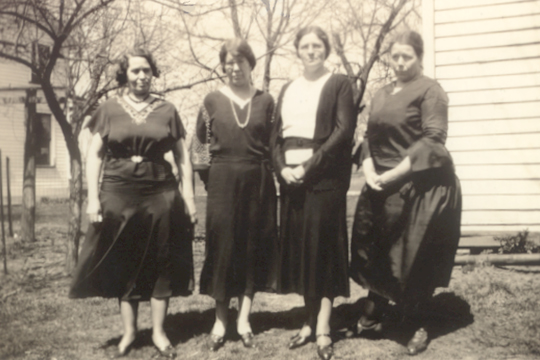
The four surviving daughters of Charles A. Warner and Mary Elizabeth Maurer in the 1930s. By the time
this was taken it was rare for all four to be in the same place at the same time. From left to right,
Edna, Alta, Sibyl, and Laura.
To go back one generation to Laura’s father’s biography, click here. To
return to the Warner/Alexander Family main page, click here.