Sibyl Bertha Warner
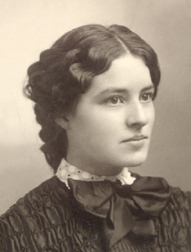 Sibyl Bertha Warner, the fourth of the five daughters of Charles
A. Warner and Mary Elizabeth Maurer, was born 8 September 1886 on the family farm in Miller Township,
Knox County, NE. She was the first of her parents’ offspring to be born there. Her older sisters had
all come into the world on the family’s previous homestead in eastern Nebraska near the small town of
Blair. Sibyl by contrast would spend the entirety of her childhood in Knox County. (The spelling of
her name here is not an error. She really was Sibyl, and not Sybil.)
The Miller Township homestead had been founded in 1884, two years before Sibyl’s birth. As described
in her father’s biography, the family faced extraordinary challenges in making a go of it there --
“family” meaning not only Sibyl and her parents and sisters Laura, Alta, and Edna and grandmother
Marancy Alexander Warner, but also Sibyl’s father’s sister Minta and her husband John Ladd, Jr. and
their kids, who had established themselves upon an adjacent parcel that very same year. The weather
assaulted them in the form of uncommonly cold winters replete with life-threatening blizzards, and
with summer droughts that persisted year after year for half a decade. Naturally those conditions had
a negative effect on crop yield. The cold meant late plantings and therefore shortened growing
seasons. The droughts meant fields would become desiccated and fail. To add insult to injury,
sometimes swarms of locusts arose and devoured ripe grain before it could be harvested. These issues
were so profound the income from the good years -- of which there were all too few -- was not enough
to make up for the shortfall of the bad years. Add to that the personal tragedies -- for example the
loss of Sibyl’s baby sister, born in the spring of 1888 and who then was only able to cling to life
for five months before being consigned to her grave. Another misfortune was that Sibyl’s first cousin
Ira Earl Ladd, two years her elder, was profoundly compromised in terms of mental ability and was heavily
dependent upon the supervision and care not only of his parents, but of all the family members based
there at the dual homestead. However, when it came to dealing with those various struggles, Sibyl did
have one advantage. Her age meant she was protected from the full weight of the hardships. The burdens
fell on the shoulders of those who were older. All in all, though, Sibyl grew up understanding what
hard work was, and knew she had to do her share.
By the early 1890s, Sibyl’s aunt and uncle came to feel they could not hold on to their homestead.
Some time in the first half of the decade -- the interval when the extended drought occurred -- Minta
and John transfered their parcel to Sibyl’s parents -- probably for little actual money but rather
with the understanding that Charles and Mary would assume the tax burden and other debts associated
with the Ladds’ 160 acres. Then in 1898, Sibyl’s father died. She had not even turned twelve years
old when that loss occurred. Not only was the incident a major emotional upheaval, but it meant the
household economic straits were even more dire. All four (remaining) daughters of Charles and Mary
responded in the most practical way they could. There weren’t a lot of career options available to
women in general and that was especially true of the local area, but the one obvious exception for
ladies of good moral standing was to become teachers in the same sort of rural schoolhouses in which
the Warner girls had received their own educations. Without exception Laura, Alta, Edna, and finally
Sibyl did precisely that. In more than one instance their initial gigs were so local they could
continue to live at home. This saved the cost of boarding-house fees, creating savings that allowed
them to better support their mother and grandmother. (Sibyl herself did not however directly support
Marancy in this manner, though, because the elderly matriarch passed away in 1901 before Sibyl had
earned a teaching credential.)
By the time Sibyl reached age sixteen, her father was deceased and her aunt and uncle had said a
firm good-by to Knox County. She did have one male family member left, though, and fortunately it
was one she could count on. He was John Warner Ladd, her first cousin. A full thirteen years her
elder, John fulfilled the role of big brother in a way no one else could. During Sibyl’s early
childhood, John had been right there in the dual homestead’s other home, and then moved no more
than a mile or two westward into Logan Township, where he farmed a rented parcel and tried to give
it a go as a young farmer. Subsequently, from 1902 onward, John could be found reasonably close
by as a resident of Creighton, the main village of the immediate area, located eight miles east and
one mile south of the Warner acreage. John became one of Creighton’s noted businessmen, first
as a liveryman and then as the proprietor of a butcher shop and ice house. For the Warner girls
and particularly for Sibyl due to her junior-most status, John was the “person to turn to.”
Without him, she might have come of age with less faith that her life would work out somehow.
One way that Sibyl compensated for the inevitable isolation of being a farm girl stuck way out on
the prairie, day after day and year after year, was to keep in touch with relatives outside of
Nebraska. We who are alive today are the beneficiaries of this aspect of her character, because
letters and postcards written by her remain in the memorabilia of some of those relatives, and
this means we have a window into what her life was like in the early years of the Twentieth
Century, and by extension, what life was like for her sisters and their widowed mother.
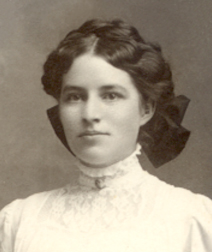 Sometimes the contact extended not just to correspondence,
but visits in person. There were two spots Sibyl and her immediate family members made a habit of
journeying to, and this was true not only during the 1880s and 1890s while Sibyl’s father was still
alive, but the next two decades as well. Sibyl’s parents had both been raised in Stephenson County,
IL on the outskirts of the village of Winslow. Relatives were still based there. Mary Maurer Warner
liked to check on her parents, and then after both passed away just after the Turn of the Century,
continued the tradition in order to spend time with her bachelor brother Anderson and her spinster
sister Belle. Charles liked coming back not only to keep in touch with his roots, but to maintain
contact with the one sibling of his who had not moved to Nebraska in the 1870s. That was his
eldest brother, John Warner. The latter had married local girl Nellie Martin back in the late 1860s
and stayed put in the area, raising a large family. For Sibyl, John and Nellie’s many kids were
favorite cousins. This was so much the case that when John and Nellie and most of their offspring
relocated to the San Joaquin Valley of California (beginning in 1906), Sibyl visited them there at
least twice. She came on her own in 1910 and then made the journey again in 1913 accompanied by her
mother. (A photograph of Sibyl and her mother taken during that latter trip can be found on this
website on her father’s biography page.)
The aforementioned 1910 trip west lasted nine weeks. That Sibyl would stay for such a substantial
interval suggests she wasn’t just being sociable. She was probably investigating the possibilities
of making California her home, as in, she was not only sampling the climate and getting to know her
kinfolk better, but was looking for a job that might suit her -- something Nebraska might not have
to offer. If over the course of those nine weeks she had found a situation that appealed to her, or
if she had met a man she judged to be a suitable romantic prospect, she might well have stayed for
good. She was in her mid-twenties and was absolutely free to choose whatever course she thought best.
In the end, she decided to return to familiar stomping grounds. Had she chosen otherwise, the course
of her life would have been radically different than what she experienced.
The next step, of course, was to figure out what else she might do now that she had crossed the
California possibility off her list. She could have taught further terms in one-room schoolhouses,
whether in the Creighton area again or farther afield. But she had grown weary of it. Doing so would
have been a “biding her time” step, and she was by contrast ready to spread her wings. Her solution?
She enrolled in pharmacy school in Fremont, NE.
In those days, a year of coursework was sufficient to obtain a degree, which Sibyl succeeded in earning
in 1911. Sibyl was top student and president of her class. Alas, that early in the Twentieth Century,
women were generally not allowed to actually pursue the profession of pharmacist. She apparently had
hopes she would be able to break that glass ceiling. Instead, despite her obvious talent and ability,
her degree meant little. As a female, the only role she could step into was to teach the materia
medica to nursing students, so that said students (all female) would be better equipped to
understand the uses of the medications the (male) doctors they worked with were prescribing for their
patients. In a sense, all Sibyl could do was go back to the classroom setting, just to a different
kind of classroom.
Her time in pharmacy college did have one happy outcome. One of the classmates she got to know was
McPherson County, KS native William Matthias Lovett, son of Freeman Lovett and Mary Meisenbach. They
stayed in touch, and after Sibyl had spent a couple of post-graduation years as a single career woman,
she and William became wife and husband. The wedding took place 5 June 1913 in Fremont -- just over a
third of a century after Charles Warner and Mary Maurer had been united in matrimony in that very
town. Sibyl and William settled in the town of McPherson where William had become, logically, a
pharmacist and drugstore operator.
One would think, given Sibyl’s degree, she would have played a role in the business, especially in
the early years before motherhoood. She is not known to have done so, the one exception being a brief
stretch in the midst of World War II when there was a shortage of labor. Instead Sibyl dedicated her
attention to being a homemaker.
The household was stable, prosperous, and well-rooted. This was a good recipe for a large
family, but in fact this did not manifest. Sibyl and William did ultimately have offspring, but they took
their time, and the final tally came to only two kids. These were Eunice, born in 1919, and Roger, born in
1925 only a couple of months before Sibyl turned thirty-nine years old. Not only did the modest level of
reproduction mean the Lovetts constituted a small nuclear family, they were part of a rather small
extended family as well, at least in the sense of relatives based near enough to be able to participate
in their daily, weekly, or monthly lives. Really, there were only three individuals -- William’s parents
and his spinster sister Annie. On the plus side, these three were based right there in McPherson, and
Freeman and Mary both survived to be elderly, and were around to provide their “grandparent energy” and
sage advice into the 1940s.
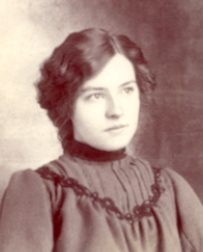 What young Eunice and Roger did not experience, though, was any sort of
frequent exposure to the
greater clans to which they belonged. They had no Lovett first cousins. On the Warner side they had
only Willard Bonge and Gladys Bonge, the children of Sibyl’s sister Edna. For Eunice and Roger, this
was not a recipe for companionship. By the time Eunice’s birth occurred, even Gladys, the youngest of
the two, was just about to enter her teens, and by the time Roger’s birth occurred, Gladys was nearly
nineteen. And for second cousins? None existed on the Lovett side, nor any on the Maurer side. On the
Warner side there were a great many, but none of them lived in Kansas.
Sibyl was conscious of her offspring’s familial isolation. It is plain from surviving letters that
she would have preferred it be otherwise, but the fact is, once she became a wife and mother, the
habit of making journeys to see kinfolk died out nearly altogether aside from trips to see her
mother in northern Illinois, and those were infrequent. An example of how much Sibyl had ceased to
roam the way she had as a single woman is epitomized in the text of a letter she composed 24 January
1922 to her first cousin Bert Warner. Bert and his wife Grace, along with their two young daughters
Marian and Josie, had paid a visit to Sibyl and family in McPherson some months earlier on
their way from California to spend some time in Bert’s original stomping grounds in Illinois and
Wisconsin. Eunice, approaching age two at the time of the visit, was thoroughly exhilarated to get to
spend even an hour or so in the company of girl cousins near her own age. (Marian was six years old,
and Josie four.) According to Sibyl’s letter, Eunice had not yet ceased mentioning the girls and
asking if they could visit again.
In early 1944, Sibyl suffered a heart attack. This may have been a major reason why William sold the
drugstore in the spring of that year. The couple continued to live in McPherson,
however, and would do so until their last moments. Despite the early heart attack, Sibyl made it into her
eighties. A stroke in the 1960s slowed her down. She died 8 January 1968 and her remains were buried in
McPherson City Cemetery. Her husband survived her by more than a decade, finally passing away 22 September
1978 in McPherson at ninety-one years of age. His grave is also at McPherson City Cemetery.
Eunice Dee Lovett continued the family tradition of capable, independent women through the next
generation. She graduated from the University of Kansas at Lawrence. Settling with first husband William
Phillipi in Junction City, KS, the spouses operated Jack and Jill, which during their tenure in the 1950s
was the largest retail clothing store in the whole state of Kansas. After the death of her second husband
William Lesser in 1971, Eunice spent the next thirteen years single. She was one of the prominent business
people of the city, was the first female commissioner in the city’s history and the first female mayor. She
also was vice mayor three times. She spent her old age with third husband William Kelley, a retired director
of advertising at the city newspaper, The Daily Union, and a former Geary County commissioner. Born
7 November 1919, Eunice was nearly eighty-eight years old when she passed away 25 September 2007 at a care
facility in Chapman, Dickinson County, KS. She was buried in Junction City’s Highland Cemetery with William
Lesser, joining him there 46 years after his own demise. (William Kelley, who predeceased Eunice by two
years, was buried elsewhere in the same cemetery with his first wife, Peggy Stafford.)
Roger Warner Lovett enlisted in the military in the late summer of 1942, shortly after turning seventeen. He
became a B-17 pilot and flew bombing missions over Japan during the final months of the conflict as part of
the 500th Bomb Squadron, meaning he was one of the touted “Rough Raiders.” Upon reestablishing his civilian
life he attended and graduated from the University of Kansas at Lawrence. Aside from a short stint in the
early 1960s as owner and operator of a radio station in Alva, OK, he spent the bulk of his working life as
an attorney. A prominent one, at that. He served as McPherson County Attorney. In the early 1970s he was the
first person to serve as examiner on the newly-formed Kansas Commission on Civil Rights. He eventually
left McPherson behind in favor of Topeka, where he spent his final decades. He was married three times,
including a brief and childless marriage during the war to Elsie Bloomquist, who would go on to have five
children with a subsequent husband -- remarkably, Roger went on to be a stepfatherish figure in their lives.
Longer marriages to Norma Jeane Rissler and Linda Kay Hendryx led to five biological children plus an adopted
stepson who became known by the surname Lovett. Roger died in the summer of 2018 only half a month before he
was to turn ninety-three years old. Of the fifty-three great-grandchildren of John Warner and Marancy Alexander,
Roger was the very last to pass away.
Between Eunice and Roger, the line of Sibyl Warner is substantial and is steadily expanding. The younger
generations of the clan are for the most part residents of the heartland of the nation. Together they make
up the whole of the surviving descendants of Charles A. Warner.
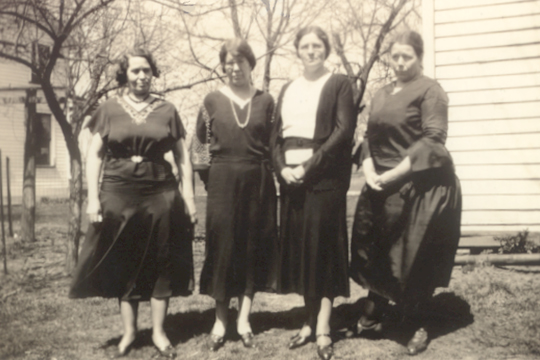
The four surviving daughters of Charles A. Warner and Mary Elizabeth Maurer in the 1930s. By the time
this was taken it was rare for all four to be in the same place at the same time. From left to right,
Edna, Alta, Sibyl, and Laura.
To go back one generation to Sibyl’s father’s biography, click here. To
return to the Warner/Alexander Family main page, click here.