Margaret Alice Branson
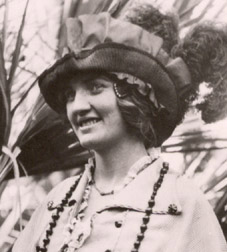 This seventh child of Reuben Branson and Eliza Louisa Armstrong
was given the name Theresa Margaret Branson as a baby. Thereafter she was usually referred to as
Margaret except in formal circumstances -- for example, in the 1900 Federal Census she is listed as
Theresa. During childhood the name Margaret was in turn sometimes reduced to Maggie. This was in keeping
with Reuben and
Louisa’s style. They had given all three of their older girls “M” names -- Mary Jane, Martha, and
Mabel -- and referred to the first two as Mamie and Mattie. Margaret, however, hated the name Theresa
and didn’t think much of being called Maggie. As soon as she was old enough, which means even
before she was out of her teens, she discouraged the use of the nickname and completely threw out her
first name. Margaret became her first name, she added Alice as a middle name, and from the first few
years of the 20th Century onward she was known as Margaret Alice Branson. She appears as such (with
the last name changing to match those of her husbands) in most surviving public documents. The rejection
of the nickname may have had to do with its origins. “Maggie” may have been inspired by Reuben’s “Little
Maggie Mine” claim of the mid-1880s. Reuben ceased to be part of Margaret’s life by 1901 and she may
have wished to erase his influence upon her identity.
Margaret was born 30 January 1887 in the foothills of Mariposa County. She had a tendency to conceal her
true age, therefore sources that give a different birth year should be ignored. (An example is the 1920
census, which lists her as born in 1891. She was married to Jack Cowsert by then, and as he was five and
half years younger than she, she no doubt “reduced” her age when giving information to the enumerator.)
Margaret spent her early childhood mostly in the mountains of Madera County, including Sugar Pine and
Fresno Flats (now known as Oakhurst). Once in a while -- usually during the short winter school terms,
she and her siblings stayed with grandparents John and Martha Branson on their ranch near the Washington
Mine complex at Quartzburg, north of Hornitos. Her name -- as Maggie Branson -- as well as the names of
her twin sisters Mattie and Mabel appear on a souvenir card given out to the current pupils of Quartzburg
School at Christmas, 1896. The longest-lasting of her homes was the community of Raymond, a quarry town
in the Madera County mountains. As one of the younger members of the family, she was then part of a move
to the city of Madera at the end of the 1890s, and then a relocation to Randsburg in the Mojave Desert in
eastern Kern County in the spring of 1901, but that sojourn lasted only a matter of weeks, her parents
splitting up during that interval, leading to Louisa’s return to Madera with Margaret and Gertie, after
which they went on to the city of Fresno during the winter of 1901-1902.
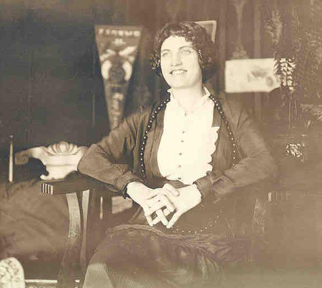 Margaret was a spirited child. She became an
adolescent rich with what might be described as “hormonal energy.” This was an unfortunate aspect of her
nature given that the marriage of her parents collapsed just as she was entering puberty, depriving her
of the extra authority structure and supervision she needed just then. Reuben had often spent long
intervals away from the family hearth; now he had even less involvement in the lives of his children.
Margaret’s eldest brother William Henry Branson, who had played the role of surrogate father during the
1890s, had passed away of pneumonia well before the move to Randsburg. To add to the trauma, her sister
Mattie rejoined the household at the end of 1901 only to catch diphtheria and die just after the turn
of the year. So much abandonment, so much reason to act out, coupled with much-reduced supervision
given Louisa’s urgent need to find some means to
support herself. The result? In the spring of 1902, at age fifteen and three months, Margaret became
pregnant. Barring the possibility she was raped -- a possibility which does not seem to fit the
facts -- Margaret appears to have gone too far with a young fellow she met in Fresno. His identity
remains unknown. The one thing that can be said with certainty is that he did not remain a part of
Margaret’s life. Instead her mother took her and Gertie to San Jose, out of sight of friends and
neighbors and most especially out of sight of Reuben, and with
the help of her older sister Bertha Biederman, managed to deal with the crisis in such a way that she
would, after the birth had taken place, be able to claim that the child was her own, supposedly sired
by Reuben during a brief reconciliation. Reuben of course knew the child was not his, but it was a
he-said she-said situation. In any case, Louisa stuck to the story, even to the extent of raising the
child, Herbert Raymond Branson, known as Blondy, all the way to adulthood as her son. How he had come
to exist was a long-held secret. Presumably Blondy was eventually made aware his supposed father was
actually his maternal grandfather, and may even have known his biological father’s name, but if so he
did not speak of it. The only family members who certainly would have known were those present during
the latter months of the pregnancy. These would have included Margaret herself, her mother, her
twelve-year-old sister Gertie, and her aunt Bertha. Logically it would also have included Margaret’s
older sisters Mamie and Mabel, but perhaps no others beyond that.
If Margaret did manage to stay out of trouble at age fifteen, she was not so lucky at seventeen. This time
around her romantic collaborator was Charles Edward Heitkemper. Born in Nebraska and raised in Portland,
OR, Charles was a son of Gerhard Heitkemper, a native of Westphalia, Germany and Mary A. Boerge, a native
of Ohio. His date of birth was 27 April 1886, meaning he was only nine months Margaret’s senior, and
therefore no more a wellspring of mature decision-making than she was. The marriage took place 14 January
1904 in San Jose without the knowledge or cooperation of Gerhard, Mary, Reuben, or Louisa. The scenario
was surely an elopement, accomplished by heading down to the Santa Clara County courthouse in the company
of Charles’s friend Oliver Horton Calkins, II and Margaret’s friend Clementine Oakey Culton. The newlyweds
then either continued to keep their status a secret and pretended to their families they were only
courting, or they ran off, cohabitating somewhere away from their usual neighborhood until after a few
months, the parents tracked
them down and had the union annulled. Getting the dissolution would have been straightforward in the
legal sense. At that time in California, marriage licenses were not granted to males under twenty-one
nor females under seventeen without parental permission. Margaret had not quite turned seventeen and
Charles was well short of twenty-one on the day of the wedding. They had both lied about their ages in
order to get the license. The
intervention was not quite in time, though. A pregnancy resulted. Margaret gave birth to son Oliver
Charles Heitkemper in early January, 1905, just before turning eighteen.
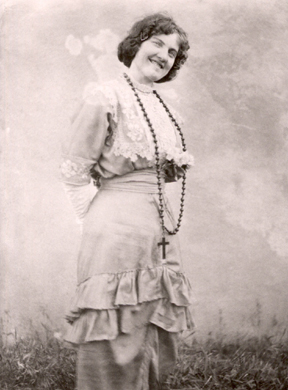 Charles Heitkemper went back to, or was forced to
go back to, Portland, where he became a jeweller like his father. For the time being he was kept in the
dark about having fathered a child with Margaret. On 18 June 1906, barely more than
eighteen months after Oliver had been born, Charles married Clara Olive Moore, a native of Washington
born 17 May 1885, and they lived out their lives together in Portland and possibly other parts of the
Pacific Northwest. They had one child together, Mary Alice Heitkemper, born in 1910, who was to die
shortly before her fourteenth birthday. According to the
Social Security Death Index, Charles and Clara passed away in Washington the same month -- November,
1964 -- perhaps indicating a car accident.
Meanwhile Margaret was soon a mother again. This child, whose entry in the California Birth Index is
rendered with no given name and the surname Garvin (born in Santa Clara County, and other sources
narrow this to San Jose), grew up as Edgar Robert Gaver. The man who received the credit -- or
blame -- for siring him was Edgar Leroy Gaver, a young tailor also employed as a minor-league
professional baseball player. Edgar was at that time a member of the San Francisco Seals. However,
one family rumor says Edgar Leroy Gaver was not a part of Margaret’s life until the pregnancy was
underway. If so, then the identity of the father is a mystery. Perhaps the rumor was nothing more than
idle talk; however, Edgar and Margaret’s marriage certificate does bear a date eighteen months
after the birth of Edgar Robert Gaver, and well into the pregnancy that resulted in the birth
of the couple’s “second” child, Margaret Brandy Gaver, soon to be known as “Little Margaret.”
Regardless of the unusual steps along the way, by 1909 Margaret was officially Mrs. Ed Gaver. Within
a year or so, Ed would change baseball teams, and the household (which included Oliver Heitkemper) was
reestablished in Los Angeles County. Margaret and Ed were residing at 1719 Newton in central L.A. when
their final child was born in the late spring of 1912. That child was Samuel Derr Gaver, usually called
Sammy or Little Sammy. Unfortunately, Sammy survived less than two months. In the wake of that tragedy
the Gavers moved in with Margaret’s sister Mabel and brother-in-law George Latham at 114 S. Olive, also
in central L.A, where judging by city directory listings, they remained until partway into the year 1914.
Ed’s baseball career lasted nearly twenty years. However, it was an era when ballplayers were not paid
the exorbitant wages they command now. Ed continued to work as a tailor during the winters of his years
with Margaret, and would go on in later life to work as a baker and as an automobile factory repairman.
A son of Samuel Derr Gaver (for whom Sammy was named) and Anna Mary Esther Toms, born 20 June 1886
in Middletown, Frederick County, MD, Ed appears to have come to the west coast specifically because of
the baseball opportunity. He would return to the East and spend the rest of his life there. But not with
Margaret. They separated in approximately 1914. Divorce followed. Ed established a new life in
Altoona, Blair County, PA and its suburbs with second wife Mary Arnetta Paul and sired two more sons,
Paul Edgar Gaver and Harry Arthur Gaver. He eventually retired to Florida, perishing 22 March 1977 in
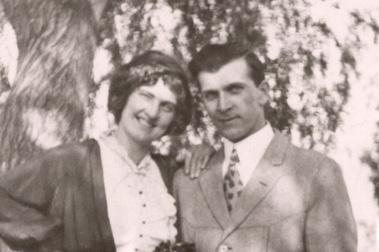
Tampa. (Shown just below right, Ed and Margaret in approximately 1912-1914.)
 Margaret slipped quickly into her next relationship. She became
the lover of John Patton Cowsert, better known as Jack Cowsert. He was a brother of Mary Etta Cowert, the
wife of Margaret’s brother Robert. This particular choice of new partner strongly implies that when
Margaret and Ed broke up, she sought out the haven of her brother and sister-in-law’s home in Randsburg,
giving her ample opportunity to get to know Jack. They did not marry right away, a repetition of the pattern
she had already followed back in 1906-09. For one thing, it may not have been possible to legally
marry when they began living together, because the final divorce from Ed might not have been fully
accomplished, so it would have been only natural for Margaret to resort to the arrangement her mother had
observed during the early 1910s with Charles R. Hine, a man she shared a house with but never legally
wed. By the time Margaret and Jack
finally managed to take care of the paperwork, they had long been claiming to others that it had already
long since been done. They surreptitiously took care of the matter while on a trip, acquiring the license in
Alameda County and then going to Stockton, San Joaquin County, CA, where Rev. J.M. Skinner performed the
rites 19 April 1919 with none of the couple’s family members in attendance. Margaret and Jack had been
together for four years or more by that time.
Jack was a son of John William Cowsert and Margaret Ann Taylor. He had been born 9 August 1892 in Farmersville,
Tulare County, CA, shortly after the family had moved there from Idaho. Jack was therefore notably younger
than Margaret, but this proved to be no impediment to their compatability. Finally Margaret had ended up with
“the right someone.” The marriage lasted for decades, ending only as a consequence of Jack’s death.
Jack was a miner. The early part of his career had been spent in Indian Wells Valley. For example, at age
nineteen, his job had been to drive a twenty-mule team and wagons from Death Valley to the borax mine in
Boron. He and men like him were the living inspiration for the mule driver in the old Borax television
commercials and print advertisements of the 1950s and 1960s. However, during the beginning years of the
marriage he was
employed at a mine in Oatman, AZ. Margaret later described the locale as not much more than sagebrush and
greasewood. With little money to their name, Margaret and Jack lived in a tent in the desert. The arid
terrain was not entirely suitable for vegetable gardening, but
Margaret accepted the challenge anyway. She planted beans all around the tent, which she nurtured by carrying
water in a pail. The bean plants prospered and grew tall, and were her special pride. One morning she heard
a commotion outside and found several wild burros feasting on her beans. She yelled at them and hit them
with a stick but found it very difficult to run them off. A few days later an old prospector came by and
she mentioned the problem to him. He chuckled and informed her that all she had to do was swear at them. The
next time the burros appeared, she tested the theory with the most blistering language she could manage.
Though known as a prim woman when it came to language, she was determined to defend her crop. The burros
tucked back their ears and took off running over the nearest hill.
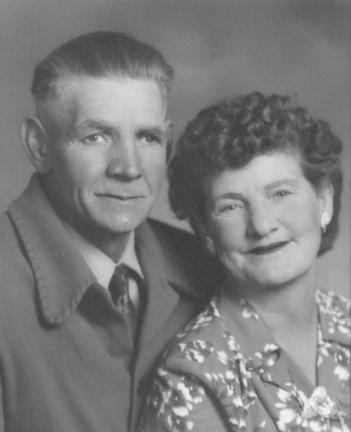 (At left, Jack and Margaret in their later years
together.) This rustic phase of Margaret and Jack’s life was not entirely suitable for the children. It
isn’t clear they were brought along. If they were, it was not a full-time thing. Margaret is known to have
spent a meaningful interval -- at least a year, perhaps two or three years -- apart
from her young ones during the late 1910s. She was a drinker and not the most stable of mothers at the
best of times, so it is possible she “went through a bad patch” and temporary custody arrangements were
made for the children. However, it is more likely she was simply looking out for their best interests,
and sent them off for their own good, to places where they would have proper beds and chances for social
interaction and a nearby school to attend, which was not true of the camp near Oatman.
By this point, Edgar Leroy Gaver was in Pennsylvania, beginning his new family with Mary Arnetta
Paul. It was a perfect time to send younger Ed, who was reaching the stage in life where a father’s
oversight was important, back to be with his biological dad. As for Little Margaret, she probably spent
some time there, too, but a different opportunity opened up for her. Mabel and George Latham moved to
Pennsylvania, where George had been raised. Mabel agreed to raise her niece for
a while. The timing of the relocation may even have been such that Mabel escorted both young Gavers
back east on the train.
That left Oliver Heitkemper. He was reaching puberty and, like his brother, was poised to benefit
from a dad’s active presence. So Margaret wrote to Charles Heitkemper and finally revealed to him that
he had sired a child with her. Charles and Clara took this revelation in stride, and agreed to have
Oliver stay with them. Charles ultimately had such an influence on Oliver that Oliver would
go on to become a jeweller in the Heitkemper tradition.
Jack Cowsert gave up mining before 1920 and took a job as a driller in the fields of the Honolulu Oil
Company in western Kern
County. The family -- once more including all Margaret’s surviving kids, though they probably continued
to spend parts of summer vacations with their fathers -- moved into a house near Taft. With four
walls around them and a steady means of livelihood secured, the time had come for another child. The new
baby, born 24 December 1920, came to be known as Louise. Her formal name was Gertrude Louise Cowsert --
the first name probably was chosen in honor of Margaret’s sister, the other for Margaret’s
mother, who by that point in her life was usually called Louise rather than Louisa.
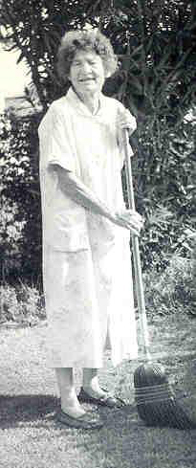 Margaret had now given birth to six children. This was far
more fecund than the majority of her siblings, who were childless with the exception of her brother
Robert. Robert eventually matched her mark of six, counting a baby that died at birth, but as of 1920
the last three of those kids had yet to be born.
Even though Jack appears to have been steadily employed by Honolulu Oil Company through the 1920s and
1930s, he was not always assigned to the same oil field. Accordingly he and Margaret went through a
series of changes of address. According to various directories, they were in Compton, Los Angeles County,
CA in 1922, in Ford
City (essentially contiguous with Taft) in 1926, in South Taft in 1930, and in Santa Barbara in 1931.
The 1930 census agrees with the 1930 directory listing, placing Margaret and Jack’s home in the
unincorporated area south of Taft. By that point, Oliver and young Ed had spread their wings, but Margaret
Brandy Gaver was still at home. Then twenty years old, Little Margaret was working as an operator in a
beauty shop. Living next door was Etta Cowsert Branson, divorced from Robert. Etta’s household included
her children Donald, Marjorie, and James.
In approximately 1936, Margaret and Jack moved to Bakersfield, Kern County’s largest community, in
that era rapidly swelling with the influx of refugees fleeing the Great Depression and Dust Bowl
conditions in Oklahoma. Jack built a house at 1216 Webster Street which would be the family
residence until both he and Margaret had died. After daughter Louise graduated from Kern County
High School and married first husband James Harold Walker, she would chose to live in Bakersfield for
most of her childbearing years. Jack retired from Honolulu Oil Company in 1940. He was not yet fifty
years old at that point and continued to find other work for quite some time. In the mid-1940s he
formed a brief partnership in an Inyo County talc mine -- the “Cookie Talc Mine,” its name derived from
the nickname of Jack and Margaret’s young granddaughter Jacqueline -- with his nephew (also Margaret’s
nephew) Donald Huntington Branson. Margaret and Jack lived in an Inyo County trailer park while
tending to that business venture, returning to 1216 Webster on weekends.
Ultimately Jack entered a rest home in Bakersfield, where he passed away 4 February 1955. The subsequent
period of widowhood was hard for Margaret. Her life had been rigorous and full of challenges until she
and Jack created a stable home in Taft, and she had the habit of bitterness. Her drinking did not help.
Though she was amiable when sober, her blistering temper would emerge when she was drunk. As a
consequence, she was more isolated as an elderly lady than was good for her, even though family members
lived in the same town.
In her mid-seventies, already suffering from emphysema, Margaret developed a duodenal ulcer that caused
a stomach blockage. Deprived of proper nourishment, she wasted away until, in her weakened condition, she
tripped over a throw rug in her home, broke her hip, and was unable to get to her telephone or crawl out
the front door. Unfortunately, due to the factors noted in the preceding paragraph, no one stopped by to
check on her for at least a couple of days. She was still alive when taken to Kern General Hospital in
Bakersfield, but her condition was so compromised she did not survive to be discharged. She passed away
14 December 1963. Her remains were laid to rest in Bakersfield at Oak Hill Green Lawn Memorial Park.
Child of Margaret Alice
Branson with unidentified Fresno acquaintance
Herbert Raymond
“Blondy” Branson
Child with Charles Edward
Heitkemper
Oliver Charles
Heitkemper
Children with Edgar Leroy
Gaver
Edgar Robert
Gaver
Margaret
Brandy Gaver
Samuel Derr
Gaver
Child with John Patton
Cowsert
Gertrude
Louise Cowsert
For genealogical details, click on
each of the names.
To go back one generation, click here. To return
to the Branson/Ousley Family main page, click here.