Edgar Robert Gaver
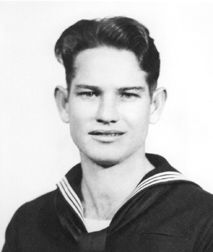 Edgar Robert Gaver (last name rhymes with favor), eldest of the three
children of Margaret Alice Branson and Edgar Leroy Gaver, was born 2 November 1907 in San Jose, Santa Clara
County, CA. His mother Margaret was from the Mother Lode of California, and his father from Maryland, but
both had come to the San Francisco Bay Area in the early years of the 20th Century. Ed, Sr., a tailor, was
playing minor league baseball for the San Francisco Seals. Margaret and Ed, Sr. were not married at the time
of their son’s birth and his conception may not have been entirely intentional. In the end, they treated it
as a happy development and their bond deepened. They finally tie the knot in 1909, a few months into the
pregnancy that resulted in the birth of Ed’s sister Margaret Brandy Gaver. The couple’s household in San
Jose also included Ed’s older half-brother, Oliver Heitkemper, Margaret’s son from her brief early-1904
marriage to Charles Heitkemper.
In 1910 or 1911, a change of baseball teams brought the family south to Los Angeles County. The relocation
was pleasing to Margaret because her mother and other kin had already moved there, where the burgeoning oil
industry was providing some of the menfolk with employment. Another happy aspect was the arrival of a third
child, Samuel Derr Gaver, known as Little Sammy. Unfortunately, Little Sammy perished at only six weeks of
age.
By 1914 at the latest, Ed’s parents broke up. His father moved back east and settled in Altoona,
Blair County, PA, where he worked as a baseball player, a tailor, a baker, and automobile factory repairman.
He would go on to wed Mary Arnetta Paul and sire two more sons, Paul and Harry Gaver. He went on to spend
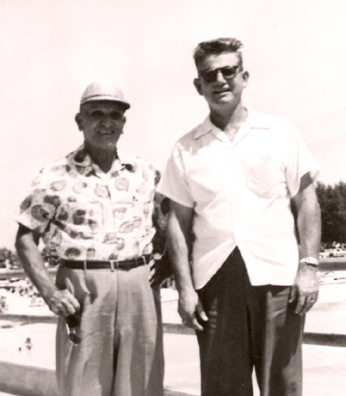
his retirement in Florida, where he passed away in 1977 at age ninety. (Shown below right is Edgar Senior
with Edgar Junior in Florida early in that retirement span.)
At first, young Ed stayed with his mother, those being the days when kids virtually always ended up
with their mothers after a divorce. But Ed would in fact get to see his dad quite a bit. In part, this
had to do with Margaret’s subsequent relationship, which was with John Patton Cowsert, the brother of
Etta Cowert, who was in turn the wife of Margaret’s older brother Robert E. Lee Branson. Jack Cowsert
had worked a variety of jobs in his life. The one he had in the early years as Margaret’s main man, prior
to their actual marriage, was to be a miner near Oatman, AZ. There he and Margaret lived in a basic way;
that is to say, in a tent pitched in the desert amid the sagebrush and greasewood. It wasn’t a place where
it was practical for the
kids to go to school, so Margaret sent her young ones away. Oliver Heitkemper went to live with his father
in Portland, OR. Ed and his sister -- whom the family called Little Margaret -- went to Pennsylvania. There
they had not one, but two homes where they were welcome. First, of course, was the home of their father. But
in 1917 or so, Ed and Little Margaret’s aunt Mabel Grace Branson and her husband George Latham moved to
Stoneboro, Mercer County, PA. It isn’t known if Ed lived with his aunt at all, or stayed entirely with
his father, but Little Margaret was with Mabel enough that in later years it was said of Mabel -- who did not
have biological children -- that she had raised Little Margaret.
 By the late 1910s Margaret and Jack Cowsert gave up their rustic
lifestyle in favor of a more settled
existence. Jack took a job in the oil fields of western Kern County, and the family moved into a house on
the southern outskirts of Taft. There Ed’s youngest half-sibling, Gertrude Louise Cowsert, was born at
the end of 1920. With a proper house acquired for them to live in, Margaret brought her kids back into
the fold. It’s an open question whether Oliver Heitkemper came back full-time; his father appears to have
embraced having a son as a regular part of his life and taught him to be a jeweller, the Heitkemper family
trade. But Ed and Little
Margaret came back, their father and stepmother perhaps being preoccupied with their younger kids and
amenable to letting the two older ones head back to California.
Taft was the town where Ed finished growing up. It was a place of relative permanence after the upheaval
of his earlier years. He attended the local high school, joined soon by Little Margaret. He got to see
his new little sister Louise proceed from baby to toddler to preschooler. There was even a sense of
extended-family presence. In the mid-1920s the house next door became home to
Etta Cowsert Branson and Ed’s first cousins Donald and Marjorie Branson and their young half-sibling
James Ray. Aunt Mamie Branson Dougherty lived in adjacent Ford City. It might have continued to be a
special place in Ed’s heart had these others stayed put. As it was, none of Ed’s kin remained in Taft
after the mid-1930s, depriving him of the chance to “go home.”
On 28 November 1927, just after he turned twenty, Ed joined the U.S. Navy, launching what was to be a
“lifer” career (though in fact his tenure took up less than a third of his very long life). His first
posting was aboard a gunboat in the Yangtze River in China. He arrived just after the conclusion
of the 1925-1927 revolution, during which the American gunboats stationed along the Yangtze had been
embroiled in a tense political situation. Ed served as a cook. An insight into what his life might have
been like during this assignment can be garnered from reading The Sand Pebbles by Richard McKenna
or watching the 1960s movie adaptation starring Steve McQueen and Candice Bergen. Richard
McKenna served on a Yangtze River gunboat during the mid-1930s -- he preferred to set the book
ten years earlier, during the revolution when things had been more dramatic. What Ed thought of the book
and/or movie is not known. Ironically, while in the Far East he was not as beyond the realm of the
Branson clan as one might expect. Within another few years his second cousin Esta Jane Fowle would
marry Robert Kennedy Service, who spent much of his early childhood along the Yangtze River in China
while his parents were involved in YMCA missionary work.
When his first hitch ended 23 January 1932, Ed briefly contemplated civilian life. By then he was an
expectant father. The expectant mother was Ora Bessie McMillian, daughter of Kentucky natives John Thomas
McMillian and Ada Nettie Wininger. Ora had been born in Illinois 8 April 1907. During her gradeschool
years her family had moved to Florence, Los Angeles County, CA. She and Ed had probably met in L.A.
during one of his furloughs, perhaps at the bakery where she worked, and had gone on to be married 27
August 1930 in Graham, Los Angeles County, CA. It is apparent their relationship had not had the chance
to become well established before the pregnancy. The couple were not compatible and did not stay together.
Ed reenlisted 25 February 1932, less than five weeks after he had been issued his honorable discharge and
about six weeks before son Robert Wesley Gaver was born. Ed did not participate in the raising of his son,
though he does appear to have provided financial support. (His new pay rate of nearly eighty dollars a
month as a petty officer third class helped in that regard. Other divorced fathers during the Great
Depression had fewer means to do the right thing.) Sadly, Ora also did not have much to do with
bringing up Robert, either. He was raised primarily by his McMillian grandparents, who appear to have
had legal custody of him. Ora does not appear to have been mother material. Robert did not become part of
her household even after Ora wed Arnim Wood in 1938. Ora spent many years in Inglewood, and later moved
to San Bernardino County, where she died 2 December 1997. Robert grew up to be a Navy man like his father,
serving in the Korean War. He eventually became a pharmacist in Bakersfield. This put him in the same town
with some of his first cousins on his dad’s side, but when approached by one of them, he stated he
didn’t want to get to know his cousins on that side of the family. That said, photographs exist of him
visiting his father in Texas in the 1950s, so the pair did have at least some contact over the years.
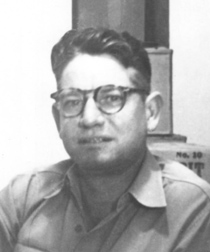 His second hitch took Ed to the East Coast. As a result of hanging
out in New York City, Ed got to know Anna Catherine Walters. Born 7 October 1914, she was eighteen years
years old -- or perhaps just about to turn eighteen -- when the romance began, but it was an era when
women often became wives immediately after they
were done with high school, and Anna apparently had no doubt Ed was the right guy for her. The pair were
wed 12 March 1933 in New York. They would go on to have a considerably more successful union than Ed had
enjoyed with his first wife, but nonetheless, an objective third party would never sum up Ed and Anna’s
marriage with the adjectives “average” or “typical.”
Anna’s life story contains some twists. Her mother Jane “Jennie” Finnegan came from Ireland in the
early part of the century. She married William Davis Walters in approximately 1907, and went with
him to Camp Wallace in The Philippines, where he was a hospital sergeant in the U.S. Army. The two
apparently chose not
to start their family until coming back to the United States. Anna’s older brother William Davis Walters,
Jr. was born in 1912 in Fort Leavenworth, KS, where William, Sr. was stationed. Anna was born shortly after a
relocation to New York and a return to civilian life.
Jennie Finnegan remained in New York for another forty years or more. The same is not true of her husband.
He resumed his military career when America entered World War I. This would last until 1919 -- and his
absence from home led to him falling in love with Margaret Schnell, with whom he would produce another
seven children, the first born in 1920, the last in 1938. The seven, incredibly enough, included another
William Davis Walters, Jr. Jennie is unlikely to have known about Margaret at first. Margaret did know, but
may have assumed William would get a divorce. Jennie was Catholic, though, and would not grant a divorce.
Nor does William seem to have wanted to end the relationship at first. So through much or even the greater
part of the 1920s, William maintained separate households. Eventually he chose to be with Margaret
exclusively. And eventually, Jennie gave up and divorced him. William and Margaret finally wed in 1932,
shortly after the birth of their sixth child.
Given this background, Anna was not in a position to be judgmental about Ed’s mother’s tendency to live
with her paramours out of wedlock. The personal history may even have given the couple extra motivation
to conduct their own relationship according to a more traditional mode. They might well have succeeded
in doing so permanently if kids had ensued. But they never had any. They did, however, remain husband
and wife for twenty years. They spent the first few of those years on the East Coast, probably in New
York, but possibly in Rhode Island, New Jersey, and/or in Philadelphia. Ed was honorably discharged
6 March 1936, after which the couple could concentrate on their domestic life together. Alas, after
three and a half years, they hit a bump in the road. They separated. Ed reenlisted 25 September 1939.
After a while, the two reconciled, but public source records do not show them together again until
the latter part of the World War II era. It is possible they were apart for as much as a five-year
stretch. Once they repaired their differences, Anna moved to La Jolla, San Diego County, CA and maintained
Ed’s stateside home.
When Ed rejoined the Navy in 1939, he would henceforth never veer from a path toward a career of thirty
years of service. (This counts his time in uniform prior to 1939.) Twenty-two of those years were on active
duty, and eighteen of those were spent at sea (counting, of course, occasions when the ships were in port).
A list of the places he was stationed include the Naval Torpedo Station at Newport, RI, Naval Receiving
Station at San Diego, CA, and Subic Bay Naval Base, the Philippines. The ships he served on include the
U.S.S. Noa, U.S.S. Lexington, U.S.S. Detroit, U.S.S. Ranger, U.S.S.
Decatur, U.S.S. Blakely, U.S.S. Cowpens, U.S.S. Hamner, U.S.S. Osbourn,
U.S.S. Grainger, U.S.S. Polaris, U.S.S. LST 1134, U.S.S. San Saba. He worked
up to the rank of Chief Petty Officer and position of Chief Commissary Steward. His service encompassed
all of the years of World War II, where he served bravely and with distinction. He was in every major
battle of the Pacific campaign. Deserving special mention is his assignment aboard the Cowpens, a
light aircraft carrier famed for its successes at Wake Island, New Guinea, the Gilbert Islands, the
Marshall Islands, Palau, Truk, the Marianas Islands, the Philippines, Formosa, Iwo Jima, and the
Ryukyu Islands. The Cowpens was the flagship of the force that entered Tokyo Bay and began the
occupation of mainland Japan after the unconditional surrender by Emperor Hirohito.
Ed, as a crewman of the Cowpens and other vessels involved
in the conflict, earned the right to wear the following medals: Good Conduct Medal, American Defense
Service Medal with Fleet Clasp, World War II Victory Medal, Navy Occupation Service Medal with “Asia”
Clasp, and United Nations Service Medal. He was also entitled to wear a bronze star for service award.
On 22 September 1947 his second consecutive four-year hitch ended. When he reenlisted the next day, he
was assigned to be the Chief Commissary Steward at the U.S. Navy
Recruiting Station in San Diego, CA. He kept this job and title until the spring of 1951, accounting for
most of the four years of his active career that he was not assigned to a ship. With the heating up
of the Korean War, Ed returned to shipboard duty. In the final two years before his release
to inactive duty, he served in the Phillipines and on the U.S.S. Polaris and finally aboard the
U.S.S. San Saba, an attack transport. His release came 1 March 1953. He would go on to spend the
next eight years on Fleet Reserve. Upon completion of an aggragate thirty years in the Navy 25 July
1961, he would be placed on the Retired list, the final designation effective 1 August 1961.
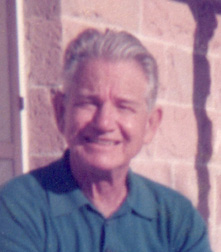 (At right, Ed in the year 1977, age 69.) Passenger manifests
show that Anna visited Ed in Manila, Philippines in 1949, and visited him in Guam in
1951. These two records demonstrate that even while serving as a commissary steward in San Diego, he was
sometimes far from home; nevertheless, the pair worked to keep the relationship going. The downfall might
have been the Korean War. Due to that conflict, Ed lost the luxury of spending regular time in port.
Family gossip says that Anna resorted to other male company to get by during the time Ed was gone. His
homecoming from the war was therefore not a happy one, and the marriage did not survive the upset.
It some ways it is hard to blame Anna. She had to spend an incredible amount of time without her husband
around. Ironically, the end came when that stress finally was no longer a factor. Ed was essentially
a civilian from 1953 onward, even if still momentarily in the Navy’s employ. He and Anna do appear to
have held it together for at least a number of months after his return, moving together to Junction,
Kimble County, TX. Precisely why Junction was chosen is a mystery. The natural thing would have been
to stay in La Jolla, or at least somewhere in southern California, or perhaps have gone back to the
East Coast. Nevertheless, it was to Junction they went, and there, by 1954 at the latest, Ed and Anna
split up. Late in 1954, she married again. She spent
the remainder of her life as Anna King. Despite the split from Ed, she appears to have lingered for good
in Junction. The town is shown as her final residence on her Social Security Death Index entry, and the
grave of her mother, who died in 1960, is in Junction Cemetery. Anna died 28 October 2000.
Ed could finally be a stay-at-home husband and father -- but not with Anna. Ed would spend his final
fifty-two years of life with his third wife, Margaret Maehulda Burt. The wedding took place 29 January
1955. It was a double ceremony that included Margaret’s sister Frederica and her groom Chevis Wyatt.
The event took place in Juntion, the Burt sisters’ hometown, and it was in Junction that both couples
would remain for good. (Frederica even served a term as mayor of Junction.) Though Ed came to the union
when he was approaching fifty years of age, Margaret was much younger (born 7 October 1928 and therefore
still in her twenties at the time of the wedding) and they were eager to start a family. Soon Margaret
was pregnant. Unfortunately fate was cruel. Their baby, born 22 November 1955 at a hospital at Fort Sam
Houston in San Antonio, Bexar County, TX, proved to have spina bifida. This inevitably caused her to
become hydrocephalic. Ed and Margaret were faced with the certainty that their daughter
would not survive her infancy. She lived less than five months, passing away 17 April 1956. She was given
the name Margaret Elizabeth Gaver. It was a special name. The most significant females in Ed’s life -- his
mother, his sister, his wife, and then his daughter -- were all named Margaret.
Devastated by this loss and unable to be sure it would not happen again, Ed and Margaret did not have
more children. Their marriage was nevertheless steady. Ed was active well into his twilight years. He lived
to the extraordinary age of ninety-nine. From the time this website was first uploaded in November, 2005
until his passing, he owned the distinction of being the eldest surviving descendant of John Sevier Branson
and Martha Jane Ousley. Ed finally expired 13 January 2007. Margaret continued on in Junction -- with her
sister Frederica serving as one of her greatest pillars of companionship and emotional support -- and
finally passed away 15 May 2018 at Hill Country Memorial Hospital in Fredricksburg, Gillespie County, TX.
Her remains were soon laid to rest beside those of Ed at Junction Cemetery.
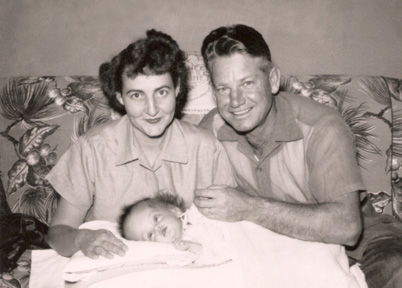
Ed and Margaret Gaver and baby daughter Margaret Elizabeth
Children of Edgar Robert
Gaver
Details of Generation Five, the great-great-grandchildren of John Sevier Branson and
Martha Jane Ousley, are kept off-line. Any surviving descendants spring from Robert Wesley Gaver, who
was born 3 April 1932 in Los Angeles County, CA and died 2 July 2000 in Bakersfield, Kern County, CA.
He is known to have had one daughter with his wife June Marcella Moon, to whom he was married no more
than half a dozen years, and he is known to have married again, probably more than once. The existence
of further descendants has not been confirmed at this time, and they are encouraged to make contact.
To go back one generation, click here. To return
to the Branson/Ousley Family main page, click here.