Margaret Brandy Gaver
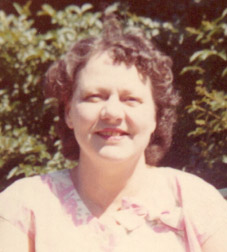 Margaret Brandy Gaver, second of the three children of
Margaret Alice Branson and her second husband Edgar Leroy Gaver, and fourth of her mother’s six
total children, was born 13 October 1909 in San Jose, Santa Clara County, CA, where the household was
located while her father played minor league baseball for the San Francisco Seals. She was known as
“Little Margaret” to distinguish her from her mother, and kept this monicker even as an adult. The
1920 census (for Taft, CA) lists her middle name as Alice, but this is an error.
In the early 1910s Ed Gaver transferred to a new team in Los Angeles, and so the family moved to
southern California, a welcome development in some ways because it brought them back within close
proximity of some of “Big” Margaret’s kinfolk including her mother, said relatives having already
for one reason or another become based in the region. Despite that benefit, the next few years were
troubled in the Gaver family. Ed and Margaret divorced. The couple reached a point of schism some
time not long after experiencing a major tragedy when their third child, Sammy Gaver, passed away
in the summer of 1912 at only two months of age. Ed Gaver moved to the East Coast. By 1915, Little
Margaret would have a new stepfather, Jack Cowsert. Jack had already been connected to the family
because he was the brother of Etta Cowsert, who was married to “Big” Margaret’s brother Robert Lee
Branson.
Jack was a miner. In the early years of the marriage he became employed at a mine in Oatman, AZ. Margaret
later described the locale as not much more than sagebrush and greasewood. With little money to their
name, Margaret and Jack lived in a tent in the desert. In the year-round sense, this was not a suitable
environment for the kids, which included not only Little Margaret but her older brother Edgar Robert Gaver
and older half-brother Oliver Heitkemper. Margaret felt that her young ones would do better in circumstances
where they would have proper shelter as well as be able to attend school, so in spite of the emotional
ordeal, she sent them away. The boys went to live with their biological fathers, Oliver to Portland, OR
and Ed to Pennsylvania. Little Margaret was taken in by her aunt Mabel Branson Latham and her husband
George Latham. Little Margaret had already had the chance to experience living under her aunt’s roof in
1913, when the Gavers had shared the Latham residence in central Los Angeles.
The Lathams became based in Stoneboro, PA in 1917 (or about then). Little Margaret therefore became a
Pennsylvania girl. Being there meant she was geographically quite close to her father, and she spent
intervals with him, even though her aunt continued to be primarily responsible for her. This occasional
presence in her father’s home would be true of her later childhood as well, meaning that Little Margaret
got the opportunity to become acquainted with her younger half-brothers Paul and Harry Gaver, the children
born of her father’s marriage to his second wife, Mary Arnetta Paul. In later years, though, her contact
with those two siblings was infrequent.
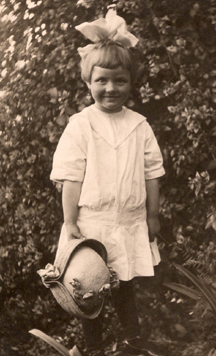 At the end of the 1910s, Jack and Margaret’s rustic
phase of existence came to an end when Jack took a job working in the extraction fields of the Honolulu
Oil Company in western Kern County. The pair moved into a house on the southern outskirts of Taft,
whereupon Margaret reclaimed her far-flung brood. Oliver, Ed, and Little Margaret would keep up their
attachments to their fathers but Taft was now their main base, enough so that in later years Little Margaret
would sometimes describe herself as being “from” Taft. (She is shown at right during the period when the
family was still in Los Angeles.)
At the beginning of the 1920s the family expanded with the arrival of Louise Cowsert, Margaret’s one child
with Jack. In not too many more years Oliver and Ed finished growing up and moved out. As the only remaining
children at home, Little Margaret and Louise, already enjoying a special bond due to being the only girls of
the family, became even closer as a result of being the only kids left in the nest. Margaret continued to be
a part of the household throughout the 1920s, with the possible exception of a short period when she may
have gone elsewhere in order to attend a beautician school. She is shown in her parents’ home in Taft in
the 1930 census. (Aunt Etta Cowsert Branson and her children are listed living right next door.)
Little Margaret worked as a beautician for many years. Though she did so mainly in Taft, for a while during
the early 1930s she was temporarily based in Los Angeles. That may have been where she met and married her
first husband. Precisely when the wedding occurred has not been determined, nor is her husband
fully identified. In family notes, his name is Sam Wilson. Whatever his genealogical background, he
was not part of Little Margaret’s life for long. After parting ways with him in the late 1930s, she took
shelter with her parents, who by that point were residents of Bakersfield. She appears with them in the
1940 census. Soon she reestablished herself on her own back in Taft.
In 1942, Little Margaret became the wife of Robert Bruce Lander. Known as Bruce, he was the youngest of the
four offspring of Charles Augustus Lander and his wife Agnes Reed. This meant that Bruce had
deep connections to San Bernardino. Charles Lander was a native of the community, part of a family that had
pioneered the vicinity. He was still remembered as a newspaper printer. Agnes Reed Lander was a figure of
even greater local renown. She had been a modiste, i.e. a fitter and seamstress of custom-tailored apparel.
She had taken up this career in 1920, which is to say, after her kids were entirely grown. Associated with
the Harris-family department store, Agnes had become a trusted professional known to virtually every lady
of prominent social stature within the city. Charles had passed away in 1936, and Agnes in the summer of
1942, so Little Margaret did not get the chance to become acquainted with her parents-in-law, but she did
know Bruce’s brother Earl and sister Lillian Eldridge. The latter was another noted professional woman of
San Bernardino due to her role as number-one buyer for the Harris company. Lillian was also unquestionably
the most influential member of her generation within the family. Bruce may have had the opinion that Lillian
cast a big shadow.
One reason to suspect there was a “big shadow” effect in play is that despite Bruce’s ties to San
Bernardino, he and Little Margaret did not reside there at any point in their decades as a married couple,
not even at the beginning when they could have used a boost getting started. In general over the course of
his adulthood, Bruce preferred to forge his own path independent of his birth family. This tendency had
first manifested while he was a teenager. He lied about his age in order to join the U.S. Army. Among
other things, this means that various public records often have his birth year wrong. The correct date is
14 June 1901. Bruce was sent overseas with the 49th artillery regiment and arrived in France in October,
1918. Within a matter of weeks the armistice was declared and Bruce came through the conflict intact and
healthy and would go on to live for almost seventy further years. Ironically it was his sister Hortense,
seemingly safe and sound and out of harm’s way in her home in Portland, OR, who perished. The great
influenza epidemic claimed her as one of its victims 31 October 1918. After his enlistment was over, Bruce
returned to his parents’ household, but lingered with them only until the early 1920s, employed as a
boilermaker apprentice, a railroad-company job. His parents divorced during that decade, and this may have
spurred his exit, and may be an additional reason why he subsequently avoided San Bernardino. He became a
longshoreman at the Long Beach-San Pedro harbor, and then in the 1930s migrated up into Kern County, where
he was based alternately in Bakersfield and Taft, probably drawn there by the presence of his brother
Earl, who had long worked in the Kern County oil industry. In 1934 in the midst of this phase of his life,
he wed first wife, Mary. Her story has yet to be fully revealed. She is shown as Mary McGinnis on the
marriage certificate and as a resident of San Bernardino at the time the wedding took place (in Yuma, AZ),
but chances are quite high that McGinnis was her prior married name. Otherwise her particulars are
partially revealed by the 1940 census, which shows her and Bruce in Bakersfield, and the 1940 voter
register, which shows them in Taft. If those sources can be trusted, Mary was a native of Texas born
about 1905. At the end of 1940, Bruce took a job in Santa Monica with Douglas Aircraft. It seems likely
he left Mary behind at that point; if not, they separated during the next twelve months. He returned to
Taft, where he and Little Margaret became an item.
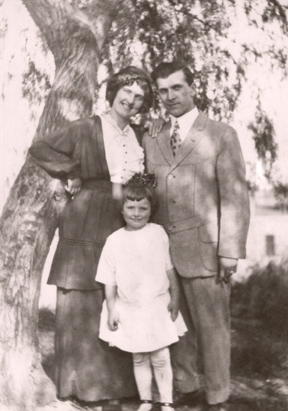 (At left, Little Margaret and her parents not long
before their divorce.) In early September, 1942, the final decree of divorce came through and Bruce was
free to become a husband again. He and Little Margaret did not waste any time. They were married by no later
than the middle of the month. Just where they went through the ceremony is not known, which suggests they
may have hopped across the border and got it done in Tijuana, Mexico. Aside from their affection for one
another, there was a logistical reason to rush things along. As of the eighth of September, Bruce was a
member of the U.S. Coast Guard. The new couple wanted to qualify for married-serviceman housing in San
Diego, where he was to be based. And indeed, that was where they ended up for the greater portion of the
war years. Bruce remained in the Coast Guard until 29 December 1944.
Two bits of genealogical trivia should be mentioned: 1) Both Little Margaret and Bruce had aunts named
Nellie Reed. Her uncle Robert Lee Branson’s second wife was Nellie Reed, and Agnes Reed Lander’s sister
was named Nellie. 2) As one might expect, Bruce’s name tended to be misrendered in print as Landers, and this
is true of various post-1942 references to Little Margaret as well.
A car accident nearly claimed Little Margaret’s life when she was a newlywed. Leaving Bruce in San Diego,
where he was busy with his training, she drove home to Taft on Saturday, September 26th. Apparently she was
too tired to make it safely to her destination, and she lost control of her car on Grocer Grade near Maricopa,
not far south of Taft. She sustained severe injuries and was hospitalized. She pulled through.
Little Margaret had not had children with Sam Wilson, and Bruce had not had offspring with Mary, but they
agreed they wanted to be parents now. Unfortunately, there was some sort of impediment that prevented them
from conceiving -- perhaps caused by the damage suffered by Little Margaret in the car accident. The solution
was adoption. The ideal scenario was some sort of arrangement that would allow them to raise a child who was
connected biologically to one or the other of them. In 1943, an option suddenly presented itself. Little
Margaret was already a doting aunt to her young nieces, daughters of Louise. The little girls called her
“Aunt Sissy” -- an extension of the nickname Louise had used for Little Margaret during her own childhood.
In 1943, Louise found herself pregnant again, and this was a problem in that she was already separated from
her husband, James Harold Walker, and was determined to finish divorcing him. To have to deal with a new
baby at such a juncture was not just inconvenient, it represented a challenge that might overwhelm her. So
soon it was arranged that Little Margaret and Bruce would adopt the unborn child Louise was carrying. In
due course, in mid-January, 1944, a baby boy was born. He was named Robert Bruce Lander, Jr. Unfortunately
the labor was complicated. Either the umbilical cord became wrapped around his neck, or he remained
compressed in the birth canal too long, depriving his brain of oxygen. The result was permanent brain
damage. He would never be able to live a normal life. Becoming parents of a disabled baby was not part of
the plan, of course, but Little Margaret and Bruce stood by the adoption arrangement. The child would go
on to be known to the family as Skipper -- a play on words, of course, but one that in his state he didn’t
seem to mind.
After the war Little Margaret, Bruce, and young Skipper settled in San Jose, or more specifically its
neighboring community of Sunnyvale. This and other parts of Santa Clara County would continue to be the
couple’s home for the rest of their lives with the exception of an interval in the mid-1950s when they
were temporarily based in Santa Fe, NM. Bruce’s regular occupation was house painter.
Little Margaret’s bad luck manifested again in the mid-to-late 1950s. She had another car accident. Again she
survived, but her recovery was far less complete than in 1942. She was left paralyzed from the waist down.
Caring for Skipper was extremely hard to do from a wheelchair and the boy had to be institutionalized. Skipper
passed away in the mid-1960s at the state hospital in Porterville, Tulare County, CA. This bitter development
may have been the wedge that drove Little Margaret and Bruce apart. They did not go far from one another in
the geographical sense, but they ceased living together. It could be they never formally divorced -- such a
move might have meant Little Margaret would no longer be covered by his health insurance coverage plan and
was quite likely something Bruce was unwilling to see happen.
Little Margaret survived with her handicap for two decades. An early 1970s directory shows her at an address
in Campbell, another borough of San Jose much like Sunnyvale. She perished 31 August 1976 in Santa Clara County.
She was buried in Oak Hill Memorial Park in San Jose. This puts her grave far apart from most family members
other than the Biederman branch -- her grandmother Eliza Louisa Armstrong Branson’s sister Bertha is the
matriarch of this branch, and it was Bertha’s presence in San Jose in the early Twentieth Century that
indirectly accounts for Little Margaret having come into the world in that city. Bruce Lander died Christmas
Day 1987 in San Jose. His grave is at Los Gatos Memorial Park.
To go back one generation, click here. To return to the Branson/Ousley
Family main page, click here.