Herbert Raymond “Blondy”
Branson
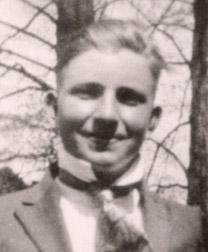 Herbert Raymond Branson was originally positioned on
this website (launched 2005) as the last of the nine children of Reuben Branson and Eliza
Louisa Armstrong, making him the second-youngest of all of the grandchildren of John Sevier
Branson and Martha Jane Ousley. And indeed, Herbert was raised as if he were Louisa and
Reuben’s child -- according to the claims Louisa made about his origin. After years of
research and an accumulating stack of evidence, it has become clear Herbert was not Reuben
and Louisa’s son. He instead could only have been a child born to Reuben and Louisa’s
daughter Theresa Margaret Branson (who in early adulthood changed her name to Margaret
Alice Branson). Herbert therefore was a descendant of John and Martha, but he was a
great-grandson, not a grandson, and despite having possessed the surname Branson qualifies
as a member of the clan not through his father -- whose identity is unknown -- but through
his mother.
To best explain the genealogical particulars requires going back a few years before his
birth and laying out some context. In the 1890s, Louisa had maintained a household in the
granite-quarry town of Raymond in the hills of Madera County, CA. Herbert’s middle name
was probably inspired by that community. Reuben was often away from home as he earned a
living as a miner or as a lumbermill worker. Instead Louisa depended upon her three sons
William, David, and Robert to be the figurative heads of the family. This worked well
enough for a number of years but then the arrangement became untenable. William died of
pneumonia in 1897. David, due to a mental impairment, was something of a burden and when
he chose to spend his time off on cattle ranches as an ordinary laborer, no longer
needing to be housed and fed by the family, it was a case of “all for the best.” That
left Robert, but at the Turn of the Century, Robert moved away to Indian Wells Valley
where he obtained a job maintaining water-pumping equipment for the Yellow Aster Mine at
Randsburg. The evolution of circumstances caused Louisa to relocate the family home to
the city of Madera down in the Central Valley. (Meaning, she found a place to rent. She
and Reuben did not have the means to purchase a house.)
Reuben was part of the move to Madera, albeit in a gone-most-of-the-time way, but soon he
was not to be found there at all because in the winter of 1900-1901, Robert got him a
position at Yellow Aster Mine. After he had worked there a few months and after gaining
faith that he would continue to be steadily employed, Reuben asked Louisa to join him and
she agreed. She set about making plans to move to Randsburg along with at least some and
perhaps all of her daughters. A society-news item in the 6 April 1901 edition of the
Madera Mercury describes a bon voyage party for the family that had taken
place the evening before publication.
But something happened. It’s not even clear the move took place. Probably so, but if
so, it was only a matter of weeks before Louisa and her daughters were back in Madera.
She and Reuben had come to an irreparable parting of the ways. Precisely what sort of
argument they had is impossible to know from the perspective of more than a century, but
reading between the lines leads to the conclusion that Reuben became aware that Louisa
had been unfaithful to him, or worse, had done so in a way that “other people knew
about,” and he refused to have her around any longer.
The family-unit, which in the mid-1890s had consisted of two parents and eight children,
was now greatly reduced. Mainly it consisted of just Louisa and her two youngest girls,
Margaret, age fourteen, and Gertie, age ten. The other three daughters -- Mamie, Mabel, and
Mattie -- were nominally still part of the household, but they were all old enough to flee
elsewhere if they preferred, and indeed they exercised that option, spending substantial
intervals with their uncle John Sevier Branson, Jr. and his wife Lillian at their
summer-and-autumn quarters at Peckinpah’s Mill in the mountains of Madera County, or with
other relatives in Mariposa County, rather than face the scrutiny of neighbors and friends
who now viewed Louisa as a ruined woman or worse.
To get away from the gossips and in order to start a new chapter, Louisa moved to the
city of Fresno in July, 1901. She was confronted now with the challenge of how to support
herself. This led to a divorce filing and all the turmoil that involved, but it likely
also obligated her to spend hours away from the house to deal with a host of necessary
particulars or to earn money at one or another of the handful of menial jobs available to
uneducated middle-aged women of that era -- cleaning houses, doing laundry, or maybe
cooking in restaurant or boarding house. On top of that, shortly after Mattie finished
her “time away” and rejoined the household and might have, at age nineteen, been a
considerable help to Louisa, she instead caught typhoid fever and died just a few days
into the year 1902.
Imagine the scenario from Margaret’s perspetive: A father who was no longer a part of her
daily life. A mother who had little time for her with all that was on her plate. Older
sisters who were often gone. The heartache of a divorce between her parents now overlaid
with grief at the loss of a beloved sister. Add to that Margaret’s own nature, which trended
toward impulsivity, adventurousness, and rebellion. The end result? By the first week of May
or thereabouts, Margaret became pregnant.
No one alive in 1902 is alive now to clarify how the conception occurred. Could it have been
rape? That possibility can’t be ruled out, but there are no particular indications that point
in that direction. There are however plenty of contextual clues that imply the pregnancy was the
result of a consensual encounter. Margaret demonstrated again and again through her life that
if she wanted to pursue a sexual relationship, she would do so. This tendency was so pronounced
that five of her six children were conceived outside of marriage. A likely reconstruction of
events in 1902 is that she met a boy she liked, probably someone close to her age, and in the
absence of sufficient parental supervision, went too far with him. True, she was young, but
she would not have thought of herself that way. Her own mother had married her father just two
weeks after she had turned fifteen. Her mother’s sister Berthalina Armstrong had wed her
husband Jacob Biederman at an even younger point -- a few weeks shy of turning fourteen.
Margaret was if anything conducting herself according to the examples set by her closest
role models, and one could argue she proceeded in a less headlong fashion than they had.
Margaret did not become an expectant mother until she was three months past her fifteenth
birthday, and she would turn sixteen before the birth occurred.
Who was the young man? There are no clues. Perhaps he was named Herbert. That was a name that
had not previously been used in the immediate Branson or Armstrong families. Other than that
possibility, he is a blank slate. What can be said with certainty is that he neither married
Margaret nor played any role in raising his son. That could be a reflection on his
character, but it could also be that he was prevented from becoming involved. His parents
might have forbidden him to associate with Margaret any longer.
The dilemma represented by the baby’s existence -- or pending existence -- was not just
Margaret’s problem. It was a complication for Louisa, too. If it became known among society
that her unwed daughter would soon be giving birth, Louisa would be regarded even more
harshly by the gossips and busybodies than she was by being known as a woman whose marriage
had crumbled. That was bad enough. But she was also in the midst of divorce proceedings and
needed desperately not to be seen as a bad mother who failed to protect her daughter’s
virtue. Reuben or any attorney who might
represent him would have a field day with that characterization. Louisa might well lose
custody of Margaret and Gertie and thereby lose her claim to child support payments, plus
might find it impossible to convince a judge to grant her alimony. So it was vital Louisa
find some way not only to preserve Margaret’s reputation, but by extension, her own.
The first challenge was to get Margaret away from her usual context, so that when her body
contour changed enough that anyone glancing at her would know she was pregnant,
she would not be seen by anyone who was not part of the scheme Louisa cooked up. That meant
they could not stay in Fresno, nor go back to Madera nor to Raymond nor to Hornitos and most
certainly not to Randsburg. Those places contained too many family members and other
acquaintances. Yet Louisa truly needed at least one adult family member who could lend
moral and logistical support, if not financial support. The answer was to flee to San Jose.
Her eldest sister, the aforementioned Bertha Biederman, had been living in nearby Morgan
Hill for quite a few years. Bertha’s home -- or a rental in San Jose within a short daytrip
of that home -- became the sanctuary Louisa tucked herself and her offspring into.
Herbert was born 18 February 1903 in San Jose. He was a tow-headed blond. This was one of
the traits that separated him from the family members that Louisa claimed were his siblings.
Some of them had a blondish tone to their hair, but more of a straw blond or strawberry
blond, not the bright yellow Herbert had. Accordingly, he became known by the nickname
Blondy. In fact, the name was associated with him to such a degree it appears on his funeral
program. However, for the sake of formality, he will continue to be referred to as Herbert
in this biography.
As stated above, Louisa raised Herbert as a son, not as a grandson. She kept to her story
that Reuben had sired him and that she had given birth to him. It could be that the only
witnesses who could
say otherwise were herself along with Margaret, young Gertie, and Bertha, though it is extemely
likely that Louisa took her daughters Mamie and Mabel into her confidence, and they may have
been part of the deception from the git-go. Whether Herbert himself knew is an open question.
It seems likely he eventually would have been told, but at what point is undetermined. Perhaps
it gave him some comfort to believe he had a father and that he knew who he was, even if that
father played no part in raising him, and Louisa may not have wanted to tear apart that
belief.
While Herbert was a baby, Louisa began operating a boarding house to make ends meet. This is
a way of saying that Herbert’s early life bore little resemblance to the early lives of his
eight siblings -- his supposed siblings, that is, meaning his uncles and aunts. They had all
been part of a large family group in a sparsely-settled part of California. Herbert was in a
context where he was in the midst of strangers, be it within the boarding house or as part of
the urban neighborhood of San Jose in which the boarding house was located. Aside from “mother”
Louisa, the only one of his kinfolk he shared his daily life with was Gertie, who was a full
dozen years older than he. His actual mother, Margaret, was around only for a few years at
most. By the time Herbert was grown, he might not have had any solid memory of having shared
the same place of residence as Margaret. The final period when Margaret was part of her
mother’s household ended when she established a separate home with her baseball-player
boyfriend Ed Gaver. That event may have taken place as early as 1906, and it is unlikely to
have happened any later than the early part of 1908, by which time Herbert was only just
turning five years old.
That said, it is worth noting that Herbert was a well-liked “little brother” not just to
Margaret (as one would expect), but to Mamie, Mabel, and Gertie, and even to Robert, though
the latter had limited opportunities to spend time with him while Herbert was a kid. Herbert
might well have been equally favorably viewed by the family even if he had played the role
of nephew instead of brother. He was after all the first of his generation, the new bouncing
baby boy, as well as being the living embodiment of the continuity of Reuben and Louisa’s
biological legacy. Herbert in return cherished his connection to them and even oversaw the
arrangements for the care of Mabel and of Gertie when they became old and feeble enough that
they needed someone to look out for them.
Some time during Herbert’s early school-kid years, Louisa began a romantic involvement with a
divorced carpenter named Charles R. Hine. She did not marry him, either because he had not
obtained a formal divorce from his spouse or because she had never succeeded in completing
the divorce from Reuben. Or maybe she and Charles just preferred to keep their options open.
The two did however establish a home together in Pasadena. Mabel had long been based in southern
California and so had Robert on an off-and-on basis. Margaret and Ed Gaver would likewise come
down from San Jose by no later than 1912. Herbert would spend most of the remainder of his
childhood as a resident of Los Angeles County aside from an interval in Randsburg when he was
in his late teens -- the very locale that had played a part in the break-up of Reuben and Louisa,
though the attraction of the place had nothing to do with Reuben, who was now deceased, but was
because Robert and his wife Etta had returned to the area, and Mamie and her husband Emmett
Dougherty were also around. If he had not already entered the working world, Herbert did so
during this sojourn, employed as an automobile mechanic at a garage.
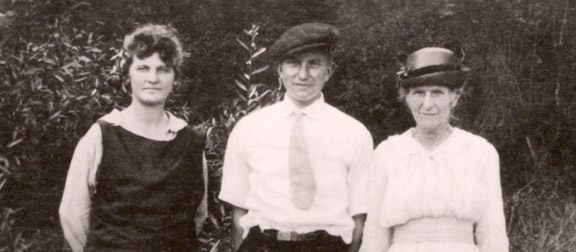
Herbert with his sister Margaret and with his mother, Louisa. Note the strong facial
resemblance between Herbert and Margaret.
In the early 1920s, Louisa and Herbert returned to L.A. County, moving in with Gertie and Gertie’s
husband Jesse Smith in the part of greater Los Angeles then known as “Walnut” but which in modern
terms would best be described as either in Watts, Florence, or Compton-- at that point still a
largely white neighborhood. A great many heads-of-households there worked in the oil-extraction
business in one way or another. This became true of Herbert, too. He would go on to a long career
in that industry.
At some point, most likely in 1924 when he had reached age twenty-one, Herbert spread his wings
and ceased living with Gertie and Jesse, and perhaps leaving his mother behind as well. (Or she may
have come with him and looked after the domestic side of the household responsibilities.) Herbert
became based in Long Beach, a logical step given the greater variety of oil-industry jobs to be
found there. Living in Long Beach at that point was Alene Weigart, maiden name Reid, who had come
to Long Beach from Colorado in 1921 or 1922 with her husband William Edward (aka W. Edward) Weigart
and their baby son, Harmon. Alene had then parted ways with Edward, the point of separation being
either in 1923 or in early 1924. Herbert and Alene became acquainted, presumably doing so after
she had become a divorcée, though the timing is unclear. What is clear is that once they met, they
hit it off and within a fairly narrow time frame decided to make their relationship formal. The pair
wed one another 22 December 1925 in Santa Ana, CA.
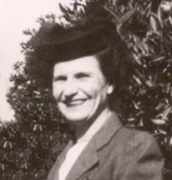
Alene Estelle Reid (shown at right, later in life) was a daughter of Missouri-born farmer
Archer Warren Reid and his Pennsylvania-native wife Eva Emma Sanders. Born 8 June 1904 in Delta
County, CO, she had gone on to spend the rest of her youth there, only leaving as a married
woman (albeit as a very young married woman, having exchanged vows at the tender age of sixteen)
when her Arkansas-born spouse chose to look for employment opportunities on the west coast. The
name Alene being unusual, it tends to be misrendered in records. For example, in the 1910 and the
1940 censuses, she is listed as Aileen. Other variations crop up, but Alene is the correct
spelling. While Alene would not be the only wife Herbert would have, she was the only one who
would provide him with biological offspring. She of course also made him a stepfather as well, but
Herbert did not play a major role in raising Harmon. Then again, Edward Weigart never did so,
either, because he died in the spring of 1926 before Harmon had even reached his fifth birthday.
However, Harmon only occasionally spent time in his mother’s home. It was his father’s parents
Francis and Florence Weigart who were primarily responsible for bringing him up, which they
proceeded to do on their farm in rural Mayes County, OK near the community of Adair. However, in
the early 1940s, having just married his girlfriend Bonnie Lee Briggs of Mayes County, Harmon
chose to settle in California for good, and in so doing saw his mother on a regular basis, perhaps
even more often than he had done during his school-kid years.
Meanwhile Louisa, given that her blue-eyed boy had set out on his own, at last brought an end to
her quarter century as a divorcée and widow. In the spring of 1925, she married Joseph (“Papa
Joe”) Eagle. Very soon thereafter they moved to Milton-Freewater, Umatilla County, OR. Herbert
and Alene also ventured up to the region. The timing makes it unclear whether Herbert was following
his mother, or whether Louisa wanted to stay near the place where Herbert had gone. In any event,
Herbert found work in the gas fields on the other side of the Columbia River gorge, near Walla
Walla.
 In 1928, while in Walla Walla County, Herbert and Alene welcomed a
daughter, Iris Irene Branson, into their lives. Given that Harmon was usually in Oklahoma with his
grandparents, Iris was to be brought up essentially as an only child. One side effect of having
such a small family was that Herbert and Alene were able to pursue a mobile lifestyle for the first
decade of their union. This was useful in that Herbert could pursue jobs that required relocations.
Soon (by no later than the spring of 1930) he and Alene and little Iris came to live in Benton City,
WA. He worked as a drill dresser. It was not the easiest or most pleasant sort of jobs, but in that
early part of the Great Depression, to be employed at all was nothing to sneeze at.
In the summer of 1930, Herbert showed his colors as a descendant of Reuben Branson and of John
Sevier Branson -– he became a gold miner. He, Alene, and Iris moved to Circle City, Alaska. Later
they would move to Fairbanks. The climate was a drastic change from the southern California desert
milieu of his youth, but Herbert met with enough success that he found it worthwhile to endure
that hardship. This success was, however, not enough to justify endangering the health of his
family. When Alene developed tuberculosis in about 1935, he sent her and Iris back to southern
California, where in those pre-smog days the air was better for her. Herbert finished out the
placer-mining season. When the streams froze over in the autumn, he rejoined his family. In
doing so, as it turned out, he was to be a resident of southern California for the rest of
his life.
The Bransons lived in Huntington Beach through most of the rest of the 1930s. Herbert worked as
a “roughneck” in the local oil fields. About 1940 the chance came to move up to superindendent of
an oil spring at Santa Fe Springs, near Whittier. They would remain in this general area while
Iris was in high school, though they did move from one address to another -- for example they
lived in Seal Beach and then Midway City in Orange County in the early part of that period.
Herbert's jobs were mostly in oil drilling, but not always. His 1942 draft card shows him as
an employee of the California Shipbuilding Corporation of Wilmington, CA.
No sooner did Iris graduate and turn eighteen than she wed Dell Harvey Cook and set out to enjoy
her lifelong marriage to him. This development meant that as of the autumn of 1946, Herbert and
Alene were on their own. As happens with many couples when their offspring have fledged, they
split up. Herbert spent some of the following year in a rebound relationship (it may have
involved a so-called “Mexican marriage,” i.e. the couple lived as spouses, but never obtained a
license recognized within the United States). This lady’s name is not recalled. Next Herbert
began courting Frances Almeda Rumsey, who had been born 21 March 1906 in Dodge City, Ford County,
KS. Frances had been the wife of another Los Angeles County oil worker, Hep Currie, and therefore
was part of the social circle that Herbert and Alene moved in. The pair were married 15 May 1948 in
Long Beach. They would later settle in Long Beach, though in the earliest part of their union
they resided in Whittier.
(Poor Alene went through quite a bad-luck phase in the late 1940s. First her marriage to Herbert
broke up, then her father passed away in November, 1948, then in October, 1949, she and her mother
were struck by a reckless driver while crossing Long Beach Boulevard as pedestrians. Alene suffered
critical injuries, including a broken pelvis, broken leg, broken shoulder, and contusions to her head,
including to her face.)
Frances and Herbert were together for about ten years -- a relationship more or less spanning the
decade of the 1950s. They had a relatively happy marriage, but for one reason or another it was not
sustainable. Frances went on to marry Hep Currie’s cousin Courtlyn Bartlett Currie (born 12
February 1908 in Iowa, died 23 June 1993 in Hemet, Riverside County, CA). Inasmuch as Frances and
Courtlyn were part of the same crowd as Herbert, they all continued to associate with one another,
just as Herbert continued to associate with Alene, friendship triumphing over interpersonal
baggage.
Herbert, meanwhile, went on to wife number three, with whom he would spend the rest of his life.
The wedding occurred 10 April 1961 in Los Angeles County. His new bride was Marion Maxine Mottice.
A daughter of John David Mottice and Bessie M. Bragdon, Marion had been born 5 January 1906 in
Colorado (probably in Pueblo). She had been previously married to Clinton D. Moffatt. That union
had lasted the better part of a decade and had yielded a daughter, but ended in divorce. In 1935,
Marion had wed second husband John Conley Mason, with whom she had two more daughters, as well as
becoming a stepmother to John’s daughter from a previous marriage. So Herbert became a stepfather
once again. He did not, however, spend much if any time being a day-to-day parent to Marion’s kids,
as even her youngest was wrapping up high school by the time Marion became the new Mrs. Branson.
Both of Marion’s former husbands had worked in the local oil business and Marion knew both Alene and
Frances. Marion’s late husband John Mason had invented a type of valve used in the industry and
had founded a company to manufacture it, securing contracts with customers in Saudi Arabia. His
efforts had started to pay off very handsomely by the time he had died in 1957. Herbert stepped in
to look after Marion’s legacy share of this business. As a consequence, Herbert’s final dozen
years of life were spent as a well-to-do man.
Herbert’s sister Gertie lived in Long Beach during this mid-20th Century period. Her presence
there may have been one of the incentives that led Herbert to settle in the city. Gertie passed away
in 1963. Several years later Herbert would bring his surviving sister Mabel from her home in Oregon
to reside in a nearby rest home, since she had become too afflicted with Alzheimer’s to look after
herself. Herbert himself did not live long enough to have to suffer his own decline into senility.
He passed away from heart disease in Long Beach 23 November 1974. His remains were interred in the
Garden of Remembrance section of Rose Hills Memorial Park in Whittier, CA.
As a widow, Marion continued to live in their home. She passed away in Long Beach 28 June 1985.
Meanwhile Alene spent her final years living with Iris in the foothills east of Sacramento. She
passed away 20 October 1986 in Penn Valley, Nevada County, CA. Frances passed away 26 December 2004
in Glendale, Maricopa County, AZ. Harmon Weigart, born 6 September 1921 in Colorado, had a son and
a daughter with Bonnie. He passed away 1 January 1986 in Pine Grove, Amador County, CA.
Descendants of Herbert Raymond
Branson
Details of Generation Five, the great-great-grandchildren of John Sevier Branson and Martha Jane
Ousley, and beyond are kept off-line to guard the privacy of living individuals. That said, the
descendants of Herbert include his daughter Iris Irene Branson (10 September 1928 - 27 January
2022), five grandchildren, ten great-grandchildren (including one adoptee), and five great great
grandchildren.
To go back one generation, click here. To return
to the Branson/Ousley Family main page, click here.