Eldridge Geary Branson
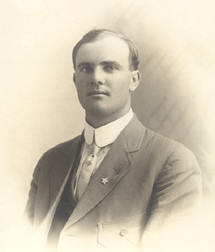 Eldridge Geary Branson, son of Joseph Branson and Ellen
Margaret “Ella” Geary, was born 4 September 1891 on his parents’ ranch north of Hornitos, Mariposa
County, CA near the no-longer-extant mining outpost known as Quartzburg. He was part of a set of
twins. The other twin was Ernest Elton Branson. The two appear to have been identical rather than
fraternal, but like many so-called “identical” twins, could be told apart fairly easily. Eldridge
often got credit for being the more handsome of the pair, in part because of facial characteristics,
and in part because Ernest grew stout whereas Eldridge maintained a medium build through his twenties
and thirties, and even when older was still the leanest among his siblings.
Along with Ernest, Eldridge was the last of a brood of six children raised on the ranch, a holding
that expanded to 1300 acres over the course of his boyhood as his father purchased the properties of
his father John, brother Thomas, and those of neighbors who were giving up on the area, discouraged by
the dwindling yields of the gold that had formerly sustained the local economy. Joe Branson had found
success raising cattle, so the family fortunes did not take the same tumble as those of other households
of Mariposa County. That said, some of the family income did in fact come from gold mining. As a boy,
Eldridge watched as hoppers of gold-bearing quartz were brought up from the mine shafts located only a
few hundred yards away from the family home. The racket of the stamping mills was an unavoidable part of
the family’s weekday existence. In this period, the Joe Branson ranch bustled with a barracksful of miners,
a barn, a blacksmith shop, a caretaker’s house -- it was almost a small town and was so “authentically
western” it was used in 1921 as the backdrop for a silent film starrring Leo Maloney, released in 1922 as
The Western Musketeer. On the whole Eldridge enjoyed a secure childhood, with only one change of
houses. That change took place in 1897 as the family moved
into better quarters, a side effect of one of the land purchases. Eldridge therefore had a solid beginning
to his life, and ready-made employment when he became old enough -- his first job as a wage-earner was as a
mine machinist. In young adulthood he would even spearhead a couple of mining efforts, investigating the
nearby Silver Lead and Margaretta claims a couple of miles northeast of Quartzburg to see if they still had
any profitable ore left in them.
Eldridge came of age with some good memories of his upbringing. His father loved to hunt and the twins
absolutely shared this passion. They hunted deer, quail, pheasant, and cottontail rabbits, as well as using
their firearms to suppress the population of two major pests, ground squirrels and rattlesnakes. They even
went after the occasional mountain lion or black bear. Eldridge would speak in his old age of the excitement
of going after the latter prey -- and of making the most of the meat, which he described as particularly
savory if the bear had been gorging on acorns. The ranch also had a tremendous garden, and an abundance of
barnyard critters -- not just the beef cattle in the fields and dogs and cats as pets, but pigs, chickens,
and turkeys, along with a milk cow. Even late in life Eldridge would raise goats and butcher
them personally, having gained an appreciation for fresh meat and for the financial efficiency of avoiding
a butcher-shop bill. In some respects, though, Eldridge’s childhood was not as sweet as it should have
been. His parents were both the type to play favorites, and apparently he was not among the sub-set that won
their approval. Looking back from the perspective of more than a hundred years, the reasons for their
attitude are not clear, but a guess can be made. Eldridge did not like conflict. He was reserved and
soft-spoken. In the face of a domineering individual, his approach was to grow quiet. This put him at a
disadvantage with his father. Joe Branson was a proud and confident man. This had the virtue
of making him magnanimous toward the outside world, and led him into a number of positions of responsibility,
winning him the appreciation of his peers. Close to home, it meant he could be unreasonably
judgmental. Eldridge had the sort of personality that in modern times would win friends, influence people,
and make a father smile. But Joe was a creature of his tough, lasso-your-steer-and-brand-its-ass
environment. He was tall, outspoken, and hard-drinkin’. He wanted each of his boys to be like him -- a man
whose presence intimidated others.
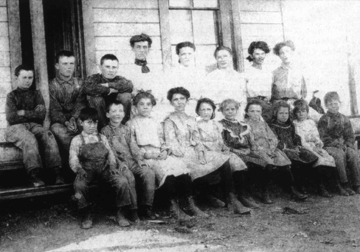 Eldridge attended Quartzburg District School. This was a
one-room rural elementary school. It was almost a family school, given that the pupils there in those years
consisted largely of siblings and cousins, in-laws, and “shirt-tail” relatives, which is to say, individuals
who could be linked in a chain of relationships if the genealogist bothers to includes all of the various
marriages and step-connections involved in the network of pioneer families of the immediate region. Eldridge
and Ernest sat side-by-side on a bench their father had constructed and donated to the school. For a while
their teacher was their own sister, Marguerite. It took the twins a long time to complete the whole sequence
of grade levels. This was due in part to the district’s truncated schedule, but far more of the blame can be
laid upon the tendency of children of the Mother Lode to scoff
at book learning, Eldridge and Ernest were still pupils there in the 1908-09 academic year, i.e. until they
were almost eighteen. They were by no means unique. The photograph at right, from a 2003 newspaper article,
shows the 1909 student body with their teacher, Ada Cress. The group of seventeen pupils includes half a
dozen who are clearly in their late teens. This number includes the twins as well as Gertrude
Branson, a first cousin who was half a year older still than they were. (Ernest and Eldridge are the
two husky youths second and third from the left in the back row.)
Eldridge’s early life may have had an interesting wrinkle, but if so, the details can only be guessed at.
His entry in the 1930 census indicates he was first married at the age of sixteen. This would seem to be
an error on the part of the enumerator -- but if the stat is correct, then it is a solitary clue to a
mystery. No other source mentions him marrying so young, nor provides the identity of the spouse.
The local mines dried up just about the same time that Eldridge entered his early twenties, soon leaving him
with nothing more to do if he stayed put, other than help take care of the ranch, which was more Ernest’s thing.
Eldridge therefore grew increasingly willing to consider leaving the area as his sister Grace and his late brother
Alvin had already done. This became even more true in 1911 and 1912 when many of his friends and same-generation
relatives abandoned the county. These departures, along with earlier ones, had whisked away Alma Branson, Alex
Branson, Inez Branson, Lizzy Bauer Reeb, and Eunice Bauer, first cousins quite close to Eldridge’s own age, who
had been part of his early years almost as much as his siblings. He was now ready to be lured away from
Mariposa County, and at just that point, the lure began to dangle in the form of a pretty young lady. The object
catching his interest was Clara Elvira Jackson, daughter of George Jackson and Ollie Clemence Brown. Born 27
August 1892 in Mill Creek Canyon, San Bernardino County, CA, she was one of eleven children. Both George and
Ollie had come to San Bernardino County as small children, remaining there through marriage and on through
many years of child-raising, until in 1912, for reasons not known, they decided to move to Mariposa County and
engage in ranching at Quartzburg. They would stay for only a year before heading back to their former stomping
grounds, but for Clara -- and for Eldridge -- that interlude was destiny-shaping. Eldridge had been embedded
in a milieu in which nearly every female of his age group was a gal he had known since before he could remember.
The Quartzburg area had seen few new arrivals since the early 1880s when the Washington Mine had enjoyed its
heyday. The young adult members of the Jackson family were the exotic new strangers. This was powerful magic.
Two local youths were caught in the spell. First was Shirley Bell Collins, a granddaughter of local butcher
George Reeb and one of Eldridge’s close neighbors and a classmate of his at Quartzburg School (She is third from
left in the front row in the Quartzburg School photo shown above.). Three years younger than Eldridge, Shirley
had just graduated from the school in June, 1912, having been handed her diploma by Inez Branson, the teacher of
the 1911-12 term (the job having temporarily brought Inez back to the area). Shirley became entranced by Clara’s
brother Robert Erwin Jackson. The pair wed 28 November 1912. Soon they were on their way to San Bernardino County.
By the time they and all of the other Jacksons departed, Eldridge had become
smitten with Clara. He would not marry her until ten months after Robert and Shirley’s wedding. The delay is
probably evidence of his shyness. He may not have been able to gather up his determination while Clara was still
living in Mariposa County. Fortunately he had a double excuse to visit San Bernardino County -- he could see his
new buddy Robert Jackson and his old neighbor and classmate Shirley, and depend on their hospitality while he
stiffened up his courage to woo Clara. Indeed, Robert and Shirley would go on to be a part of Eldridge’s
life until his dying day.
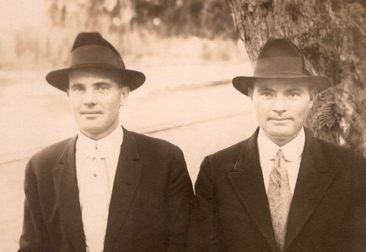 Eldridge is on the left in this 1910s photograph of him
and twin brother Ernest.
Once Eldridge and Clara finally did decide to become husband and wife, they made up for the somewhat leisurely
pace of their courtship with astounding haste -- so much so it surely must have sparked gossip that Clara was
pregnant. However, pregnancy does not appear to have been a factor. The couple’s first baby did not make his
appearance until two-and-a-half years after the wedding. And yet Eldridge and Clara said their vows so
abruptly that not one member of Eldridge’s family was in attendance. The only person there who had known Eldridge for
more than eighteen months was Shirley Bell Collins Jackson. The latter could arguably be called a relative, but
only in that above-mentioned “shirt-tail” sense -- a couple of her Reeb uncles had married first cousins of
Eldridge. Is it possible
Eldridge’s kinfolk were opposed to the idea of him marrying Clara? This is not a question addressed by any
available source. However, multiple sources do confirm the naked fact that the only witnesses to the rites,
held 17 September 1913 at 3:30pm at the E Street Baptist Church in San Bernardino, CA, Reverend Mark B. Shaw
officiating, were immediate relatives of the bride. Among those sources is a postcard Clara sent two days after
the wedding to her new sister-in-law Grace Branson Warner of Sanger, Fresno County, CA, informing Grace she had
“a new sister” and commenting that the news would no doubt be a surprise.
As soon as they became a couple, Eldridge and Clara settled in Urbita, also known as Urbita Springs, a small
community of only a few dozen homes that lay just outside the southern city limits of the city of San
Bernardino. Here they would stay until the 1960s -- a span of over fifty years. Their address was 808 Adell
Street, and they were homeowners from the start, probably thanks to help from one set of parents or both with
the down payment. Urbita would cease to exist in December, 1924 after all forty-eight households within the
district voted to allow annexation into the city. (Eldridge and one other neighbor spearheaded the annexation
effort. Eldridge and Clara were active members of the Urbita Progress Club for many years, and the annexation
effort was one of the club’s major endeavors.) Nowadays the unique history of the vicinity is not easily evident.
The chief feature of the neighborhood is the sprawling Inland Center Mall. But when Eldridge and Clara first
got there, the spot was best known as a resort
based around the hot springs that welled up there, forming a small lake. (The lake no longer exists, having
been covered by the mall.) Strange as it may seem, San Bernardino of the 1910s was known as a place to retreat
for reasons of health. Though infamous in later decades for the intensity of its smog, at that point the local
air was so clean a number of tuberculosis sanitariums had been built there. Tourists came for the sunny weather
and wide open spaces. Urbita as a specific destination had the added selling point of its springs. Visitors
could soak in the geothermally-heated water. They could take mud baths. As with many other areas of that sort,
local shysters promoted the water and the mud as therapeutic, and found plenty of gullible customers. Adding to
the cachet was that allegedly, mud from the area had been used for the adobe used in the construction of the
Mission San Gabriel back in the days of Spanish California.
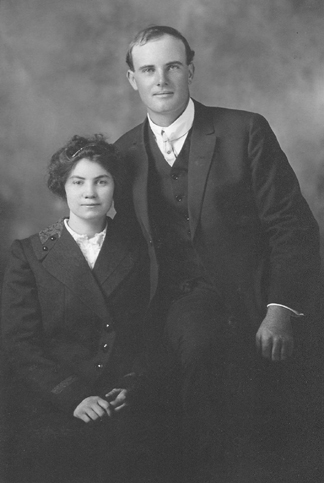 (At right, Eldridge and Clara’s wedding portrait.)
Even if Eldridge had come to San Bernardino for reasons other than romance, it still would have been a good
place for him to settle, because unlike Mariposa County, he could count on getting a job. San Bernardino was
where Santa Fe Railroad maintained a large facility for the storage, cleaning, painting, maintenance, and
construction of its rail cars. The company employed a sizable work force, and Eldridge’s experience as a
machinist made him a desirable person to hire. The skills needed to keep stamping mills operating smoothly was
not all that different from the skills needed at railroad maintenance yards. That said, it took a few years
before Eldridge succeeded in landing such a position with Santa Fe. In the meantime, he was a driver for American
Truck Company, then a clerk for Harry Milton Haun. And in 1916, by which time Eldridge was a father with an extra
mouth to feed, he put in shifts on Saturdays as a parking attendant at Urbita Springs. This was a convenient
job in terms of locale. The lake was only a fraction of a mile southeast of 808 Adell. He could walk to work.
And oddly enough, it was the first time he was able to say he was on the payroll of a railroad. Due to the
urban development around the hot springs, including the creation of the residential neighborhood in which
Eldridge and Clara lived, one of the only empty areas remaining that was suitable for parking at the lake was
a vacant lot owned by Pacific Electric Railway Company -- known familiarly as the Red Car Line -- the commuter
railway that connected San Bernardino to Los Angeles. That was who Eldridge worked for, the railway management
not being inclined to just let people leave their
vehicles on their land for free. Eldridge was not able to keep moonlighting as an attendant over the long term,
though. Pacific Electric Railway was a subsidiary of Southern Pacific. Santa Fe would not have looked kindly
at an employee who worked simultaneously for its main rival. Once Eldridge finally did land his position as a
machinist, he was obliged to focus upon it.
Clara gave birth in early 1916 to son Hugh Geary Branson. Twenty-two months later, along came second son
Joseph Eldridge Branson. And that was it. Though Eldridge and Clara were well shy of thirty years old when
Joseph was born, they did not have more children. Small family size was a choice echoed by a great many
of Eldridge’s generation of the Branson clan. This was a dramatic shift from the ample broods of the 1880s
and 1890s. By siring two, Eldridge actually exceeded the average number of offspring produced by his
siblings and first cousins. He was also the only child of Joseph and Ella Branson to have male children, i.e.
children who carried on the Branson name. John, Marguerite, and Grace had only girls, and Alvin and Ernest
had no children at all. Small family size was the tendency among Clara’s siblings as well, though not
universally so. Robert E. and Shirley Bell Jackson produced eight children (counting three who died in early
infancy).
Being in San Bernardino did have the downside of isolating Eldridge from the rest of the Branson clan. This
became increasingly true as the years went on, even more so than the usual pattern of kids roaming far from
home upon reaching adulthood. Perhaps the situation was exacerbated by the ambivalence Eldridge felt toward his
folks. After a visit to Urbita by his father (and probably his mother) in 1916, the old man wrote to say that he
sure hoped young Hugh -- newly born, the reason for the visit being that Joe and Ella wanted to see their new
grandson -- grew up to be like him, Joe, and not like Eldridge. What a thing for a father to say! Ella was known
for her own habit of criticism, though chances are it was less directed at her boy and more in the style of
“advice” to Clara, such as wondering out loud why Clara dressed Hugh in the same outfit day after day. However,
not all of the drifting apart was intentional. Simple geographical distance, and the fact that Clara’s parents
and siblings were near at hand while Eldridge’s were not, played a significant role in the separation. There
were moments of togetherness, though -- see the biography of Marguerite Branson and you will find a photograph
of Eldridge and Clara standing in the midst of Branson relatives during a visit to the Quartzburg ranch. Click
here to go to that page.)
Eldridge had the misfortune of being one of the thousands of workers who lost their
jobs as a result of the Great Railroad Strike of 1922. Unions had become strong during the war years thanks to
the urgent need for laborers in major industries and the departure of manpower to Europe to fight as soldiers,
but now the labor agreements made in 1917 and 1918 were expiring, too many people were looking for jobs, and
corporations were getting the upper hand again. The Railroad Labor Board approved a decrease in wages of seven
cents per hour for shop workers, i.e. those workers like Eldridge who worked in fixed-place facilities, as
opposed to the employees who actually operated the trains in the course of a regular business day, i.e. the
locomotive engineers, the firemen, and the conductors. The latter were protected from the wage reduction. Seven
cents might not sound like much to those of us who live in the 21st Century, but a typical wage for railroad
company shop workers in 1922 was fifty-six cents per hour, so the workers were being asked to give up an eighth
of their pay. It’s no surprise they chose to strike. It was a widespread and sometimes violent uprising.
Unfortunately destiny was not with the laborers. The railroads hired scab workers, kept the trains on the tracks,
and ultimately won.
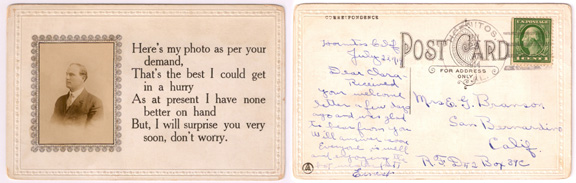
The postcard shown here was sent by Ernest Branson to his new sister-in-law Clara in the
summer of 1914. Eldridge apparently did not possess any recent photos of his twin brother, and Clara
wanted one in order to be able to show people to what degree Ernest and Eldridge looked alike. The original
card appeared on eBay in August 2006 and the listing was spotted there by Clayton
Guest, a descendant of John Sevier Branson’s cousin Irena Branson Scott, who alerted Dave Smeds to
the auction. Dave was the only bidder and now owns the item. The seller was an antiques dealer who
had probably acquired the postcard through a series of estate sales.
Being laid off could hardly have been a welcome development for a young father with a family to support,
particularly because Santa Fe, like all the big railroad empires, had operated as a monopoly for decades,
with politicians in their pocket, and was used to bullying people around. The company’s head honchos carried
grudges and liked to make examples of those who defied them. So Eldridge had no real hope of returning to his
old position. It was more than a loss of wages. The railroads had the best retirement packages in America, and
now Eldridge would not become vested. However, things worked out well over the long run. Eldridge became a
warehouseman for Independent Feed & Fuel Company. This would go on to be a decades-long gig, providing him
with an honest wage throughout the economically fraught years of the Great Depression, and on into the World
War II era. In the near term, it meant Eldridge and Clara did not have to move away from their existing home.
Eldridge would have hated that. He loved 808 Adell. The lot was triple-sized, which allowed him to maintain a
garden so ample it verged on being a farm. Back in Quartzburg his parents had maintained a huge vegetable garden
every year, and in addition his mother had grown various types of flowers within and around the wire fence that
surrounded the main residence. Other close relatives had tremendous gardens, in particular Eldridge’s
uncle and aunt, Thomas and Frances Branson. Eldridge loved being able to maintain the same sort of tradition
in spite of the urban setting in which he had found himself. His effort was magnificent. He did not have
just a “green thumb,” but an even more profound understanding of how to make his fraction of an acre as
productive as it could be. To paraphrase a surviving granddaughter, he scratched the earth and things grew.
He raised not only vegetables and other annual crops, but planted a mixed orchard of one each of just about
every type of tree that was capable of flourishing in the climate and soil of the San Bernardino area. The
trees included a Mission fig that grew to be gigantic -- the grandkids would climb high into it during their
elementary-school years in order to gaze out at the neighborhood as if it were their kingdom. A walnut tree
inbetween the house and garage provided the shade for a picnic/patio area, site of many outdoor family
get-togethers, and a favorite spot where Eldridge liked to relax in a chair. There was a cling peach, and a
freestone peach. And quince. And every year, Eldridge would grow sweet peas along a wall of the garage. His
neighbors marvelled at how lush and hardy they were, filling the vertical space from the ground all the way
to the eaves. His secret was working lots of chicken manure deep into the soil. Clara had her own love of
the garden. She would grow flowers against the house. She would turn figs into jam, and peaches into peach
butter. That said, the outdoor space at 808 Adell was Eldridge’s special domain, as well as a retreat in later
years when he preferred to limit the amount of time he spent with Clara.
Clara was a homemaker while the boys were small, but once they were both in school, she
built up a career as a real estate agent. At first her employer was the firm Preston & Shay. By 1930, she was
working with Noah Adair, whose name was very well known to readers of the local newspaper, the San
Bernardino County Sun, Adair having for years been one of the main fire insurance brokers in the city.
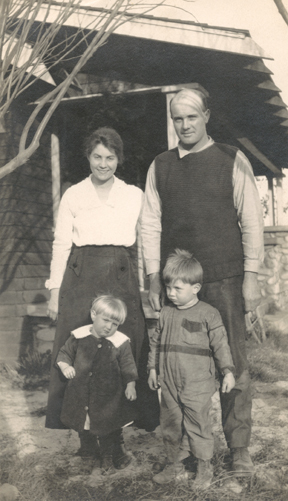 (At left, Eldridge and Clara and their sons in
1920, or about then.) The first twenty years of his married life was very much the prime of Eldridge’s
existence. Decent job. Stable residence. Parents both still alive. Stage by stage his boys proceeded toward
manhood. By the time Eldridge turned forty-five years old in the early autumn of 1934, it is fair to say he was
enjoying the best circumstances of any of the children of Joe and Ella Branson with the exception of his
sister Grace. The other four kids? Well, John had gone through one broken marriage and now his second was on
the rocks. Marguerite had sickened and died. Alvin had been killed young in a mine accident. Ernest was childless
and even at that point, still did not own the house he was living in. By contrast, Eldridge was married,
healthy, and financially comfortable. Nor had he treated anyone badly in order to get ahead. Any objective
person would have said he deserved what he had. Unfortunately, things changed. Eldridge would know all too
much heartache in the decades to come. Clara was at the core of it. Late in life he admitted that if he had
known what was to come and what Clara would be like as a middle-aged and elderly woman, he would have divorced
her, but he was a steadfast man. He would have thought himself at fault if he had turned his back on his wife.
By the time he accepted that he had chosen the wrong course, he felt it was a done deal. He was too old to
start over with anyone else, and so he went on to spend his final years in a state of quiet desperation.
Eldridge’s descent into hell was a journey of many steps. The first really big one took place in October,
1934. The men of the Jackson clan went out hunting. Hugh Geary Branson, then age eighteen, was encouraged to
come along. Hugh, however, had been raised in a neighborhood setting, not on a ranch as had been the case
with his father or his uncles. While the group was crossing a fence, Hugh leaned his rifle
against a post. The weapon fell over and discharged. The bullet struck his uncle Vernon George Jackson in
the abdomen. In those pre-antibiotic days, a belly wound was a death sentence. Inevitably the injury led to
an infection that in turn led to blood poisoning, and Vernon died. Vernon himself did not blame Hugh, knowing
it was an accident stemming from Hugh’s inexperience as a hunter. But it was Clara’s lasting opinion that
Hugh had murdered her brother. (Vernon happened to have been her only remaining brother other than Robert.)
Clara simply would not let go of this view. She couldn’t forgive her son. She hated him for the rest of her
days. She even hated him after he was dead and was no longer there to serve as a direct target for her venom.
Hugh was much like his father. He wanted to make peace. His reaction to his mother’s rejection of him was
to try to win back her love. For his part, Eldridge continually tried to defuse Clara’s rage. The approach
was quite possibly just the opposite of what Clara actually needed. Not calling her to task for her behavior
may have enabled her. If she had been condemned by both husband and elder son, and been forced to apologize
to them for acting as she did, maybe she would have grasped -- at least in some slight way -- the
error of her stance. Instead, the poison inside her fermented, only to spew from her in increasingly nightmarish
ways.
Clara’s choice meant she had only one focus left for her indulgence and her unconditional love -- her baby boy
Joe. She showered him with her approval. This was a recipe for disaster. Hugh was by nature moral and
hard-working, and though he sometimes couldn’t help but vent his frustrations, he cared for those around him.
Joe was the sort of person who needed strong guidance and discipline so as not to become a degenerate. Instead,
what Joe got was pampering.
Joe reached eighteen years old at the beginning of 1936. The 1936 San Bernardino city directory shows him as an
employee at the county hospital. This gives the impression he had managed to land a job. Unfortunately it is
more likely an indication he had committed some sort of infraction -- perhaps something he did before
turning eighteen -- for which a judge had sentenced him to community service, leading to basic janitorial work
at the hospital. At best, the gig was simply an early example of the many short-term jobs he had. He never
settled into a career. The problem is that he was not reliable, and all employers quickly learned they could not
place him in a position of trust and/or responsibility. The only occupations he seemed to have a true knack for
were drinking booze and siring children.
The worst part of his story is that second part. He became a father way too early, and way too often, and then
did not give his offspring the kind of nurturance, oversight, support, and love that any child needs in order
to grow up right. The kids most definitely did not grow up right. They grew up so wrong the wrongness affected
their DNA. Subsequent generations have had trouble leading happy and functional lives, even those who never
had any direct encounter with Joe. The drama began when Joe was nineteen, and he wed a young woman he’d just
met, fifteen-year-old Iva Laster. He had managed to find someone who thought he might be the prince she needed
to come to her rescue. Iva’s stepfather was abusive and she was eager to get out of her mother’s house. She
should have held out for someone better. Unfortunately, Joe should have done the same thing. He ended up with a
wife who was unequipped to help him chart a sensible life course. Together they proceeded to produce children at
a rate of one per year for the next six years. The babies were Ernest, Joseph, Blaine, Stanley, Ann, and Gladys.
Little Joe, the second-born, perished at seven months of age.
The omens were there from the beginning, but for the moment, Eldridge and Clara were encouraged to see their
son move into a home with his bride. The young couple established themselves first at 732 Adell Street and then a
year or two later did so at 878 Adell. At first, this was a happy arrangement. Eldridge and Clara were
close at hand to help with the grandchildren. After a while, though, the proximity became too convenient. The
grandchildren were dumped off at Eldridge and Clara’s too easily, including at times when Joe should have been
spending time with them, honing his fathering skills instead of lurking in saloons and pool halls.
The war years began. With it came some positive developments. The San Bernardino Police Department found itself
short of manpower and Hugh was able to get a job with them. In 1944, he also acquired a wife in the form of divorcée
Janet Lovell Klinker. When Hugh moved in with Janet and her little boy and girl, Eldridge and Clara finally could
imagine they had finished raising their kids and could begin to enjoy the freedom that came with that. Articles
published in that era in the San Bernardino County Sun serve as evidence that Clara was widely involved in
neighborhood and city social functions, particularly the activities of Lugonia Parlor, the local lodge of the
Daughters of the Golden West. She wrote patriotic poems, as well as coming up with the lyrics for a song, “We of
America,” which she and her collaborator, Bertha Heap, registered with the U.S. Copyright Office.
But the interlude ended, leading to a maelstrom that no amount of optimism could mitigate. In the summer of 1944,
Iva gave birth to Gladys Janet Branson, the sixth of the children. She was so miserable she decided she would not
survive if she stayed with Joe -- nor for that matter, in the shadow of her mother-in-law. She did not allow the
chance to become pregnant again and become even more trapped. She had no means to escape with so many little ones
in tow, but her need to escape was so extreme she didn’t care. She simply ran away. It would be nearly twenty-five
years before she reappeared in the lives of any of her children -- and she only did so at that point only because
Joe was dead by then.
That a mother would leave her children is horrifying. But the most horrifying consequence of the abandonment was
that the kids were left in range of Joe. The only blessing was that he was so unequipped to look after them that
everyone involved realized legal custody must go to someone else. Even Joe understood that. Unfortunately, that
someone else was Clara. That was not much of an improvement. The burden of truly nurturing her pack-of-wolves
grandchildren was beyond her. Moreover, it was a burden she didn’t want, and the bitterness of having to
do it anyway made her resentful.
Clara’s opening response to the crisis was worthy of the witch in Hansel and
Gretel. She declared that young Stanley was not her grandson, that he was instead the product of Iva’s infidelity
to Joe back in early 1941. Any objective third party would have scoffed. Stanley had been conceived only three
months after the birth of Blaine. Joe said no, Stanley must be my son. Eldridge agreed with that, and Hugh did
as well. But Clara had the legal authority to do as she wanted. Accordingly, she arranged for Stanley to be adopted.
He was placed with a couple in nearby Colton and raised by them as Richard Stanley Hathaway. He would remain
aware of his biological parentage -- his name, as Stanley Hathaway, is mentioned as a surviving son in Joe’s
1962 obituary -- but he would spend no further part of his childhood at 808 Adell.
Stanley was the lucky one in that respect. The remaining quartet -- Ernest, Blaine, Ann, and Gladys -- were
brought up in chaos, unable to find their anchor when the adults around consisted of a drunken deadbeat father,
a harpy grandmother, and a grandfather who could not quell the out-of-control behavior of his wife and son.
The only silver lining for the four kids is that Hugh’s marriage to Janet ended in 1947. A sad development for
Hugh, but it meant he came back to live at 808 Adell. He remained for the next four or five years. Naturally he
did what he could to help. However, their childrearing of his nephews and nieces was technically speaking not his
problem, and in any case, Clara did not want
his help. In fact, Hugh should simply have left. He got so embroiled in the family dynamic that he despaired of
finding happiness, and committed suicide in 1955, leaving behind his second wife, a stepson, a baby, and another
baby in the womb.
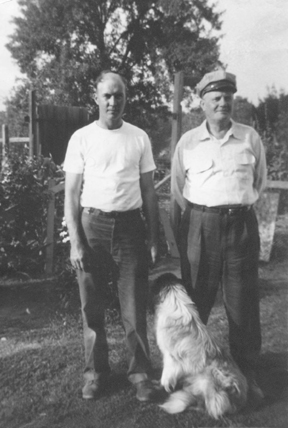 (At right, Eldridge with son Hugh in the garden at 808
Adell.) Joe’s inability to stay sober and keep a job led him to even start stealing from his parents. His
mother no longer left her personal cash anywhere around the house. She took to hiding it a little coin purse
which she kept tucked into her bodice. She also locked away the extracts in her kitchen because Joe would go
after anything with alcohol in it. Joe was not to be stopped. He raided the family freezer, taking out the meat
from the goats Eldridge had raised and slaughtered, and would sell it to whomever he could to get money for
booze. He would come staggering back home in the wee hours and be greeted by a locked door. Sometimes he would
make it around to the back before he collapsed into an unconscious heap. Other times, the neighbors would get a
show.
With Hugh gone entirely, Joe’s kids had even less positive guidance around them, and they now slipped
into truly out-of-control behavior. Their teachers came to dread having any student named Branson in their classes.
Ernest, the eldest, a
teen alcoholic, had such a propensity for violence that he was only saved from jail by entering the Air Force,
where the discipline gave him the structure he needed, as well as some sort of outlet for his aggression. One
hitch was not enough, though. He went back in, and only after serving as an ordnance disposal specialist in
Vietnam and seeing the carnage of the war did he contemplate sobriety. Gladys became pregnant not long after
she turned fifteen. Though she did manage to keep the relationship going long enough to have three, not just one,
child, she was not a fit mother. Drug use did not help. Ann became pregnant at seventeen and in the pattern
shown by her parents, had a child every year, though she managed to stop at four instead of six, though the
tally may have ended up that low only because of problems in her reproductive system, which soon led to
uterine cancer and a hysterectomy. The dysfunctionality of these three paled however compared to their brother
Blaine. There is no way to sugarcoat it: Blaine was a homosexual pedophile. He preyed on little boys.
In mid-1962, Joe died, a victim of the effect his behavior had upon his health. He had only reached forty-four
years of age. Eldridge was still only seventy, and yet he had outlived his own offspring. If there was any
karmic balance in play in this family saga, it is that Joe survived long enough to see what his failure as a
parent had wrought, and that by dying when he did, a level of peace could unfold. One, he was no longer around.
Two, at least by 1962, three of the four kids were in somewhat stable points in their lives, Ernest in the USAF,
Ann with her husband, Gladys with hers. Even Stanley Hathaway was doing well. At the time of Joe’s death,
Stanley and his fiancée were in the last stage of preparation for their wedding.
Unfortunately, that left Blaine and his mischief. At the time of his father’s death, Blaine was twenty-one years
old and was living in Los Angeles, but soon his life was in a shambles and he showed up again at 808 Adell. He
was there far too often over the span of the 1960s. He was in and out of trouble with the law, which not only
thrust more worry and stress into Eldridge and Clara’s lives, but swept them up in the economic fallout,
because they felt they had no choice but to offer compensation for the property losses Blaine’s victims
suffered. Had the old couple declined to do so, Blaine would have faced some substantial jail time. Eldridge
and Clara probably should have just let matters take their natural course. Blaine would ultimately spend much
of his life in prison and as far as can be determined, died while incarcerated. (That demise occurred in 1997
at the age of fifty-seven.) He seemed destined for that fate, but in the 1960s, Edridge and Clara maintained
hope he could be rehabilitated -- or at least believed they should act on his behalf no matter what. One would
hope they were unaware of the full extent to which Blaine had already crossed the line during his teens and early
twenties.
In 1965, Blaine committed a burglary. This proved to be a watershed moment. It was not his first such brush
with the law, and thankfully was a crime of property, not direct harm perpetrated upon a living person, but
nevertheless was an incident that cost Eldridge and Clara deeply. If not for that collatoral-damage aspect,
the scenario is almost laughable, and had the potential to serve as fodder for one of AM-radio celebrity Paul
Harvey’s “And Now, the Rest of the Story” anecdotes about the doings of truly stupid crooks. Blaine made so
many blunders his arrest was all but inevitable. His behavior
was so bizarre the judge would later interrupt the criminal proceedings long enough to have Blaine undergo a
psychiatric examination to determine his sanity -- or lack of it. Perhaps he was drunk. Perhaps narcotics
played a role. If not -- whoah! This is the story in a nutshell: During the early hours of 3 June 1965, Blaine
broke into the office of Coe Pump Company of San Bernardino. He went after the safe, trying to burn
the hinges off with an acetylene torch. He failed. The safe was too well built, and Blaine was an amateur with
the tool. Instead, he grabbed anything else that wasn’t nailed down, but might have some value assuming he
could find someone to fence the merchandise. His haul included an adding machine, an electric typewriter, an
electric drill, a bench grinder, a check protector, and an intercom system. But he had no vehicle, so he was
obliged to carry everything away on foot. He left such clear tracks that in the morning, two sheriff’s
detectives, Glenn Bowen and Robert Richardson, had no trouble figuring out that Blaine had proceeded to a clump
of bushes across the street where he had hidden some of the items. His route from there was plain. The two men
trudged along, eyes to the ground, and were reliably led to 808 Adell, a journey of about a mile. They arrived
at 9:20am, found Blaine lying placidly on his bed, and arrested him.
Eventually, either in the wake of the 1965 arrest or during the subsequent few years, Eldridge and
Clara lost their home, having no choice but to sell it to cover the cost of making up for Blaine. They moved
to 3312 Sepulveda Avenue. This was probably a rental. If not, having the deed didn’t mean much because they
had little or no equity and no time to acquire much during what remained of their lifetimes. Worse, the
parcel was so much smaller that Eldridge had no ability to recreate his magnificent garden and no room for a
goat pen. He planted a few trees and kept a few rows of vegetables going, but every day all he had to do was
step outside and he was reminded how limited his holdings were compared to what he had enjoyed for over half a
century.
Well into their seventies at the time of the relocation, Eldridge and Clara had more on their backs than
anyone of that age should have. By then, the younger generations should have been taking care of them, but
there was no hope of that, and plenty of chance just the opposite would continue to plague them. Clara at
least can be viewed as having earned that sort of wretched status, but in retrospect even she
is a figure to be pitied. It was an “if not one thing, then another” scenario. It’s a wonder both spouses
managed to survive into their eighties.
One bright spot in the gloom was that daughter-in-law Mary McMahan Branson became willing to let her
children visit Eldridge and Clara. While Joe had survived, Mary had been afraid he would be there drunk and
belligerent and she didn’t care to expose her little girls to that. As the 1960s went on, Eldridge spent many
an hour with Hugh’s eldest daughter, sharing gardening tips, telling her about old Quartzburg, and generally
just getting to hang out with a grandchild who recognized him for the nice old grandpa he
was. Clara did not take advantage of the opportunity to establish this sort of rapport. She still would
not forgive Hugh for having “murdered” her brother Vernon. Since Hugh was not around anymore, she
transferred her bitterness onto his offspring. This took a particularly cruel form with Hugh’s younger
daughter. Clara repeatedly aired the opinion that said girl was not Hugh’s biological issue, i.e. it
was Clara’s contention that she must have been the product of an affair her mother was having when Hugh
died, and that the affair was a cause of his suicide. Her story had no basis -- and in fact DNA tests done
in the
2010s have confirmed that the girl and her older sister are indeed Hugh’s progeny. But Clara spewed
her poison anyway. Hence, when the older sister visited Grandpa, the younger sister tended not to come
along because she did not want to encounter Clara.
Eldridge died of a pulmonary embolism 31 March 1972 at St. Bernardine Hospital in San Bernardino. He had held
on to his twenty percent undivided share of
his parents’ ranch until death. He had deliberately not filed a will, knowing that by forcing his estate
to go into standard probate, the value of his half of the community property would have to be split equally
among his grandchildren, and Clara
would be unable to cheat Hugh’s kids out of their portions, barring the possibility she could prove the
younger one was not a biological child -- which of course was something she could not orchestrate.
Having no choice, Clara (as a real estate agent) arranged for the share of the ranch to be sold in 1973.
Half of it was purchased by Horace Meyer, the rancher who had leased the acreage since the late 1920s, and
the other half was acquired by Eldridge’s surviving sister, Grace, increasing her portion
of the whole to thirty percent. As near as can be determined, the transaction was the last time there was
face-to-face contact between Eldridge’s family and any other part of the Branson clan.
Clara suffered a stroke in 1974 and was moved to a care facility in Inglewood, CA so that her baby sister
Reva Coffin, who had power-of-attorney over her affairs, could look in on her without making the commute to
San Bernardino. Clara died 6 October 1974 at that facility. She was laid to rest beside Eldridge and many of
her other relatives at Montecito Memorial Park, San Bernardino, CA.
Children of Eldridge Geary Branson with
Clara Elvira Jackson
Hugh Geary
Branson
Joseph Eldridge
Branson
For genealogical details, click on
each of the names.
To go back one generation, click here. To return
to the Branson/Ousley Family main page, click here.