Marguerite Ellen
Branson
Marguerite Ellen Branson, eldest daughter and second child of Joseph Branson and Ellen
Margaret “Ella” Geary, was born 31 December 1881 on her parents’ cattle ranch near Quartzburg,
Mariposa County, CA, a mining outpost a couple of miles north of the village of Hornitos. Her
home throughout her childhood was on that ranch. That said, in 1897 the ranch itself expanded as
her father bought out neighbors and relatives, and the family moved into a larger, newer house
on one of the newly-acquired parcels. Marguerite was seventeen by the time of that development,
and had already started earning her own money, but she came to know that home well,
spending much time living in it as a bachelorette, and later visiting a great deal, often for
weeks at a time, something that remained true throughout her twenties and thirties and including
the period after she had become a wife and had children and a husband tagging along with her.
Marguerite’s nickname was Maggie. This name appears only in a tiny number of sources, though. For
example she is listed as Maggie Branson on an 1896 souvenir card of the local elementary
school, Quartzburg District School -- where she was part of a roster of pupils composed largely of
relatives, future in-laws, and children of her parents’ in-laws. Otherwise her nickname is
known chiefly from the genealogical writings of her daughter Emily.
Marguerite distinguished herself academically, to the extent that Frank Albert Bondshu, the Mariposa
County superintendent of schools, arranged for her to pursue advanced studies after graduation
from Quartzburg. Accordingly, Marguerite took courses in the town of Mariposa -- higher in the
hills on the route to Yosemite Valley -- and then out in the Central Valley in the town of
Merced. Two years of that was more than enough to allow her to pass the state teachers examination,
achieving her goal of having a certificate to be an instructor at rural schools, which is another
way of saying, be her own boss as most such schools were too small to have more than one employee on
hand on any given schoolday. She proceeded into her profession in
Mariposa County. She even did so at Quartzburg School, where her younger twin brothers Ernest
and Eldridge were among her students, sitting side by side on a bench Joe Branson had constructed
and donated to the school. Because Marguerite did not go on to become a wife and mother right
away, she was able to pursue her career for the minimum six years needed to obtain a California
Teacher’s Life Diploma, freeing her of the need to periodically be re-certified -- this status
would come in handy down the line. Earning the Life Diploma was a feather-in-the-cap that her
younger sister Grace would also garner. Also, four female first cousins -- Lizzy Bauer, Eunice
Bauer, Emelia Bauer, and Inez Branson -- became rural one-room teachers, not just in the Mother
Lode but in other parts of California. However, Marguerite was at the forefront of this
wave, and could be said to have been the role model for the others.
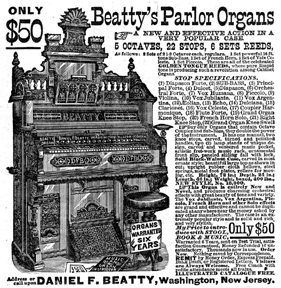 With the first money she earned as a teacher, Marguerite
purchased a pump organ from a Sears,
Roebuck & Co. catalog. The item was shipped from Chicago by train to the nearest depot, which at
that Turn-of-the-Century juncture was in Merced. Her father hitched up his team, got in his new
spring wagon, and made the eighty-mile round trip to fetch it. The organ remained in the parlor of
Joe and Ella’s home for decades, Marguerite chosing to leave it there rather than transport it to
her subsequent places of residence. It can be seen in the background of a scene in the silent
film The Western Musketeer, which was filmed at the ranch in 1921. (The advertisement
shown at right is from an 1882 source, but it demonstrates what pump organs of the era looked like.
Marguerite probably made her purchase based upon seeing an advertisement similar to this
one.)
Among Marguerite’s postings was the one-room school at Pleasant Valley on the Merced
River not far from where her grandfather John Sevier Branson and his partners had once mined in
the 1850s and 1860s. Articles in the Mariposa Gazette confirm she was the teacher there
for the 1902-03 term, and she might have spent a small number of additional academic
years there. It was an out-of-the-way assignment. Pleasant Valley was an even-more-lightly settled
part of Mariposa County than Quartzburg, though it did have a store and a post office -- and the
school of course. The little hamlet soon gained a degree of
attention due to to the construction of the Yosemite Valley Railroad. Pleasant Valley was one of
the spots where the tracks crossed the Merced River. In 1908 or 1909, the community was renamed
Varain after prominent local citizen John Varain. The hamlet did not survive very far into the
Twentieth Century, however. The creation of Lake McClure indundated it, erasing it from view.
Marguerite was fortunate in that sense that she did not dwell there long enough to develop much of
a bond with the locale.
All the children of Joe and Ella turned out tall and robust. This was a blessing for the four
boys, who were uniformly handsome and manly in their young adulthood. For Marguerite and her
sister Grace, the legacy was more problematic, particularly in the case of Grace, who became
stout as well. In an era when women typically married no later than their early twenties, the
sisters remained single past their 25th birthdays, meaning they were inevitably teased about being
old maids. It did not help, of course, that they reached their prime courting years just as many of
the young men they knew were abandoning the county in order to find a means to make a steady
living, the gold industry no longer being a reliable avenue to do so. Happily, in the earliest
portion of the Twentieth Century there was still enough happening locally that other young men
were arriving -- a counter exodus. One of them was LeBaron Guy Thistle, known as Guy.
Guy’s initial reason for coming to Mariposa County was not a happy one. He had been a co-worker of
Marguerite’s twenty-two-year-old brother Alvin Arthur Branson at a copper mine in Bisbee, AZ when
Alvin had fallen down the mine’s elevator shaft on Christmas Eve, 1905, at the cost of his life.
Guy decided to attend the funeral. When he got a look at Mariposa County, he found it more appealing
than southernmost Arizona, and chose to stay. Another motive may have been that Marguerite caught his
attention at once. Not long after the wake, which was held in the parlor of Joe and Ella’s home --
the parlor that contained the pump organ -- Guy fell into the habit of showing up at the ranch to sit
with Marguerite in that very same parlor, that being the room of the house perceived as the appropriate
venue for the courting of its resident young ladies. Things proceeded fairly quickly on the romantic
front -- though not in the rush typical of a set of younger sweethearts -- and the two were wed 16
January 1907 at the ranch. Grace Branson served as bridesmaid, and eldest brother John Joseph Branson
was best man. Reverend C.W. Long presided.
None of Guy’s family members made it to the ceremony. That’s because he was from
eastern Canada and it was impractical for his kinfolk to get there. Guy had been born 14 October 1872
in Victoria Corners, New Brunswick. He was the eldest of the many children of Oscar William Thistle and
Elizabeth Euphemia Bedell. Among other things, that means Marguerite married a man nearly ten years
older than she. By all accounts, this was not an issue and they enjoyed a good match. It did mean
they were eager to get started on a family. Daughter Alice Marguerite Thistle was born 11 November
1907, not quite ten months after the wedding.
By the time he became Marguerite’s husband, Guy had lived in the United States for many years, having
left Canada as a young man, but he had not yet become a citizen. That led to a bizarre circumstance. By
marrying him, according to the poorly-written citizenship code of the era, Marguerite became a
Canadian -- even though she had been born in California of a mother native to California and a father
whose American heritage went back to the mid-1600s (and perhaps even earlier than that, if
the rumors of a bit of Indian ancestry have any validity). Marguerite in fact never once in her entire
lifetime stepped outside the boundaries of the state, and by extension, never was within Canada for even
a single instant. And yet she was obliged to file for naturalization and go through all the associated
bureaucratic folderol in order to regain her citizenship. Even more ridiculous, Alice eventually had
to do so as well!
The newlyweds settled at Mt. Bullion mining outpost, where Guy was employed at the Princeton Mine. They
remained there for about a year, and were still there when Alice was born. Soon they moved to the village
of Mariposa. That community continued to be their official place of residence for nearly a dozen years.
Second daughter Emily Helen Thistle was born in Mariposa in
early 1912, and third and final child Imogene Emelia Thistle in early 1915. No boys. In that respect,
Marguerite was like the majority of her siblings, who produced female offspring or none at all. The only
exception was her younger brother Eldridge, who fathered two sons. Marguerite was however the only one
of Joe and Ella’s kids to have more than two children.
In approximately 1914, Guy’s youngest sister Alice Elizabeth Thistle came to Mariposa County.
This was not a sibling Guy knew well, as she had been born after Guy’s departure from the land of his
birth, but the bond would from this point grow strong. Alice worked as a teacher in Mariposa County
schools. She would go on in 1920 to marry Marguerite’s brother Ernest. In other respects, Marguerite
and Guy’s web of friends, family, and neighbors shrank during the 1910s. The gold-extraction
industry was not just floundering, it was now in full collapse, and the county was emptying out.
Marguerite and Guy stuck it out for a while. Guy resorted to a variety of occupations in his attempt
to make enough money to pay the bills. Guy was a determined breadwinner but he had to scramble to earn
enough. Over the course of the dozen years the family was based in Mariposa, he tried all sorts of
things, pursuing some of those occupations simultaneously. He was briefly
a stage driver (working the route from Mariposa to Yosemite via Bagby, a narrow, twisting dirt track
riddled with hairpin turns), a telegram deliveryman for Wells Fargo, a skating rink manager, a drugstore
clerk, a mail carrier. In the early 1910s he sold New England Mutual life insurance policies. He
spearheaded the founding of a telephone exchange in Mariposa and then sold telephone equipment to
local homeowners and businesses. He was a real estate agent -- alas at a time when few buyers were
interested in acquiring Mariposa County property. During World War I, he earned a bit of additional
income serving as a draft registrar.
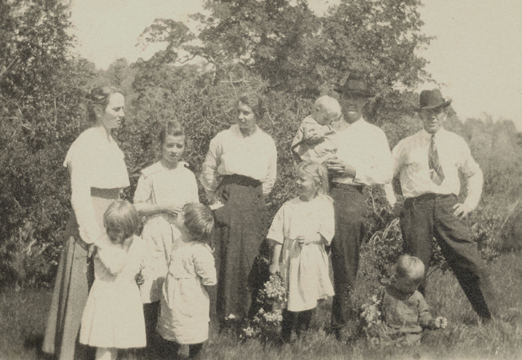
Shown here are some of the participants in a gathering of the Branson family in 1920. Marguerite is
on the far left, Guy Thistle on the far right. The two older girls are Alice and Emily Thistle. Imogene
Thistle is one of the two small girls -- but not the one closest to her mother. Marguerite has her hand
on the shoulder of her niece Marian Ruth Warner, daughter of her sister Grace. The other two adults are
Marguerite’s brother Eldridge and sister-in-law Clara Jackson Branson. Eldridge is holding younger son
Joseph Eldridge Branson while three-year-old son Hugh Geary Branson plays among the wildflowers.
Finally, as had so many others before them, Marguerite and Guy left the Mother Lode region. They did
manage to
hold out until 1919, which was later than most, but finally they needed to look elsewhere in order to
build a future. They settled in the city of Fresno, residing for a few years at 2821 Kern Street and then,
in approximately 1923,
finding a lasting situation at 559 Cornell Avenue. Guy devoted himself more fully to his insurance-agent
career. However, income from Marguerite’s teaching gigs was important, so she took a job as a first-grade
teacher at Lincoln Elementary School about a year after the family arrived. Marguerite wanted to keep
Imogene with her and to make that possible, placed her in first grade even though she was kindergarten
age. (Lincoln School probably did not even have a kindergarten class at that juncture.) As the girls grew
older, Marguerite taught more and more, doing so not only in Fresno County but also in Madera County. This
of course meant she was less able to tend to her role as a homemaker. The challenge was especially
tricky when Marguerite taught summer school sessions. At such times the girls would often spend a great
deal of time at the Quartzburg ranch. This would again be true when they were teenagers due to Marguerite’s
declining health. The three girls loved the ranch and adored their grandparents. This degree of affection
for the place, and for Joe and Ella, was paradoxically not universal. Grace Branson refused to leave her
daughters, Marian and Josephine Warner,
with Joe and Ella overnight because she felt they were too mean -- Joe too coarse and intimidating,
and Ella too strict. Joe and Ella do seem to be the
sort of people who played favorites with their children and grandchildren, though why this was so is
difficult to understand. The Thistle girls clearly fell on the old couple’s good side.
Marguerite went through an extended period of frailty resulting from leukemia, an affliction that
ultimately took her life. She died 9 May 1933 in a Fresno hospital at the all-too-young age of
fifty-one, not yet having known the joy of becoming a grandmother as her children were only just
reaching adulthood at the time of her demise, and even Alice was as yet unmarried. The funeral and
burial occurred four days later. Alas, Guy did not survive her long. He passed away 7 February 1934.
(This date was shown here as 8 March 1934 until
corrected in August, 2014. Apologies. The wrong date was due to a transcription error made by Emily
Thistle Christensen in the early 1980s.) The shared grave is at Belmont Memorial Park in Fresno.
Child of Marguerite Ellen Branson with
LeBaron Guy Thistle
Alice
Marguerite Thistle
Emily Helen
Thistle
Imogene Emelia
Thistle
For genealogical details, click on
each of the names.
To go back one generation, click here. To return
to the Branson/Ousley Family main page, click here.