Hugh Geary Branson
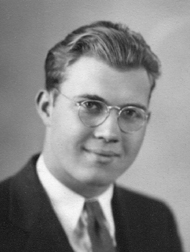 Hugh Geary Branson, son of Eldridge Geary Branson and
Clara Elvira Jackson, was born 17 February 1916 in San Bernardino, CA. He grew up in San Bernardino
and resided there for his entire life aside from momentary intervals away. In fact, for a significant
portion of his adulthood his official residence was his childhood home at 808 Adell Street, a
triple-sized lot that his parents continued to own until the 1960s.
Hugh’s upbringing was not as happy as it should have been. His mother played favorites and early on
she decided it would be her baby boy Joe -- Hugh’s slightly younger brother Joseph Eldridge Branson -- that
she would pamper. Clara’s dissatisfaction with Hugh rose to an extreme when he was eighteen years old. In
October,
1934, male Jackson-clan family members went on a family hunting excursion. Coming to a fence, the group
began clambering over. Hugh leaned his rifle on the fence, forgetting to put the safety on. The rifle
fell over and discharged. The bullet struck his uncle Vernon George Jackson in the abdomen. In those
pre-antibiotic days, a belly wound was a death sentence. Inevitably the injury turned septic, and
Vernon died. Vernon himself did not blame Hugh, knowing it was an accident stemming from Hugh’s
inexperience as a hunter. But it was Clara’s lasting opinion that Hugh had murdered her brother.
Eldridge had always tried to do what he could to balance out Clara’s favoritism, and continued to
do so after the 1934 incident, but Clara’s enmity for her eldest son was now too profound to blunt.
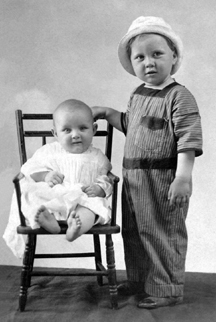 (At right is Hugh with baby brother Joe in 1918. Clara
dressed Hugh in the same clothes nearly every day, judging by the many images of him from that era, all
showing him decked out in the same outfit.)
The awful incident involving his uncle occurred while Hugh was still in high school. He was of an age that
one has to wonder why that was the case. Under normal circumstances, by the autumn of 1934 he would have
already graduated along with his peers the previous June. That had not happened. He attended San Bernardino
High for one more semester, graduating at the end of January, 1935 as part of the so-called mid-winter
class. He got his diploma barely shy of his nineteenth birthday. The delay may be an indicator of how
much turmoil he was dealing with at home even before the hunting accident had brought things to
an extreme.
Given the sort of dysfunctionality within the immediate family, one would think Hugh would have
left home as soon as he reached adulthood, and probably have left San Bernardino. But he stayed. He was
twenty-seven before he finally lived anywhere but at 808 Adell Street. Hugh’s attitude toward his mother
seemed to be that he was always “trying to make it up to her.” He tried to be the dependable one of the
family of his generation, carrying on the good example set by his father. Ultimately this was his ruin.
His mother was happy enough to take Hugh’s support, financial and otherwise, and offer nothing much in
return. This became the mode followed by Hugh’s younger brother. Joe chose the opposite life path from
Hugh. Joe failed to hold down a steady job, he sired children he failed to look after with either money
or emotional nurturance, and he became an alcoholic who at his worst would steal cash from his parents or
help himself to their supplies and possessions to pawn for money to buy more booze.
Hugh did not always hold down a full-time job, either, but it was not from lack of desire or ability. He
came of age during the Great Depression, and jobs were hard to come by. However, during the late 1930s and
the early 1940s he managed to find employment for significant stretches with the San Bernadino City Parks
Department and Santa Fe Railroad. The latter was one of the prominent employers of the area because the
firm used its San Bernardino yard as one of the prime places to build and repair its rail cars. Hugh’s
stints were not necessarily consecutive; judging by old directories and voter registers, he went back and
forth between these two employers and may even have occasionally worked for them simultaneously in order
to get enough hours.
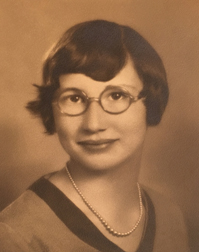 Hugh was married twice. The first wedding occurred in 1944. He
probably had been acquainted with his bride-to-be for some years, perhaps through Masonic lodge social
activities or by encountering her while getting his teeth cleaned while she was employed as a dental
assistant at the office of San Bernardino dentist W.E. Bedford. She was Janet Estelle Lovell (shown at
left in late teens), daughter of shoe salesman Edmund Henry Lovell and Grace Gertrude West, born 19
October 1915 in Brockton, Plymouth County, MA. Her parents were natives of Plymouth County, raised in the
Abington/Whitman area near Brockton. Edmund and Grace had moved in the 1920s to California and had settled
in Pasadena before the end of the decade, in time for Janet to attend high school in that city, and then
go on to nursing school at Pasadena City College. As an only child, Janet learned to be independent.
A measure of her nature is apparent in old directories and voter registers in the way her maiden name
regularly appears as a middle name during her married life. Her in-grown tendency for self-reliance may
have been furthered by the death of her mother when she was an adolescent.
Janet arrived in San Bernardino in 1937 and went to work for Dr. Bedford. She remained single for three
years, then wed Rex Albert Klinker 14 September 1940 in Las Vegas, NV. He was in charge of Montecito
Memorial Park in nearby Colton -- the very cemetery where Hugh and his immediate family members would
eventually be buried. Thanks to his city parks job as a tree trimmer, Hugh may have had a passing
acquaintance with Rex. Ten months after Janet and Rex became husband and wife, Janet gave birth to
fraternal twins John (Jack) and Joyce. Unfortunately they put in their appearance nearly four months
after the
death of Edmund Lovell. Janet’s father therefore never got to see his grandchildren, though he at least
had the pleasure of knowing his family line was about to expand. Another unhappy turn of fate is that
Janet and Rex’s marriage fell apart. Rex was twenty-one years Janet’s senior and there was the
complication of his ex-wife and their teenaged son. In December, 1943, Janet sued for divorce. She
and the twins retained the home at 3063 Pershing Avenue, and 3063 Pershing was where she and Hugh were
for the duration of their spousal relationship. Unfortunately their marriage was almost precisely as
brief as Janet and Rex’s had been.
No children resulted from Hugh and Janet’s union. This was probably for the best. Joyce recalls Hugh
as having been mean to her and Jack, for example insisting they not dirty up their shoes on trips to
the desert, which meant they had to go barefoot even though that exposed them to the discomfort of
stepping on sharp rocks or being poked by puncture-vine burrs. Joyce also recalls her mother and Hugh
arguing a lot -- though perhaps this was more typical of their final months together. Hugh did not drink
as much as his brother did, but he did indulge, and Janet was so fond of alcohol she would ultimately
die of cirrhosis of the liver at only forty-three years of age. While times were decent, the couple may
have discussed the possibility of Hugh adopting the twins, particularly following the 1945 death of Rex
Klinker. There is no sign that this prospect came to fruition. Lack of harmony and stability probably
ensured things never got as far as the filing of paperwork. Janet
had been quick to rid herself of one spouse who wasn’t supplying her with the kind of life she wanted.
She was quick to do it again. Life as Mrs. Hugh G. Branson became too fraught for her. In August, 1947,
she and Hugh asked a judge to declare an annulment. Janet found a replacement husband just as quickly
as she had before, marrying Gerald Cletus Trowbridge in February, 1948.
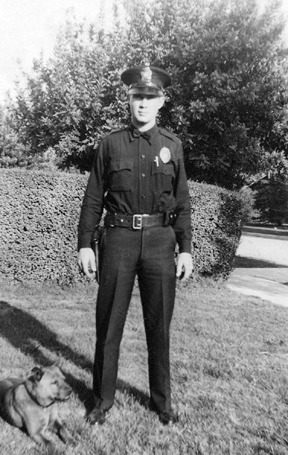 Hugh was no doubt doubly disappointed with the way
things worked out, because he had entered into his relationship with Janet on a particularly high note.
He was riding the high of a proud personal accomplishment. In 1943, he had succeeded in becoming a police
officer. (He is shown at right in his uniform. This image probably dates from 1943.) With so
many young men serving as soldiers, the local police department had plenty of job openings and Hugh
had been able to take advantage of that. The war even provided a distraction for his mother, who
organized lodge gatherings in support of the troops and wrote lyrics for patriotic songs. Finally out
from under Clara’s thumb, with a pair of step-kids to help forge the sense of a domestically-balanced
household, Hugh had a real shot at making a decent life. Hindsight says he should have moved away from
San Bernardino; that might have allowed his bond with Janet and her kids to be nurtured and might have
kept open the door to his personal contentment.
Unfortunately, things blew up in the post-war period. Among other things, Hugh lost his job as a
policeman. Perhaps the return of the soldiers caused him to be laid off. More likely, the stresses
wrought by Joseph Eldridge Branson had some sort of contaminating effect, prompting Hugh’s
acquaintances, employer, and even his wife to say they wouldn’t have anything to do with Hugh if it
brought them within range of Joe. Certainly Joe’s own immediate family was embroiled in the midst of
a toxic level of upheaval. Hugh’s sister-in-law Iva Laster Branson got fed up with his husband’s
drunkenness, lack of financial responsibility, and to the burden of all the children -- six babies
in six years starting in 1938 when Iva had been only sixteen years old. She ran away. It was so bad
she did not take the kids. The only way to escape was to leave them behind and make a clean break.
Since Joe was incompetent and unsuited to be a parent, this meant suddenly Clara and Eldridge Branson
were burdened by a household full of very young grandchildren. And it was a wild set of grandchildren,
given the insecurity of the home life those kids had experienced to that point.
Hugh undoubtedly tried to help. It was in his nature. His happiness would have been better
served if he had done what Iva had done, and simply removed himself from the scene. But Hugh took on
some of the burden. This did not sit well with Janet. She had never been a patient woman. Now she had
every reason to say, “This is so not my problem.”
As a result of the split, Hugh moved from 3063 Pershing back to 808 Adell Street. He became a carpenter.
Unlike the police officer position, this was an on-and-off profession, but it was the post-war period
so at least the flow of construction projects was reasonably steady -- an improvement over the 1930s.
Unfortunately Hugh tended to obtain one-person gigs doing repairs for brief intervals, rather than
scoring on-going regular hours with a construction company. Even more unfortunately, at home he was
embroiled within the chaos of his family.
With all he had to deal with, a few years went by before Hugh managed to carve out any time for romance,
but finally he managed it, leading to a wedding 20 September 1952 in Las Vegas. Hugh’s new bride was Mary
Elizabeth McMahan, born 14 August 1919 in
Barry County, MO to parents Thomas Newton McMahan and Euretta “Tibbie” Lee. Early in her childhood the
family arrived in San Bernardino. In her teens she wed John Henry Shadwick, with whom she had a son, John
Thomas Shadwick. She was a widow when she became involved with Hugh. Upon their union, Hugh made plans to
adopt young John. Due to Hugh’s untimely death the adoption was not finalized, but the boy went by the
surname Branson for a number of years. Hugh and Mary settled into a house at 1368 Oregon Street. That is
where they were
residing in 1954 when they became parents together. Hugh at last had biological offspring. Another
baby was born the following calendar year. The latter was a child Hugh would
never see. Hugh committed suicide 14 March 1955. He was not yet forty years old. His body was buried at
Montecito Memorial Park, San Bernardino, CA, where his parents would eventually be laid to rest as
well.
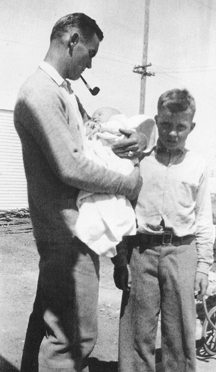 (Shown at left is Hugh only months before his death,
holding his baby. Stepson John stands beside him.) From an outside perspective, we can never know precisely
what triggered the suicide. It may have been impulsive. He poured strychnine down his throat. It’s possible that
if he had not had a box of rat poison around then and there, available simply by going down to the basement, he
might have weathered the crisis and survived for several more decades. He had reasons to live -- a wife, a baby,
another on the way. On the other hand, he had been dealing with so much for so long, it is understandable that
he would want to kill himself. His mother was a nightmare. His stepson Tommy was looked at with concern by his
teachers at school simply because he was going by the name Branson and thanks to Joe’s kids, teachers had
learned to be wary of having any pupil in their classes who had that surname. Tommy would in the course of
time be molested by his cousin Blaine Allen Branson, who even at a young age was firmly on his way to becoming
a homosexual pedophile. Tommy would spend a lifetime struggling with the psychological effects of that. Hugh
would never know of the long-term scope of this matter, but if he had become aware of any nascent shred of it
back in the spring of 1955, he would have been devastated to think he had played a role in Tommy’s suffering
by becoming his stepfather.
An alternate explanation for Hugh’s suicide is contained in a 1979 family-history memoir written by Hugh’s first
cousin Emily Thistle Christensen. According to her account, a doctor in 1955 told Hugh he was about to go
completely blind due to reaching the final phase of a process that had started over twenty years earlier. The
scenario as outlined by Emily: A football game was about to take place at Hugh’s high school during his time
there. The event was to feature a large bonfire. Wood was brought to the field and stacked in place a day prior.
A rumor
went round that guys from the rival high school planned to sneak onto the campus during the night to light the
fire prematurely. Hugh was part of the students who were guarding the stack when a carload from the rival school
drove past and the car’s passengers shot at the sentries with BB guns. Pellets hit Hugh in both eyes. Doctors
could not save the vision in one eye, but until 1955 Hugh had been able to get by using the other one, but now
even that one was going bad. Emily also claimed that Hugh had accomplished his suicide using a capsule of
strychnine he had pilfered from the evidence locker of the police department, where it was part of the seized
stash of a drug-dealer suspect.
Emily’s account is not credible. For one thing, drug addicts don’t get high on strychnine! It is deadly poison
with no pleasant side effects, and there would not have been any in the evidence locker to steal even assuming that
Hugh planned his suicide years in advance. But more to the point, there is no independent verification that Hugh was
ever blinded in the first eye, much less that he had been hit
simultaneously in both eyes while guarding the bonfire stack at the football field. If he had not had 20-20
vision in both eyes, or very close to it, he would not have met the physical fitness requirements for entry into
the police academy. There are occasional individuals who remain working cops with damaged eyesight, but only if
their vision becomes impaired after they are already members of the law enforcement community. Emily’s memoir has
other details wrong such as the name of the baby born in
1954, and Emily says that baby was Mary’s from her previous marriage. She also has various other details wrong
about the whole Eldridge Branson clan. It seems clear Emily was not working from
direct knowledge of her San Bernardino relatives, and in the case of the suicide, had been supplied with a
fabricated story. Whoever talked to her probably preferred to invent a suicide
scenario that would engender sympathy, as would be the case had Hugh actually been a young father going blind
because of the idiocy of a high school kid with a BB gun. Sounds much better than, “He got really depressed
and ate rat poison.”
Clara reacted to the death of her eldest son in a predictably loathesome way. She claimed there was a suicide
note -- one that supposedly the police took away and did not return. Clara said Hugh had killed himself because
he had learned that the baby in the womb was not his. Even Clara’s own siblings and siblings-in-law questioned
the credibility of this contention, but Clara stuck with the story. Over the years to come, she consistently
treated Hugh’s posthumous child as unrelated to her in the biological sense, except when forced to do otherwise,
as when Eldridge died intestate and probate rules required Clara to divide up the estate equally among the
grandchildren, and not to deny her youngest grandchild’s share unless she had proof of the non-relationship. Of
course, Clara’s accusation was untrue. A pure fiction created out of hate. Nevertheless the venom still had a
poisoning and hurtful effect. Even fifty-eight years after Hugh’s death, the two children, for the sake of their
own healing process, felt motivated to objectively demonstrate that their grandmother had lied, so the siblings each
submitted DNA samples to AncestryDNA. The results showed them to be full siblings. Further, when the test results of
Branson-side second cousin Dave Smeds became part of the database in March of 2014, the relationship of him to each
was unequivocally that of second cousins. Clara Jackson Branson has been dead for forty years and cannot be confronted
with this proof, but at least it is now on-the-record as far as posterity is concerned.
 Because of the San Bernardino venue, and the reluctance of
Clara’s in-laws to be around her, Hugh is one of the members of the Branson-Ousley clan who was almost invisible
as far as the main group was concerned. In one respect, that is ironic, because he was among the most “Branson-like”
of all of the great-grandchildren of John and Martha when it came to his favored means of community outreach. The
Bransons of Hornitos often funnelled their social lives and charitable efforts (which includes such things as helping
out neighbors with major understakings such as weddings and funerals, not just charity in the sense of donating to
worthy causes) through Masonic lodge activities. Hugh’s grandfather Joe Branson had been a Mason of the 33rd Degree,
which is essentially as full-tilt Mason as it gets. Joe was still alive when Hugh began his involvement in the San
Bernardino chapter of The Order of DeMolay, and was proud of him for it. Joe would have applauded again when Hugh
proceeded in due course into the adult lodge. It was Hugh who inherited his grandfather’s various lodge publications,
including the 1898 volume Fifty Years of Masonry in California, Vol. I by Edwin Allen Sherman, a book that
contained a photograph of Joseph Branson as a member and officer of Hornitos Lodge No. 98.
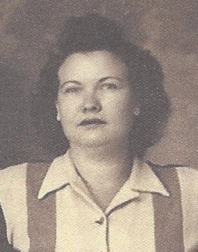
Mary McMahan Branson (shown at right) went on to
raise her three kids in San Bernardino. Her third marriage occurred in the
1950s but was annulled, in part because Mary saw he couldn’t control his drinking, but it also may be that
the groom hadn’t actually divorced his estranged wife, with whom he subsequently spent the rest of his
life. Mary’s fourth marriage (or third, if we don’t count the annulled one) was a successful and lasting
one to Charles Eugene “Chuck” Cummings. It began in 1968, by which time her son John was grown and her other
two children were in their early teens, so the development came at the conclusion of a substantial period spent
as a
single mother. Her means of supporting herself included being a foster mother and working for ten years as
an office manager for the Salvation Army. The latter part of Mary’s life was spent in San Bernardino’s
eastern suburb of Highland. Widowed yet again in 1981, Mary passed away 1 December 1997 in Highland. Her
remains were laid to rest at Montecito Memorial Park with those of Chuck Cummings.
As mentioned, Janet Lovell married Gerald Cletus Trowbridge at the beginning of 1948. A widower, he was the
manager of Grapette Bottling Company in San Bernardino. Gerald adopted Jack and Joyce, who took the Trowbridge
name. However, the union turned out to be another brief one. Gerald would eventually have far better luck with a
third wife after he moved back to his original stomping grounds in Indiana. Meanwhile Janet and her kids took off
for Honolulu at the beginning of 1951, and that was where Janet spent the few remaining years of her life before
the cirrhosis claimed her. She married again circa 1952 to James Linton Duthie, who had moved to Oahu during
the war years. This led to the longest marriage Janet was ever part of, but sad to say it barely out-paced the
others, lasing only about four years because James wearied of her alcoholism. Janet wed again in 1957 to
Carl Edward Beckwith -- a former pressman famous for his role in the production of various newspapers devoted to
the African-American community -- but they did not have much time together because she passed away in May, 1958.
Children of Hugh Geary Branson with Mary Elizabeth
McMahan
Details of Generation Five, the great-great-grandchildren of John Sevier Branson and Martha Jane
Ousley, are kept off-line to guard the privacy of living individuals. However, we can say Hugh’s
(biological) descendants consist of two children plus a grandchild who was raised outside the family.
To go back one generation, click here. To return
to the Branson/Ousley Family main page, click here.