Mary Juanita Seay
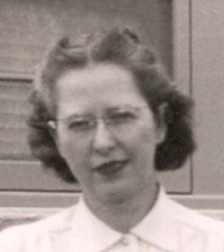 Mary Juanita Seay, third of the three children of Lulu Fay Brown
and Edgar Gardner Seay, was born 20 March 1913 in Texarkana, Miller County, AR, where her father had
recently become the pastor of College Hill United Methodist Church. When Mary was less than one year
old, her father was stricken by polio. His condition worsened and he passed away before Mary reached
two years of age.
Lulu did not remarry, but carried on as a single mother. When Mary was quite young, Lulu moved herself
and her offspring to Arkadelphia, Clark County, AR, and that is where Mary grew to adulthood. Mary did
not get to experience the “family all around” circumstances her mother had known as a child. Aside
from the occasional boarder, the individuals dwelling in the home consisted of Mary, her mother, and
her older brother Edgar William Seay. Lulu had given birth to one other daughter, Margaret Seay, but
poor Margaret had died in early infancy in 1911, and Mary never got the chance to meet her, much less
have a relationship with her.
Once Mary was old enough that she was in school for a good chunk of every weekday, Lulu felt she had
enough time available to take up some sort of career. She chose to become the owner and proprietor
of a florist and nursery business. Many of the plants she sold were raised within the family’s own
greenhouse. As Mary grew up, she helped out more and more, at first with simple tasks like watering,
and eventually more sophisticated contributions such as customer interaction. As a teen, Mary probably
spent less time socializing than her classmates did in order to participate in the family venture.
In the summer of 1928, when Mary was fifteen, her brother moved to Little Rock to work for Command-Aire,
Inc., an aircraft manufacturer. However, he would be laid off when the stock market crash of 1929 forced
Command-Aire to downsize -- the company would within two years go out of business entirely. Edgar would
continue to live with his mother and sister for a further five years. He set up a workshop in the attic
above the greenhouse and constructed parts for model airplanes to fulfill the hundreds of orders he had
accepted at aircraft shows or obtained via a former co-worker who acted as a sort of sales agent. Mary
assisted her brother by doing some of the painting while he concentrated on the carpentry and engineering
aspects.
At the beginning of 1935, Edgar moved to Dallas, and as it happened would continue to reside in the city or
its immediate vicinity (mainly in the suburb of Irving) for the rest of his very long life. Lulu and Mary
chose this juncture to finally leave Arkadelphia in favor of Little Rock. The fact is, whether Mary chose
marriage or a career as her personal destiny, Arkadelphia was too small to present her with much in the way
of opportunity. The change of venue produced results in short order -- and it was the romance-and-marriage
scenario that won out. Mary became acquainted with Paul Russell Abel, a son of Robert Carl Abel and Margaret
Dotts, Paul had been born 19 January 1915 in Shannon City, Union County, IA. The pair didn’t need long to
decide they were meant for each other. The wedding took place 8 December 1936 in Little Rock.
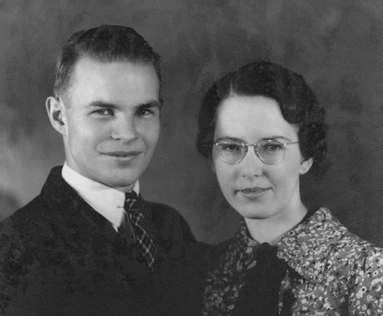 During his upbringing, Paul (shown at right with Mary
in the year 1938) and his family had moved quite a number of times. His father had been a mechanic and a
salesman of auto parts whose job frequently required the whole household to relocate. Over the course of
his childhood, Paul had become familiar with many parts of Iowa, as well as Chicago, IL and then Arkansas.
He and Mary would pursue a considerably more stable lifestyle. It is accurate to say that over the course of
the entire marriage, they only ever called two places “home.” The first of those locales was Vicksburg, MS,
where they moved as newlyweds so that Paul could take a job in the sales department of a candy and
packaged-food wholesaler.
Conscious of the hard economic times they had experienced as part of the generation that finished coming of
age during the Great Depression, Mary and Paul did not have kids at first. It was a full five years before
they got down to business and conceived a child. They didn’t waste any time doing so again, though. The
result was two sons -- all the offspring they would ever have -- both born in the midst of the years the
United States was embroiled in World War II.
As for the war, it was the great driver of destiny of those times, and Paul could no longer wait on the
sidelines. In early November, 1943, only a matter of days after the birth of his second son, he enlisted in
the Navy.
The Navy mustered out a great many of its young men on Pearl Harbor Day, 1945, whether or not they had
reached the end of a standard term of enlistment. Paul was part of that throng. He would go on to serve in
the Navy Reserve for several years, but he did not take up that obligation until the spring of 1947. In the
meantime, Mary and Paul were able to reestablish themselves as a civilian couple. At first they did so in
Vicksburg, but in the late 1940s, Paul received an offer to manage the newly-built Shawnee Mills Wholesale
facility in Elgin, TX, a suburb of Austin. The couple moved, and quickly found they liked Elgin a great deal.
They would continue to be residents of the immediate area for the rest of their lives, purchasing their first
home there two years after their arrival. After a small number of further changes of address, they found a
piece of property they particularly liked, upon which they had a house built specifically for them. Over the
years they made many improvements -- in fact, they were in a sense forced to do so in that when they first
acquired the lot, curbs did not exist along the street side, and their driveway was made of dirt.
In the first part of the 1960s, both sons went off to Southwestern University. The eldest, after time away in
his twenties, returned to Elgin and became a horse breeder and cattle rancher, remaining in the area for good.
The other, after a Navy career spent largely in Japan, became employed by Exxon and variously resided in such
disparate locales as Texas, Wisconsin, Wyoming, and Australia. Both married while in their twenties, and both
became fathers. Mary thereby became a grandmother, though because she herself had not become a mother until she
was on the cusp of turning thirty, she was in her fifties before her first grandchild was born.
In middle age, Mary was not only one of the key relatives looking out for her own mother in her last years,
but also played this role for her aunts Ethel Brown Cannon and Ada Brown Luton, both of whom were like Lulu
in that they had been widowed young and had never remarried. Mary was also an important part of the life of
her first cousin Hazel Cannon Rodgers. Mary was in effect Hazel’s heir at least in terms of family memorabilia,
though ultimately did not personally fulfill that duty because in the long run Hazel survived Mary by a few
months despite being eight years her senior.
Mary’s health declined early by the standards of the Martin-Strader clan -- she was only in her seventies when
she was obliged to enter a rest home. She passed away Sunday, 2 September 1990 in Austin. Her remains were
interred 5 September 1990 at Elgin Cemetery. Paul survived her by nearly four years. He remarried in the summer
of 1991, but then perished 1 August 1994 only three years into that union. His second wife, though well into
her nineties, still survives as of 2019.
Descendants of Mary Juanita Seay
and Paul Russell Abel
Details of Generation Five -- the great-great-grandchildren of Nathaniel Martin and Hannah Strader --
are kept off-line. However, we can say Mary’s line consists of two children, three grandchildren, and
five great-grandchildren. (This tally omits two step-grandchildren and their progeny.)
To go back one generation, click here. To return to the Martin/Strader
Family main page, click here.