Lulu Fay Brown
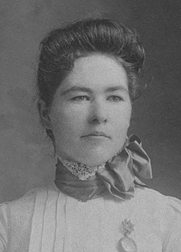 Lulu Fay Brown, fourth of the five children of Emma Ann Martin
and Cullen Penny Brown, was born 11 October 1885 in West Plains, Howell County, MO. She and other
family members pronounced her first name as “Loo-luh,” which led to her name being recorded in certain
public records -- and on her gravemarker -- as Lula Fay Brown.
The family had come to Howell County two years before her birth. It was a temporary sojourn. Her father
had been hired to establish a large lumber mill, and so he had brought his family there for the duration
of the project. Lulu’s birth raised the number of kids to three, though it would have been four if not
for the early death of Lulu’s sister Edna Brown in 1879 from diphtheria. Her surviving sisters
were Lena, age nine when Lulu was born, and Ethel, nearly five years Lulu’s senior. In 1886 (or about
then), the Browns went on to Kansas City, MO where Cullen was involved with another project. Then at the
end of the decade a gig brought them to Fort Smith, Sebastian County, AR. During that stay, Lulu’s
younger sister Ada was born. Finally, though, the family returned to the residence they had kept throughout
their wandering. “Home” was Martintown, Green County, WI, where her mother had been born and raised. Emma
and Cullen owned one of the main houses associated with the estate of her parents, Nathaniel Martin
and Hannah Strader, founders of the community. Once back, Emma and Cullen and their girls stayed put until
the late 1890s, at which point Lulu was entering her teens. Thanks to that stable interval, Lulu had the
opportunity to get to know her kinfolk on her mother’s side quite well -- certainly better than she knew
anyone on her father’s side, in part because her grandfather James Scott Brown had died thirty years before
she was born, and her grandmother Mary Varner Brown perished in early 1891 when Lulu was only five.
In 1898, Lulu’s father was persuaded to establish a sawmill in DeQueen, Sevier County, AR. It was so prime
an opportunity that it soon came to be viewed as a permanent relocation. Cullen Brown literally helped
build DeQueen, which had been founded not long before the family’s arrival. Lulu, along with her sisters
Ethel and Ada, would later in life look back on DeQueen as being the place they were from, as if it were
their hometown. By contrast, this was not the case with their eldest sister. In fact, after a few trial
months in DeQueen, Lena and her new husband, Frank Hastings, chose to return to Martintown and would live
either there or close to it for the remainder of their days. In some ways this was a natural development.
Lena was already in her twenties in 1898, and past the age of uprooting herself and moving to a new place
merely because her parents were doing so.
In the autumn of the year 1900, Ethel Brown became Mrs. James L. Cannon. Unlike the situation with Lena,
marriage did not set the stage for Lulu to lose the regular presence of a sister. In fact, if anything, it
ensured the opposite. James was the publisher of the local newspaper and was deeply involved in the
social and political milieu of DeQueen, which not only caused Ethel to be even more profoundly tied to
the community than had already been the case, but served to do the same for the whole Brown family.
What the marriage did do, though, was put Lulu in the “next bride up” position. Among her female cousins,
that was a recipe for finding a groom sooner rather than later. Lulu charted a different course. She took
her time and waited for just the right suitor. She was still single at age twenty-one when her father died
in a sawmill accident, and would remain that way for two further years.
 In the meantime, Lulu she kept herself occupied with pursuits
such as her involvement in the Epworth League, the then-vibrant Methodist youth organization. While serving
as the DeQueen delegate of the league at a conference in Fordyce in central Arkansas in April, 1907, she
developed an interest in the delegate from Warren, Bradley County, AR. He was Edgar Gardner Seay. The mutual
attraction led to a year-and-a-half courtship. The pair would wed 29 October 1908 in DeQueen, the Reverend
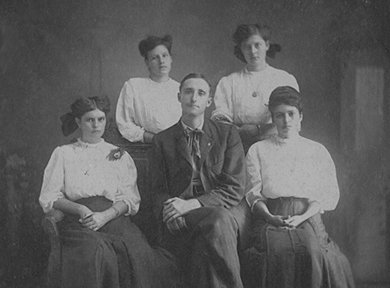
W.R. Harrison officiating. Edgar is the man in the center in the photo above right. He is posing with four
friends of Lulu from the DeQueen chapter of the Epworth League. They are, left to right in back, Alice
Stevenson (later Mrs. Dick Burtch) and Annie Wallace (later Mrs. McClure); and left to right sitting, Cynthia
McKinley and Dora Stevenson.
A son of William Alexander Seay and Mary Elizabeth Gardner,
Edgar had been born 4 November 1882 on a farm near Warren. His grandfather, Charles Hinton Seay, was well
remembered in Bradley County as a pioneer and as a pillar of the Methodists of that area, known to
neighbors and fellow parishioners as their beloved “Uncle Charley.” Though Charles had died when his
grandson was only two years old, Edgar had been impressed by the example, and had spent his boyhood
imagining that one day he, too, would preach. This ambition had become stronger in his late teens. With
his father’s death, the household had been reestablished within the town of Warren. Though the need to
contribute as a breadwinner had consumed much of Edgar’s day-to-day life -- he was obliged to work in local
mills between his school classes -- the shift into town had provided him with increased opportunities to
mingle among greater numbers of people and be more involved in church activities on a larger scale. In
particular, his involvement in the Epworth League had cemented his desire to lead congregations, and he had
received his license to preach 2 July 1904 at a mere twenty-one years of age. He had subsequently been
awarded assignments on the so-called “travelling circuits” of Arkansas. Spreading the Word and recruiting
for the church, he roamed through the counties of Sevier, Polk, Howard, and Little River. At the time of first
acquaintance with Lulu, he was based out of the village of Dierks in Howard County, about fifteen miles or
so northeast of DeQueen. He was soon raised to deacon and reassigned to the circuit based out of Vandervoort,
Polk County, a town about twenty miles north of DeQueen.
No sooner had Lulu and Edgar become wife and husband than they were on the road, as Edgar resumed his work
on the Vandervoort circuit. The pair were still in Vandervoort when they welcomed their firstborn, Edgar
William Seay, into the world in mid-November, 1909, a little more than twelve months after the wedding. The
proud father’s next assignment, received at a 1910 conference, was to Foreman, Little River County, AR.
The job would last for two years. Midway during that span, at a 1911 conference, which happened to again be
in Fordyce, he was raised to full minister. Another happy event that year was the birth of second child
Margaret Seay on the 26th of May. Alas, unlike Edgar William, who was so robust he would go on to live for
more than a century, little Margaret did not thrive. She passed away 14 June 1911 at less than three weeks
of age.
At the late 1912 conference in Little Rock, AR, Edgar was offered the position of pastor of College Hill
United Methodist Church in Texarkana, Miller County, AR. This was an honor of which he could be proud, and
he accepted. However, he was in fact already in the the early stages of a tremendous decline in health that
would all too soon claim his life. He had been accidentally crushed by his own buggy at Foreman, and was not
recovering as well as everyone had hoped. Unlike his vigorous pioneer grandfather Charley Seay, Edgar was a
somewhat frail man. Thanks to his injuries, he had not even been able to attend the conference, which that
year was held in Hot Springs, AR.
 At the beginning of 1913, when Edgar had improved a bit,
the household was reestablished at Texarkana
and the new pastor began his ministry. He had hardly taken up active pursuit of the job when he was obliged
to have an appendectomy. The surgery was successful and he recovered well from it, but he had only been back
at the pulpit for less than a month when he was struck down by infantile paralysis, the disease usually referred
to today as polio, which was widespread in the area at that time. His case was severe, involving a considerable
loss of function, and for the first several weeks, during which the family lingered in Texarkana, it was expected
he would probably die. Had that development occurred, he would not have had the chance to enjoy the babyhood of
his third child, Mary Juanita Seay, who was born on the twentieth of March. Instead, Edgar was spared, and he
gradually gained back a little strength. Lulu took him to his mother’s home in Warren, hoping that familiar
surroundings would buoy him up. To a small degree, the plan was successful. Edgar had to give up the College
Hill pastorage as well as any other formal assignments, but over the next two years his condition stablized.
He was able to continue his church studies and to attend the Autumn, 1913 conference in Pine Bluff, AR and then
made it to the 1914 conference in Little Rock. At the latter event, he was made an elder of the church by Bishop
Morrison, and had the joy of showing off his parchment to Lulu upon his return. Achieving that distinction
proved to be his “last hurrah.” Weak and always subject to lung and and other organ problems due to paralysis
and enforced inactivity, he developed the grippe and then pneumonia. He succumbed Friday, 18 December 1914, at
the age of only thirty-two years.
The Seay family had spent the last few months of Edgar’s life in DeQueen. It was a haven where Lulu could count
on the support of her mother and sisters; however, she did not linger as long as one might expect from a woman of
her generation, even though she had been left a widow with very small children. She was an independent and
self-reliant person -- so independent, in fact, that she never married again. That had been the precedent set by
her mother and both grandmothers, and it would be followed by all three of her sisters, but Lulu’s case is the
most striking because the others were beyond their childbearing years when they lost their spouses, whereas Lulu
had not even yet reached her thirtieth birthday. One factor in her choice was that apparently money was not a
concern. Either a life insurance policy award left her on solid footing, or the Methodist community put together
a fund for their admired lost brother. By 1917, Lulu moved to Arkadelphia, Clark County, AR. The precise timing
of the relocation was probably the summer of 1916, because it is known that her mother went back to Martintown in
September of that year in order to help take care of her own elderly mother, Hannah Strader Martin.
Even now in the Twenty-First Century, Arkadelphia is still a small town. Back in the mid-1910s it was only a
fraction of that size. What drew Lulu to that particular spot is a mystery, but she apparently found it a good fit.
She purchased a home there and settled in. She would remain almost twenty years, during which time she would
complete the raising of her kids. Given that she did not have to pay rent, her cost of living was modest, but
eventually her initial lump of capital was drawn down. She slowed this process by renting out a room to a man who
was an instructor at the local agricultural college, then in the 1920s, with Mary now in school for large portions
of every weekday, Lulu decided her means of earning an income would be to establish a florist shop, growing some of
her supply of plants and flowers within her own greenhouse. Being a merchant was very much in keeping with family
tradition within the Martin clan. While this usually manifested among the male heads-of-household, Lulu was far from
being the only female who observed the trend.
At the end of 1927, Edgar William Seay turned eighteen. He had long been fascinated with airplanes, and as it
happened, the city of Little Rock -- only seventy miles northeast of Arkadelphia -- was home to one of the leading
American manufacturers of airplanes, Command-Aire, Inc. Edgar succeeded in landing a job with the firm as a
carpenter -- many aircraft parts still being made of wood in those days -- and moved to the city to begin his
employment on the first of August, 1928. Lulu missed the help around the greenhouse and shop, but by then, Mary was
fifteen years old and was capable of dealing with the increased responsibility.
 In the autumn of 1929 the stock market crash and resulting
near-total collapse of customer orders for their
airplanes caused Command-Aire, Inc. to lay off the bulk of their workers. Back came Edgar to Arkadelphia. However,
he did more than just resume putting in hours at his mother’s business. He had garnered such a reputation as a
builder of model airplanes that people began ordering custom kits from him -- lots and lots and lots of people.
Lulu did not have to worry about her son getting discouraged by the tough economic times. He installed a workshop
above the greenhouse where he labored away to meet the demand. A 1932 tradeshow appearance resulted in nearly
five hundred orders, which took him until the summer of 1933 to fulfill even with Mary stepping in to do some of
the painting.
It was inevitable that eventually a model-airplane company would want to add Edgar to their workforce. Golden
Aircraft Corporation did so, and Edgar moved to Dallas, TX at the beginning of 1935 to become part of their team.
He would soon proceed to become an aviation instructor at Love Field and would later take on other jobs having to
do with full-size aircraft. He would never again need her to keep a roof over his head. With that, she decided the
time had come to pull up roots and venture beyond the confines of Arkadelphia. She may have been concerned that
Mary, who was now into her twenties, did not have enough suitable marriage prospects in Arkadelphia -- nor career
prospects should that be Mary’s inclination. Accordingly, mother and daughter relocated to Little Rock.
Not long after becoming part of the Little Rock scene, Mary met Paul Abel and the pair quickly became fond of one
another. They wed in December, 1936. Soon they departed for Vicksburg, MS so that Paul could take up a position there
with a candy and packaged-food-items distributor. Lulu saw no reason to linger in Little Rock now that the nest was
empty. Her brother-in-law John B. Luton had recently died. Lulu became a support presence to help her little sister
Ada get through the early phase of her widowhood, much as Ada (and the late John) had been there for Lulu twenty years
back at the onset of her own widowhood. Over the course of those two decades Ada and John had left DeQueen, spent a
long period managing a hotel in San Angelo, Tom Green County, TX, and then in the 1930s had set themselves up on a
large ranch in Real County, TX. Thanks to her experience as co-proprietor of the hotel, Ada knew perfectly well how to
manage employees to keep the ranch going, but she appreciated Lulu’s presence and advice nonetheless. That said, Lulu
does not appear to have lived with Ada for any longer than it took to become familiar with the area and acquire a house
of her own. The 1940 census, taken in April of that year, shows her still there, getting by as a lone head-of-household
even as Ada was in the process of reestablishing herself in San Angelo.
Lulu proceeded on to San Angelo herself later in 1940 or in early 1941, once again choosing to be near Ada. However,
she did not have the time to purchase a residence for herself as she had done in Real County. Her son and his new
wife, Mildred Taylor Seay, let Lulu know she was soon to become a grandmother, and so by the end of 1941 Lulu moved
to Dallas to help out with the baby. And with America in the war and Edgar putting in full shifts at his
now-more-important-than-ever aircraft-industry job, Lulu felt she should stay put, and did so. Another way she made
herself useful was to take up some form of nursing -- she appears in the 1945 Dallas city directory with that
occupation. Given the lack of formal training, this probably means she went to work at a convalescent home performing
basic care.
When her job allowed it, Lulu spent time in Vicksburg with her daughter and son-in-law, who during the war years made
her a grandmother a second and third time. The last of these babies -- a boy like both of the others -- came along just
after Lulu turned fifty-eight years old, meaning she was young enough she was able to be involved in the lives of all
three grandsons and got to witness them grow all the way to manhood. She would not have the same luck with the following
generation. While the first two of her great-grandchildren were born during her lifetime, the pair spent most of their
early childhood years as residents of Japan and by the time they were back in the United States on an on-going basis,
Lulu had gone to her grave.
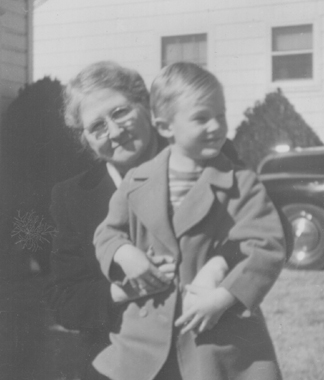
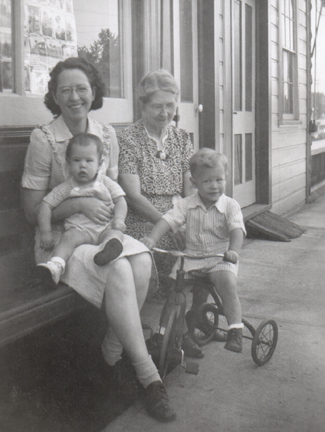
(The image above left shows Lulu with her son Edgar’s son in the mid-1940s. The other image above right is from
a July, 1944 visit Lulu made to see her sister Lena and other relatives in Martintown and vicinity. Lulu and
her daughter Mary and Mary’s two little boys paused at a street bench in Winslow, IL -- Martintown’s sister
village -- and posed for this picture while they were just a few steps away from Hastings Confectionery, the
candy and sweets store owned and operated by Lulu’s nephew John Cecil Hastings and his wife Wanda, and only a
few steps from the grocery store owned and operated by Lulu’s other nephew Leland Francis "Hap" Hastings and
his wife Hulda.)
It was during the mid-1940s that the first serious genealogical efforts began among the descendants of Nathaniel
Martin and Hannah Strader, a project instigated by Sarah Jeanette Hodge, a California-based great-granddaughter
of the couple. Soon four of the granddaughters -- who unlike Sarah had actually personally known Nathaniel and
Hannah -- took and interest and expanded upon Sarah’s preliminary effort. Lulu was the one who stepped up and
provided the information about the “Arkansas-Texas” branch of the family.
In the post-war years Paul Abel was offered a job in Elgin, Bastrop County, TX. He and Mary and the boys
relocated. They found they liked Elgin a great deal and they would in fact never reside anywhere else for the
rest of their lives. Soon afterward, in 1948 or early 1949, Edgar Seay found himself in enough of a tight
financial situation that he decided to sell his house so that he could pay off the debts without having to
declare bankruptcy. He and Mildred and their son moved into an apartment he had constructed in the back of the
model-airplane hobby shop he had founded in the Dallas suburb of Irving. Lulu saw no reason to remain in her
home in Dallas and given that she was going to have to move, chose to find a place in Elgin rather than in
Irving. As in Mary and Paul’s case, this would be a “for good” sort of development.
In Elgin as in every other locale in which she had lived, Lulu continued to participate in the doings of the
Methodist church -- even if that involvement was less direct than it would have been had Edgar, Sr. been by her
side. Even in her seventies she often was hostess to meetings of the local Cyrena Rankin Circle.
Lulu suffered a fatal heart attack 29 January 1970. Flemming Hospital was the place where she was declared dead,
but in fact she may already have been taken her last breath before the ambulance rolled into the driveway of her
home. Her remains were taken back to DeQueen and interred near those of other Brown family members -- and with
her husband -- at the city cemetery, also called Redmen Cemetery.
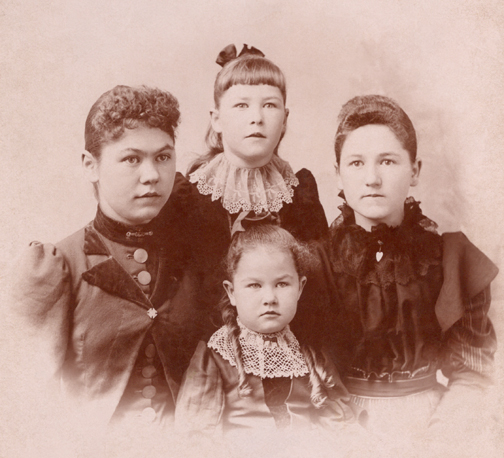
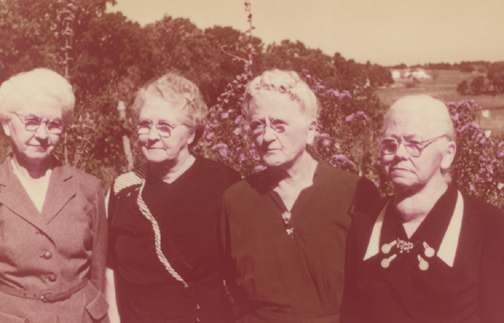
Above and below are two views of the four Brown sisters. (There would have been five sisters if Minnie
Edna Brown had lived past early childhood.) Above is a studio portrait taken in the mid-1890s. Lena is the
teenager on the left, Lulu is in back, Ethel is on the right, and a very young Ada is in the center front.
Below is the same quartet more than sixty years later at a family reunion in 1955. The scene is Martintown
or a spot near there. Left to right, youngest to eldest: Ada Vonner Brown Luton, Lulu Fay Brown Seay, Ethel
Irene Brown Cannon, and Mary Lena Brown Hastings.
Children of Lulu Fay Brown with Edgar Gardner
Seay
Edgar William
Seay
Margaret
Seay
Mary Juanita
Seay
For genealogical details, click on
each of the names.
To go back one generation, click here. To return to the Martin/Strader
Family main page, click here.