Imogene Emelia Thistle
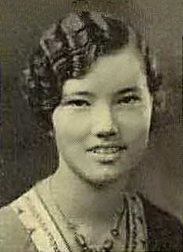 Imogene Emelia Thistle, third of the three daughters of
Marguerite Ellen Branson and LeBaron Guy Thistle, was born 24 January 1915 in Mariposa,
Mariposa County, CA. Her older sisters were Alice and Emily. She was the junior member of the family and
her nickname had a tendency to stick. It was Genie. We’ll often call her Genie in this biography as a
nod toward that affectionate label.
At the time of Genie’s birth her parents were struggling financially.
The economy of the Mother Lode had collapsed, reaching its last gasp not long after the government
instituted firm regulations against hydraulic mining and other extraction methods that harmed the
environment -- methods that had been the only thing keeping the harvesting of ore viable in the
immediate region. Guy Thistle had to snag jobs where he could find them. Among other things, he was a
realtor, an insurance salesman, a notary, and a draft registrar. None of those occupations could be
counted upon to generate income month in and month out. Marguerite was obliged to return to
work as a school teacher. Often it was difficult for either parent to be at home
with their girls. During the first few years of Genie’s life, though the household was officially
based in the town of Mariposa, the kids often stayed with their maternal grandparents
Joseph and Ella Branson on their sprawling cattle ranch north of Hornitos. The ranch was as much home
to the trio as anywhere, and throughout their lives they maintained an affection for the place.
They held on to their mother’s twenty percent legacy share of the acreage throughout their lives, and
their heirs did not sell their interest until the year 2016.
In 1919, belatedly yielding to the exodus that had siphoned off most of the population of Mariposa County,
Guy and Marguerite chose to relocate to Fresno. Guy continued to sell life insurance there. Marguerite
took a job by the autumn of 1920 teaching at Lincoln Elementary School. Given how recently they had
become established in Fresno, and how untested their support system of neighbors and acquaintances was,
Marguerite chose to enroll Genie, even though there was no kindergarten. At five years old, she was
placed in first grade despite being a year younger than the average member of the class. However, this
was the room and class that Marguerite herself taught.
Even after becoming residents of Fresno, the Thistle girls were often to be found at the ranch. This
was particularly true of the summer. Sometimes their mother was there, too. Other times they were in
the care of their grandparents. The girls loved it there. The ranch had a chicken house and a substantial
number of hens. Genie was allowed to adopt the rooster as her special pet. He was a Buff Orpington with
an orange body and a collar of iridescent blues and greens. Genie named him Fluffy. He was the only chidken
allowed up on the porch among the humanfolk. In the evenings, when the insect life thickened, Grandpa Joe
would swat flies and gnats and Fluffy would feast on the remains.
Genie grew up with the fondest of memories of those sessions on the porch with her sisters and grandparents.
The summer heat rendered the house a less-desirable venue. Instead, the family members retreated to the
porch, which was huge. The umbrella trees growing all around provided ample shade. Genie and Alice and
Emily were all avid readers, and would stretch out on the porch’s abundant array of cots, books in their
laps. The sisters would snag pieces of homemade beef jerky from a jar and chew until their jaws were exhausted,
the pieces seeming to expand in their mouths. They would look out at the sun-drenched wheat
undulating in the wind -- a reliable breeze that they were grateful
for. Much of the grain was destined as feed for the cows, but some was for household use. At harvest,
Ella would instruct the girls to set out a length of canvas at one corner of the porch, and everyone would
pour measures of wheat into strainers and proceed to winnow the chaff.
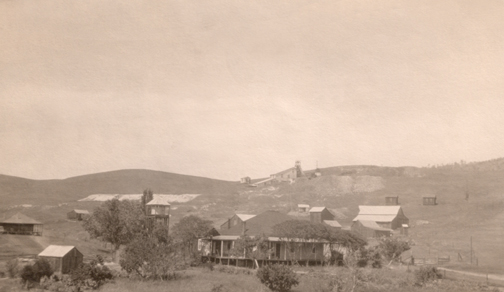
The Joe and Ella Branson ranch in its prime. This view prominently shows the porch where Genie
and her sisters idled away the hours.
Gradually, though, Fresno became “home.” After the one year at Lincoln, Genie attended Heaton Elementary
School, Hamilton Junior High, and Fresno High. (The photograph shown in the upper left corner of this
biography comes from the 1932 edition of The Owl, the yearbook of Fresno High School.) She was
an accomplished student -- her mother would have been disappointed by anything less.
Unfortunately, Genie’s high school years were not as bright and enjoyable as they should have been because
her mother’s health deteriorated. She developed leukemia. After an extended decline, she succumbed in May,
1933, just before Genie graduated from Fresno High. Worse still, Genie’s father only lived another ten
months. A few months after that, Joseph Branson passed away. In a sense, Genie -- perhaps we should call
her Imogene now -- had independence thrust upon when she had barely reached adulthood.
One way Imogene coped with the sudden change in life circumstances was to immerse herself in her college
classes. She attended and then graduated from Fresno State College in 1937 with a bachelor’s degree in
Education, and proceeded to become an elementary school teacher. In doing so,
she was following the tradition of a large number of females of the Hornitos clan, including her mother,
both sisters, her aunt Grace Branson Warner, and several cousins. More than any of those, she marched
in the wake of her father’s sister (and wife of her mother’s brother) Alice Elizabeth Thistle Branson,
because the place she began her career was in Kerman, about twenty miles west of Fresno, where Alice had
taught in the late 1910s. Imogene lodged in a home owned by two Swedish immigrants, Olaf Nelson Glim and
his wife Ingebord. The latter couple had other means of income -- Olaf was a Lutheran minister and raisin
farmer, and Ingeborg taught piano lessons -- but in the midst of the Great Depression, they were conscious
of the need to supplement the household finances if possible. Making Imogene their lodger yielded an
unexpected fringe benefit. She became romantically linked with the son of the family, Robert John Glim.
Imogene and Robert wed 23 November 1939 in Fresno. She was the last of the Thistle girls to marry. When
Bob -- also a teacher,
educated at FSC and UC Davis -- was hired by Woodlake High School in Woodlake, Tulare County, CA to
launch a vocational agriculture department, Imogene gave up her own position, having taught four years
at Kerman. This freed her for motherhood, and in less than a year the first of the couple’s five children
was born. They remained in Woodlake until 1948, when Bob was hired to join the faculty of the newly
expanded agriculture program at Fresno State College. He would remain at this institution for the rest
of his career, a professor for thirty years, and then an assistant dean of the school of agriculture.
Fresno became the family’s place of residence.
Imogene was active in Fresno art circles for many years. She was a member of the Fresno Community Hospital
Women’s Service Alliance and the Calvary Presbyterian Church. At one point she served as president of
the women’s society of the church.
In 1961 Imogene and Bob went to Africa as part of the Fresno State College Sudan Project, which in
turn was part of the USAID effort to help African nations to develop effective higher education programs
in modern agriculture. She taught at the American school in Khartoum. This went on for three years. As a
result, all five Glim kids went through a far more colorful educational experience than the sort known to
typical San Joaquin Valley natives. Even the eldest two, already beyond high school age, were swept up in
that phenomenon. They attended the American University in Beirut, Lebanon. The third child, not quite
university age while Imogene and Bob were in Africa, attended the American School in Alexandria, Egypt.
The Sudan Project posting appears to have been scheduled to last five years, but the sojourn was cut short
in 1964 on account of Imogene’s health. The couple returned to California, where Imogene fought and lost
a battle with non-Hodgkin’s lymphoma. In the end, her lifespan was almost precisely as short as her
mother’s had been. She entered a Los Angeles hospital for treatment and spent an extended period there,
dying at the facility 2 September 1966. Her remains were brought back to Fresno and were interred in
Belmont Memorial Park Cemetery.
Among the bitter aspects of her early demise is that Imogene never got to hold any grandchild in her
arms. Only one grandchild existed yet, and that baby boy, five months old when Imogene breathed
her last, was out of reach all the way across the Pacific Ocean in Japan, where Imogene’s son-in-law was
serving as an Air Force pilot stationed at Yokota Air Base.
Bob Glim survived Imogene by more than half a century. As this page is updated in January, 2018, he has only
just recently passed away at not quite 102 years of age. This biography will soon be expanded so that his
portion of it achieves
the level of coverage typical of other Branson-clan in-laws on this website. He parented the youngest two
kids through their (remaining) high school years, assisted by his mother until her own death in the spring
of 1968. By the time Bob remarried in early 1970, his youngest child was already seventeen years old.
Children of Imogene Emelia Thistle with
Robert John Glim
Details of Generation Five, the great-great-grandchildren of John Sevier Branson and
Martha Jane Ousley, are kept off-line to guard the privacy of living individuals. However,
we can say that Imogene’s descendants include five children, six grandchildren, and five
great-grandchildren.
To go back one generation, click here. To return
to the Branson/Ousley Family main page, click here.