George Bertrand
Johnson
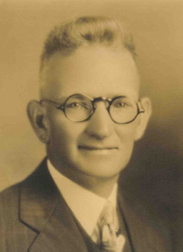 George Bertrand Johnson, the second child of Mary
Jane Branson and Alonzo Diah Johnson, was born 19 October 1885 in Merced, Merced County, CA, where his
parents had recently set up their home after having wed one another in Mariposa County, where Mary had
grown up.
Alonzo Johnson ceased to be part of his wife and children’s lives by the late 1880s. As a result, George
did not have a typical sort of upbringing. From age five until his late teens, George lived in a boarding
house operated jointly by his mother and by his widowed aunt, Nancy Anne Branson Harrington. It was a
scheme that allowed the sisters to not only keep a roof over the heads of themselves and their offspring,
but also provide a large portion of the economic wherewithal they needed in the absence of breadwinning
husbands. Aunt Nan was on site round the clock as cook and housekeeper, while Mary worked full-time in a
drygoods store and did the boarding house laundry in the evenings (and sometimes well into the night).
George and his little sister Alice Bretelle Johnson lived on premises along with their six cousins, Nan’s
kids. Older brother Clarence was taken as the ward of another aunt, Theresa Branson Moore and her husband
William Osborne Moore. Theresa and Will lived three doors down on the same street. All in all the place
and its operation added up to a stable and loving environment in which to spend his childhood, and one
thing was certain -- George never lacked for companionship. The boarding house was not only home to the
ten relatives, but of course to the paid boarders as well. Add to that, in 1896 Nan wed her second husband
John Napier, and he became part of the crowd.
Though George had plenty of supervision in a general sense, the lack of a father or stepfather looking
over his shoulder may have had an influential effect on his personality. George became notorious for
antics, including one infamous incident when he and some buddies stranded a carriage atop a building.
(This would probably have been a carriage being worked on by his uncle, William McDonald, who was a
Merced-based wheelwright.) This roguishness stood in contrast to the behavior of his brother Clarence,
who became somewhat staid and mature beyond his years.
Blue-eyed George grew up to be a hair short of 5’8” tall. An outstanding baseball pitcher, he was
extremely healthy and had all the strength, perceptiveness, and competence needed to establish himself
as an adult out in the world at large. In a way, it is good that he was so ready, because when the
moment came to launch into that independent existence, he didn’t have the option of reversing course.
He had to go forward. That’s because in the first half of 1906, shortly after George turned twenty,
his immediate family’s circumstances drastically changed. Early in the year Will Moore, then an
undersheriff, was credibly accused of attempted murder, and he and Theresa had to leave, and then keep
moving about, in order to avoid his arrest. By then the boarding house no longer existed and hadn’t
for a few years. Bretelle was at last finishing school and was set to wed her boyfriend Gifford Fowle.
Clarence in turn was just about to wed Lillian Brown, a Berkeley gal he had met while proceeding
through his own process of fledging his wings.
And then came 18 April 1906. The big earthquake and fire devastated San Francisco and caused great
damage throughout the Bay Area and wine country to the north. George appears to have still been in
Merced or at least in the general vicinity, perhaps on a ranch where his mother was working as a
cook. Nevertheless the ground shook tremendously where he was. Late in life he described how the
horses were the first to sense something odd was happening, and how agitated they became.
Merced was no longer the place to stay. And an obvious place to go was the Bay Area,
not only because Clarence had become familiar with it, but because there were now lots and lots of
jobs for able-bodied young men while the city and its suburbs proceeded through their process of
rebuilding. As far as can be determined, George headed off that summer, though it is slightly
possible he waited until after his twenty-first birthday that autumn.
Despite his vigorous health, George tended toward employment in retail salemanship or at desk jobs
rather than hard physical labor. This penchant may help explain why he remained in the East Bay for
the rest of his life, whereas Clarence moved back to the San Joaquin Valley by no later than the
early part of 1910 and ultimately became a farmer.
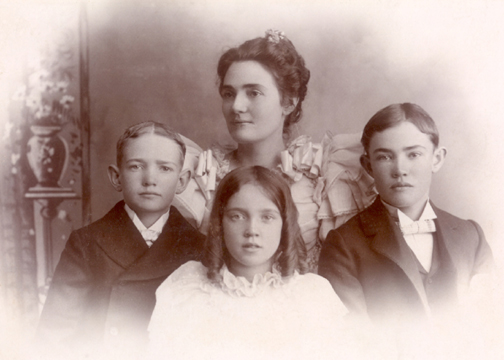
Mary Jane Branson Johnson circa 1895 with her children (left to right) George,
Bretelle, and Clarence.
In the 1910 census, George appears as a single man living as one of two boarders in the Oakland
home of Charles and Arletta Welch at 568 15th Street. George is described in that census as a
salesman in a grocery store. That sounds like a mundane sort of occupation, but George wasn’t
working for just any old grocery outfit. He was employed by Goldberg Bowen & Company, a major
enterprise with a particularly high-profile presence in San Francisco and Oakland where its main
stores were. Established in the 1880s as a merger of legacy businesses that in one instance
stretched all the way back to 1850 Gold Rush-era San Francisco, the firm was not just a retailer,
but a “gourmet” retailer, as well as a wholesaler/distributor, issuing non-perishables and various
prestige items under their own label -- merchandise such as coffee beans, tea, beer, soda pop,
canned foods, cosmetics, and liquor. They were well known for their whiskey. Even now in the 21st
Century a person can consult eBay or a similar source of rarities and oddities and find vintage
(empty) Goldberg Bowen whiskey bottles for sale. Clarence Johnson appears to have been employed
by them as well, and may have been the one who got George added to the workforce, but it was
George who fully embraced the opportunity. He would remain an employee until 1914, long after
Clarence had moved on.
Among the benefits George might have enjoyed as a result of this extended-term employment situation
was that he could have afforded to set himself up in individual living quarters. He did not do so.
Thanks to his upbringing and his sociable personality, living in a communal fashion wasn’t
just a means to watch his pennies and/or avoid having to cook his own meals, it was a lifestyle he
favored. Accordingly he continued to be a lodger of Charles and Arletta Welch, and this remained
true even when the couple relocated in approximately 1911 from 568 15th to 1221 Jefferson.
George reached his late twenties before becoming a married man, i.e. he waited notably longer than
either of his siblings and was already an uncle five times by that point. The wedding took place 23
September 1914 in San Jose, CA, officiated by Halsey Werlein, Jr. rector of Trinity Church. The bride
was Elizabeth Glenn Bennett, one of three children of Roger Williams Bennett and Frances Cornelia
Strader. Elizabeth, born in January, 1893, was technically a native of Nebraska, but in terms of
identity was absolutely an Oakland girl, her family having moved to the city while she was still quite
young. As an adult she had lingered in Oakland while her parents -- or at least her father -- moved on
to San Jose. (This relocation was undoubtedly the reason why the the wedding took place in San Jose.)
Oakland is where Elizabeth and George remained for the time being, though he of course finally ceased
boarding with the Welches in order to begin his conjugal life with Elizabeth. Their first shared
address was 1055 Eighth Street.
Not long after George became a married man, he underwent a significant shift in occupation. He began
working for the Alameda Works Shipyard, a newly-established division of Bethlehem Shipyards Corporation,
the giant of the U.S. shipbuilding industry. He began as a file clerk but soon was promoted to foreman
and timekeeper. A timekeeper was the sort of labor supervisor who would hand out the work assignments
to the hourly-wage workers, as in the construction crew members, and keep track of how much time they
put in per shift. In the late 1910s, huge numbers of Bay Area men worked in the various shipyards, a
number which grew even more robust as America entered World War I. This is another way of saying George
probably enjoyed a decent level of pay. Even so, George preferred not to take on a home mortgage. He
and Elizabeth continued to rent. There was certainly plenty of reason for George to be cautious.
Despite his wage level, he did not necessarily enjoy true job security. For one thing, he did not have
the protections a union might have provided. He had to put up with circumstances a worker of the
21st Century would no doubt push back hard against. For example, George developed a severe peridontal
condition. His dentist declared the only effective way to treat it was to remove all of George’s
teeth. (Perhaps a better way to describe it would be to say his remaining teeth.) And indeed,
George would forever after have to put up with dentures. To add to the distress of facing that
prospect, when he asked Bethlehem Shipbuilding Corporation for a day off, his boss told him, “Sure.
You can have the day off. Just don’t come back to work the next morning.” George told this story a
number of times in later years, of how on the day he had his teeth pulled, he had to go right from
the dentist’s office to his workplace, mouth stuffed with gauze and jaws aching in pain, and take
care of his usual timekeeper duties or he would have been out of a job altogether.
In approximately 1917 George and Elizabeth left 1055 Eighth Street in favor of 179 Ninth Street. The
latter place does not seem to have been better or newer. A couple of years later they moved to 169½
Ninth Street and this was not even a house of its own, but only an apartment consisting of a
portioned-off section of a larger house. And then, to top it off, they took on lodgers. In moved George
Fox, a shipyard co-worker, and his wife Elizabeth, who had until then been renters just a few doors
down on the same street. (Two Georges and two Elizabeths at the same address -- what were they
thinking?) And then for a brief interval at the end of 1919 and into early 1920 they squeezed in one
more housemate: George’s brother-in-law Gifford M. Fowle, who had come up from Santa Barbara County to
begin a new job with Southern Pacific Railroad. Again, this demonstrates George’s abundant sociability
and the level of tolerance for the sort of crowded living conditions he had known as a child. One has
to wonder if his wife was equally pleased.
If Elizabeth did have any frustration with the lack of privacy in her daily life, she must have been
looking forward to what the year 1920 appeared to have in store for her and George. As January began
she was precisely halfway through a pregnancy. It was time for the couple to say good-by to
housemates. Early that year they began renting a house at 1509 Morton Street in Alameda. This was
anything but a randomly chosen spot. Not only was George now closer to his job site, but 1509 Morton
was only a block away from 1442 Morton, a home purchased in 1919 by his first cousin Josephine
Harrington McDonald. Josephine was the eldest of the five Harrington girls with whom George had been
raised in the Merced boarding house. She was a treasured “big sister” figure. She therefore was the
ideal person to play the role of “auntie” to George’s offspring. George well knew the value of a
family support system.
Unfortunately 1920 did not end up being a year George and his kinfolk would look back upon with joy.
The first bleak turn came at the end of February when Josephine’s husband Charles McDonald died.
Charles had long struggled with a chronic hereditary condition but even so his passing was a shock,
coming as it did before the age of fifty. George represented a vital “shoulder to cry upon” for
Josephine throughout that spring and beyond.
Naturally the successful conclusion of the pregnancy was a bright spot. George Bertrand Johnson,
Jr. was born 19 May 1920. A heathy baby boy. Then tragedy struck again. Elizabeth died only five
weeks later on the 24th of June.
The precise circumstances and the cause of her death constitute a mystery. Childbirth itself was
not the mortal aspect, or Elizabeth would not have lasted another five weeks. It is worth noting
that the nation was still in the depths of the great influenza pandemic, and though the virus
typically claimed its victims in the cold months of the year, there were a number of Bay Area
flu casualties in June of 1920, and perhaps Elizabeth’s passing contributed to the tally. But
it is not unreasonable to wonder if a psychological factor was in play, and that her death may
have been suicide. She and George had waited nearly five years after their wedding before
conceiving a child. That was unusual for their generation and suggests there may have been an
issue that led them to be cautious. Concern over her emotional stability might have been such a
reason. Five weeks after a birth is precisely when post-partum depression can reach a crescendo.
Perhaps Elizabeth just couldn’t cope.
Many years later George spoke of his wife having made a confession of some sort on her death
bed. He didn’t say precisely what she admitted to, but the fact that she made the disclosure
provides us today with a bit of a perspective on her final moments. If she had time to utter the
words, it means whatever led to her death was not something that killed her instantly, as would
probably have been the case had she chosen do do away with herself by a violent means -- as for
example when Josephine’s daughter-in-law Tonia Utkin McDonald gave in to depression and threw
herself out of a high window in 1934. As for the rest, barring the possibility of a death
certificate surfacing, we just don’t know.
George’s son was now motherless. That was crushing enough, but now there were the practical
concerns to worsen the anguish. The early 20th Century was not an era when men took care of
infants on their own. Short of handing little George over to an orphanage, never to see him again,
the grief-stricken new father had only a few alternatives. The one he chose was to agree to let
Elizabeth’s sister Grace Strader Bennett adopt George Jr. The boy would go on to be raised by
his aunt and by his maternal grandmother, Frances. In some ways this was an ideal solution. Grace
was a divorcée and was childless and the adoption was regarded as probably her only chance to be a
mother. In other ways, it was not ideal at all. For one thing, Grace wanted the assurance the
arrangement would be permanent. George was not to take back his kid even if he remarried. And to
rub salt in the wound, Grace and her mother were now based in southern California and George would
not be able to see his son much at all, as he might have if the two women had continued to reside
in the Bay Area.
Father and son stayed in touch. The younger George knew all along about his origins. Otherwise the
relationship was about as far from a standard father-son connection as it could be. The only
exception was that for a few months in 1938, George Sr. might have regained custody in a strictly
technical sense. In February of that year, Frances Strader Bennett passed away, having outlived her
daughter Grace by seven months. Grace’s second husband Park Boyce, whom she had wed in 1925, had
died four years before her. So young George may have needed his biological father to act as his
legal guardian during the three months that remained until he turned eighteen. However, George,
Jr. did not relocate to Alameda during those few months. He had inherited the family home in
Hermosa Beach and stayed there. His maternal uncle Wilson Sumner Bennett and wife Eva temporarily
moved in to serve as
the mature figures in the household. George Sr. is sure to have sent funds on a regular basis
as a form of child support despite the adoption. Neither Grace nor Frances had jobs outside the
home while raising young George, and Park Boyce did not figure into the equation for the first
five years. In 1929, when Grace and Park and Frances bought the aforementioned house in Hermosa
Beach, one reason they were able to do so must have been due to George Sr.’s continuing
contribution to the finances of their household. The dedication of some of his income in this
manner helps explain why George himself continued to be a renter throughout the 1920s and 1930s.
And in fact, he then remained a renter until the day he died.
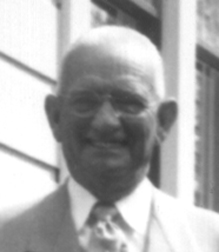 As a widower, George might have fled to some other
city or region. That would have been a mistake, because part of what made George his genuine
self was the abiding bond he shared with his locally-based family members, neighbors, and
co-workers. Alameda was the best place for him. Fortunately George understood this. He stayed
put. That was true even to the extent of continuing to inhabit 1509 Morton. His landlord was
perfectly happy to have him stay. The only hesitation George might have felt was whether or
not the place would remind him too
much of Elizabeth, but the pair had only spent a small fraction of a year within its walls.
There hadn’t been time to build up a lot of memories. The house was however too empty for him
to linger there all by himself. And so his mother moved in. She had just finished spending
several months living with Clarence and Lillian in Manteca, CA, and before that had spent a
year or so with Bretelle and Gifford in Santa Maria, CA. She would now stay at 1509 Morton
Street until George remarried.
It would appear Mary did not work outside the home while she was there. This was uncharacteristic
of her. Something unusual must have happened. It was the first time since George’s infancy that
she chose not to be a wage-earner. In the past, whenever she had moved, she had immediately found
a position as a clerk at a drygoods store. But during the next few years while sharing the house
at 1509 Morton, she limited herself to doing the cooking, laundry, and housekeeping for the two
of them. Given the sort of labor she was used to, this amounted to a vacation. It is quite likely
that George wanted his mother to scale back in just such a way. After all, she was on the verge
of turning sixty. He would have seen it as a special gift, something she had always deserved but
which he had never been able to offer her before. And Mary accepted. George was probably the only
person who could have persuaded her. Mary cherished her ability to call her own shots and to
never be dependent upon a male.
George ceased being a timekeeper. For a few years he did a little of this and a little of that. Voter
registers and city directories describe him as a salesman, but these sources paint an incomplete
picture. Salesman of what? Working where? In 1923, his employer’s name is known to have been B.E.
Severt, but Severt has not been identified and what sort of goods he dealt with is still a mystery.
However, a seed catalog published in 1921 provides a snapshot of one of George’s ventures. He grew
two species of ornamental aspargus and sold packets of the resulting seeds by mail order. This was
undoubtedly a sideline-level enterprise -- it had perhaps been how Elizabeth had contributed to the
household finances, and in 1921 George was simply continuing her work -- but he probably counted on
the money. The largest-size packets, holding ten thousand seeds each, he priced at eight dollars for
Asparagus plumosus and ten dollars for Asparagus sprengeri. If he sold three packets of
either, he made his rent for the month. (The 1930 census shows his rent by then was thirty dollars per
month. In 1940, it was thirty-five. In the early 1920s, it was probably twenty-five.)
Being a man of his era, and having become familiar with the bachelor lifestyle during his twenties,
George might have remained a widower for quite a stretch, but he had female relatives in his corner. They
knew he would be happier with a wife beneath his roof. So after allowing a respectful period of mourning,
Josephine McDonald and Mary Jane Branson Johnson began keeping their eyes open for prospects. The ladies
found who they were looking for in the person of Bessie Porterfield, a bookkeeper at the local Rug Works.
Bessie, a divorcée in her mid-thirties with a son about to enter his teens, had recently moved to Alameda
from Cloverdale, Sonoma County, CA, where she had spent thirteen years married to a much-older man, farmer
William Harvey Porterfield. The pair of matchmakers steered Bessie in George’s direction, or vice versa,
and things clicked. George and Bessie were wed 14 March 1923 in Alameda by Congregational minister Harvey
V. Miller. Josephine and Mary were the witnesses on the marriage certificate. Harvey V. Miller would
go on to officiate the following year at the wedding of Josephine to her second husband Daniel W.
Baysinger.
George’s first wife Elizabeth had been nicknamed Bessie. It was a name she seldom used as an adult, but
she had usually been called Bessie in childhood. That both of George’s wives were known as Bessie
eventually led to some confusion in a genealogy or two. His new Bessie was not, however, an Elizabeth
nicknamed Bessie, but simply Bessie, period. Her maiden name had been Bessie Marie Reisinger. Born 27
March 1887 in Pennsylvania, she was a daughter of Herbert C. Reisinger and Ella J. Sprinkle. Her family
had moved to Alameda County just before the turn of the century. She had been twenty when she wed
William Harvey Porterfield (1862-1931), who had East Bay connections even though Cloverdale was his
main base from the beginning of his life to its end. For example, his ex-wife Martha Ford Chalfant and
their two daughters, Alice (1885-1975) and Helen (1890-1969), were residents of Oakland at the time
Bessie and William got to know one another. William and Bessie’s only child was Herbert John Wilson
Porterfield, born 26 June 1908. Bessie had custody, so Herbert lived at 1509 Morton as a teenager. And
then he lived there some more. The 1930 census shows him there at not quite twenty-two years old. The
1940 census shows him there at not quite thirty-two. Whether he was there in all the years up to 1940
is unconfirmed. He probably made attempts to live independently, but may have found it a challenge to
keep a job during the economic turmoil of the Great Depression, causing him to do what so many bachelor
sons did in that era, and move back home for a while. Early 1950s directories do show Herbert residing
at 824 Oak Street in Alameda, a locale nearly a mile away from 1509 Morton.
Not long after marrying Bessie, and certainly by no later than the early part of 1924, George became
the proprietor of a gasoline service station at the corner of Everett Street and Santa Clara Avenue in
Alameda, a mile and a half from his home. He came to this at nearly forty years of age, but it is
accurate to describe the business as the main career of his lifetime. (He was not the only one in the
family to do likewise. His first cousin Grace Mildred Branson’s husband Bert Warner had opened a gas
station in Sanger, CA in 1919, and Josephine McDonald’s brother-in-law John Everett Riddell would take
over one in Santa Cruz, CA in the late 1930s.)
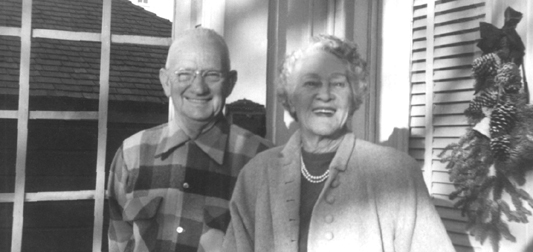
George and Bessie Johnson in their sixties. They were always in good
cheer for the holidays.
George had reached the prime of his life in the sense of steady circumstances, a hand-picked place to
live, a prosperous business, a lasting partner -- he and Bessie would remain married until her death, an
idyll of thirty-four years. George was a characteristically happy person, and now he had plenty to be
happy about. To be sure, over the thirty-four years of the marriage, there inevitably were occasions of
tragedy or wistfulness, an example of the former being the loss of his brother in 1932 at not yet fifty
years of age, and an example of the latter being the departure of Josephine in 1924 to begin her life
with Dan Baysinger in Palo Alto, CA. But all in all, that was not so far away. Bretelle
and family were even closer (Berkeley and later, Oakland), as was first cousin Nancy McDonald Price.
Josephine’s son Bob McDonald remained at 1442 Morton. And in the mid-1930s, Josephine would return to
Alameda. She and Dan acquired a home at 1535 St. Charles, just around the corner from George and Bob.
Within a year of her arrival her widowed sister Elsie Harrington Cowell moved in with her, to be replaced
in 1940 by yet another widowed sister, Irene Harrington Salmon. The bond was strong among the kids who
had grown up in or beside the Merced boarding house, and in their mature years, they sought out the
balm wrought by that special connection.
Merced was, however, a milieu of the past, home by the 1920s and 1930s to only a tiny fragment of the
clan. George and his generation honored the family ties in their own fashion in the locales where they
were currently embedded. One of the bases was Manteca, home to Clarence Johnson and family and to Theresa
and Will Moore, as well as Nancy Branson Harrington Napier and to Josephine’s sisters Elsie, Eunice, and
Irene. In the summers, George and Bessie would go there, as would Bretelle and family, regularly spending
Fourth of July at Clarence’s farm. Everyone would take a turn at the crank helping make the homemade ice
cream. The winter season holidays were spent in the East Bay, hosted in rotation by Bretelle and Gifford,
by Nancy and Roy Price, and by George and Bessie. Sometimes these gatherings were made up of just those
three households plus Mary. On other occasions the Manteca group would descend. A treat for George were
those special occasions when his son George was able to make it up from southern California.
Those holiday gatherings were recalled with deep affection in a 1988 memoir written by George’s
niece Esta Jane Fowle, who attended the events regularly from age nine, when her family came back to
the Bay Area after the sojourn in Santa Barbara County, until her early twenties when she and her
new husband Robert Kennedy Service moved to Shanghai, China. Rather than paraphrase what Esta said,
read the memoir for yourself. Click here to go straight to
that essay.
In the memoir, Esta mentions the joke about George being a bootlegger because he brought out two
bottles of wine at one year’s holiday festivities, even though said festivities occurred during the
Prohibition era. His ability to do so is easily explained. He surely still had connections from his
days at Goldberg Bowen. Plus, as a service station proprietor, he might well have made a habit of
accepting such things as wine and/or moonshine from customers who couldn’t otherwise pay for their
automobile maintenance -- nor even for their gasoline -- during the hard times of the Great
Depression. One way or another, he “knew the right people” to make life better, and he was not the
sort of man to say no to alcohol. George was an enthusiastic drinker throughout his adult life.
Even as an old man, he kept his favorite, Ancient Age bourbon, ready at hand. The habit does not
seem to have had a negative effect on his health or his lifestyle. The same could be said for his
use of tobacco, though that was different in that he eventually played it safe and quit.
George treasured his family. And they treasured him. He was a rascal, yes -- but a rascal for the
sake of entertainment, not in the sense of cheating or mean-spiritedness. It is a shame he did not
get to be a day-to-day father to his son George, Jr., because he would have been the best of
fathers -- determined not to follow in the mold of his own father. Of all the forty-five
grandchildren of John and Martha Branson, George was without question the best loved. A measure of
this was plainly evident during the interviews conducted in 2006-2008 as part of the research for
this family-history website. Esta Jane Service was still alive at that point, and was asked if the
“many guests” at the holiday gatherings George and Bessie hosted included Josephine Baysinger and
the McDonalds. It is a fact they were indeed among those guests, yet Esta, then in her mid-nineties,
could recall no such relatives. On another occasion, Bob McDonald’s son Bill recalled how in the
1940s and early 1950s when he was growing up, “Uncle George” was still popping by nearly every day
at 1442 Morton to say hello and see how everyone was. Even Bill’s niece Carla Wedemeyer knew George,
because even in the 1960s and early 1970s when Carla was growing up, he was still checking in,
long after Josephine and Bob were deceased. Bill had no recollection whatsoever of Bretelle and her
family. The awareness of distant kinship had faded. But everybody remembered George, and
fondly.
If anyone deserved to “keep going,” it was George, but that sort of good fortune brought with it a
flipside in that he kept going so long he inevitably had to say a lot of farewells to loved ones.
Among the first to go were Nan and Roy Price, both succumbing in the early 1940s. George’s mother,
despite owning the distinction of a longer lifespan than any of her nine siblings, was gone by the
end of that decade. The year 1955 brought a double loss, with Josephine Harrington McDonald Baysinger
dying that summer, and her son Bob following less than two months later, both as a result of cancer.
And then, on 24 March 1957, Bessie died.
The first time he had become a widower, George had been young and the emotional support he had been
able to call upon had been especially potent given that it was coming variously from elders with
wisdom to offer and contemporaries he could count upon to be there for him for decades to come. But
in 1957, the house at 1509 Morton was an echo chamber of loneliness. George responded to that in a
resoundingly George-like fashion. He filled the void by resorting to the communal circumstances he
had grown up with. He acquired housemates.
It is fair to say that as much as George needed company, his main incoming co-tenant needed even
more to put herself within George’s sphere, containing as it did all of the steadiness, friendliness,
and beneficent nature he so reliably brought to bear. Her name was Helen Ivadel Reese. On the verge
of entering her forties, she was attempting to extricate herself from a thoroughly bad marriage to
her second husband, Estle Lindsey. She and her ten-year-old son needed not just a place to live
that they could afford -- preferably in Alameda where the boy could continue his schooling with the
peers he knew -- but needed a refuge. If Helen and her child had moved into unshared accommodations,
she would have risked the prospect that her estranged spouse would barge in and she would end up
right back in the predicament she was trying to escape from.
 George was happy to be her guardian. As an
old man, he was not a threatening figure to spur Estle Lindsey to a jealous rage, but at the same
time, his mere presence helped insulate Helen from encroachment because there he was, a living,
breathing third-party witness to Helen’s day-to-day situation. Helen thoroughly appreciated the
role he played. And then, as she came to know George in a general way, not just as a housemate
and not just as a bodyguard of sorts, but as a man -- a fine, funny, considerate man -- her
feelings evolved into something more. Given that George was thirty-two years her senior, it
probably didn’t occur to her at first that she might come to regard him as a potential lover,
but eventually a lover is indeed what he became. How long the sexual phase of their relationship
lasted is unclear. Perhaps all they indulged in was a single intimate encounter -- an instance
when their mutual admiration reached such an intensity they simply had to express it in physical
terms. Whatever the particulars, Helen became pregnant with George’s child.
That this happened remained a secret. When Helen gave birth in early 1959 to a son, he was
named Steven Douglas Lindsey and as far as the world at large knew, he was the progeny of Estle
Lindsey. And that is how things remained. George and Helen took their secret to the grave. Not
even Steve was privy to the truth.
It was the truth, though. The skeleton in the closet came to light in the spring of 2025.
Steve had decided he would submit a DNA sample to Ancestry in order to check on a family legend
he’d heard that Estle Lindsey had possessed quite a bit of Native American heritage. Steve’s late
brother Chuck had possessed the dark hair and deeper skin tone that went with that sort of
origin, but Steve had a fair complexion, light hair, and blue eyes. When he submitted the
saliva sample, he wasn’t planning on doing much in the way of genealogical research. He just
wanted the ethnicity analysis. Of course, when the results became available, they showed no
detectable percentage of First Nations heritage. However, the results included one other surprise,
and it was a whopper. Many of his closest DNA matches were members of the Branson-Ousley clan,
the strongest of all being the family members most closely related to George. For example, Steve
matched quite strongly with a great-grandson of George’s sister Bretelle.
Steve was familiar with the Branson-Ousley family, not only because of stories George had told him
about growing up in the Merced boarding house, etc., but because, in the 2010s, Steve had found
and read an earlier version of this biography. He had sought it out because with the exception of
his mother, George had been the most important figure in his pre-adult life. That happened because
even though George had gone unheralded as Steve’s biological father, he’d been absolutely, openly,
and officially Steve’s godfather.
And what a godfather he was. George was a constant part of the Steve’s life until literally the
day he died, babysitting him when Helen had things going on, walking him to school and back each
day, taking him on excursions, cooking favorite dishes and treats for him. In short, he did the
very sort of dad-like things he had never been able to do for George, Jr., and that the young
fellow was never going to get from the man whose last name he bore.
Speaking of the man whose name Steve bore, Estle Lindsey was arrested in October of 1958 for two
separate robberies of Bay Area businesses with different sets of accomplices. Such clear indications
of his career-criminal nature, and of his unworthiness to have rights as a family man, provided Helen
with ammunition to help convince a judge to grant her a divorce. More important, it gave her the means
to ensure she would have full custody of her offspring. That included not only her school-age son,
Chuck, but her offspring-to-be, because by October of 1958 Helen had reached the final trimester of
the pregnancy. But even as the legal proceedings played out, Helen understood she was already enjoying
a better life. She felt so secure in this fact she even went so far as to invite her teenaged daughter
from her first marriage to come and live with her at 1509 Morton, George having endorsed the plan. The
girl and her older brother -- Helen’s firstborn -- had spent the majority of their childhood years
living with Helen’s parents in Portland, OR because Estle Lindsey had neither wanted to have step-kids
in his household nor could he be trusted with supervision of them.
Given that Helen became able to marry again, the big question is, why did she never marry George?
Why was it such an abiding secret that George was the man who had sired Steve? Those are mysteries
that are not likely to be solved. But if all we have is speculation, it is worth considering a
number of the factors that may have been in play. First, an admission that her baby had been sired
by her housemate would have been leverage Estle Lindsey could have used to sustain an accusation
of adultery, and that might have affected the custody judgment. Second, Estle was capable of
violence. He may well have said to Helen any number of times, “If I ever find out you’ve been
unfaithful to me, I’ll kill you.” Helen may have lived in a state of paranoia during the marriage
that the divorce could not fully cure the syndrome. She may not have wanted to tempt fate, not
even after Estle was no longer her legal spouse. It is worth noting that in later decades Helen
had no idea where Estle might be. For all she knew, he was still “out there” lurking, and might
follow through on his threat somehow. (Estle died in 1990, but Helen, who had only eight more
years to live herself, is not likely to have been informed, and may never have felt she was out
from under his shadow.) Third, George was so much older than she that Helen wanted to keep her
option open to find a younger man to marry, one who would still be around when Steve reached
adulthood. George would in fact live precisely that long, but when Steve was tiny, Helen had
no way of knowing that was how things would play out.
George and Helen and her kids continued to share the house at 1509 Morton well into the year
1962. To the outside world, they maintained the fiction that they were, and always had been,
just a man and woman whose circumstances had caused them to share a place of residence. If
they ever considered admitting their relationship was, or at least briefly had been, more
than that, the time when they might have revealed it was during that window of opportunity.
They did not do so, and the window closed. In the autumn of 1962, Helen wed third husband Fenton
Simmons. While this union would eventually end in divorce, it was long-lasting. Helen would
hardly have wanted Fenton to know more about the role George had played than Fenton would have
been comfortable with, and so that was that. Lips sealed for good.
That is not to say that Fenton’s presence put a stop to George and Helen’s involvement in
one another’s lives. Helen and Fenton established themselves at 1535 Ninth Street, which means
their house was only a short stroll away from 1509 Morton. George dropped by nearly every day.
In addition to hanging out with his godson, he spent long sessions tending the garden. Part
of the plot was devoted to flowers, richly stocked with Helen’s favorite: dahlias. The rest was
a vegetable garden. George grew not only the standard sort of thing you’d expect, as in
zucchini and other types of squash, tomatoes, corn, carrots, etc., but also blackberry and
boysenberry bushes, using some of the crop from them to make jelly and syrup.
Fenton grew jealous of the obvious regard Helen continued to have for George and from time to
time would run interference, trying to limit George’s interactions with his godson or telling
George he couldn’t keep the garden going. Fenton declared he was going to “do something else”
with that part of the yard. But of course he had no actual intention of personally taking up
gardening or landscaping, nor could he muster the same sort of emotional investment in Steve’s
existence that George routinely exhibited. His passive-aggressive strategies did not work in
the long run. George and/or Helen wouldn’t let that sort of bluster ruin their bond, nor do
lasting damage to George’s role as a surrogate father.
In his eighties, George finally had to move out of 1509 Morton. His landlord of many decades passed
away, and the man’s son did not want the burden of maintaining a rental property. (He might also
have simply wanted to convert the equity into cash.) When the lot was sold, it went to developers
who put up multi-unit housing. So at last George moved. Sad though he was that a relocation was
necessary, he took the development in good spirits. The important thing to him was that he could
continue to dwell within his immediate neighborhood and be able to carry on his life pretty much
the same as ever. The place he moved into, an apartment at 827-C Haight Avenue, was only about
six-tenths of a mile due west of 1509 Morton, and therefore met his criteria.
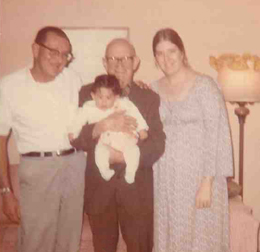
(The image above at left provides a glimpse of what George’s place at 827-C Haight looked like.
The snapshot was taken in February 1973 during a visit young George and his daughter Dawn made to
see the old man, coming up from Sunland, CA to Alameda. George is holding his six-month-old
great-granddaughter Lainne.)
George survived into his nineties. Moreover, he did so in good health. One could even describe him
as robust -- certainly compared to other people his age. Aside from issues he’d dealt with since he
was a young man such as his lack of teeth and his need to wear eyeglasses, he had only one medical
ordeal along the way. He developed a painful rheumatoid arthritic condition. It forced him to have
to use a double set of canes in order to walk. Fortunately he responded to treatment. Bob McDonald’s
widow Loretta helped him with his physical therapy. She was a professional nurse and she was close
at hand because though she had by then moved out of 1442 Morton Street, she had only shifted a few
doors down to 1418 Morton. The pain in George’s joints subsided. He continued on in fine form until
his final few weeks of life.
One day in early May, 1977, George did not drop by at 1535 Ninth Street. Helen grew concerned
because it wasn’t like him to skip a day unless he had mentioned in advance that he would do so.
She sent Steve over to his place. The boy, now a senior in high school on the verge of graduating,
could not see any sign of activity within the dwelling, but found an unlatched window in the back
that allowed him to enter. George was inside, and was alive, but he had been unable to get out of
bed because a stroke had paralyzed one side of his body. The teenager called an ambulance and
George was taken to Alameda Hospital.
A measure of George’s vigorous constitution is that in spite of the severity of the stroke, he
began to recover. It was only a fraction of a month later, when confronted by his son George Jr.’s
stated intention to move him down to a nursing home in the San Fernando Valley, that he understood
he was not going to be able to truly go home nor to continue on in some semblance of his prior
existence. His spirits faltered. He slipped into a coma. He succumbed entirely 27 May 1977 while
still at Alameda Hospital.
George held on to such an extent his lifespan was the third-longest of all of the grandchildren of
John and Martha Branson. At the time of his death, only three of the other grandchildren were still
alive, and two of those were much younger than George. He even outlived his stepson, Herbert
Porterfield having died in 1969. George’s grave is at Park View Cemetery of Manteca, there among
the resting places of close relatives such as his mother, his brother Clarence, his aunt Nan
Branson Harrington Napier, and also second wife Bessie Reisinger Johnson. His first wife Elizabeth
Glenn Bennett Johnson’s remains by contrast lie with her mother and sister at Pacific Crest
Cemetery of Redondo Beach, CA.
Child of George Bertrand Johnson with
Elizabeth Glenn Bennett
George
Bertrand Johnson, Jr.
Child of George Bertrand Johnson with
Helen Ivadel Reese
Steven
Douglas Lindsey
To go back one generation, click here. To return
to the Branson/Ousley Family main page, click here.