Mary Jane “Mamie”
Branson
 Mary Jane Branson, the
third child and first daughter of Reuben Branson and Louisa Armstrong, was born 8 November 1877 in
Mariposa County in or near one of the spots in the hills where her father was employed. The location
would have been either near the McCabe or Chase gold mines, or near the lumber operations at Hite’s
Cove. Mary Jane, known lifelong as Mamie, is not to be confused with her father’s sister, Mary Jane
Branson Johnson.
Mamie grew up in the hills along with many brothers and sisters, the family’s home shifting
as her father worked different claims, in particular those in the Potter Ridge Mining
District of Mariposa County and the Grub Gulch region of Madera County. The longest-term home was
in the quarry town of Raymond, Madera County, through much of the 1890s.
Mamie was somewhat crippled. Two stories survive among family lore to explain the infirmity. One
tale is that she contracted polio as a child. The other is that as an adolescent she fell and
dislocated a hip. This accident occurred when she was working as a servant in a home.
Her employers were Christian Scientists, and when Mamie tripped and came down hard on a brick
hearth, they would not summon a doctor because doing so was against their beliefs. The injury was
ignored until proper healing became impossible, leaving one leg permanently shorter than the
other. The latter story is considered more likely to be true
because Mamie led an active life as an adult, carrying a full workload, and she is often seen
standing in photographs. In short, though her body had been damaged, she still had command over
it. However, her condition may explain why she never had children.
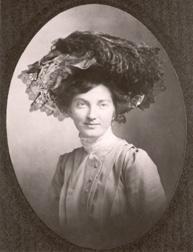 Mamie was an adult by the turn of the century, when her parents
moved to Randsburg in easternmost Kern County. She had the option of remaining behind in the gold
country, but she appears to have joined the migration. Then, when her mother and sisters went on to
San Jose, she appears to have stayed in the Mojave Desert, probably for reasons of courtship and
romance. In about 1904, she married railroad worker William Emmett Dougherty. The youngest child (by
far) of Lemuel McCallum Dougherty and Margaret (Maggie) Reed, Emmett was more than eight years younger
than Mamie, having been born 19 December 1885 in Hartford, Lyon County, KS. Raised in Kansas, his
mother had died when he was ten years old. His sister Sarah Belle had then become the maternal figure
in his life, and this would continue to be the case. In late 1898, his father remarried, but a few weeks
later, Belle married her first husband Charles Christopher Reardon, and Emmett became part of their
household, freeing up his father to begin his life with new bride Anna Kunkle Hurd unencumbered by
offspring. The Reardons moved from Kansas to Needles Township, San Bernardino County, CA by the turn of
the century. Emmett appears with them in the 1900 census, already employed at age fourteen as a “call
boy.” This means his job was to deliver telegrams.
Emmett was probably only eighteen years old when he became a husband. Mamie was apparently sensitive
to the extreme difference in their ages and told everyone she was only a year older than he. In this,
she was just like her mother and her sisters Mabel and Margaret, who drastically “adjusted” their
reported ages downward while married to younger men.
The couple moved about quite a bit during their years together, and given that they left no
descendants to tell their story, the picture of their married life is not entirely in focus, but
public records confirm at least this much: They remained in the desert until 1909 or early 1910.
Emmett continued to work as a railroad engineer. Given that there were no children to tie Mamie to
a home setting, she may have accompanied her husband some of his runs, but chances are high she
stayed behind, meaning she spent a large portion of each week and/or month almost as a single woman.
The home may have been at first in Needles, but soon it was in Barstow, San Bernardino County.
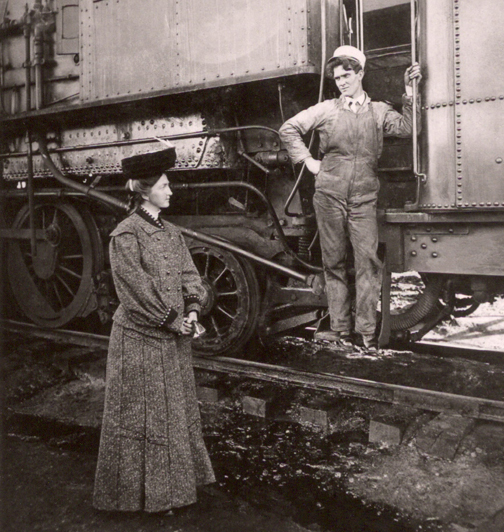
Mamie and Emmett in his days as an engineer
By 1910, Emmett apparently gave up his railroad career for good, though there is a chance he resumed
it for a period in the next few years. He and Mamie relocated to a farm in Fresno County, CA.
(The 1910 census curiously describes this as a “round house” farm.) The pair probably remained in
Fresno for a very brief time. They could not have stayed longer than seven years, because the
1917-1918 voter register and Emmett’s 1918 draft card shows that he and Mamie were by then back in
San Bernardino County, residing in Atolia, a very small community located slightly south and
east of Randsburg. Randsburg had continued to be where Mamie’s brother Robert E. Lee Branson was
based. Robert was soon to leave for a while, but about that point, and Mamie’s mother Louisa and
little brother (perhaps actually a nephew) Herbert Raymond Branson moved there. Mamie had kinfolk
living near her for what may have been the first time since she had become a married woman. She
would never again be widely separated from members of her immediate family.
Emmett is described on the draft card as a miner, but this was another temporary occupation. By
the late 1910s, mining had become a difficult way to make a living in the southern half of California.
It’s not surprising he shifted to one of the region’s mainstay sources of employment -- he became an
oil worker. He and Mamie moved to Taft, Kern County, CA, probably arriving in the late summer or
early fall of 1920. Taft had just become home to Mamie’s sister Margaret and brother-in-law Jack
Cowsert and family. By the mid-1920s it would also be home to her brother Robert’s ex-wife Etta
Cowsert Branson. Mamie therefore got to be an on-the-scene aunt for a gaggle of nieces and nephews.
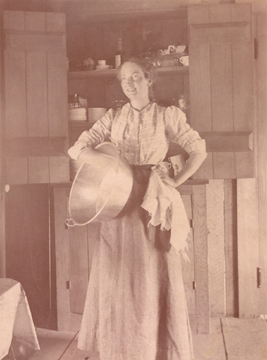 In the early 1920s, Mamie and Emmett parted ways. The cause
is unknown. The gossips among the Branson clan wondered if perhaps Emmett had wanted children all along
and therefore gave up on Mamie once she was far enough into her forties that he saw no hope that she
would ever become pregnant. But if that was Emmett’s reasoning, it turns out he wasn’t overly bothered
by childlessness. When he married again in 1926, he chose a forty-five-year-old bride.
Emmett appears in the 1924 voter register in Taft. That is chronologically the last trace of him
found that puts him near Mamie. It may be that his name had simply not yet been purged from the voter
rolls and he had departed years earlier. He spent a while in the oil fields of Oklahoma, then he and
his second wife put down roots in Colorado. His father and his sister Belle -- now married to second
husband Howard Harold Sands -- had moved there some years earlier. It may even be that when Emmett
went to Pueblo for the late November, 1920 funeral for his father, he chose that point to break up
with Mamie, never returning to her in California. He wed Marie A. Bundy 7 January 1926. This was a
lasting union. In the 1930s the pair established themselves in Fremont County, where Emmett raised
cattle. He died 20 February 1942 at his ranch near Penrose of a self-inflicted gunshot wound to the
head. His grave is at Lakeside Cemetery in Cañon City. Marie was laid to rest with him when she died
in 1964.
Mamie never married again. However, she was like her mother and her sisters -- she appreciated having a
man in her life. But also like her mother and her sisters, she didn’t worry too much about having a
ring on her finger before getting involved. Whether she went as far as co-habitating
with any of her lovers is not known. Public records do not make that clear as they do in the case of her
mother, who is shown in the 1910 census sharing a house with her beau Charles Hines, and in the case of
her sister Margaret, who twice became pregnant by Ed Gaver before marrying him, and who later spent years
living with Jack Cowsert before they got hitched. Any family
member who might have been privy to the particulars of Mamie’s romantic life as a divorcée have long since
carried that knowledge to the grave. There is however one surviving picture of her taken in the 1920s that
shows her with a fellow described on the back of the photo as a boyfriend. His identity is not known.
Whether she did so completely as a single woman or not, Mamie moved some time in the 1920s from Taft to
its sister community of Ford City. The two towns being essentially contiguous, she was therefore still
close to her sister and sister-in-law and their broods of kids. By 1930, most of those kids were reaching,
or had already reached, adulthood. One of the exceptions was her favorite, her niece Louise Cowsert, born
in 1920. Her bond with Louise was as close as Mamie would ever get to being a mother.
In 1930, Mabel Branson’s long-term marriage to George Latham, much of it spent in Pennsylvania, came to an
end. Mabel came back to the West Coast, using Oregon as her new base of operations because of the presence
of her mother and her stepfather, Joe Eagle, in Milton-Freewater, and “brother” Herbert Branson and
sister-in-law Alene in the Walla Walla area. Alene introduced Mabel to a new acquaintance, Alfred Wallace
“Doc” Bayn, and before long, he and Mabel became husband an wife -- his second marriage, her third. Doc
and Mabel began operating a getaway-resort inn known as Bigelow’s in the woods near Bend, Deschutes County,
OR. The gig required more innkeeping than the two of them could do on their own, so they hired Mamie to
help with the cooking and housekeeping. Mamie accepted with enthusiasm. (The photo of Mamie at left
was taken at the inn during this period.)
Unfortunately, Mamie’s participation in the business was not longterm, because
she died 9 February 1935. After her death, arrangements were made to transport her body to Madera,
Madera County, CA, where it was interred at Arbor Vitae Cemetery next to the graves of her brother
William Henry Branson and sister Mattie Branson, who had both perished in young adulthood. Later
her mother and her stepfather Joseph Eagle would also be laid to rest there.
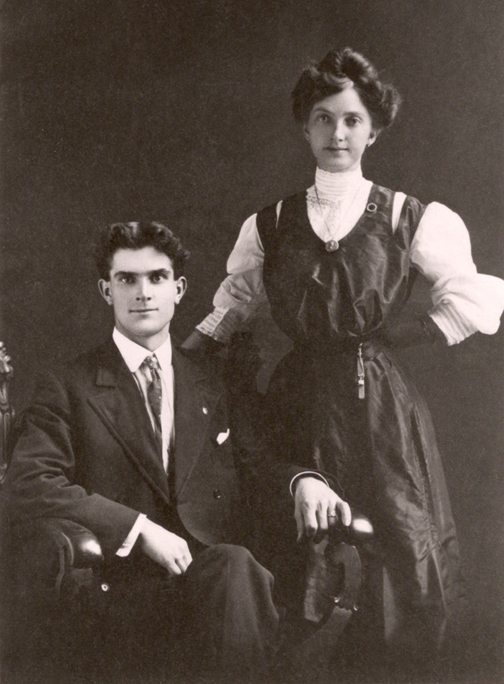
Mamie and Emmett in 1907
To go back one generation, click here. To return
to the Branson/Ousley Family main page, click here.