Lila Frances Reeb
 Lila Frances Reeb, the only child of Alma Branson and Frederick
William Reeb, was born 7 June 1905 in Hornitos, Mariposa County, CA. Her father Fred was the son of George
Reeb, a prominent citizen of Hornitos famous for the sausages and meats he prepared and sold at his butcher
shop, the Hornitos Market. The Reebs, Bransons, and Bauers knew each other well during the pioneer days of
Mariposa County, and as the years went on it was inevitable that some members of the younger generations
would find their spouses from among that pool of neighbors and friends. One particularly relevant example
is the union of Alma’s first cousin Elizabeth Ann Bauer, daughter of her uncle Michael Bauer and his wife
Mary Jane Geary, to Fred’s brother George Manuel Reeb.
A bit of genealogical trivia: Fred Reeb’s sister Katherine, who became Mrs. John B. Morrison,
was the grandmother of Jeanette Morrison, better known as film star Janet Leigh. So Lila was cousin to
Janet Leigh and therefore to Jamie Lee Curtis.
Fred Reeb died of typhoid fever when Lila was a toddler, and she spent some of her childhood in the home
of her grandparents Thomas Henry Ousley Branson and Frances Bauer in Hornitos, while her mother worked in
Merced, Merced County, CA as a nurse. Eventually, and certainly by no later than the autumn of 1913 when
her mother married Herbert Kibby Youd, Lila came back to her mother’s household full-time. Lila may have
been adopted by her stepfather. A small number of public records list her under the last name of Youd
but by age eighteen she resumed using the last name of Reeb again and would continue to do so until her
marriage. It is not clear if she had to legally change her name back or if it had only been Youd on an
informal basis.
Lila lived with her mother and stepfather in Merced until the cusp of her teens. In 1918 or 1919, the
three of them moved to Richmond, Contra Costa County, CA. Herbert found a job at the Standard Oil refinery.
Alma became a nurse at Cottage Hospital. The relocation was part of a greater exodus of the clan to this
town on the northeast shore of San Francisco Bay. Lila’s uncle George Manuel Reeb also came to work at the
refinery, as did her (step) uncle George Youd, both men bringing their families. Michael and Mary Jane Bauer
also migrated there, and in addition to their daughter Elizabeth (Mrs. George Manuel Reeb), most of their
other surviving children followed suit. It was almost as though, for this interrelated group, Richmond had
become the new Hornitos.
One relative was particularly close. In 1920 or 1921, Lila’s maiden aunt Inez Branson came to live with
Alma and Herbert and Lila. This would be a long-term arrangement. Inez did not move out until well into the
1940s and then came back in the late 1950s, and was part of the package even on occasions when the whole
household moved to different houses in Richmond, from 452 Ninth to 920 Barrett to 903 Barrett -- these three
dwellings all being within a stone’s throw of Alma’s workplace -- and finally to 600 Thirtieth. Soon after
arrival, Inez took up her long-term teaching position at nearby Peres Elementary School.
Lila attended Richmond Union High School and then obtained a degree in education at University of
California at Berkeley, graduating in June, 1927. (The image of Lila at the upper left of this biography
was taken from the 1927 UC Berkeley Blue and Gold annual.) For the next two or three years, she was
employed as a teacher in the Sierra Nevada region, as so many of her female relatives of the previous
generation had been, including her aunt Inez. In Lila’s case, the school was as remote as any her various
relatives had known. She was assigned to Loyalton Ranch, a very sparsely-populated area north of Lake Tahoe,
so far into Sierra County the foothills were not those on the Central Valley side that Lila had known in her
early childhood, but the foothills on the eastern side of the range, putting her almost in Nevada. She
finished this gig at the beginning of summer, 1930. In many respects, her three-year sojourn marked the only
time in her life she lived far away from the bevy of her extended family. (During the early part of her
undergrad years she was probably obliged to live in student housing, but if she got homesick, she she knew
she was only a short trolley-car ride from Berkeley back up to Richmond.)
Upon her return to Richmond -- and her move back into the home of her mother, stepfather, and aunt -- Lila
joined the faculty at her alma mater, Richmond Union. She was one of several female graduates of the high
school to come full circle and teach at the same institution they had once attended as students. Lila would
remain an employee of the Richmond Unified School District for four decades. She would become a school
counsellor some time in the mid-1940s, but in the beginning she was a teacher. The 1945 school annual
describes her as teaching History. One of her students in the mid-1930s was her own cousin (first cousin on
the Reeb side, second cousin on the Bauer side) Marian E. Reeb, daughter of Lizzie and George.
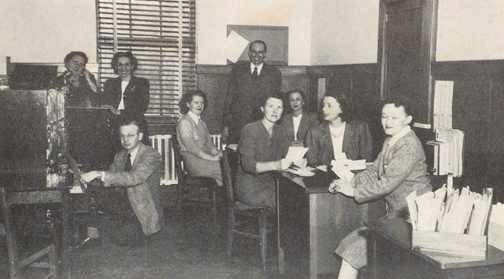
Lila is second from the right, seated, in this photo of the school counsellors from the 1947
edition of The Shield, the yearbook of Richmond Unified.
Lila remained single throughout the 1930s. Finally, she married. Her husband was Frederick George
Reinertson. He was far better known just as Fred G. Reinertson and appears in most public records under
that version of the name. Fred was born 22 February 1900 on a farm in Story County, IA, near the village
of Kelley. He was one of the youngest of fourteen children born to Edd Reinertson and Jennie Wilson, a pair
of Norwegian immigrants who had founded their farm as newlyweds in the early 1880s. (Their original names
appear to have been Adolf and Jakapena, and Wilson is surely not the Norwegian form of Jennie’s birth last
name.) As a twentysomething bachelor, Fred relocated to Omaha, Douglas County, NE, where he worked as an
attendant at a filling station. He spent some of his time there as a husband, having in December of 1922
married Alpha Orvald Keefe, daughter of Daniel Keefe and Viola Mae Webb. Alpha was another native of Story
County, IA and the couple may have initiated their romance back home, though the wedding itself took place
in Omaha. The union did not survive the decade. Restless for a better situation, Fred decided to head to
California. The impetus luring Fred out from Nebraska and Iowa may have been the fact that his sister
Florence Hopkins and family became based in the Pasadena area. Whatever the reason, Fred did come west. By
1935, he reached Oakland. By 1937 he was in Richmond. (Of the many children of Edd and Jennie, most remained
in Iowa. The exceptions were Florence, Fred, and Jessie, aka Mrs. Henry Sandness. The latter came to Lodi,
CA in 1937 and then went on to Long Beach five years later.)
More genealogical trivia: Fred’s ex-wife Alpha also came out to California, establishing herself in Los
Angeles by no later than 1930. Over the years, she married three more times. She passed away in 1997 in San
Diego County at ninety-five years of age. Her marriage to her third husband is part of an incredible
scenario. That husband was John Gordon Jefferson. Ostensibly John made his living as the owner and
proprietor of a garage, but his true profession was marrying women for their money. In his pursuit of
wives, he married eight women in eight years (1940-1948), managing to commit bigamy at least three times.
It was the latter practice that led to his arrest in April of 1949, which in turn led to extended newspaper
coverage of his trial and his crimes. Alpha was the seventh of those wives, sharing a state of matrimony
with him for part of the year 1947. What finally tripped John up was his attempt to land a ninth bride,
forty-seven-year-old divorcée, Mrs. Agatha Clark. He moved too swiftly with her, proposing to her at a dance
within minutes of meeting her, and then “borrowing” $2500 from her, ostensibly to renovate his garage,
even before the wedding had taken place. Agatha grew suspicious and began checking up on him, and when she
realized what sort of man he was, she called the cops.
In Richmond, Fred was once again a gas station attendant, employed by H.L. Jordan, but by the time he wed
Lila, he was his own boss. He had become the operator of a station in Richmond at 1300 McDonald along the
city’s main thoroughfare. Once in place, he made another attempt at matrimony -- but not with Lila, who
appears to have been his “rebound chick.” The 1940 census shows Fred with a wife, Grace. She was Grace
Fern Johnson, and she was more than a dozen years Fred’s junior. Originally from Texas, Grace had come to
southern California in her childhood. In 1929, she was impregnated by Harry E. Howard. The latter made a
token attempt at “doing the right thing” and married Grace a couple of months into the pregnancy, but did
not stick around long enough to be there for the birth of son Patrick Edward Howard in the summer of 1930.
The aforementioned 1940 census entry includes young Patrick as a member of the Richmond household. Grace
did not have any better luck lasting as a wife with Fred than she had with Harry. The couple are unlikely
to have joined forces any earlier than the latter part of 1939, and may not have done so until early 1940.
Grace may scarcely have moved in prior to the census date, and a few weeks later, she was gone. There does
not appear to have even been a formal marriage. Presumably the pair were intending to take their
relationship to that level, but while that intention was enough to convince them to move in together,
the romance fizzled. In which case, no divorce was necessary. Fred was able to marry Lila. The wedding
took place 16 June 1940 in Carson City, NV. Once again Fred was exhibiting his tendency to propose on a
dime, but as it turned out, the “third time is the charm” principle was in play.
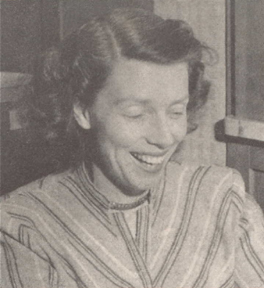 (At right, Lila as shown in the 1949 edition of The
Shield.) Marriage meant Lila finally moved out of the family home, but the homes she and Fred chose
over the years were never far from her relatives. She and Fred did not have children -- nor does he appear
to have ever been a father other than the brief interval he spent as the stepfather of Patrick Howard. She
continued to work at Richmond Union High School. All in all, her life went on much as it had through the
1930s, requiring her only to make a few adjustments in order to blend a spouse into the picture. That said,
there were some evolving circumstances through the 1940s and 1950s. She and Fred moved a number of times,
shifting during the war years from 1401 Barrett to 118 Murdock, both addresses in Richmond, and then before
the war had ended, to 6140 Park Avenue in nearby San Pablo, CA. By the early 1950s they were
back in Richmond at 345 34th Street. By the end of the 1950s, they moved to El Cerrito, just south of
Richmond.
In the early 1950s, Fred stopped managing the service station and became a farmer. (This detail comes
from the 1953 city directory.) Where he farmed is a bit of a mystery, because even in that era most of
the arable land along San Francisco Bay had become covered by houses. It is likely his workplace was on
the other side of the hills in the Walnut Creek area, meaning he was an unusual type of farmer -- one
who commuted to his job.
Lila -- along with Fred of course -- ended up with quite a bit of money in the latter portion of her
life. This was almost inevitable given her modest lifestyle, her steady income, the addition of Fred’s
income, and the absence of the financial drain children would have represented. On top of that, she was
her mother’s only heir and was quite likely her aunt Inez Branson’s primary heir. Among the things she
did with her funds was to establish the Lila F. Reinertson Scholarship at the University of San
Francisco School of
Medicine (possibly doing so as a memorial to Fred after his passing). She also contributed in 1964 in
her late aunt Inez’s name to the Montana Standard of Heart Fund, one of the charities her other aunt
Mabel Branson Culbertson had taken to supporting after the sudden heart-attack death in 1944 of her
husband Frank Culbertson.
The long period of domestic quiet and comfort ended with a series of deaths, first of Lila’s mother in
1958, then her aunt Inez in 1964, and then Fred succumbed as well. He passed away 28 March 1968 in El
Cerrito. The first two losses had left Herbert Youd soldiering on alone in the home he had shared with
Alma and Inez at 600 Thirtieth Street in Richmond. Lila
decided to move in, sharing a home with her stepfather well over half a century after she had first
done so. It is not clear whether she did so immediately after she was widowed, or came there a few
years later when her own health began to fail.
Lila officially retired from Richmond Unified in July, 1970. That was not to say she suddenly vanished
from the scene. If anything, retirement simply made it easier for her to broaden her involvement in her
non-job activities. She was a member of the Live Oak Branch of Children’s Hospital Medical Center in
Oakland, Richmond Business and Professional Women’s Club, and the Retired Teachers Association of Richmond,
and now that she had more time available, became the chairperson of the Richmond Citizens Urban Renewal
Advisory Committee. She was one of the forty-three investment partners in Fremont Associates, which
owned a restaurant in Fremont, Alameda County, CA and probably had other properties in its portfolio.
Finally, though, she had to slow down. A malignant tumor in her liver, first diagnosed in late 1971,
increasingly affected her vigor. She managed to withstand the cancer for a total of about eighteen
months before she succumbed. She passed away Wednesday, 25 April 1973. Funeral services took place
in Richmond three days later, Wilson and Kratzer Mortuary seeing to the details. Her grave is part of
a sequence of four at Sunset View Cemetery in El Cerrito devoted to her and her husband, mother, and
stepfather.
Speaking of her stepfather, Herbert Youd survived Lila, though he was nearly twenty years her senior.
In 1977, age ninety, tired of living without his wife and child and the various other loved ones who
had resided around him once upon a time -- and possibly diagnosed with a terminal illness -- Herbert
hung himself in the garage at 600 Thirtieth.
To go back one generation, click here. To return
to the Branson/Ousley Family main page, click here.