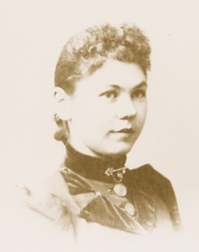
 Mary Lena Brown, eldest of the five children of Emma Ann Martin and
Cullen Penny Brown, was born 6 March 1876 in Martintown, Green County, WI. She was known by her middle
name to such an extent that it appears first in multiple public records.
Mary Lena Brown
Mary Lena Brown, eldest of the five children of Emma Ann Martin and
Cullen Penny Brown, was born 6 March 1876 in Martintown, Green County, WI. She was known by her middle
name to such an extent that it appears first in multiple public records.
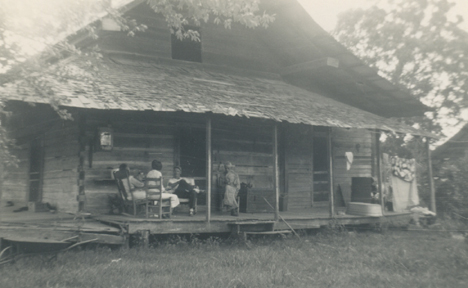
As a granddaughter of village founders Nathaniel Martin and Hannah Strader, Lena experienced an early childhood replete with a sense of place. Though there would eventually come to be a total of thirty grandchildren of the patriarch and matriarch, none outmatched Lena in the total number of years spent residing right in the village itself. Her childhood home was one of the three main houses of the Martin estate. All these dwellings were located on the north bank of the Pecatonia River just behind the family mills. The westernmost (largest) house was that of Nathaniel and Hannah themselves. The one in the middle belonged to Lena’s uncle Horatio Woodman Martin. The easternmost house was the one the Browns lived in. The greater part of the village of Martintown stood on the opposite side of the river. (A photograph near the end of this biography shows that house as it looked in its final, falling-apart days in the 1960s, a few years after Lena had passed away.) Lena attended Martin elementary school just a short walk across the bridge from her front door. She partook in religious services in the church built by her grandfather when she was three years old, a building she could see from her front yard.
This is not to say that Lena’s early childhood was entirely rosy. In 1878 her grandfather Nathaniel suffered a breakdown and was temporarily committed to an asylum. In the summer of 1879, her eighteen-year-old uncle Abraham Lincoln “Linky” Martin drowned in the river. A few months later a diphtheria epidemic began raging that would claim the life of her sister Minnie Edna Brown and then her equally young first cousin Ida Ellen Warner. Linky and the two toddlers were buried in graves Lena -- as she grew a little older -- could visit by climbing to the top of the low hill behind her house. But these dark events had the virtue of occurring when Lena was quite young and better days followed. Lena got to come of age as Martintown and the Martin clan were thriving, and this beneficence had a formative effect upon her.
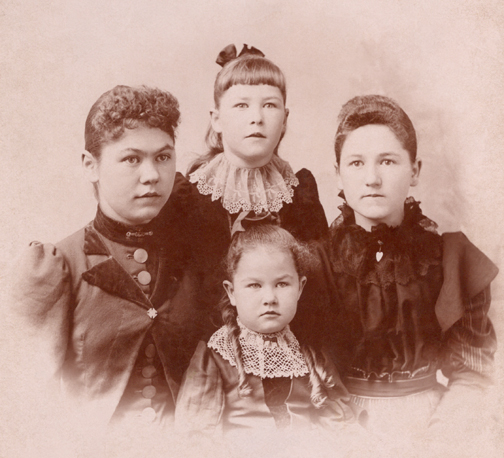
It is something of an irony that Lena would eventually be so linked to her birthplace, because her later childhood involved a good deal of time spent elsewhere. First, in 1883, her father accepted a position helping to set up a lumber business in Howell County, MO. Cullen Brown had apparently become well versed in what was needed to plan and build the infrastructure of a mill and then train the employees. Inasmuch as the project was likely to take a couple of years to complete, the whole family (consisting at that point of Cullen, Emma, Lena, and the littlest Brown girl, Ethel, born in 1880) moved down to Howell County. They were not entirely separated from the familiar relatives, though. Cullen was more than able to supervise the design and construction of the mill and the installation of its equipment, but he wanted someone gifted in salesmanship to establish a customer base, so he enlisted the help of his brother-in-law John Warner, husband of Lena’s aunt Nellie Martin. As the Browns had done, the entire Warner household relocated for the duration, moving to Willow Springs in the late spring of 1884 and remaining about a year. Lena’s cousin Bert Warner, the seventh of John and Nellie’s eight children, was born in Willow Springs in the late summer of 1884. Lena’s sister Lulu was born in West Plains, the county seat, in the autumn of 1885. Inasmuch as Lulu and even Ethel were still quite young during the Missouri sojourn, Lena was especially glad to have her same-age cousins Emma and Belle Warner near at hand.
 The Browns would not give up their ties to Martintown for quite a while
yet, and the house there was still their “real” place of residence, but the precedent of extended sojourns
elsewhere had been set. Cullen Brown continued to receive offers to establish sawmills in the South. Inasmuch
as he had been born in southern Missouri and was comfortable with the culture in a way that might have been
difficult for other men of the clan (all of whom had sympathized with the North in the Civil War and one of
whom -- John Warner -- had actually served in the Union Army), Cullen continued to accept offers. Almost
at once after leaving Howell County, the Browns were based in Kansas City, MO for a year or two, i.e. in 1886-87,
and then before the decade was out, plopped themselves down in Fort Smith, Sebastian County, AR. It was in Fort
Smith that Lena’s youngest sister, Ada, was born at the end of 1889. The household may have remained in Fort
Smith well into the 1890s, though documentation is sparse enough that it is also possible they returned when Ada
was still a small infant. They were definitely back by 1894, though, whereupon they remained until 1898.
By the time of Ada’s birth, Lena was already a teenager. She had spent enough years in Martintown that her affection for the village became instilled in her. This was reinforced by the presence of her sisters-of-the-heart, Emma and Belle Warner. Soon the three young women’s destinies would become even further intertwined as a consequence of their marriages to various grandsons of Green County pioneers William S. Spece and Julia Ann Youngblood. Their children therefore would be cousins to each other on both maternal and paternal sides.
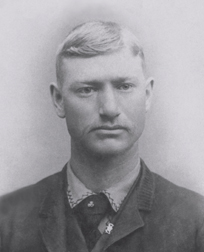
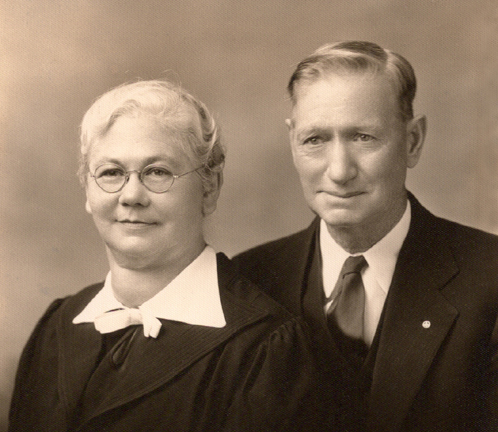
The first of the three marriages was that of Belle Warner and Alfonso James (“Alie”) Spece in late 1894. Ten months later, Lena married Alie’s first cousin Frank Opal Hastings (shown at left). Born 19 May 1868 just north of Martintown in Cadiz Township, Frank was a long-time neighbor known to Lena from an early age. The final pairing in the sequence was that of Emma Warner to Frank’s brother Fred Philo Hastings, who tied the knot in late 1897.
 Lena and Frank’s wedding took place 9 October 1895 in
Green County. The event involved a buggy ride that
remained famous in family lore. Frank’s parents Barbara Ann Spece and John Quincy Adams “Picket” Hastings
rode with the young bride and groom. Picket Hastings, a Civil War veteran, was known for enjoying his
liquor, and the celebratory occasion had given him license to indulge himself. He was roaring drunk as
the buggy rolled on down the road on its way home. Lena is reported to have said she wondered what kind
of a family she was getting into.
Lena and Frank settled in Martintown. Inasmuch as Emma and Cullen Brown and their younger girls were so often in Arkansas, the house Lena had grown up within was available to Lena and Frank to occupy as newlyweds. It was not officially their house, though. It still belonged to Cullen and Emma, and when the middle-aged couple and their three younger girls were not in the South, the quarters could get rather crowded. This was the case for much of the calendar year 1897, the year that Lena and Frank’s first child, John Cecil Hastings, was born. But in 1898, Cullen was hired to found a sawmill in DeQueen, Sevier County, AR. This was a new and rapidly expanding community and was so attractive a place to them that Cullen and Emma soon began to look at it as their “real” home, as did Ethel, Lulu, and Ada. The visits to Martintown became less frequent. Lena and Frank chose a different course. At first, the young couple considered becoming part of the relocation. They went south in the spring of 1898 and were in DeQueen when second son Leland Francis “Hap” Hastings was born at the begining of October of that same year. Lena and Frank would not linger much longer, though. They came back to Martintown. The 2 November 1898 edition of the Monroe Evening Times describes this scenario: “Mr. and Mrs. Frank Hastings are coming back from Arkansas. They went there last Spring and have been sick the most part of that time. They think Wisconsin is good enough.”
The family was now up to two kids. It would grow to eight children. Frank needed a breadwinning job. He found one with Illinois Central Railroad, launching in 1899 what was to be a thirty-eight-year career. His specific task was track maintenance. This sometimes meant he had to be sent to locations that required him to stay away from home overnight. For quite some time, none of these postings was lasting enough or far away enough to warrant uprooting the whole family and moving. Instead, Lena would stay in Martintown with the kids while Frank made do with temporary accommodations. One example of a posting was Dodgeville, Iowa County, WI in the summer of 1906. Finally in 1907 came the one exception to the rule of keeping the family base in Martintown. Frank accepted a posting almost a hundred miles to the north in Dilly, Vernon County, WI. By then there were five children, the new ones being Ruth, born in 1900, Jim, born in 1902, and Fred (often called Fritz), born in 1905. The need to stay together as a unit was important, so Lena and the kids came north as well. The rented house in Dilly is where sixth child Ernest Brown Hastings was born in the early autumn of that year.
 There may have been a negative reason for leaving Martintown.
Right at that point -- the period from 1905 to 1910 -- the Martintown area was hit hard by tuberculosis. Some
victims were neighbors. Some were close members of the clan. At the beginning of 1906, Minnie Warner, wife of
Belle and Emma’s brother Cullen, died even though she had only a short while earlier been a robust young woman
in her mid-twenties. Ninety days later Lena’s uncle Horatio Martin succumbed to a case that had only manifested
as of the latter part of 1905. Lena and Frank may have felt it was a good time to remove themselves.
TB or not, Martintown was too dear in their affections to stay away for long. Back Lena and Frank and their growing family came early in the winter of 1907-08. They did not, however, return to the legacy home in which Lena had been raised. That had been sold when they moved away -- not just because they were moving, but because Cullen P. Brown had been killed in a sawmill accident at the end of 1906, and selling the property made the division of the estate assets cleaner and less fraught with conflict than if Lena and Frank had been forced to come up with the funds to buy out her mother and sisters. When they returned, they moved into a different house on the top of the hill in the main part of the village, not far from the church. Unlike the other house, this one was purely Lena and Frank’s, not a holdover from her parents’ tenure in the community.
Nathaniel Martin had died in 1905. Lena was one of the local grandchildren Hannah depended upon during her widowhood, a span that stretched for nearly fifteen years. Others who helped in this were Emma Warner Hastings and Rose Bucher Buss, but toward the very end it was Lena who was Hannah’s primary caregiver.
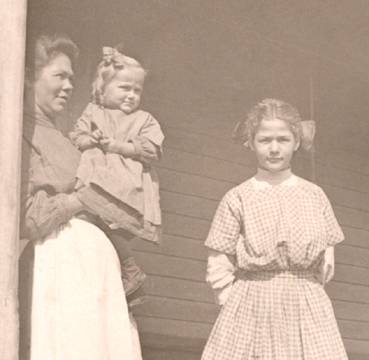
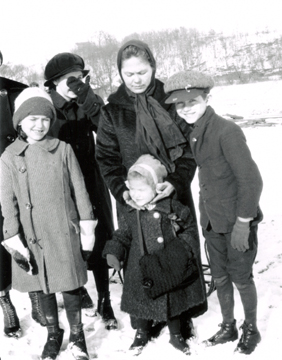
Two more children came along, Mary in 1910 and Anna in 1913. (Above, Lena is shown with her oldest and youngest daughters, Ruth and Anna, in 1914 or 1915. At left is Lena with several of her younger kids on a snowy day in the late 1910s.) Their childhoods of these two daughters was spent entirely in Martintown. For the most part, all of the kids stayed close throughout the first three decades of the Twentieth Century, the exception being Jim, who enlisted in the military in his late teens and was posted far from home. (California soon became his place of residence.) Hap stayed closest of all, becoming the proprietor of Martintown’s general store -- a job which included being the postmaster. (After a few years, though, the economic decline of Martintown prompted a relocation by Hap and his family to Winslow, Stephenson County, IL, a mile south of Martintown.)
For the last four years of his career, Frank was a track maintenance foreman in Rockford, Winnebago County, IL. During this interval he and Lena maintained a home in Rockford, but did not give up on Martintown -- in fact, Frank served as Martintown/Cadiz Township clerk during those same years. He did not quite die in Martintown, however. Two years after he retired, Frank was diagnosed with the case of stomach cancer that would soon claim his life. He was cared for in his final days and hours in the apartment above Hap and Hulda Hastings’s general store in Winslow, and that is where he breathed his last in the early morning hours of 13 May 1940. He was just shy of seventy-two years old. His memorial service was held two days later at Hastings Confectionary in Winslow, the candy store/restaurant/bakery owned and operated by son John Cecil Hastings and his wife Wanda. The burial took place at Saucerman Cemetery, Green County, WI.
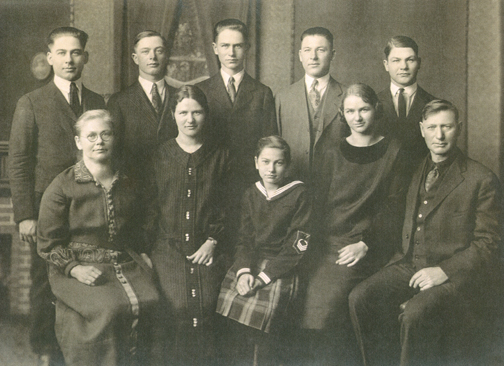
Lena and Frank Hastings and their eight children in the mid-1920s. From left to right in back, John Cecil, Frederick Cullen, Ernest Brown, James Lawrence, and Leland Francis Hastings. From left to right in front, Lena, Ethel Ruth, Barbara Anna, Mary Hilda, and Frank Opal Hastings.
Lena did some travelling in her later years. She and Frank, along with their two youngest, went west in 1936 to spend some time getting to know their new daughter-in-law Blanche, wife of Jim Hastings. The occasion gave Lena and Frank a chance to see the many members of the clan who had long since settled in the San Joaquin Valley, a group that included Belle and Alie Spece. In the mid-1950s, as a widow, Lena came to California again for that same daughter-in-law’s funeral, and once again the excursion doubled as a family reunion. After daughter Ruth and son-in-law Rolland Parsons moved to Boston in the mid-1940s, Lena made trips East as well -- for example, a visit of many weeks in the summer of 1951 to help with preparations for a granddaughter’s wedding. The free go-anywhere-in-the-country pass Lena possessed as the widow of a long-term railroad man came in handy.
 Lena survived Frank by more than two decades. With her widowhood,
her home in Martintown came to be too isolated a place for her. A turning point came in the
spring of 1953. Lena was visiting her daughter Mary and son-in-law Eggo Koning, who were preoccupied moving
into a new home on a farm in Winnebago County, IL. Lena was carrying a freshly-collected batch of eggs
down to the basement pantry when she slipped on the stairs and fractured a bone in an arm and a leg. She
healed up just fine, but despite her desire to dismiss the incident as just an error of judgment -- she
had been wearing her Sunday shoes, not the best footwear with which to navigate a set of basement stairs
-- she was urged not to be on her own too much. She took this to heart and spent much of her remaining
eight years of life residing with one child or another. The child she stayed with more than any other was
Mary, on the farm near the villages of Seward and Pecatonica. When she did make it back to her own house,
she was often kept company by a family member. These included not only her children or children-in-law or
grandchildren, but members of her own generation such as Emma Warner Hastings.
Lena’s health fell to a critical low in the summer of 1961. In early August, she was brought to the home of her son John and daughter-in-law Wanda in Winslow. She lasted only two weeks more. It was obvious she was dying. Family members made a special effort to drop by and see her, and some then lingered for the actual death vigil. By the time she finally expired 21 August 1961, all of her children and many of her other descendants and descendants-in-law had been able to come, except for son Jim, who was unable to make it there all the way from California. Many of them were with her as she quietly slipped away. Her body was interred at Saucerman Cemetery, as Frank’s had been.
Lena was blessed in the sense that all eight of her children thrived and outlived her. She was not so fortunate when it came to her grandchildren. A distressing proportion -- eight out of the twenty-six -- perished before adulthood. Six died very young. Another, Paul Eugene Hastings, died at sixteen in a car accident. Lena endured the anguish of these seven losses, but her own demise spared her from knowing that the very last of her grandchildren, Blanche Anita Fernstaedt, would ultimately pass away at only eighteen years of age.
To this day many of Lena and Frank’s descendants live in the Wisconsin/Illinois border region, a group which represents the largest clump of descendants of Nathaniel Martin and Hannah Strader to remain so close to where the founders of the clan dwelled. The same could be said for the Spece/Youngblood clan. While the Hastings branch is still well-represented locally, the greater part of the Spece clan went on to Iowa, an exodus that began in the early 1870s.
Children of Mary Lena Brown with Frank Opal
Hastings
For genealogical details, click on
each of the names.
To go back one generation, click here. To return to the Martin/Strader Family main page, click here.