John Sevier Branson
by Dave Smeds
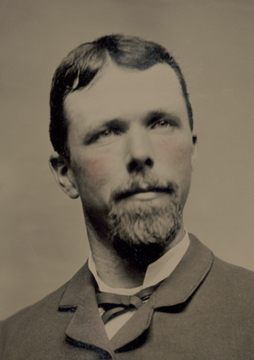 John Sevier Branson, a son of Thomas Branson and his
second wife Anna McGown (aka McGowan), was born 17 March 1826 in Tennessee. He was named after John Sevier,
the state’s first (and five-term) governor, who had earlier been the
governor of Franklin, a territory that petitioned for statehood but did not quite succeed in being admitted
to the union, its land ultimately becoming a dozen of the northeastern counties of Tennessee. John Sevier
the governor was not only the sort of much-admired founding father parents liked to name their sons
after, but he was also a cousin of “our” John’s grandmother. The distinctive middle name makes John
Sevier Branson a kind of genealogical landmark. An abundance of Bransons with common given names
(William, Robert, James, John, Andrew, Thomas, Susan, Ann, Elizabeth, Sarah, Mary) were born in the
southern states between the Revolutionary War and the Civil War. Many of these Bransons were part of
huge families. Many of their identities have since become obscured by the poor record-keeping of the
day, or by losses since, for example the burning down of the courthouse in Marion County, TN, or by
disinformation arising from lazy genealogy. It is particularly easy to get confused by the existence of
several Andrew Jackson Bransons, many of them closely related. John Sevier Branson presents the opposite
challenge. Apparently all mid-1800s references point to the same man, which tempts family historians to
regard him perhaps with too much scrutiny. Some of those researchers have been unable to resist
“adopting” him. One of the most persistent errors is the number of members of the family. The best
research indicates only twelve. His eleven siblings were Sarah, Jared, Mary Ann, Andrew,
David, Reuben, Margaret, Nancy, Ann, George Washington, and Rhoda. However, many genealogists add
Madison, Stephen, Thomas Jr., Andrew Cornessus, and another (!) Mary Ann. The mistake stems from an
1850s list of John’s father Thomas’s heirs from a dispersal-of-estate court filing -- a list
detailing who would receive what shares of the money generated from the sale of Thomas’s land. The extra
five were Thomas’s grandchildren, the surviving progeny of his late son Jared. These five split the
inheritance share Jared would have received had he still been alive. As orphans, these five had moved
from Marion County, TN to Gasconade County, MO to join their grandfather and remained closely associated
with Thomas and his descendants and with the geographical area (four are buried in the same cemetery
there). Interestingly, John himself did not receive his part of the heritage proceeds -- perhaps it was
too logistically difficult to send the sum to him, given that he was in California by then.
When I wrote the first version of this essay in 2005, firm knowledge of the Branson family prior to
John’s generation was so unreliable I regarded it as a kind of will-o’-the-wisp. Some of it was the
problem noted in the above paragraph -- bad record-keeping on the part of officials, and the destruction
or loss of records over the years. It’s also because so very many members of the relevant line of
Bransons were just about uniformly illiterate. They didn’t create personal genealogies, and by the
time descendants tried to make up for that lack, too much information had become murky due to faded
memories, a lack of any reference material, or due to guesses that led to additional confusion. I didn’t
even have the
benefit of a family Bible as a resource. John and his wife Martha did own a Bible over the course of their
marriage and it did contain some basic facts about their forebears (in spite of the fact that they were
both illiterate and did not personally make the entries), but that Bible was destroyed in a house fire a
year or two before the end of John’s life. An attempt was made to restore the burned record, but only to
the extent of recreating the list of names and birthdates of John himself, his wife, and his ten
children.
I found the lack of dependable source material to be incredibly frustrating. I didn’t want to upload
anything lengthy about John’s ancestry unless I could be sure I was
giving an accurate account, and yet an accurate account was impossible in the face of so many unanswered
questions. Therefore in 2005, I only sketched in the story of his father and grandfather here in the
midst of this one page. Instead I paid attention to the stories of his descendants, resulting in the
120-plus biographies of his children, grandchildren, and great-grandchildren you can find elsewhere on
this site.
A lot has changed since 2005. I’m not so in the dark anymore. The story of the older generations has
increasingly revealed itself. I still have certain questions, but I now feel as though I can tell the
tale of John’s father, Thomas, and of his brothers and of his father, Jarred, in a meaningful way. That
essay remains a work in progress, but I have done a lot of work on it and I will of course share it. If
you’re wondering why it’s not already here, it’s because after all this delay, I want to be sure to “get
it right” and tell the story properly, because there are literally tens of thousands of descendants of
Jarred Branson out there in the world today, and I don’t want them to have an unpolished version of what
I have to share. Stay tuned. This site will in the future have a page called The Branson Clan of
Gasconade County. In the meantime, I have left some of my original “sketched in” account, which
you will find immediately below in the “Ancestry of John Sevier Branson” section. I last revised those
paragraphs in the summer of 2023.
The Ancestry of John Sevier Branson
John was a son of Thomas Branson, a man born in 1778 at Burks Fork, VA in what was then Montgomery
County. Jurisdictions in that part of Virginia were later rearranged and the site of Burks Fork is now
to be found within Carroll County. Thomas died on his farm in Third Creek Township, Gasconade County, MO
in 1851. Thomas’s mother was almost certainly Sarah Cock (from a family whose other members more often
appear in sources under the name Cox). Thomas’s father was Jarred Branson, born in the 1750s (probably
in 1754) in Virginia, who died in early 1831 in Gasconade County. Jarred and Sarah had six known
children, born between the mid-1770s and the mid-1780s, consisting of John, Thomas, Andrew, Mary Ann,
Jared E., and Valentine.
Jarred’s origins are difficult to pin down. That is part of the reason I have not uploaded the longer
version of the story. In a nutshell, though, Jarred was part of a clan of Bransons that goes back to
Englishman Nathaniel Branson (1605-1678). Born in Ipswich, Nathaniel became enthused by the teachings
of George Fox and by the mid-1600s, became a dedicated member of the Friends movement, which is to
say, he became a Quaker. Nathaniel moved to Berkshire, England at that point in order to be among
others who had found Fox’s writings and speeches to be compelling. Many of his immediate descendants
were just as devout as Nathaniel, and his line could fairly be described as the “Quaker Bransons.”
Nathaniel’s grandson Thomas L. Branson (1670-1744) was among those Quakers to become established in
the colony of New Jersey. There is no question in my mind that Jarred “sprang from” Thomas L.
Branson -- probably by being a great-grandson. But just where he fits is the question. Modern-day
descendants
of Jarred have donated DNA samples and the y-chromosome pattern derived from those samples does
not match the pattern of most male-line descendants of Thomas L. Branson. There clearly is some
wrinkle to Jarred’s origin. He is not simply a son of a son of a son of Thomas L. Branson, even though
that scenario would ordinarily be the logical framing of how he came to be. Instead, Jarred may have
been a son of a Branson female and ended up with the last name Branson because of he had no biological
father willing or able to pass his “actual” name down. Perhaps he was an adopted stepson of a Branson
male, i.e. a boy whose mother married a Branson man as a young widow with existing offspring. Or
perhaps Jarred was an adoptee of some other sort. For the time being the question is still unanswered.
Jarred and Sarah stayed at Burks Fork for a number of years, perhaps even until their youngest, Valentine,
was a small child. The couple went on to Patrick County, VA, and it was while they were in that county
that all six of their children finished growing up and became married adults with offspring of their own.
The first to obtain a spouse was Thomas, who in approximately the year 1800 wed a wife whose identity I
have yet to determine. Over the course of the succeeding decade, that wife on to give birth to the first
five of Thomas’s children -- Sarah, Jared, Mary Ann, Andrew, and David -- before she passed away in either
1810 or 1811.
Losing his wife seems to have spoiled Thomas’s satisfaction with his circumstances. In the latter half
of the year 1811, he put Patrick County behind him for good, and began migrating down along the
Cumberland range into Tennessee. Along the way -- possibly during a stopover in Kentucky -- he became
familiar with the McGown family, and soon wed Anna McGown, who was about fourteen years his junior.
She would go on to give birth to the remaining seven of Thomas’s kids, with John Sevier Branson being
the last.
By no later than 1814, Thomas and his new bride settled in the Sequatchie Valley, almost as far south
in Tennessee as one could go, and almost in Alabama. The area was then part of Bledsoe County, but
soon Bledsoe was reduced in size, with the southern portion, where the Branson farm was located,
becoming Marion County. The Sequatchie Valley seemed to be a promising place to stay and was
home to Thomas and Anna for a decade. Coming along with him, or joining him soon after, were his
siblings Andrew, Mary Ann (Haines), and Valentine. Another close relative showed up -- John Branson.
Some researchers assume he was Thomas’s older brother of that name, but I don't think that’s right.
The older brother, as far as I can determine, had died back in Patrick County prior to 1810, and the
John who came along to Marion County -- who would eventually become known to modern-day Branson
researchers as John Jefferson Branson -- was a first cousin, meaning he was Jarred’s nephew, though
just how this works out genealogically speaking is another of the mysteries I’m still trying to sort
through.
In the mid-1820s, Thomas and his brothers became enthused by the idea of moving west. (The decision
may have had something to do with the fact that the Sequatchie River region was within the malaria
zone.) While various relatives including his own three eldest children
cleaved to Marion County, Thomas moved to Gasconade County, MO. Along with him -- or following soon
after -- came his brothers Andrew and Valentine and also John Jefferson Branson. Joining them, having
never been part of the Marion County sojourn, was final brother Jared E. Branson. The old folks,
Jarred and Sarah, were part of the scene as well, though they passed away within the first few years
of occupation.
This arrival in Gasconade in the late 1820s marks the founding of what I and many others call the
Branson Clan of Gasconade County. To this day there is a heavy presence of descendants of Jarred and
Sarah, particularly
the descendants of Thomas Branson (1778-1851). The longer essay will go into much greater detail. For
now, the important thing to convey is that Gasconade County was where John Sevier Branson spent nearly
all of his childhood. He came close to being born there. His birth occurred in Claiborne County, TN as
Thomas and Anna were navigating north from Marion County to the main wagon route that would take them
west into Missouri.
The Life of John Sevier Branson
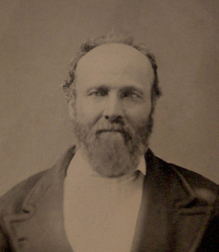 As mentioned above, John was born 17 March 1826. He
was proud of the fact that he was a native of Tennessee; nevertheless, it is almost certain that by the
time he was an adult, he had no direct memory of the place. His parents’ farm in Third Creek Township near
Mount Sterling was surely the only “home” he pictured when he was reminiscing about his early days.
John’s upbringing was for the most part steady and secure, but with a couple of major exceptions to
that rosy picture. First, he lost his mother while still at a rather tender age. While a precise
death date for Anna McGown Branson is not available, she seems to have succumbed in the mid-1830s.
John was probably nine or ten when it happened. In 1836 or 1837, John acquired a stepmother, Susannah
Wyatt, formerly the wife of Jacob Coffelt. Susannah had recently arrived in Missouri, having tagged
along with her grown son Pleasant Coffelt as he became a settler in Third
Creek Township as a neighbor of new widower Thomas Branson. John and his close-to-the-same-age
sisters, Anna and Rhoda, seem to have been heavily influenced by Susannah in terms of politics.
Susannah was a staunch proponent of the institution of slavery and looked dimly at the authority
of the federal government, whereas Thomas and his late wife Anna appear to have held views that
were moderate on those issues. The second upheaval in John’s childhood was the arrival of his nephews
and nieces. These were the offspring of his eldest half-brother Jared, who along with his wife had
passed away back in Marion County, TN. These orphans may or may not have crowded into the same house
where Thomas lived -- they may have instead been boarded in the homes of nearby neighbors and
relatives -- but Thomas looked after them all and it is plain John had plenty of competition for
his father’s attention.
Some of the other folk who lived in Third Creek Township or in adjacent townships were members of
the Ousley clan. In the early 1840s, John’s sister Rhoda married Robert Housley Gilmore. This was one
of many intermarriages between the Ousleys (Owsleys, Housleys) and the Branson clan. In the mid-1840s,
a new arrival was Robert’s first cousin William Ousley. Within him came his teenaged sister, Martha
Jane Ousley, who was on hand to help her sister-in-law keep house and deal with the babies. John
and Martha seemed to have hit it off at once, and were soon wed. The happy event probably occurred
in January, 1846, but alas, the precise date is one of the stats that was lost when the Bible burned,
and like many early Gasconade County marriages, does not appear in surviving county records. The date
is an educated guess. It is unlikely they became a couple before the end of 1845, and Martha
gave birth to first child Reuben Branson 16 November 1846. A wedding in January, 1846 would fit well
within the time frame.
John and Martha did not found their own farm while in Missouri. Instead, they stayed with John’s
father and stepmother in Third Creek Township and with William Ousley a few miles away in Osage
County, going back and forth between the two places. I used to wonder why John did not try to acquire
acreage of his own there in familiar stomping grounds. I am no longer surprised. I believe John was
too ambitious to ever consider that obvious path-of-least-resistance. As a confident and enterprising
sort of man, he dreamed of a life westward. It is true that if he had stayed, he would have been
“helped along” just fine. The Branson clan was extremely well established in south-central Missouri by
that time. His father and uncles were well-known pioneers and property-owners. A number of his brothers
were well on the way to making their own marks. For example, Andrew would be among the most prominent
men of Osage County in the middle and late decades of the Nineteenth Century, becoming a
long-remembered judge for whom local sites were named including the village of Judge. George Washington
(aka “Wash”) Branson would go on to be nearly as well-known. David Branson, who moved to Maries County,
kept amassing cattle and property and eventually had so much net worth he was able to let his money make
money in the form of loans to others. At the time David died in 1881, his estate was said to be the
largest in Phelps County, where he had moved in his later years. But John did not want to live in the
shadow of his older relatives. If he had stayed, he would always to some degree have been Tom’s youngest
boy or Andy, David, and Wash’s kid brother. That wasn’t good enough. He wanted to be his own man. The
only sure way to accomplish that was to go where nobody knew his kinfolk.
Some of the details of John’s early adventures are laid out in a 1959 letter written by John Joseph
Branson, one of his grandsons, in answer to questions posed by his first cousin Ivan Thorpe Branson about
how and when John and Martha reached California. John Joseph Branson was in his late seventies in 1959 and
he admitted his memory was imperfect, but he had heard the relevant tales multiple times not only from
his grandfather, but from the two men who had accompanied his grandfather from Missouri: Charles Alonzo
Sutton and Isaac Paulton. Alonzo and Ike, as they were known, had gone on to become Mariposa County miners
and had lived long enough that John Joseph Branson had personally known them. So he had the story
“straight from the horses’ mouths” as it were, whereas Ivan was twenty-one years younger and had never
been able to have direct, adult conversations with any of the three men. John Joseph Branson reiterated in
his letter than the tales were fairly consistent no matter which of the three pioneers had been speaking,
so while John Joseph Branson’s memory in 1959 may have been weak enough to mangle a few details, at least
what he himself had heard was probably accurate.
According to the 1959 letter, John Sevier Branson, Ike Paulton, and Alonzo Sutton journeyed west
before the Gold Rush, most likely in the latter part of 1847. They were headed for Oregon to see
what the homesteading opportunities were like. They made it as far as a place called Round Valley in
Nevada, but ran out of food and then had their livestock stolen by local Indians. They came back
without having reached their destination. It seems likely John was back in Missouri in time to be present
at the birth of his son Thomas Henry Ousley Branson.
John, Alonzo, and Ike had the bad luck to return a little too soon to have heard of the discovery of
gold. But once that news arrived, John’s case of gold fever was as profound as any. With the same
companions, he headed west over land in a Conestoga wagon in the spring of 1849. As she had before, Martha
stayed behind with the boys. She was slightly into her third pregnancy by then.
It remains possible that the “early journey west” and the 1849 trip were one and the same. Round Valley
may not have been in Nevada. It could have been the Round Valley of northern Mendocino County. The
latter Round Valley is in the same general area where John is known to have prospected in 1849. Even
though John would in his later years be associated with Mariposa County, he did not go to the Mother Lode
at first. When he and his companions reached the west coast, the talk in Sacramento and San Francisco was
full of complaints that the good claims in the Sierra Nevada had all been snapped up by the people who had
been able to get there during 1848. Some people imagined they would have better luck heading north to the
Trinity Alps in the Klamath Mountains west of the Mount Shasta region, where the presence of gold had
been revealed just months earlier. John decided to cast his lot with the northward-bound group. He was
residing in a mining camp somewhere in the Trinity Alps when his third child, Joseph, was born 14
November 1849 at William Ousley’s farm in Osage County. It could be that his first winter there involved
an incident in Round Valley. The 1959 letter goes on to say that after the Indians stole the livestock,
the men later chased down the Indians and got their stock back, along with taking the Indians’ food. That
would be quite an accomplishment for three starving travellers floundering in Nevada, but the scenario as
described matches tales of how prospectors dealt with the Indians of the Trinity Alps in 1849. Groups of
’49ers would trespass on Indian lands, be harassed by the native population, and then use that harassment
as a rationalized justification to chase the natives off and steal their supplies. John and his buddies
would have had plenty of help.
The 1959 letter mentions that John briefly returned to Missouri and then came back west again. This
agrees with the information shown in the 1850 census. Alonzo Sutton is enumerated in Calaveras County, CA.
Ike Paulton is shown in El Dorado County. John, by contrast, is shown twice -- and in neither case is he
in California. One enumeration, recorded September, 1850, shows him along with Martha and the kids at
William Ousley’s farm in Osage County. In the margin next to John’s name is the notation “Gone to
California.” (Actually it is abbreviated all the way down to “G. to C.”) In the other enumeration, which
was recorded 29 October 1850, John is shown with Martha and the kids on his parents’ farm in Gasconade
County. This time there is no notation of absence -- because he wasn’t absent. He was back, having
apparently returned some time in late September or early October, and having collected his family from
his brother-in-law's place and sought out the haven of the home he had known for so many years.
So John was back, but he apparently made it clear he liked California and wanted to live there long-term.
He and Martha must have agreed on a plan to relocate the family. The first part of the plan was for John
to go ahead of the rest and find a place to transform into their new home.
Off he went again. He returned to the Trinity Alps for another couple of years. (The 1852 California state
census shows him in Trinity County.) The venture seems to have been successful. Ivan Branson mentions in
Bones of the Bransons that John “did well” as the saying went. Though the gold rush there is largely
forgotten today, shadowed by the historical significance of the Mother Lode strike, there were substantial
deposits of placer gold in the streams there in the early years. With his earnings, John initiated the plan
to be a farmer. He chose to make his first attempt in the Santa Clara Valley, acquiring a parcel, possibly
by lease or rent rather than purchase. He planted potatoes because the influx of newcomers to the state had
created a high demand for that staple.
When things seemed ready, John sent word to his wife of his whereabouts, and told her to come. Inasmuch
as he was not literate, he would have had to ask someone to pen the letter. Martha set out with the boys
in 1853 (or about then) escorted by three male friends of the family. (John Joseph Branson did not recall
the names of the three escorts when he wrote of them in 1959, but he had spoken directly with them in his
youth. The group would not appear to have included Alonzo Sutton, even though Ivan credited Alonzo with the
deed in Bones of the Bransons.) The party set out down the Mississippi River to the port of New
Orleans and took ship to the Isthmus of Panama. In later years the three escorts spoke of the challenge of
getting young Joseph Branson -- the “little bud” -- across the isthmus, which apparently required them to
carry him on their shoulders to keep him safe and cooperative. (There were pack mules, but apparently
little Joe didn’t always care to be placed aboard one of the animals.) After the journey by ship from
Panama to the San Francisco Bay Area, Martha went looking for her husband.
The travellers located John not in the Santa Clara Valley, but over the range of hills to the east, in
the Livermore Valley. Apparently the crop raised in San Jose had not done well. John had found a new
parcel, perhaps feeling that he needed a hotter, drier climate for his purposes. It could be that he had
sent word of his relocation to Missouri, but the letter missed Martha in transit. Eventually she managed
to find him. John came in from the fields one day to find supper on the table and his spouse and sons
waiting to dine with him. Old family gossip says Martha found a female “housekeeper” in place when she
arrived, but if so, the situation was resolved at once. The marriage had survived a separation of a number
of years and more than a thousand miles -- nothing would weaken it now.
By the time the potatoes were ready to harvest, the price had dropped precipitously. There was no point
in trying again, and the Livermore Valley had relatively little to recommend it. The family remained long
enough to welcome the arrival of fourth child and first daughter, Phoebe Ann Branson. Shortly thereafter
everyone loaded into the Conestoga wagon and set out through Altamont Pass and east across the Central
Valley to the lower foothills of Mariposa County. The year this migration took place is somewhat unclear
because Phoebe’s birthdate is subject to doubt. Ivan Branson stated it was 8 February 1854. His source is
not clear. Phoebe’s 1889 obituary supplies a birthdate of 7 March 1855. The latter, repeated in cemetery
records, is more likely to be correct.
Mariposa County was home to a tremendous number of pioneers, drawn by the phenomenally rich deposits of
gold along the Merced River. Strangely, modern-day Mariposa County is one of the least occupied parts of
California, with a total population of less than 20,000 residents. (This total does not reflect the
multitudes of tourists who visit Yosemite Valley.) In the very early days of statehood, Mariposa
County included parts or all of Merced, Fresno,
Kern, Los Angeles, Madera, Tulare, Mono, and Inyo Counties. It is called the “Mother of Counties” because
so many counties, some of them huge, were split off from its original territory. It is ironic that the
parent county became so small, but that choice was made while the Merced River watershed was the sweet
spot of the Mother Lode, and it made a certain kind of sense to wrap the borders snugly around the
population concentration.
For the next few years, John maneuvered to find a claim that would produce enough income to provide for
his growing family. The Merced River sediment had been and still was rich, but the easy gold had already
been removed. John set his hopes on the upper banks near the adjacent camps of Johnson’s Flat and Harte.
Here was ground that had not been dug earlier because it lay too far from the river. The construction of
a ditch provided the water needed to run through the sluice boxes. Whether John helped dig the ditch or
simply took advantage of its completion is not known.
The yield was not abundant, ditch or no ditch. John and Martha did not stay at either Johnson’s Flat or
Harte for long. They moved upriver to Barrett City, where fifth child Nancy Anne was born 6 November
1856. Barrett City was a major mining center on the western bank of the Merced. However, its heyday had
already passed. Soon John and Martha moved again. They made a new home a mile downriver on the eastern
bank at Phillips Flat. Son Alvin Thorpe Branson was born there 25 March 1859. Here, finally, was a place
worth staying. The amounts of gold John and other miners found in the local bench gravels was enough to
sustain a more-or-less continuous mining effort and a semi-permanent presence of about sixty residents,
enough that for a year between late 1857 and late 1858, there was a post office in operation there. (When
this closed, mail came via the Hornitos post office.) Production was good enough that John bought a mining
claim there in the latter part of 1858. He did so with three partners, J. Coons, O. Thompson, and J.
Howard. These three would appear to be the same three men who escorted Martha across the Isthmus of
Panama. John Joseph Branson’s 1959 letter specifically says the three escorts were later partners with
John at Phillips Flat. The investment paid off so well that when the original three-year term expired in
1861, the four men renewed it, and did so again 1 November 1864. The paperwork of this final renewal
can still be found in old Mariposa County courthouse records. The documentation shows that John was the
major owner. He paid $1200 in 1864 to renew his one-third share. Coons and Thompson each had a quarter
share. Howard had a one-sixth share. The claim had earlier been owned by Philip Thackster, who despite
the lack of two L’s in his name may have been the person for whom Phillips Flat was named. There is
another possibility for the name origin, though. Early in the Gold Rush a pioneer from Wisconsin, John
Phillips, had maintained a ferry on the Merced River at a spot whose description is a close match for
Phillips Flat. In his tenure the place was known as Phillips Ferry. Were Phillips Ferry and Phillips
Flat different names for the same place? We might never know. It seems likely. If true, Phillips
Ferry was the name in use in the early 1850s, while Phillips Flat became the name used from the mid-1850s
until the camp faded away a couple of decades later.
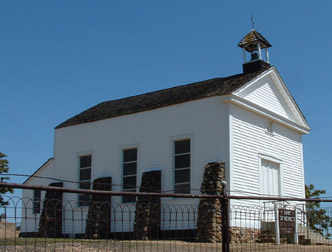 All of the Merced River communities mentioned in the
preceding paragraph no longer exist, not even as ghost towns. When the Exchequer Dam was built in the
20th Century, the resulting reservoir, Lake McClure, covered the sites. Barrett (no longer a “city”)
can still be found on some maps. On MapQuest, the bullseye is slightly offshore, in the lake. Of
all the Mariposa County communities that John and Martha were part of, only one exists today. That one
is Hornitos. (Shown at left is St. Catherine’s, the Catholic church in Hornitos, built in 1851. Many
individuals associated with John and Martha are buried in the adjacent cemetery, including Joseph Branson
and his wife Ella. John and Martha’s own gravestones -- located in the Oddfellows cemetery one hill
east -- can be glimpsed from the hill on which the church sits. Photo taken by Dave Smeds 5 May
2003.)
John was a popular figure in Phillips Flat. Though he was illiterate to such a degree that he signed
his legal documents with a mark, his perceptiveness and common sense were easily apparent. Described
as mild-mannered and gentlemanly, one local man said of him that if John had had a better education, he
could have been governor of California. He slipped into a leadership role, and even held minor
governmental office, such as when he was appointed roadmaster for the Hornitos/Temperance Creek Road.
This was no small responsibility, for in those days before railroad lines had become established in
California, the condition and security of such stagecoach routes was vital to the well-being of whole
communities.
His home, barn, and corrals seem to have been on higher ground, above the diggings, and he and
his family lived in a substantial house at a time when many locals were still getting by in
tents and the simplest of cabins. He was no longer a desperate 49er hoping for a quick bonanza.
He and his family represented a picture of permanence and wherewithal often in short supply in the
era of the Gold Rush. The prospect of poverty was a fear that never plagued John and Martha again.
In 1927, their son Joseph, then seventy-seven years old, was called upon to testify in court as to
the value of the Phillips Flat placer claim in order to determine how much the estate of his wife’s
brother-in-law Charles Arthur should be compensated for its loss, Charles Arthur having been the
final owner of the placer rights at that spot when the land was seized by the government as part of
the creation of Lake McClure. Joseph stated, “Well, my dad raised ten children, clothed and fed
them first rate, sent them to school, and never owed a dollar in his life. All from the lesser
portion of that claim.”
This is not to imply that John had grown wealthy. Secure, yes. And he was unquestionably rich in
character. However, his pockets seldom bulged. By frontier standards he was successful, but the gold
yields varied. Sometimes this was because the metal itself turned up in low amounts per hours expended
to retrieve it. At other times, simple logistics interfered. In dry seasons, which in California could
be very long indeed, the river’s flow would grow so shallow the main diggings were impossible to work
and mining therefore produced no income. In rainy seasons, floodwaters covered the digs. John raised
livestock and did odd jobs to get by. His chief alternate employment was as a hauler of supplies
between the camps and towns of Mariposa County, particularly the route between Stockton, the furthest
inland that barges and ships could bring heavy cargo, and the stores and warehouses at Barrett City
and Hornitos. His wagon, pulled by oxen, proved to be the family’s prime asset. John would make sure
never to sell it. Ivan Branson wrote of sitting in the bed of the vehicle a few years after his
grandfather’s death, tossing small rocks to wake up the imaginary team and get the animals moving.
Probably nothing did more to enhance John’s reputation within the community than his behavior during
the flood that came during the winter of 1861-62. This was a weather event of a proportion not previously
seen in California by anyone of European extraction -- not by the early Franciscan missionaries, not by
the Mexican land barons. The state has yet to see anything like it, even though over a century and a
half has gone by since it happened. Over a period of forty-five days so many storms rolled in that a third
of all the taxable acreage in the state ended up being covered by water. The California treasury was so
negatively impacted that the government declared bankruptcy. The Merced River rose to levels the people
living on its banks had not believed possible. Phillips Flat was washed away. The miners’ tents, food
supplies, and equipment disappeared in the current. The Branson home appears to have been high enough
up to be spared, but some neighbors and temporary laborers lost everything but their lives and the
clothes on their bodies. They faced starvation. John responded by slaughtering his oxen to feed them.
In terms of political parties, John was an unwavering Southern Democrat to the end of his days. His
values were so deeply embedded that even long after his death, some of his children and grandchildren
refused to register as Republicans, even though by then the policies of the Republican Party mirrored
their own, because the Republican Party had been the Party of Lincoln. During the Civil War, John
sympathized with the Confederacy. Naturally he took no part in the war itself due to residing in
California, but upon Lincoln’s assassination, he was instrumental in declaring a celebration of the
killing in Phillips Flat. When the authorities heard of his impertinence, the U.S. Marshall’s office in
San Francisco dispatched men to arrest him. The deputies were told in Hornitos that Phillips Flat had
been washed away in a flood and no longer existed. The deputies chose to use this as their excuse to
return to San Francisco empty-handed. It was either that or keep searching and have to look to their
own safety in territory where John’s attitude was the prevailing one.
Phillips Flat had of course been reestablished after the flood, and its mining operation
continued well past the end of the Civil War. However, as the 1860s marched on, the gold
grew less easy to find. Thankful though they might have been for the good years, John and Martha
nevertheless understood they could no longer shackle their destinies to the place. It
was no doubt distressing to find themselves facing that development. Phillips Flat had been
their home longer than any one location during their marriage. Three children had been born
on-site. After Alvin had come Mary Jane, born 25 July 1862, and Theresa, born 24 October 1865.
Yet when the time came to leave,
they did not do so halfway. The family piled into John’s old Conestoga wagon and left
the Mother Lode entirely. They journeyed north, where John briefly investigated the
mining possibilities in his old stomping grounds in the Trinity Alps. The prospects
were apparently not good enough to tempt them to stay. They continued on immediately and
did not stop until they reached the Williamette Valley of Oregon.
The soils were fertile. The grass was green and thick. John tried farming. But a year in the
rain proved too much for Martha. She had grown used to California’s sunny skies. Anxious to
get home without delay, they put their wagon, oxen, worldly goods, and themselves on board a
ship at Portland and sailed down to San Francisco Bay. Once back in Mariposa County, John used
what savings he had accumulated during the previous twenty years and purchased land just to the
northwest of Quartzburg, a mining outpost a couple of miles northeast of Hornitos. The 160 acres,
a parcel that had formerly belonged to Daniel and Margaret Mahon, shared a property boundary with
the Washington Mine. Much later Washington Mine would be known as the Jenny Lind Mine, but not until
its heyday had come and gone. At the time the Bransons arrived, Washington Mine was becoming
one of the prime spots in the county for hardrock miners to make a living. The name Quartzburg was
becoming less significant, and locals would often describe their place of residence as Washington
Mine rather than Quartzburg, though there wasn’t really a geographical distinction between the two.
The Branson family no doubt appreciated being close to the sites they already knew; Phillips Flat was
only a few miles to the west over a range of low, grassy hills. John and Martha would remain on
this land, which they called Grasshopper Ranch, for more than a third of a century -- the rest of
their lives.
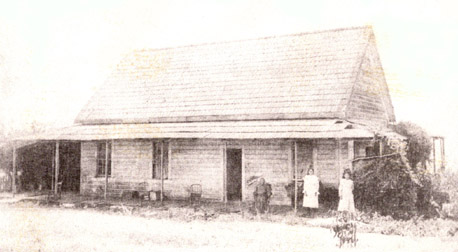
Shown above is an 1890s image of Grasshopper Ranch. Martha is the old woman on the porch in the
rocking chair. The two adolescent girls are her granddaughters Elsie and Eunice Harrington, daughters
of Nancy Anna Branson. This picture was published in Bones of the Bransons.
Quartzburg, whether called that or referred to by any of its mine-outpost alternate names, is little
known now even by locals. The settlement had been founded at the very beginning of the
Gold Rush by 49ers who had come from the Deep South. These sons of Dixie had chased away the
would-be miners of Mexican and otherwise “questionable” descent. The disenfranchised prospectors had
instead put down roots a few miles away -- this was the creation of Hornitos. In the end, the bigotry
of the
founders of Quartzburg would seal its fate. Once the gold was gone, the place soon became uninhabited
because it never developed the broader infrastructure that Hornitos enjoyed as a result of the
diversity and size of its initial population. Today when Quartzburg
is mentioned, it tends to be in reference to the headquarters of the California Rangers that was
located there during the earliest years of the Gold Rush. That headquarters was the place from whence
Captain Love and his men set forth on the mission that resulted in the capture and execution of
notorious Gold Rush outlaw Joaquin Murietta. If you went today to the spot where Quartzburg was located,
you would see only a few raggedy olive trees as the remaining meager indication of its once-abundant
human presence. Likewise, what was once Grasshopper Ranch looks
like nothing more than barren, rattlesnake-infested foothill country. But back then, John and Martha had
ample reason to be satisfied with their purchase. The exact timing of their arrival was probably late
1867 or early 1868, in time for the
birth of John Sevier Branson, Jr. 20 May 1868. Ivan Branson, in Bones of the Bransons, places the
Oregon sojourn after this birth, but that seems unlikely given that the Bransons were already paying
property taxes on “the old Dan Mahon place” (along with a one-dollar dog tax!) in 1868, as shown in old
Mariposa County assessor’s records.
John still prospected now and then, but once he had his land, viewed himself as a farmer. (We would
use the term rancher these days, as he mostly “farmed” in the sense of raising livestock, the only crops
being hay and grain for his animals and whatever Martha helped raise in the family garden.) As ever,
he turned to
hauling loads when cash was needed. The last few decades of his life were on the whole secure
ones. Most of the residents living in the area during that time were those who had come in the
1850s, or the descendants of same.
John also, for the first time, had some of his original kinfolk close at hand. It has always struck me
as odd that none of his Missouri relatives came with him. The lure of gold was apparently not enough.
But finally, two of John’s first cousins made the journey along with their households. They came not for
the gold, but for refuge. The two were Isaac Branson and his older half-sister Irena Branson Scott. Both
were children of John’s uncle Valentine Branson. They -- or at least, Irena and her husband William
Wyatt Scott -- were Confederate sympathizers. William had not joined the Confederate Army, but his
sympathies, and probably his actions in support of those sympathies, had become too well known in
the Union-leaning part of northern Missouri where much of Valentine’s clan had settled in the 1840s and
1850s. They needed to get away, so in 1864 they joined a wagon train of like-minded folk and headed
west. Alas, a Union Army garrison was keeping watch at the so-called California Crossing of the
South Platte River, a bottleneck through which virtually all such wagon trains were forced to go, and
William Wyatt Scott was recognized as a known fugitive. He was executed on the spot. Later Irena would
claim her husband had been killed by a lightning strike. The rest of the wagon train, including Irena,
was allowed to proceed. Irena and her kids, and Isaac and his family, eventually made their way to
Mariposa County, where they were welcomed by John and where they lived out the remaining decades of
their lives. John and Isaac and Irena would go on to be further connected in a genealogical sense
through a maze of intermarriages among the pioneer families of Mariposa County -- the Guests, the
Scotts, the Spagnolis, the Peards, the Simmonses, and the Bransons. Their children grew up as neighbors,
friends, coworkers, business partners, schoolmates, and of course as kinfolk. John remained particularly
close to Irena. She eventually acquired a ranch that looked out at the Washington Mine complex. Irena’s
grave lies so close to John’s at the Oddfellows Cemetery in Hornitos that a person could put their hand
on one headstone and just about be able to reach out and brush fingers against the other.
John and Martha were in their place, happy to be able to provide their younger children -- the youngest
being Mattie, born at the ranch 27 February 1870 -- with the stable existence that their eldest
offspring had not experienced. Reuben and Thomas each took wives in the summer of 1872, and became
fathers in the summer of 1873, but lingered close to home -- at times staying at Grasshopper Ranch
itself. Joseph remained a bachelor a little longer. All three boys spent a certain amount of time mining,
though this applied to Reuben most of all -- even to the extent of leaving his wife and youngsters
alone for extended periods while he found work at different mines. Thomas’s life was more eclectic.
He supplemented his mining income with work as a tinsmith, as a teamster, and as a translator,
having picked up a working knowledge of Chinese, Spanish, and German from neighbors. Thomas’s
father-in-law Egidi Bauer owned a vegetable garden that probably supplied the two local Chinese cooks,
Ah Sing and Ah Fong, with whom the Bransons and Bauers were closely associated in the 1870s and
1880s and beyond.
Given John’s Confederate sympathies, it is worth noting that a member of his social circle in his later
years was Moses Rodgers. The latter, despite having been born a slave, became the boss of Washington
Mine and was therefore a close and influential neighbor, at various times employing quite a number of
men associated with the Bransons, including Alvin Thorpe Branson and Alonzo Diah Johnson (a son-in-law
of John and Martha). As noted above, John was mild-mannered and comported himself well -- he must have
found it easy to cast his bigotry aside when it came to one-on-one relationships. It would appear the good
terms between the Rodgers and Branson households even went as far as Martha serving as the midwife when
Moses’s daughter Louella was born, a role that meant not only helping with the birth, but doing the
cooking and housekeeping for the family during the lying-in and post-partum phases. It is quite
possible the effort consumed a number of weeks.
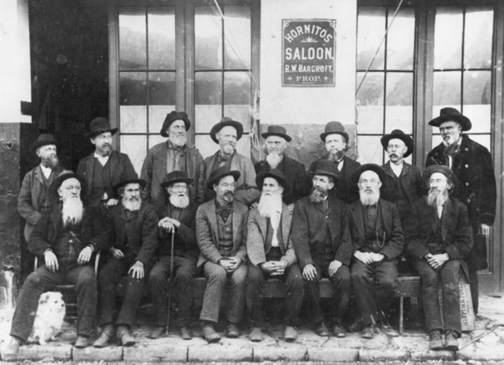
John was among the sixteen old-time residents of the Quartzburg/Washington Mine/Hornitos area who
posed for this photograph circa 1890 in front of the Barcroft Saloon in downtown Hornitos. From left
to right, back row: Henry Nelson, Thomas James Smith, John Sevier Branson, William Roland Dennis,
Benjamin Allen Shephard, Guiseppe Gagliardo, James Duffey Craighan, Moses Logan Rodgers. Front row:
Ralph Wood Barcroft, Elbert Franklin Sylvester, Samuel Collins, Joseph Spagnoli, Nathaniel Ashe
Bailey, Thomas James Thorn, Robert Arthur, Thomas Williams (aka Spanish Tom). Over forty years later
this photograph was included in The Call of Gold by Newell D. Chamberlain (near the back of
the book between Chapters 38 and 39). It was also featured in the special commemorative edition
From Quartz to Gold, the story of Hornitos Lodge No. 98, F.&A.M. by Kenneth Cooper. John was a
Mason and a member of Hornitos Lodge No. 98, something that may have been true of all sixteen of these
men.
As John and Martha’s eldest four girls came of age, they each chose to relocate to the newly-founded town
of Merced. They were part of a widespread exodus from the area that began about that time, as Hornitos
began to become a backwater. Until the early 1870s, Hornitos had remained vital not only because of the
gold in its hills, but due to the freight that travelled by wagon and stagecoach up and down the
Stockton-to-Millerton road. But from that point on, merchandise typically moved by means of the railroad
through Merced, and the latter community, located fifteen miles from Hornitos out in the Central Valley,
soon became more settled and sophisticated than Hornitos would ever be. First to depart was Phoebe, who
married William McDonald in 1874. Nancy, Mary, and Theresa soon followed in their elder sister’s wake. In
addition, Thomas maintained a tinsmith shop in Merced from the mid-1870s until 1887, though Quartzburg
continued to be his official residence. However, it would not be accurate
to say John and Martha were ever separated from their offspring the way that they themselves had become
separated from their own parents back in Tennessee and Missouri. All ten kids stayed close enough that they
had no trouble showing up whenever a major family event such as a wedding occurred.
Genial as John was, he was also a man of his rustic times and occasionally “had words” with neighbors.
The family had the custom of raising pigs. So did the Collins family. Neither set of pigs seemed willing to
obey property boundaries. The porcine trespassing led to some shouting between the owners. Eventually the
two families resolved the matter by agreeing that neither would raise pigs again. This was a
decidedly better solution than what happened in 1881 when Egidi Bauer’s neighbor and good friend D.K. Pitzer
shot him dead in the road on the outskirts of Hornitos over just such an errant-pigs situation.
In the summer of 1885, John butted heads with George Reeb, the prominent butcher and sausage-maker of
Hornitos. John, in his capacity as roadmaster, accused George of installing an illegal barbed-wire fence
across the East Phillips Flat Road, a nearly-forgotten and all-but-invisible track. George argued his fence
was legal and that John knew very well that this was true but wanted the route clear for his own purposes.
The two men conducted their battle in the pages of the Mariposa Herald. Again, matters were resolved
without burning any bridges. George continued to buy beef from the Bransons (not only from John, but from
John’s sons Thomas, Joseph, and John, Jr.) for many years to come, as he had done for the previous fifteen
years. (George Reeb’s purchases of cattle for slaughtering made up a significant portion of John and Martha’s
income in some of those years.) Both the Reeb clan and the Collins clan can now be linked to the Branson
clan in several different ways due to marriages among members of the younger generations.
Sometime in their old age, probably in 1897, John and Martha sold their homestead to their son Joseph,
who added the 160 acres to his ever-growing cattle ranch. (Eventually Joe would accumulate 1300 acres,
absorbing much of what had once been Quartzburg. As the gold ran out, the price
for his neighbors’ properties fell to levels he was readily able to afford.) Joe and his wife Ella had a
house of their own, though, so John and Martha were able to stay in the same living quarters they had
known for so many years. Unfortunately this was only true until approximately 1904, when a fire consumed
the structure. No one was injured -- though grandson Ivan, two years old at the time, was startled to
awaken in a barn stall instead of the bed inside the house where his mother, Alvin Branson’s wife Mary,
had put him to sleep. This was when the family Bible was lost, much to the frustration of later family
historians.
John was literally a man of the Nineteenth Century, but he lived long enough to get a taste of what the
younger generations would experience. He personally witnessed the installation in 1900 of a
refrigeration unit at George Reeb’s butcher shop, whereupon George could not only keep his meat fresh far
longer, but begin selling ice to local denizens for their home ice boxes. John never owned an automobile,
but he was able to ride in one -- and in doing so, appreciate the profound difference between rolling
down a road at forty miles an hour versus the plodding pace of a team of oxen pulling a heavily-laden
Conestoga wagon. In February, 1902, a telephone was installed in his home. At first it only allowed him to
connect to only six nearby homes, but it wasn’t long before he could, if the inclination had struck him,
have initiated a call from his very own residence and ended up speaking with either of his two
surviving siblings back in Osage County, MO, Nancy Pointer or Reuben Branson, with whom he may very well
have not have shared a conversation in fifty years.
The number of John and Martha’s grandchildren would eventually swell to forty-four. Martha would live to
welcome them all into the world, along with twenty-one of her great-grandchildren. John missed out on the
birth of his final grandchild, Dorothy Branson, the daughter of John Jr.
John’s obituary in the Mariposa Gazette states that he was eighty-three years old at death.
His death certificate confirms the death date of 27 November 1905, and (correctly) states he was
seventy-nine. This mark was a bit better than average for his generation, though well short of the
record-holders. His sister Sarah had reached ninety-nine. His brother Reuben was still alive in 1905
and would survive to 1907, making it past his ninety-fourth birthday. John was buried in the Oddfellows
cemetery in Hornitos. Martha would be laid to rest beside him slightly more than two years later. Just
seven weeks after Martha’s passing, John’s cousin Irena would be interred in the neighboring grave,
joining her children Charlotte Marshall, Elijah Scott, and William Wyatt Scott, Jr.
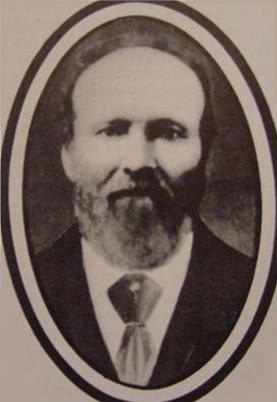
This is a scan of John’s portrait as published in Bones of the Bransons. If you look
closely, you will see it is actually the same picture of him as reproduced at the beginning of the
“Life of John Branson” section of this biography.
Apparently Ivan Branson’s niece, Melba Branson Larsen Sharp, who handled the book production at her
print shop, was not satisfied with the reproductive potential of the source photo. The latter was a
tintype (no doubt the very same tintype that was later scanned for use here), and may
have been too dark. So Melba
superimposed John’s face upon a painting. The suit and tie are obviously painted, but less apparent is
that the background and his hair is also part of the “fake.” Only the face itself comes from the
photographic source. Part of the challenge Melba faced comes from the fact that so few photos of
John survive.
To return to the Branson/Ousley Family main page, click here.