John Joseph Branson
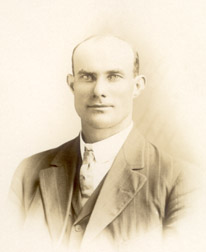 John Joseph Branson, eldest son and first child of Joseph
Branson and Ellen Margaret “Ella” Geary, was born 12 September 1880 on his parents’ ranch north of
Hornitos, Mariposa County, CA, near the mining outpost of Quartzburg. He was raised in the very house
in which he had been born until he was well into his teens. In 1897, his father expanded the ranch by
purchasing additional parcels including the acreage that had belonged to his own parents and his brother
Thomas. This triggered a move on the part of Joe and Ella, along with John and his younger siblings Marguerite,
Alvin, Grace, Ernest, and Eldridge, into a newer house on one of the newly-acquired pieces of land.
In the womb, John’s right hand and lower arm did not develop. He was born missing that part of his anatomy.
This inevitably led to unkind nicknames such as One Hand Jack. A less coarse version, One Arm John, plagued
him throughout life. However, aside from his hatred of that sort of mockery, he coped with his limitation
extremely well. He even engaged in a number of occupations as a grown man that one would think would demand
the ability to grasp things firmly with two hands. This refusal to act handicapped is all the more remarkable
when one studies his penmanship and realizes he would have been right-handed if given the choice. He learned
to apply humor to his circumstance. When a niece’s young daughter asked him why he had no hand, he replied
that as a boy, he had been very hungry, and when his mother said she had no cookies to give him, he ate his
hand.
That John would have had this peculiarity is a freakish coincidence because in 1864, his grandfather John
Geary had accidentally shot off his right hand. They were a set, so to speak.
John attended the Quartzburg District School in a class composed largely of relatives and children of his
parents’ in-laws. He was part of the Class of 1896, 1897, or 1898. Yes, this does mean he was well beyond
than the usual graduation age of thirteen or fourteen. This was
not a reflection on John’s level of intelligence. For one thing, many youths of the vicinity, and of
that era, took most of their teens to finish eighth grade. For another, John’s upbringing was shaped by
the tug-of-war of values between his parents. Though Joe and Ella were resolutely united in many ways
and enjoyed an iron-clad union, they butted heads on certain deeply-held philosophical positions. For
example, Ella was Catholic, while Joe was generally opposed to church of any sort -- even those of
Protestant demominations -- and preferred to do his “good work” through the medium of Masonic lodge
activities. Formal education was another bone of contention. Even though Joe was proud that he had gone
to school and had learned to read and write -- as his parents had not -- he did not believe it was a
priority that his offspring spend more than a few years in a classroom setting. As Joe saw it, it was
perfectly fine if his kids were “educated by life.” He didn’t see the point in keeping them indoors when
they could instead fill their time with such productive activities as herding cows or tending the garden
or even deer hunting. Ella, on the other hand, regarded formal education as vital. The family parlor
contained a large bookcase chock full of all sorts of volumes. The couple’s compromise?
Their two daughters pursued education to such a degree they earned teaching credentials and became
schoolteachers. Their sons? At Ella’s insistence, they did all eventually finish eighth grade, but at
advanced ages. John’s twin kid brothers Eldridge and Ernest are known to have finished up the same summer
they turned eighteen (i.e. in 1909). John’s story was the same, or nearly so.
All of the children of Joe and Ella turned out tall and robust. The four boys were all handsome and
manly in their young adulthood. A tendency toward a receding hairline was part of this heritage as well,
and John exhibited this trait early on.
By the time John came of age, gold-mining was still a common occupation in Mariposa County, and it was only
natural that he try his hand at it. That said, he could not be said to have dedicated any significant portion
of his youth to laboring away in the mining tunnels or stamping mills. In this, he differed from his brother
Alvin and from various Branson cousins. John could see that the industry
was in decline, and did not pin his future upon it. He had the wisdom of his father to serve as his example.
Joe had chosen to earn his money by raising cattle. And there was also the example of grandfather
John Sevier Branson, who despite doing very well as a placer miner in the Gold Rush, had not made the
error of depending on the windfall to continue. In the late 1860s, in his early forties, the elder John had
switched to cattle ranching, and even during his miner days, had always made a substantial portion of his
income as a teamster, hauling many sorts of cargo with his oxen and his trusty Conestoga wagon, the same
conveyance he had brought with him when he crossed the Great Basin in 1849. After a number of short-term jobs
as a common laborer, the younger John decided he, too, would be a teamster. His grandfather appears to have
been pleased by the idea of a grandson carrying on the tradition. The younger John probably used horses
rather than oxen, and would have used a newer wagon. The Conestoga still existed in the early years of the
Twentieth Century, parked at the ranch, but was now too old to depend upon. John did not, however, use a
motorized truck. Such vehicles had not yet come to dominate short-distance hauling in the foothills, and would
not do so until the late 1910s and early 1920s. In the meantime, young John hitched up his teams and made his
deliveries the old-fashioned way.
As John proceeded through his adulthood, his attitude toward social institutions was a mixture of the contrasting
philosophies of his parents, with whom he continued to live until his early thirties (perhaps
interrupted by brief intervals elsewhere). As far as religion went, he had more tolerance for Catholicism than
his father did, though he was not cemented to the church, and certainly devoted himself fully to lodge membership.
In fact, John was not only a member of the local chapter of Sons of the Golden West, Hornitos Lodge 138,
but was its president during the first half of the 1910s. When it came to politics, he usually registered
as a Democrat. He was on the conservative side of the spectrum, but John Sevier Branson had firmly sympathized
with the Confederacy during the Civil War, and few of his grandchildren, even in their advanced years, could
bring themselves to register as Republicans, as if they feared their grandpa’s ghost would chase them down and
scream at them for becoming members of the political party to which Abraham Lincoln had belonged.
John was still ensconced at home in Quartzburg in the year 1912, which seems to have been a particularly
thriving point for the Branson cattle ranch as well as some of the other ranches in the vicinity. As a result of
the bounty, an unusual number of ranch hands flocked to Mariposa County from other parts of the state. In times
past, the available jobs would have been snapped up by local men, but with the recent shut-downs and slow-downs
of nearly all of the area’s mines, a labor shortage had developed. Among those seizing the opportunity were
Robert Jackson of San Bernardino County and Charles Ashton of San Luis Obispo County. The Sierra foothills gigs
were temporary, but they represented solid, honest, wage-earning employment at a time when Robert and Charles
were in need of that. As it happened, both men had female relatives who decided to tag along. Robert’s sister
Clara Jackson became the sweetheart of John’s younger brother Eldridge Geary Branson. After the Jackson siblings
moved back to San Bernardino County, Eldridge would decide he missed Clara too much, and he would follow her and,
in the late summer of 1913, would become her husband. Meanwhile, at the end of March, 1912, Pearl Drumm
joined her sister Ruby, the wife of Charles Ashton, who was employed at that point in Bear Valley, just east of
Quartzburg. Soon John’s attention turned her way.
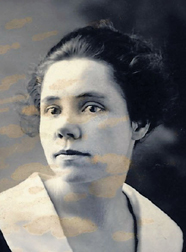 Pearl Drumm (shown at right), born 20 July 1887 in Santa Barbara
County, CA, was a daughter of James Howard Drumm and Mary
Cordelia Stubblefield, a couple who had wed in November, 1879 -- which happens to be the same month that Joe and
Ella Branson became husband and wife -- and had gone on to raise their brood of eleven children in the Santa Maria
Valley in Santa Barbara County. The family home was a farm just outside the small community of Orcutt, which
in turn was just south of the town of Santa Maria. (Today Orcutt is more-or-less a neighborhood of the latter
town.) Pearl’s original full name was Lillian Pearl Drumm, and it was her parents who decided her middle name
was the one she would be known by. She had other ideas about her name, though. By the time she was a young adult,
she had taken to using Pearl as a first name, and Marie as a middle name. In the early 1920s, when she was in
her early thiries, she further transformed her identity and became Jean Marie. She used this on all formal
documents thereafter, and signed her name that way. By the time she died she had been known as Jean Marie for
well over sixty years. We will continue to call her Pearl in this essay in part because that is the name John
knew her by, and in part so as to more easily distinguish her from her daughter, who was also a Jean.
Pearl’s mother died when she was only seven years
old. This was a character-shaping event, instilling in Pearl a tendency toward independence. One could say it also
lent her a degree of impulsiveness -- or perhaps it would be better to say a restlessness -- that might have been
expressed less severely if she had been blessed with uninterrupted maternal caregiving. When she was ten years old,
James Drumm married second wife Frances Caylor McClellan, but this had its complications, leading to Pearl being
sent to Paso Robles, San Luis Obispo County, CA to live with her maternal grandparents, Coleman Stubblefield and
Sarah Jane Hobbs. It is accurate to say that Sarah, a profoundly capable, inspiring, and formidable pioneer
matriarch, was the key figure of Pearl’s upbringing.
Pearl left home at only fifteen years old, going to Bakersfield, Kern County, CA to live with an aunt. By fibbing
about her age, she was able to get a job as an operator with a telephone company. By her late teens, she found
herself back in the Santa Maria Valley, though to the north and west of her father’s ranch in the section of the
valley that lies within the boundaries of San Luis Obispo County. She became involved with Burnett Knotts of
Nipomo, whom she wed 5 April 1906 at eighteen years of age. She may have looked at him as quite a catch. He
was one of the elder children of Emery Knotts and the late Lenora Fry, a couple who had come out from Bartholomew
County, IN and settled in Nipomo in the mid-1880s, founding a saloon there in 1886, shortly after their arrival.
The saloon became highly successful. Even today (current 2026), the successor to that enterprise survives in
the form of Little Jocko’s Restaurant, an extremely popular steakhouse operated by descendants of Burnett’s younger
brother Ralph “Little Jocko” Knotts. All eight of Emery and Lenora’s sons worked at various times at the saloon, and
this was true of Burnett, the eldest of the eight. Pearl may well have been a saloon employee who caught
Burnett’s attention. She probably was well pleased by the social prominence she gained by becoming a Knotts, but
in time she found it was not worth the trade-off. Burnett was in other ways not the best match for her. He was
seventeen years her senior. He did not provide her with children. The marriage became contentious and lasted
only five years or so. Her retreat to Mariposa County was a case of a young lady using geographical distance to
buffer herself from her estranged spouse.
Once John and Pearl met, things proceeded swiftly on the romantic front. By early 1913, the pair were determined
to become husband and wife. This was a slight problem in that Pearl was not quite clear of Burnett Knotts in the
legal-paperwork sense, so she and John went to Reno, NV and took steps to get the matter resolved. Judge Thomas
Moran granted a divorce decree on the eighteenth of February, 1913. (It was
one of the many thousands of divorces the judge handled over the course of his long career, a tally that has left
him famous in Reno history.) The next morning, before leaving town, Pearl and John obtained a marriage license. After
a quick train ride through the Sierra Nevada, they were married in Sacramento later that same day, the nineteeth.
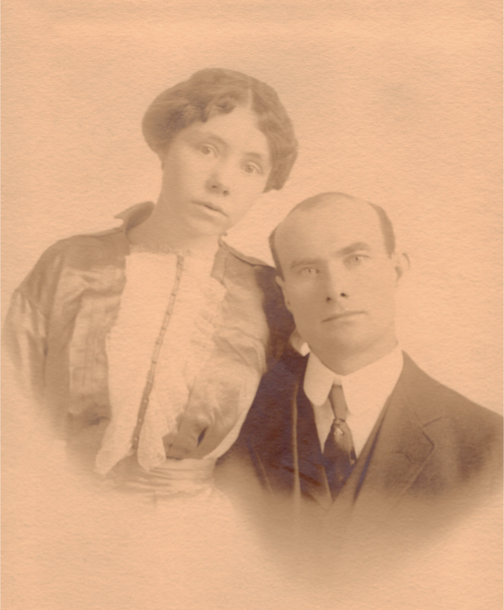
The wedding portrait of John Joseph Branson and Pearl Drumm
(Strange as it may be, Pearl’s brief first marriage is not the only way that John’s story touches upon that of
the Knotts clan of Nipomo. During the 1980s, John’s granddaughter Anna Marie Gabriel would briefly be the wife of
Gerald Knotts, a grandson of Little Jocko.)
John and Pearl’s backgrounds were identical in one particular respect -- they were both grandchildren of
long-lived pioneer grandmothers who served as midwives at the births of many, many neighbors and family members.
More to the point, Sarah Hobbs Stubblefield had been the midwife who ferried Pearl into the world, and Martha
Jane Ousley Branson the midwife who attended Ella when John was born.
John and Pearl established themselves in Mariposa County. Daughter Jean Clair Branson was born there 9 April 1915.
At first the couple may have lived with Joe and Ella, but more likely they rented a house within the village of
Hornitos. This would have been a small home, in keeping with a young couple just starting out. However, in 1916,
things changed dramatically. The couple acquired a ranch of 917 acres. The parcel may have shared a boundary with
his parents’ spread, but it was enough to the north to be considered part of the Hunters Valley fragment of the
county rather than part of the Hornitos district. That John was able to acquire such a huge piece of property
implies a story-behind-the-story. Certainly he must have had some personal savings, and his parents may have
helped out. Certainly he must have taken out a bank loan on mortgage terms rather than pay everything up front
in cash. But all of that put together was unlikely to have been enough to make the deal achievable. Pearl must
have come up with funds. The likeliest source is an inheritance. Her grandmother Sarah had died in late 1915,
and Pearl had been a favorite descendant. Perhaps Pearl suddenly had money. In any case, the real estate was
acquired, and with that, John slipped into a new identity. He was now a Mariposa landowner of a status
equivalent to his father. Moreover, there was enough money left in the bank that it was John who put up half
of the bail bond when his first cousin James Sutton Branson was arrested in February, 1917 for assault with a
deadly weapon. (While drunk, Jim had unfortunately brandished his pistol in the face of Hornitos saloonkeeper
George Latchaw. He was given a suspended sentence by Judge Joseph J. Trabucco, a friend of
the Branson family. Alas, Jim violated his probation in a saloon brawl a few weeks later and as a result, had
to spend a year in San Quentin penitentiary.)
The acreage must have contained some workable gold veins, because John’s occupation in the 1916 voter register is
miner, but its primary value was as grazing land. In this respect, John and Pearl’s acquisition could not have been
more poorly timed. The Mother Lode entered a drought that would more-or-less go on for twenty
years, alleviated by only one genuinely wet year in the midst of that span. The spring of 1917 was particularly
dry, and fires became an all-too-likely possibility.
And indeed, there was a fire. It happened in May, 1917, and it was devastating, consuming not only the grass, but
the house, the barn, and destroying all of the farm implements. In the wake of this development, John and Pearl
proceeded to sell their property. This is understandable. They had lost everything but their lives and a few personal
possession, and they may not have had enough capital to put up new buildings, acquire new equipment, and start over.
That said, one wonders if the real story might be different. John and Pearl’s relationship had become strained. One
clear sign of this is paperwork preserved in Mariposa County records showing that at least some of the acreage was
transferred into Pearl’s name at the end of April, 1917. Perhaps the conflagration and sense of hopelessness it
generated contributed to the domestic friction, but there’s no question the rift had already opened before the fire
occurred. This suggests the fire may have been deliberately set. John and Pearl needed to free up their wealth for
divorce purposes, yet by that point in 1917, in part due to the drought and in part due to the general
economic conditions, they were not likely to sell the land for as much money as they had invested. Burning
the ranch deliberately and collecting the insurance money was a way out of that dilemma.
Did John and Pearl do something so underhanded? If so, naturally they did not admit to it and there’s no proof of
such a scheme. Yet it’s hard not to read between the lines. John’s insurance agent was none other than his
brother-in-law Guy Thistle. Guy was the insurance company representative who visited the ranch after the fire,
determined that it was not arson, and approved the claim. Further, Guy was a real estate agent, and he quickly
proceeded to arrange a sale of the entire
917 acres to Louis Trabucco and Frank Trabucco, Jr., close kinfolk of the aforementioned Judge Trabucco. The deal
was completed on the eleventh of August, less than three months after the fire.
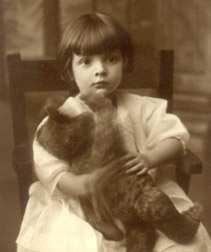 John and Pearl said farewell to Mariposa County. They moved to Orcutt. They
appear to have done so together, and may have shared a home for at least a portion of the next couple of years, but
they were definitely growing apart. Any remaining closeness appears to have been a function of John refusing to
give up. This may not have been so much a case of maintaining his bond with his wife as it was maintaining one with
his little girl. The early Twentieth Century was still a time when divorced fathers had a hard time remaining
involved in the daily lives of their kids. The common wisdom is that it was the “best thing for everyone” that the
mothers got the kids full-time, and the men were expected to provide financial support, not love. Many men
shook their heads and became reconciled to the circumstances. John was not one of that type. Though he did not
have a lot of control over his situation, he pursued options that might allow him to see Jean on a regular basis.
He didn’t want to just know her face only from the photograph in his wallet. (An example of
the photos he carried was the one shown at left, scanned from a print owned by his sister Grace.) The
best way to achieve this desire was not to be divorced in the first place. So John stayed in Orcutt and tried
to win Pearl back.
Any reconciliation, assuming there was one, did not persist. The 1920 census still categorizes John as Married,
but he was by then no longer sharing a home with Pearl and Jean, who had moved temporarily to San Francisco and
who would soon relocate to southern California. Pearl had closed the door on the union and was
forging her new life. Increasingly known from that point on as Jean Marie, she wed oil-field worker
Clifford Emmett Turley, son of William Turley and Mary Taylor, 24 August 1923 in Los Angeles. This marriage
was her briefest yet, lasting a fragment of a year. Less than two months after marrying Clifford, she was
pregnant by another man -- not a recipe for matrimonial bliss. She gave birth to a son, John Louis Moffet Hurn,
in the summer of 1924, marrying the father, Jack Arthur Hurn, 7 November 1924. Sadly, the baby died nine days
after the wedding, but the couple would go on to have a daughter, Janet Lee Hurn, in the autumn of 1925. Jack,
Pearl’s fourth and final husband, was another oil-field worker. He was a son of Ona Mae Usher
and a stepson of John Louis Moffett, born 17 July 1894 in Inyo County, CA and having been raised in such
places as Bakersfield and Coalinga. Pearl and Jack spent most of the next few decades in Kern County,
usually in Bakersfield, interrupted by brief intervals in the oil-production regions of Los Angeles
and Orange Counties, including the town of Brea. After the kids were grown, Jack accepted positions in more
distant parts of the world. Colorado was one example, but most notably, he was in Iraq for seven years. Pearl
joined him for the last five of those years. In retirement, Pearl and Jack moved to Ukiah, Mendocino County,
CA, where Jack died 1 March 1981. Pearl was still alive to be
a widow despite being so much older than Jack -- an age differential she had not always fully disclosed
when asked for her birth year. She went on to live another seven years, finally passing away in Ukiah 12
March 1988 at the impressive age of one hundred, and beginning to approach one hundred one.
Jean did not entirely vanish from her father’s sphere. While Jack Hurn was her day-to-day paternal figure
for more years than John was, she did maintain some connection to her biological father and his side of the
family. Records show Jean continued to go by the last name of Branson throughout childhood, and she was a known
attendee of some of the “big deal events” involving her dad’s side of the family. For example, she was there
at the fiftieth wedding anniversary of her grandparents Joe and Ella held in Mariposa County in late 1929, and
she made it to the funeral of her grandmother, held at the Hornitos Cemetery in 1946.
John lingered in Orcutt. He may have held out hope that Pearl would move back, given her roots. On the other
hand, he may have stayed because the area had more economic opportunities than he would have found back in
Hornitos. He probably needed those opportunities. Whether it was bad luck, restlessness, the missing hand, or
a tendency to abuse alcohol, John did not manage to hold down a lasting job during the 1920s. He drifted from
one thing to another. His 1918 draft card describes him as a dealer in stock cattle and a farmer. The census two
years later has him as a day laborer. Voter registers list him as a merchant, laborer, oil worker, or retired.
His niece Emily Thistle Christensen mentioned in a 1979 essay that John was a laundryman at some point. By the
end of the decade he became a hotel proprietor. That is the occupation listed in the 1930 census. Pearl’s
sisters Ruby and Hattie had been operating a boarding hotel in Santa Maria when he had first moved to the area
in the late 1910s, and he may have acquired a “staff perspective” familiarity with the operation of such
establishments at that juncture.
Though his employment situation may have remained unsteady, his domestic life fell into better order, leading
to his second and final marriage. His new wife was Marie Thurlwell, to whom he was wed 2 August 1924. Marie,
who had been born 16 April 1887 in Lancaster County, NE on a farm just northwest of the city of Lincoln, was
the daughter of John Henry Thurlwell (originally of Illinois, of English parentage) and Gertrude Beeson
(originally from Indiana). In the early 1910s the Thurlwells -- John and Gertrude, their grown daughter Marie,
and son Vernon, leaving another grown daughter, Hazel, back in Lincoln -- had moved out to San Luis Obispo
County, where they had shortly afterward purchased a farm in Los Berros Valley, not far from Nipomo. It is not
known precisely how John and Marie met, but probably she obtained some sort of job in Orcutt/Santa Maria, which
from her parents’ farm was the closest spot where a non-agricultural job might readily be obtained. John’s
relationship with Marie was ultimately as lasting as the one with Pearl had been fleeting. The marriages
did share one characteristic -- they each resulted in the birth of precisely one child, each time a
daughter. The new baby was Gertrude Ellen Branson, named for her two grandmothers. Gertrude, called
Trudy, was born in Santa Barbara County in late 1926, probably in Orcutt. (Her obituary states Santa
Maria, but this may have been an imprecise reference.) Inasmuch as her mother turned forty within months
of her birth, it is not surprising she had no younger siblings.
John and Marie were nearing ten years of marriage, all of it spent in Orcutt, when a sea change occurred
in the family dynamic. The health of John’s elderly father had deteriorated to the point where it was obvious
he would not last much longer, so John came back to Hornitos in late 1932 or in early 1933. His father passed
away in the summer of 1934. Judging by voter registers of the next dozen years, John remained on the ranch
and took care of his mother, who otherwise would have persisted in isolation in a house out of sight of any
neighbor. He did not have to deal with primary responsibility of the ranch itself because it continued to be
rented by Horace Meyer, who grazed his cattle there, pasture being about the only thing the acreage was good
for at that point. John got by doing whatever jobs he could grab, including helping out at the ranch, employed
either by his mother, or by Meyer, or by both. At the end of the 1930s he became a constable (including a
period as a deputy constable), a job he kept for several years. One of the more dramatic incidents of his
career was his discovery of the bodies of two murder victims in a cabin near Hornitos in 1941.
It is an open question whether John stayed in Hornitos full-time during the twelve years. Certainly his
mother needed companionship, and during the second half of that stretch, the position as constable would have
demanded his regular presence. But surely Marie and Trudy needed him as well, and yet it is plain they were
not based in Mariposa County. Marie earned some income as a piano teacher, but this was not enough to support
herself and Trudy; she needed a breadwinner’s contribution to the household finances. And yet, as the voter
registers of that period make plain, the spouses were not consistently together. Those sources show Marie
in Los Berros Valley in the mid-1930s -- a strong indication she had gone back home to her parents -- and
then in Arroyo Grande on the coast. It may be that John simply registered in Hornitos in 1934
because he was spending all his time there while his father fell into his final decline and passed
away, and then afterward, John simply did not bother to re-register elsewhere for many years. Perhaps
Ella Geary Branson was only at the ranch
part-time, and joined John, Marie, and Trudy in their home on a regular basis. However, the fact
is that family records are too incomplete to be certain John and Marie did not go through an estrangement
and separation. If so, the experience did not permanently destroy the marriage. Subsequent public records
imply the couple resumed living together in the mid-1940s as soon as Trudy graduated high school and became
a wife. Trudy herself stayed in San Luis Obispo County, but Marie moved to Hornitos.
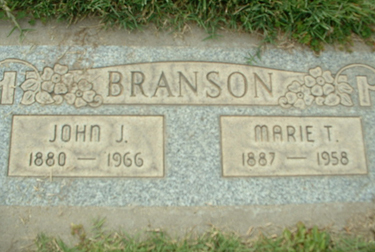 John’s mother died 29 June 1946. Emotionally this was
of course a heavy blow, but in one particular way, he was glad of it, because he could indulge his desire to
mine for gold on the family property. He had long wanted to do so, but his mother had refused to allow it.
Ella had never completely recovered from the death of her son Alvin in a mining accident in his young adulthood,
and was determined not to lose another child in a similar fashion. After the property’s two main mines had
been shut down in approximately 1910, Ella had blocked any attempts to re-open them. This had frustrated
John, who had always believed that there was still a worthwhile amount of ore hidden in the soil of the
1300-acre parcel. Now, at last, he was free to look. He did so for two or three years, or perhaps a bit
more, only to discover nothing worth the trouble of digging up. Disgusted, he sold his twenty-percent
share of the ranch to Horace Meyer. (Meyer would later acquire Ernest Branson’s share and half of
Eldridge’s, making him a fifty percent owner of the property, with Grace and the heirs of Marguerite
retaining the other half-interest.) He and Marie and Marie moved (back) to Arroyo Grande.
By the time John walked away from Hornitos for good, he had become a grandfather twice over, Jean having
given birth to the second of her two children in the mid-1940s. At approximately seventy years old, he
was well past the typical age of retirement. Yet he had accumulated so little wealth over the course of
his working life that even the infusion of funds garnered by the sale of his share of the ranch was too
little to keep him going. Needing to put in a minimum number of calendar quarters as a wage-earning
employee in order to qualify for Social Security, he spent three years or so in the civil service,
working at Camp San Luis Obispo. During or at
the conclusion of this period, he and Marie settled into a home at 1140 S. Thirteenth Street in Arroyo
Grande’s sister community of Grover Beach. This home was in a prime spot only half a mile from the shore
along Pismo Beach. This would be the couple’s home for the remainder of their lives.
Trudy’s marriage to first husband James Miller lasted only until about 1953. In about 1954, Trudy wed
Bernard “Gabe” Gabriel, with whom she lived in Arroyo Grande. The first marriage had been childless. The
second -- just the opposite. During her first eight years as Mrs. Gabriel, Trudy gave birth five times.
John was close at hand to welcome the arrival of each new bundle of joy. Marie was less lucky. She
did not survive long enough to witness numbers four and five. She died of complications of ovarian cancer
at San Luis Obispo General Hospital 16 December 1958. Her remains were interred at Arroyo Grande Cemetery
three days later.
Throughout his interval as a widower, John’s contribution as a grandpa was significant. Not only did
Trudy have her hands full simply keeping up with so many little ones, but Gabe had a drinking problem,
and the marriage had its ups and downs. Trudy eventually sought a divorce, which was achieved by 1965.
Unfortunately John could not be around to see how
things played out much beyond that. Suffering from blocked coronary arteries, he was admitted to Arroyo
Grande Community Hospital, where he perished there of a heart attack 7 October 1966. His remains were
buried at Arroyo Grande Cemetery on the tenth.
Child of John Joseph Branson with
Jean Marie “Pearl” Drumm
Jean Clair
Branson
Child with
Marie Thurlwell
Gertrude Ellen
Branson
For genealogical details, click on
each of the names.
To go back one generation, click here. To return
to the Branson/Ousley Family main page, click here.