Inez Branson
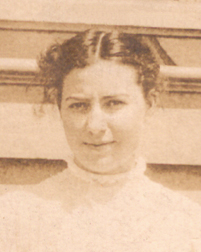 Inez Branson, last of the eight children of Thomas Henry
Ousley Branson and Frances Bauer, was born 5 March 1890 on ranch land in the immediate vicinity of
the mining outpost of Quartzburg, Mariposa County, CA. At the time of her birth, this community was
often known by its alternate name, Washington Mine, a designation that would fade away by the time
Inez was in her teens.
Inez spent her whole childhood in Mariposa County, but not all of it within the same home. Until
age seven, she and her parents and older siblings continued to inhabit the house in which she had been
born. Her father’s acreage was next to, or may even have been a section of, the 160-acre homestead of
his parents John Sevier Branson and Martha Jane Ousley. In 1897, Inez’s uncle Joseph Branson, who
possessed his own ranch nearby, bought out both his parents and his brother. The elderly couple
continued to live on the land, but Thomas and Frances and family chose to move to a house about two
miles south within the village of Hornitos. This residence was along Burns Creek in the part of Hornitos
known locally as the Chinese section. It may have formerly been the home of Frances’s brother Michael
Geary and family. Tom and Frances would make this their base until 1911, though it should be added that
from 1902 to about 1908, Tom was often employed elsewhere in the county at Mt. Bullion mine, and both
he and Frances sometimes stayed in the barracks there. They kept title to the Burns Creek house, though.
It is an open question how much time Inez may have spent at Mt. Bullion. Probably some, but several of
her older siblings stayed put, and Inez probably remained in Hornitos with them on a regular basis
rather than be subjected to the less comfortable environment of the mining outpost.
The end of the Nineteenth Century and early Twentieth was an era when folk of lightly-populated areas
such as lower Mariposa County had to create their own social entertainment. A number of Tom and
Frances’s kids rose to this challenge. Inez’s eldest two brothers, William and Hugh, were members of
the Hornitos orchestra, playing bass horn and violin, respectively. Inez was the organist for the
Protestant club -- the meetings of which were held in private homes, the only church in Hornitos being
the Catholic one, St. Catherine’s.
The Branson-Bauer nuclear family was strikingly tight-knit, with several children lingering in the
household as adults. Inez shared the tendency to cleave to kinfolk. That was true even as she became
the one female member of the group who most clearly demonstrated the ability to pack her bags and forge
on as a solo being when necessary. By her mid-teens, she was already spending
long intervals away from home. She had decided to become a teacher. There were no teaching-credential
programs available near Hornitos. One of the nearest, if not the nearest, was in Stockton, San
Joaquin County, CA, obliging her to find a suitable boarding situation there. Given her parents’
protectiveness, it was not an option to live with strangers. Happily, her older first cousin Mary
Josephine Harrington McDonald and family had moved to Stockton, and so Inez lodged with them at their
home at 16 N. Union Street. The photo at upper left was taken in the front yard of that house 19 May
1907. In the uncropped version, Inez is standing near the whole McDonald family and some visitors
they were entertaining that day.
The school Inez chose was Western School of Commerce, a small private institution that prided itself
on using the most modern methods and offering credentials in a variety of business skills such as
bookkeeping, stenography and typing, indexing and filing, banking, and nursing. Many of these were
skills seldom utilized in previous generations because until the dawn of the 20th Century, the vast
majority of jobs consisted of menial labor on family-owned farms. The world was changing rapidly,
and even such established service professions as nursing and teaching were utilizing unprecedented
techniques and equipment with a much greater emphasis on training and certification. The school had
only been founded in September, 1901. (It had operated under the name Gas City Business College for
its first year.) Inez was among the earliest crops of students to graduate from Western School of
Commerce with a certificate in education.
In taking up her career, Inez was pursuing a family tradition. Her first cousins Elizabeth “Lizzie” Bauer
Reeb, Ethel Bauer, and Eunice Bauer (later to become Eunice Fipps), daughters of her uncle Michael Bauer,
a Hornitos liveryman, and his wife Mary Jane Geary, were among those who taught in Sierra Nevada
rural schools during the early 20th Century. So were her other first cousins, Marguerite Ellen Branson
Thistle and Grace Mildred Branson Warner, daughters of her uncle Joe Branson and his wife Ellen
Margaret Geary (sister of Mary Jane Geary).
Inez began teaching in small rural schools in the Mother Lode. (“Small” usually meaning one-room.) One
of her earliest assignments was in Calaveras County. The family home in Hornitos remained her official
address and was where she could be found when school was out of session. The 1910 census includes her
as a member of the household, and the 15 June 1910 Mariposa Gazette includes an article welcoming
“local girl” schoolteachers such as Inez home for the summer. This pattern of living elsewhere during
the school year and then coming home to her parents continued into the mid-1910s. On at least one
occasion, she did not have to leave at all. She was hired to be the teacher at Quartzburg School for
the 1910-11 term. As a result, some of her older pupils were boys and girls who had been her younger
classmates at the very same school only a few years prior. It was Inez who handed the diploma to
Quartzburg School’s lone 1911 graduate, Shirley Bell Collins. (In just a couple of years more, Shirley
would be Inez’s in-law. Shirley married Robert Jackson in 1912. In 1913, Robert’s sister Clara Jackson
wed Eldridge Geary Branson, a first cousin of Inez who had been her almost-the-same-age classmate at
Quartzburg School.)
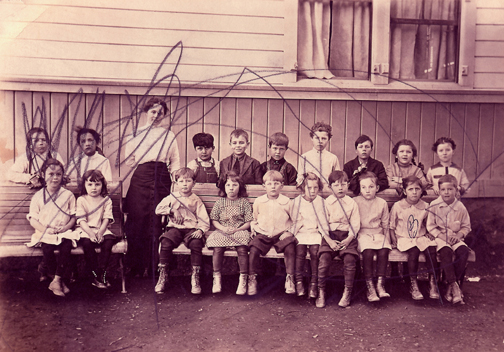
In the middle-to-late 1910s, Inez is known to have taught in the town of Mariposa, as evidenced by two
surviving photographs preserved by one of her students, Bernice Castagnetto (later to become Bernice
Turner). One of those photos is reproduced in full below, courtesy of Bernice’s granddaughter-in-law
Jacque Turner. Unfortunately a child scribbled on the original. The damage may well have been the work
of Bernice herself, who was a first grader the year the photo was taken and may have simply been wanting
to embellish the picture. Bernice is the little girl second from the right, seated. Inez is, of course,
the adult woman standing between the benches. When making a note on the back of the photo in her old
age, Bernice wrote down Inez’s name as Inez Bauer. This was an easy mistake to make, given Inez’s
family connections, but it also may be a hint that her full name was Inez Bauer Branson.
In 1911, Inez’s parents moved to Manteca, San Joaquin County, CA, so that was the home Inez returned to
for the next few summers. In the 18 May 1914 issue of the Oakland Tribune, Inez Branson “of
Manteca” is described as the corresponding secretary of the central California chapter of the Federation
of Parent-Teacher Clubs, a precursor of the national PTA. The article shows she was active in the
pursuit of greater influence of women in education policy. The article’s main topic is the organizing
taking place to pressure the county board of education in Stockton to add a woman to their number.
She was not alone among the Branson women in this attitude. Her aunt Nancy Branson Harrington Napier
was the vice president of the San Joaquin County chapter at that time, and was part of the campaign.
During the 1915-16 school term, Inez taught in Stanislaus County. When she became free for the summer, she
had something different in mind than just returning home to Manteca. Her eldest brother, William, had been
suffering from tuberculosis for a number of years, during which time his mother was one of his main
caregivers -- William shared the house with his parents, and his condition was one reason why he had not
embraced his parents’ departure to Manteca as the natural juncture to start living on his own. It was
obvious to all, William included, that he would probably not live to see another summer. Inez decided the
main purpose of her summer vacation would be to go camping in Yosemite Valley with her big brother for a
couple of months. It wouldn’t slow down the disease, but at least the beauty of the surroundings, not to
mention the cooler temperatures of the mountains, would provide a degree of solace and comfort. The scheme
had the additional benefit of giving Frances a break. Frances had kidney disease and was not doing well.
Inez’s decision was well-timed. Her loved ones were still strong enough to enjoy the benefit of her gesture
for the entire stretch. They didn’t have much longer after that, though. Frances and William died in early
November, literally on the same day and in the same house, about seven hours apart.
The death of her mother and brother occurred while Inez was in the midst of her year in Mariposa, teaching
the students shown in the photo above. Looking back at the course of her entire life, it is plain to see
the loss of these cherished family members marked the dawn of a new era in Inez’s existence. She was no
longer satisfied living the sort of isolated and non-cosmopolitan lifestyle that she was subject to as a
teacher stuck out in the boonies. As soon as her year was done, she redefined herself, immersing herself
in a considerably more urban milieu than she had known -- the San Francisco Bay Area. Her first taste of
that new life was in Vallejo, Solano County, CA, where she taught at Lincoln School for the 1917-18 school
term and possibly for another year or two. Then in the early 1920s -- probably within the calendar year
1920 itself -- she moved in with her sister Alma and brother-in-law Herbert Kibby Youd. Alma and Herbert,
who had spent the first bit of their married life in Merced, had relocated to Richmond, Contra Costa
County, CA during the World War I years. Alma was a nurse. Herbert was an employee of the local Standard
Oil refinery. Once becoming part of their household, Inez remained with them for more than twenty years.
For most of the 1920s and 1930s this home was also shared with her niece, Lila Frances Reeb, Alma’s
daughter, born in 1905, though there were short stretches when Lila was not there -- in particular, a
few years at the end of the 1920s when Lila was off teaching at a small rural school in Sierra County.
In the early 1920s, their address was 452 Ninth. (Alma and Herbert had resided at 450 Ninth until Inez
showed up. Apparently her arrival obliged them to obtain larger quarters next door.) From 1923 or so to
about 1928, they lived at 920 Barrett. After that, 903 Barrett. All of those homes were within a stone’s
throw of one another, and in turn were very close to Cottage Hospital, Alma’s workplace. The last, 903
Barrett, was practially within the walls of the facility.
Inez began teaching for the Richmond city school district, apparently coming on board as one of the
many teachers brought in to teach at the large, brand-new school built at Port Richmond. By the mid-1920s
she established herself for many years to come at Peres Elementary School. In addition to teaching, she was
highly involved in lodge activities, especially the Order of the Eastern Star, the female Masonic
organization.
 The lives of the three and sometimes four housemates
reflected the same sort of stability and relative quiet that the Thomas Branson/Frances Bauer household had
enjoyed for so many decades in Quartzburg and Hornitos. Not only did all members seem inclined to this in
terms of personality, but there was little practical need to uproot themselves given that they did not change
employers, not even during the Great Depression when many people in the nation could not count on having jobs
at all, much less ones they knew and were satisfied with. Another aspect that echoed the Mariposa County
environment was that a large number of kinfolk lived nearby. Lila returned in 1930 and became a teacher
and counsellor at Richmond Union High School. (She moved out upon her 1940 marriage to Fred Reinertson.)
Other relatives from Hornitos had made Richmond their base of operations in the late 1910s or early 1920s.
Inez and Alma may not have had their parents with them, but they did have their beloved uncle and aunt,
Michael and Mary Jane Bauer (who resided just three blocks away on the same street at 1208 Barrett
Avenue), along with Bauer/Geary first cousins and other familiar figures such as George Manuel Reeb,
whose brother Frederick had been Alma’s first husband (and father of Lila), and whose wife was Lizzy Bauer,
their first cousin.
One curious aspect of this entire group was the dearth of further children. Inez neither married nor had
offspring. (It seems likely she was gay, but she lived in an era when she would have paid a price for
coming out, and if she did have that orientation, there is no direct evidence, only clues such as a complete
lack of a male romantic figure in her life, and her steady practice of employment sufficient to avoid the
need to find a husband just to be able to have a roof over her head.) Lila was Alma’s only child, and Lila
herself was childless, though she became a wife well before forty. Of the others, only George Reeb and Lizzy
Bauer reproduced, and they had only one child, Marian Reeb, born in 1919, who in turn never became a mother.
Perhaps the absence of any significant propagation of the clan kept the bond unusually tight between the
extended family members who had chosen to settle in Richmond. They all remained until death or the brink of
it.
The living arrangements became more fluid as the 1940s went on. Not only was there the departure of Lila in
1940, but in about 1943, Alma and Inez moved to a new place at 600 30th Street, about nine-tenths of a mile
due east of their former home. This change of venue was probably welcome, but there was a hiccup. Herbert
Youd does not appear to have been invited along. The 1944 voter register shows him at 2729 Grant Avenue,
putting him a block north and a block west of Alma and Inez -- a small separation, but not easy to explain
unless there was some sort of marital rift. However, any discord must have been quickly resolved. All
records after the mid-1940s to his death thirty years later identify Herbert as a resident of 600 30th.
As Alma and Herbert patched things up, Inez may have decided it was time to grant the couple a level of
privacy they had never had before. For the entirety of their marriage they had shared quarters with either
Lila, or Inez, or both. Some time before the end of the 1940s, Inez moved a short way to 330 29th. However,
she did not have long without a sister for company, if there was any solitude at all. Alice Branson
separated from Milton James Henry, her husband of more than twenty years, and left him behind on his farm
near Manteca. Alice joined Inez in Richmond. The 1950 census shows the two siblings at 330 19th.
Furthermore it shows they had three bachelor lodgers. Taking on boarders was probably Alice’s means of
contributing to the finances; she had not had a job outside the home for almost fifty years. (She was
renowned as a cook.)
As far as can be determined, the rift between Alice and Milton, aka M.J., continued all the way to his
death in 1953. However, she was probably still his widow in the legal sense. As a way of smoothing out the
handling of his estate, or simply out of common decency, Alice’s stepson Lloyd Henry, a well-to-do Manteca
dentist, offered Alice the use of a small house on some Manteca-area farm acreage he owned -- M.J.’s farm
having been sold -- and she accepted. The 1953 Richmond city directory shows Inez living at 560 28th. That
was either a place she moved to just after Alice departed, or where she had come to be during the time when
Alice was still with her. In any case, she remained there until at least 1956. Soon, however, she moved
back in at 600 30th. Alma had developed Lou Gehrig’s Disease and needed help. Inez as ever was a supportive
sibling.
Alma passed away from the effects of the disease in 1958. Rather than resume an independent life, Inez
stayed put, sharing 600 30th with Herbert. He probably needed the company more than she, but there is
little doubt she appreciated having someone around, because with her resources she could have lived alone
for long stretches if that had been her natural inclination.
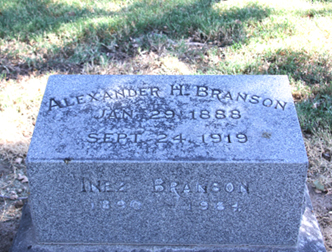
Inez perished 13 November 1964. Her remains were interred in section 37 at Stockton Rural Cemetery, Stockton,
San Joaquin County, CA. By the time she died, section 37, which contained the graves of her parents and all
three of her brothers, had long been sold out. To accommodate her desire to be buried with her kinfolk, she
was buried with Alex. (This was in keeping with the burial of her brother Hugh in 1949, whose remains had
been added to their mother’s grave.) Inez's name and years of birth and death were inscribed on the front
side of the gravemarker -- Alex’s own name and stats occupying the top side.
(Inez is not to be confused with her extended sister-in-law Inez Lilley. Inez Lilley, born Inez Youd,
was the sister of Herbert Kibby Youd. Her father-in-law, Walter Lilley, had been a doctor Alma Branson
worked with in the early 1910s at Merced Sanitarium.)
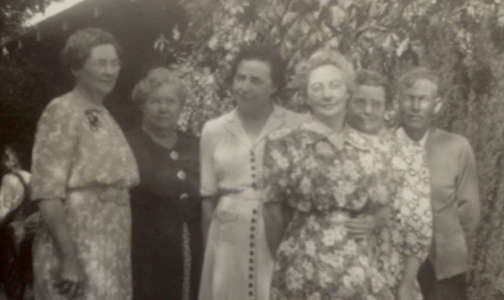
Inez and the other surviving children of Thomas and Frances Branson, a photo taken outside
Alice’s home on M.J. Henry’s farm near Manteca, CA in 1943. From left to right, Mabel, Alice, Inez, Alma,
Evalena, and Hugh.
To go back one generation, click here. To return
to the Branson/Ousley Family main page, click here.