Grace Mildred
Branson
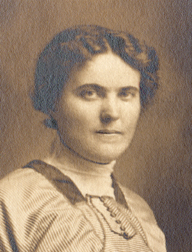 Grace Mildred Branson was born 15 August 1885 at the Mariposa
County, CA home of her parents, Joseph Branson and Ellen Margaret (Ella) Geary Branson. She was the fourth
child overall, and the second of the two girls of the family. Her older siblings were John, Marguerite, and
Alvin. Her younger brothers were twins Ernest and Eldridge. Grace did experience a change of residence when she
was twelve years old, a move of a fraction of a mile into a new house, but throughout her childhood, home
was a cattle ranch located within the then-active hardrock mining district of Quartzburg. The community has
since vanished completely. Even when it did exist, it never was a platted village with blocks of streets.
It was instead a loose concentration of buildings -- residential and otherwise -- scattered along the gentle,
grassy slopes of the lowermost fringe of the Sierra Nevada foothills. Nearly every shack, cabin, and ranch
house was within sight of a mine head outfitted with a stamping mill to pound the metal free of the quartz
that enclosed it -- which is a way of saying that every dwelling was within range of the cacophony raised by
said equipment. The nearest true village was Hornitos, located about two miles to the south.
Though Grace’s father’s main occupation throughout his married lifetime was the raising of stock cattle,
some of the family income came from gold. Two productive mines were located within the ranch acreage. As of
1897, once Joseph had completed his acquisition of additional land -- including his parents’ “Grasshopper
Ranch” -- and relocated the family home, Grace was able to stand outside her front door and observe gold
ore being removed from the ground only a few hundred yards away from where she stood. Though the place where
that home was located is now resolutely uninhabited, displaying a vista that suggests no human settlement of
any sort ever existed there, in the 1890s and early 1900s it was a bustling venue that featured a miners’
barracks, a barn, a blacksmith shop, a caretaker’s house, water towers, and more. It so resembled an
authentically western hamlet that it was once used as the backdrop for the 1922 feature film The
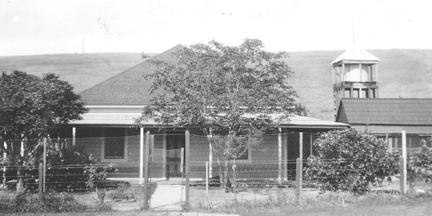
Western Musketeer, directed by William Bertram. (Shown at right is the home of Joe and Ella Branson
in its prime, complete with its own low-tech
version of deer fencing. Grace would have known this version of the home when coming back for visits as
a grown, married woman.)
 Grace went to the local Quartzburg District School,
sharing her classes with a student body made up almost entirely of relatives, be they named Branson or
Peard or Simmons or Northrup or Spagnoli. Some were siblings, some were cousins also descended from John
and Martha Branson. Some were more distant cousins decended variously from her grandfather’s first cousins,
Isaac Branson and Irena Branson Scott. Some were not blood relatives, but were members of families that had
intermarried with the Branson clan.
Grace grew up tall and heavy-set. This, along with the exodus of young men from Mariposa County in
the early 1900s due to the collapse of the gold-mining industry, meant she did not enjoy the
attention of an abundance of suitors. She did not wait for one to magically appear, and instead became
a school teacher. After graduating from Stockton Normal School, she taught close to home in Mariposa
County at Bear Valley. This is not to say that Grace
had no prospects as a young lady. One of those possible romances deserves mention. To her dying day
Grace kept a photograph of a young man in her personal effects. It was a formal studio portrait from
the late 1890s or early 1900s of Herman Maurice Gossner. Herman’s father had been a saloonkeeper in
Hornitos in the late 1860s and early 1870s, then had become a brewer in pioneer Merced, where Herman
had been born in 1874. The Gossners appear to have been very well acquainted with Grace’s Merced-based
Branson-side aunts Phoebe, Nancy, Mary Jane, and Theresa and their households. It stands to reason these
relatives may have thought well of the handsome bachelor and pointed Herman in Grace’s direction -- with
at least a little matchmaking success or Grace would not have preserved a picture of him. (She was not
the sort of person to go out of her way to save photos.) But the extent of the relationship with Herman
remains a mystery. Herman caught tuberculosis in
1903, when Grace was eighteen, and may out of consideration for her health subsequently limited the scope
of any courtship he may have initiated toward her. He died of the effects of his disease in 1905.
In 1907 Grace accepted a posting at Round Mountain
School in Fresno County. This, too, was a one-room rural schoolhouse situation. The facility,
nestled amid the rolling, wildflower-dotted hills along a small stream called Fancher Creek,
had been erected to serve the children of the ranchers living in the area. The school served the
children of Letcher and Academy, both tiny trading outposts that would not survive far into the 20th
Century. (That said, a vestige of Academy still persists because it is along the main route up to the Shaver
Lake and Huntington Lake recreation
areas.) It was a school essential to its era, but one that would disappear once roads became paved and
automobiles became common, allowing local children to be sent to campuses in larger communities.
Accepting the job took Grace beyond the southern limits of the Mother Lode, and whether she intended it
or not, uprooted her from her childhood milieu for good. It also took her out of the sphere of the Branson
clan in interpersonal terms, though this process was a bit more gradual -- in her mid-twenties she still
made regular visits back home during gaps in school terms, and in 1910 did have the company of her
first cousin Emelia R. Bauer as another Letcher-district teacher, but soon the people in her life would be
almost entirely different. In great part this was because she met her
future husband while teaching at Round Mountain. A family from the Wisconsin/Illinois border named Warner
had relocated to California in 1906 so that one of the grown sons of the family, Cullen, could benefit
from the arid climate of the Great Central Valley, and hopefully stave off the tuberculosis he had been
infected with, a disease which had already killed his young wife. Cullen’s parents John and Nellie Warner
(John Warner and the former Eleanor Amelia Martin) had purchased a large property along Fancher Creek,
where Cullen would be away from a town environment and less likely to infect others, naming it Spring
Brook Ranch. Various family members lived there part-time. Cullen’s one full-time companion was his
slightly younger brother, Albert Frederick Warner (born 13 August 1884 in Willow Springs, Howell County,
MO).
 Grace caught Bert Warner’s eye. At first, he could only lightly
pursue that interest because he was Cullen’s number-one caregiver at those times when the latter’s
symptoms flared up. But Cullen succumbed entirely at the beginning of May, 1909. Sad as this was, the
development had the virtue that Bert no longer had cause to postpone pursuit of a lovelife. Over the
next couple of years, Bert gave up cattle-ranching and took a job as assistant manager of the feed
grain warehouse and hardware store, Warner Warehouse Company, that his father and his older brother,
John Martin Warner, founded twenty miles south of Academy in the town of Sanger, Fresno County, CA.
Bert’s father was becoming a senior citizen and preferred to play the role of investor or “silent
partner” rather than actively co-manage the day-to-day business, and Bert was his chosen surrogate.
Bert’s salary was set at sixty dollars a month. Meager as that may seem by today’s standards, it was
more than enough to ensure Bert had the ability to support a wife, and so he proposed to Grace.
Grace gave up teaching upon her marriage. Ironically, she was
granted a lifetime certificate to teach at elementary school level in California that same year, 1911.
The formal paper arrived after she had turned her back on the occupation forever. She spent the rest
of her days as a homemaker.
The marriage took place 28 May 1911 at St. Paul’s Methodist Church in Fresno, Pastor Harold Govette
conducting the rites. After the wedding, bride and groom set out in a covered wagon pulled by two horses,
and six days later arrived at their honeymoon location, Yosemite Valley. They camped for their two-week
stay. Camping remained one of their favorite forms of recreation throughout their active years. This was
particularly true of the period when they were raising their two daughters, Marian and Josephine, born
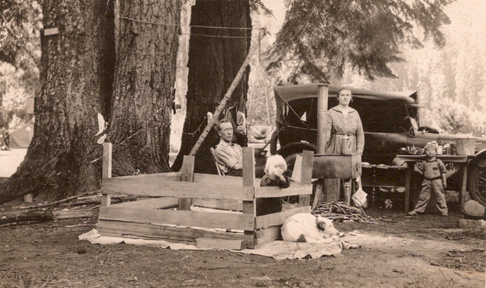
during the World War I years. (Shown above left, Grace and Bert and their two girls. Marian is the
older child, Josie the tow-headed toddler confined to the makeshift playpen.) Both girls retained an
affection for the Sierra Nevada. Marian would marry a foothills cattleman and reside just outside
Tollhouse. Josie and her husband would camp and go on packtrips and, beginning in 1950, own a cabin at
Huntington Lake.
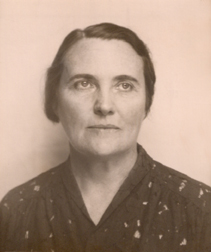 Though Grace did not work outside the home as a wife,
she was a member of the Yeoman and Rebekah
Lodges. The decades of the 1920s and the 1930s, in spite of the uncertainties that came with the Great
Depression, were prosperous times for the Warners. In 1919, three years after the death of his father,
Bert had become full and sole owner of the warehouse, and as his first major “I’m calling the shots now”
decisions, had immediately added a gasoline service station to the property. This proved to
be a stroke of genius as far as generating income for the family. Families were beginning to depend
on automobiles and dispense with their horses, and the Warner service station was perfectly located
within the town of Sanger. Things went so well, in fact, that Bert was able to retire from active
business life in 1934, at age fifty. He self-mortgaged the sale of the station to a former employee,
and he and Grace lived off the payments over the next twenty years. It should be noted, though, that
he worked as a clerk in an automobile parts store during World War II to help out while so many young
men of the nation were overseas. That income, plus the Social Security checks Bert subsequently qualified
for as a result of that job, was a further boost. Thanks to a paid-off home and other investments, Grace
and Bert had no worries about their financial situation as they grew elderly.
(Albert Frederick Warner is profiled on this website in the sections devoted to the family of
his grandparents, Nathaniel Martin and Hannah Strader, and the family of his other grandparents,
John Warner and Marancy Alexander. To read his biography, click here).
Grace and Bert enjoyed a long, easy span of
senior-citizenhood. They enjoyed good health, aside from the inconveniences of poor eyesight and
both carrying a large amount of weight. (Bert had been thin as a youth, and ultimately thinned out
again as a very old man, but was quite stout in middle age.) The improvement in the national highway
system by the middle of the 20th Century enticed the pair to do a great deal of travelling, even to
such far-flung spots as New England and Florida. Bert loved to visit his relatives back in Wisconsin
and Illinois, and observe the changes to the places he had known in his childhood. Grace never did
learn to drive, having come from a generation where ladies let husbands take care of such things.
This decision was also in keeping with her personality. She often felt comfortable keeping to
traditional modes of behavior.
In 1972, Grace had a scare when Bert suffered a severe heart attack. In the hospital, his doctors said
he would not live to go back home. But he had always looked after Grace, and simply could not leave her
to fend for herself. He did recover, and did come back home. Instead, it was Grace who was the first of
the couple to die. She had already outlived all of her siblings -- even her six-years-younger brother
Eldridge, who had made it to 1972 -- but in her late eighties, even her robust constitution failed her. In
September, 1974, a severe stroke left her unable to communicate or care for herself. Bert had no choice but
to admit her to the Sanger Convalescent Hospital, where she lasted only a few weeks. She succumbed 4
November 1974. She was laid to rest in the Warner section of the rural
Mendocino Avenue Cemetery south of Sanger, beside Bert’s parents. Bert would join her there,
but this would not occur for some time, despite his having reached ninety years of age
before Grace’s final deterioration of health began. Various medications kept his heart problems in
check, and he enjoyed a long, generally good twilight period as a popular patriarch of his clan. Bert
actually survived for sixteen and a half years after his heart attack, and finally passed away 12
October 1988 at the age of one hundred four.
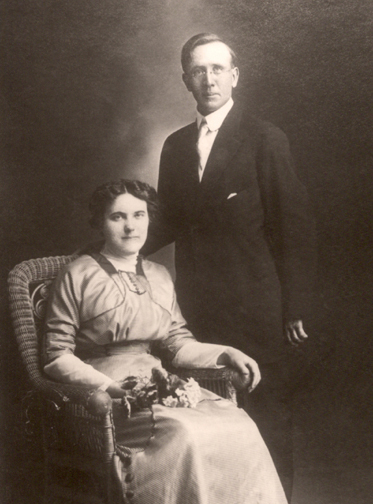
Grace Mildred Branson and Albert Frederick Warner, a wedding portrait taken at Raisin City
Studio, Fresno, CA.
Children of Grace Mildred Branson with
Albert Frederick Warner
Marian Ruth
Warner
Josephine Alberta
Warner
For genealogical details, click on
each of the names.
To go back one generation, click here. To return to Albert Frederick
Warner’s page, click here. To return
to the Branson/Ousley Family main page, click here.