Gertrude Branson
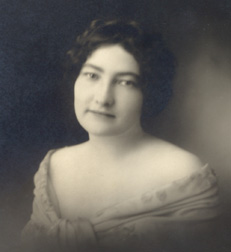 Gertrude Branson, daughter of Reuben Branson and
Eliza Louisa Armstrong, eighth of their eight children, made an exciting entry into the world.
The family was living in the
logging community of Sugar Pine, in the Grub Gulch area of Madera County, high in the mountains
when Louisa went into labor. Complications developed. A doctor was needed. Unfortunately,
the nearest available doctor was in the town of Madera, down in the Central Valley, over
sixty-five miles away. The only means of transport that would give mother and baby the
quickest and best care was to ride the Gertrude Flume, down which logs were sent to be milled
into lumber. Reuben and Louisa climbed into a makeshift vehicle -- a log cut into a triangular
shape, with only eyebolts to hang on to -- and clung to it during a frightening hour-long ride
downslope. Somehow they made it safely to their destination. The child was born healthy 22
January 1891, and was given the name Gertrude in honor of the flume. She was often known as
Gertie.
Gertie in turn may have inspired the name of the Gertrude Mine in the Potter Ridge area, one of
several Madera and Mariposa mines that her father worked over the rest of the 1890s. Gertie
spent her early childhood in cabins near mines and sawmills of the mountains. The most long-lasting
of these homes was in the quarry town of Raymond in Madera County. This phase of her life lasted
until late 1899 or early 1900, when Reuben finally gave up on the mountains. The family
established a temporary home in the city of Madera, the very community in which Gertie had been
born. All four of Gertie’s sisters -- Mamie, Mattie, Mabel, and Margaret -- were part of this
relocation, which Gertie no doubt appreciated given that she had never before lived in an
environment that could be called urban.
In the winter of 1900-01, Reuben took a job with the Yellow Aster Mining Company at Randsburg in
Indian Wells Valley in eastern Kern County. The gig looked steady enough that he asked Louisa to
join him. She and the girls made preparations to do precisely that. Their friends and neighbors in
Madera even gave them a bon voyage party in early April, 1901. And chances are good mother and
daughters -- with the possible exception of the eldest, Mamie -- did in fact go to Randsburg. If
so, they did not stay there long. Reuben and Louisa’s marriage ended, and she retreated back to
Madera. In late July, she proceeded to the city of Fresno. This time the family group was much
smaller -- only Gertie, her adolescent sister Margaret, and her mother. Her other three sisters
were old enough they could live independently and they chose to do so rather than be caught up in
the divorce furor. For the next several months they alternately lingered in Madera and/or took
shelter with their uncle John Sevier Branson Jr. and his wife Lillian up in the hills at Peckinpah’s
Mill. John and Lillian had lived near Reuben and Louisa during the Raymond years, and the girls
viewed them as surrogate parents.
 Sister Mattie moved into the Fresno home by the end of
the year. Alas, she caught diphtheria and died just after the winter holidays. It’s easy to imagine
Gertie’s increasing shock. Between her ninth and tenth birthdays not only had her parents split up,
but now her sister had died. These two catastrophes were unfortunately only the opening rounds of the
turmoil in which Gertie would be immersed for the remainder of her upbringing. A few months later her
sister Margaret became pregnant at only fifteen years of age. That was too young to put a good face
on things and too young for Margaret to found a family with her paramour -- even assuming he was
mature enough to make the attempt. (His identity remains unknown.) Louisa hatched a plan to nip the
potential scandal in the bud by pretending Margaret was not pregnant and setting up a scenario that
would, in due time, explain how and why a new baby had appeared in the family. She and Margaret moved
to San Jose, CA, putting them near Louisa’s older sister Bertha Biedermann of Morgan Hill. Because of
her tender years, Gertie was swept up in these logistics as well. Margaret was tucked out of sight
during the second and third trimesters. Meanwhile Louisa pretended to be with child, saying the
pregnancy was the result of one final attempt at reconcilation between herself and Reuben. When the
baby was born, Louisa proclaimed him to be Reuben’s son, and named the boy Herbert Raymond Branson.
His nickname would come to be Blondy. Reuben told those who would grant him the benefit of the doubt
that he and Louisa had not been intimate for over a year before Blondy’s conception. Most of his
kinfolk found his account credible. After all, it seemed obvious to any objective observer that the
traumatic episode of Gertie’s birth had ended Louisa’s ability to ever have children again. In that
era medical science was not advanced enough to provide a means of determining paternity in a
conclusive fashion, so the circumstances boiled down to a case of, “He said, she said.” For the rest
of her life, Louisa insisted Blondy was Reuben’s son. Gertie was among the few witnesses who could
say otherwise. She kept quiet, though, and continued to do so even late in life, when revealing the
truth would not have made much difference. Gertie and Blondy remained close and were a regular part
of each other’s lives. He had been raised as her brother and she loved him as one, even if technically
he was a nephew.
When the move to San Jose occurred in late 1902, Gertie had yet to turn twelve years old, and it was a
given that she would remain in her mother’s household. But her father and his relatives continued to
worry that Gertie was not in an environment suitable for a young lady. This concern was heightened as
Margaret again ran off with a boy and became pregnant. Margaret and her fellow, the equally
young Charles Heitkemper, married in secret. It was not a valid marriage because he was too young to
obtain a marriage license without parental permission. The parents stepped in and had the marriage
annulled, and Charles was successfully pressured to return to his home in Portland, OR. It would be
quite a number of years before he learned he had sired a son, Oliver Heitkemper. This time there was
no ruse perpetrated to pretend Louisa -- then nearly fifty years old -- was the boy’s mother. Margaret
had to bear the loss of reputation. Her response? She took up with minor-league baseball player Edgar
Leroy Gaver and became pregnant by him not once but twice before finally marrying him.
Somewhere along the line, Reuben stepped in and arranged an alternate situation for Gertie. Reuben did
not have the means to acquire or maintain a house of his own, but he knew he could depend upon the
hospitality of his siblings Tom, Joe, Mattie, and Alvin back in Mariposa County. In particular, there
was plenty of room for Gertie at the sprawling Joe Branson ranch north of Hornitos. Joe’s wife Ella
saw to it that Gertie finished her education. In those days among the clan, “finishing one’s education”
meant graduating from the eighth grade. Gertie attended Quartzburg District School, a one-room
elementary school near the ranch. Many Branson relatives had gone there over the years. During Gertie’s
tenure her classmades included first cousins Ernest and Eldridge Branson, the twin sons of Joe and Ella.
The three of them graduated in the early summer of 1909. Gertie had recently turned eighteen. Ernest
and Eldridge were just about to.
 Gertie’s circumstances over the next seven years are
only vaguely known. She was always grateful for the support and kindness her uncles and aunts and cousins
showed, but from that point on -- eighteen to nineteen years of age -- she steered down a path that kept
her in touch with kinfolk on both sides but left her able to avoid having to declare exclusive loyalty to
either. At the brink of the 1910s, her mother and sisters and even her brother Robert became based in
southern California, where the oil industry was booming. Her mother was in Pasadena, living with
boyfriend Charles R. Hines. (Blondy Branson was part of the household.) Gertie found some sort of living
arrangement a few miles to the west in the small community of Tropico, which was one of the many little
towns of the region to spring up wherever there seemed to be some hope of drilling for oil. Tropico lay
to the south of Glendale and was southeast of Griffith Park. In 1917, Tropico ceased to exist as an
independent jurisdiction when its residents voted to allow annexation by Glendale. Many modern-day
residents of the neighborhood are unaware of the old place name.
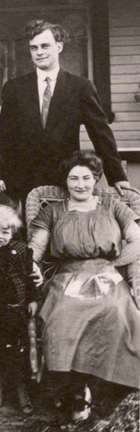
Gertie appears in a group photograph taken about 1910 that shows her, her mother, her three surviving
sisters, and their men. The youngsters -- Blondy Branson, Oliver Heitkemper, and the two Gaver kids --
are also in it. Charles Hines is shown with Louisa. Mamie, Mabel, and Margaret are all attended by
their husbands. And standing behind Gertie is a young man who we must assume was more than just her
date given the nature of the group posing that day. He might even have been a fiancé. Gertie is not
known to have acquired a spouse that early in her life, so the best guess is, wedding bells never
rang for the pair. In the absence of marriage paperwork to consult, the fellow’s identity remains a
mystery, and it is unresolved how long he was part of Gertie’s world. (The portion of the photograph
that contains Gertie and her gentleman friend is shown at left.)
Gertie was still a resident of Tropico when she met a new arrival to southern California, Jesse
Murray Eastep Smith. They appear to have moved in together in 1916 or even in late 1915, but did not
marry right away, the usual pattern for Louisa and her daughters. Gertie and Jess do however seem to
have presented themselves to the public as a married couple. This means that when they finally did get
hitched, they did not do so by means of a widespread announcement and in the presence of a crowd
of family, friends, and hangers-on. Instead they slipped off to Hanford, Kings County, CA -- a place
neither of them was associated with -- and quickly and quietly took care of their vows and paperwork
at the courthouse, out of view of friends and family who might have asked, “But, wait -- aren’t you
already married?” The date was Monday, 28 May 1917.
Barring the faint possibility that Gertie’s “lost years” of the early 1910s included a brief marriage,
Jesse was the one and only husband of her lifetime. He was her senior by two dozen years. Naturally,
that meant he had already accumulated some life history. Here in brief is what he did during his first
half-century on the planet:
Jesse (occasionally known as Jess and as Jessie), born 24 October 1866 or 1867 in San Joaquin County,
CA east of Stockton, was the only son of William Harrison Eastep Smith and Tina Ann McDowell. His first
name was bestowed in honor of multiple relatives including his maternal grandfather Jesse Franklin
McDowell, his grandmother’s half-brother Jesse Fuller, and his great-grandfather Jesse Aiken. Jesse was
brought up at first in San Joaquin County and perhaps in Stanislaus County, and then in the 1870s after
his mother died and his father remarried, in Humboldt County in the vicinity of Rohnerville, where his
father raised beef cattle. Upon becoming an adult, Jesse came south to the Salinas Valley. He did so as
an employee of Southern Pacific Railroad. The company had decided to extend its line south in 1886 from
Soledad through King City and on down to Paso Robles and other towns of the coastal range. Jesse may have
been part of the 1886 construction crew, doing so as he was approaching twenty years old. How long he
remained with Southern Pacific is not clear. Perhaps not long at all. Regardless of whose payroll he was
on, he did however linger in the Salinas Valley. The local infrastructure was expanding and the
population swelling thanks to the availability of tracks along which shipments of wheat, beef, and coal
could head to market, and merchandise of many sorts could flow in. The flurry of economic activity meant
there were many ways a young man might earn a dollar. The 1888 voter register places him in Gonsales on
the El Camino Real between Salinas and Soledad.
One of the ant-hills of civilization in southern Monterey County right on the railway line, not far from
King City, was Chalone. That was a place name due to become obsolete because with the establishment of the
depot, the community suddenly expanded and a post office was established. The first postmaster was W.H.H.
Metz, and Chalone soon came to be called Metz Station and then simply Metz. In 1877, Francis Marion
Carnahan and his wife Charlotte Ianthe Hamilton had established a farm in the immediate vicinity. The
couple’s eldest daughter was Elizabeth Floretta Carnahan, born 11 October 1868 in Hollister, CA. She and
Jesse became an item. He had good reason to be impressed by her. As the eldest of nine children, most of
whom were female, Elizabeth (also known as Lizzie) was accustomed to taking a leading role, and was already
in the process of founding her own homestead not far from her parents’ acreage. She was willing to give
up that venture to have Jesse, though. The sweethearts were wed 12 August 1891 at her parents’ home. The
timing seems to have been influenced by Jesse’s plans. Even before the wedding took place, he had already
relocated to San Francisco. Now Elizabeth joined him and the newlyweds began transitioning into life
in an urban setting -- a big change for both of them. Over the next seven years Elizabeth gave birth to
four children, twins Walter and Edna in 1892, Nellie in 1894, and Jesse in 1898. Unfortunately Edna perished
at six years of age and little Jesse at only nine months. The only point when Jesse and Elizabeth could
gather their entire brood in their laps was a few months in the late summer and early autumn of 1898.
Through much of the 1890s, Jesse was employed as a member of an Underwriters’ Fire Patrol. This means
he was at times a firefighter, but his role was not the same as what most people think of when
the term firefighter is bandied about. In the late Nineteenth Century and on into the early Twentieth,
several major cities, San Francisco among them, allowed major insurance carriers to form fire-suppression
crews that functioned semi-independently within the normal fire-department jurisdictions. The insurance
companies subsidized the brigades, which at times worked side by side with the city guys if extra manpower
was needed to deal with a blaze, but which otherwise worked in the economic interests of the insurers.
The personnel would for example conduct safety inspections of steam boilers and gas lines
within the buildings owned and/or occupied by policy holders. After a fire, they would move in to sift
through the char and rubble for intact items of value that could be auctioned off to defray the losses
the insurers had suffered. Jesse was a driver -- as in, he controlled the reins of the horses that pulled
the wagons -- and was promoted to sergeant by 1897. The 1892 voter register mentions he had lost both
forefingers. Assuming that is accurate, perhaps he had an accident early in his fire-patrol career.
Being a fire patrolman, even a sergeant, does not seem like much of a way to get rich, and until the year
1900, perhaps Jesse never did much more than keep himself and his family clothed and fed. But the first
decade of the Twentieth Century would be very good to him in terms of making money. Perhaps with the help
of funds supplied by his parents-in-law, he became a businessman and set out to exploit an oil field
southeast of King City in the hills of western Kern County. The place was so remote the kids
would sometimes be left with their grandparents in Metz so that they had better schooling and a more
child-friendly environment to be in. Bit by bit the oil derricks went up and the oil came out of the
ground and Jesse (and Elizabeth) became rich. In 1907, their outpost formally became known as Reward,
and had its own post office. Reward was part of the McKittrick oil district, McKittrick being the name
of a similar outpost about three miles away. In 1908, a year when California’s major oil companies
collectively generated a staggering fifty million barrels, the McKittrick district was one of the top four
most productive oil fields in the state. The windfall was tremendous. Prices remained high thanks to the
rapid expansion of population and infrastructure within the region, and the establishment of all manner of
fuel-burning industries throughout the nation. Things were so good that Jesse retired in 1911. He and
Elizabeth acquired a home on Glen Canyon Road just north of the city of Santa Cruz. He was familiar with
the Santa Cruz region because his father, who had died in late 1907, had lived there for several years at
the end of his life, and Jesse’s stepmother was still based there.
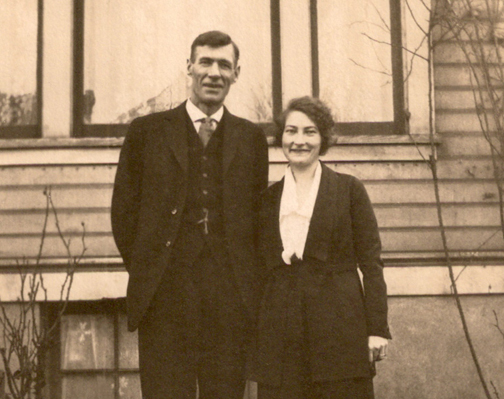
Gertie and Jesse outside their home in the 1930s.
Jesse was only in his mid-forties in 1911, and being completely retired just didn’t suit him. Accordingly,
he and Elizabeth soon left Santa Cruz in favor of reestablishing themselves in San Francisco. After all,
what better place to live the good life and balance out the ordeal of years spent amid dry hills and oil
derricks? They could partake of a level of society considerably more lofty than they had known during
their previous sojourn. Jesse found an occupation that would keep him occupied but at the same time cause
him to be viewed as a gentleman of means. He teamed up with a young automobile dealer, David Cleveland
Longwill, under the business name Smith & Longwill. The partners proceeded to sell Auburn Motor Cars from
a showroom on the original Van Ness Avenue auto row. Auburn Automobile Company was the Twentieth Century
manifestation of the successful Eckhart Carriage Company of Auburn, IN. Their vehicles, more upscale than
those of Ford, were popular throughout the country. The firm’s fortunes peaked in the first half of the
1910s, so Jesse’s decision to tie his success to theirs was -- for the moment -- an astute move on his
part.
In early 1912, Jesse’s twenty-three-year-old female relative Ted Estelle Okell (aka O’Kell) came west from
Fort Madison, IA. Ted -- if her first name had a formal version such as Theodora, it appears in no source
found thus far -- was the daughter of Jesse’s first cousin Nettie Thurman Hobbs, daughter of his aunt Sarah
Estella Smith Hobbs. Nettie had lived her entire life in Iowa and Jesse his entire life in California, so
Jesse did not know his cousin well and by extension did not know Ted, even to the point of perhaps never
having encountered her in person. Ted arrived in the company of a pair of female friends with whom she
began sharing quarters in the Westonian Apartments in San Francisco at Broderick and O’Farrell, not far
from the Smith & Longwill dealership. Ted was not just “seeing the world” beyond Iowa, she was fleeing an
awkward situation back home. Her mother had abandoned her father after a quarter century of marriage and
had run off with a lover, eventually to marry him after she became a divorcée. Nettie had her hands full
with that transition and was not in a position to play hovering mother hen over her daughter, who after
all was a full adult and capable of looking after herself. However, the social mores of the era dictated
that when an unmarried young lady ventured on her own far from her point of origin, she should if possible,
for the sake of her reputation, seek out the oversight of older kinfolk, perhaps even temporarily living
with them and using them as a stepping stone to be “introduced to society” and have a safe haven in which
to greet young gentlemen callers. Nettie may well have asked Jesse (via correspondence) to serve in the
role of guardian of virtue and as an advisory figure, and/or at least help find a means of subsistence
for her far-flung progeny.
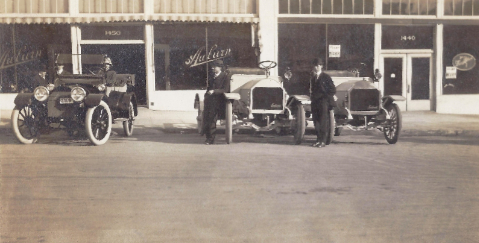 Jesse handled the last item on that list straight away.
He hired Ted as a so-called demonstrator. Many car dealers of the 1910s employed women not only to give
prospective customers test drives, but show that the vehicles were so easy to operate that “even a woman”
could do it. Shown at left is Ted on the job in front of the Smith & Longwill dealership. She is sitting
in the vehicle on the left while salesmen stand in front of two other customer-ready models.
As for his role in arranging appropriate chaperonage, Jesse utterly failed. By the winter of 1913-14,
Ted was no longer occupying the accommodations in the Westonian Apartments with her two gal-pals from
Iowa, she was sharing them with Jesse. As one might expect, Elizabeth Carnahan Smith did not take this
development well. She filed for divorce 16 January 1914, asking for a community-property division and
alimony, and simultaneously
sued Ted for alienating her from her husband’s affection. She demanded that Ted pay her $100,000. That was
the opening round, the details derived from an article in the Oakland Tribune. Where things went
from there is known only by the broad strokes. First, Jesse was able to afford a good lawyer. Second,
Ted did not have the means to pay so outrageous a sum and it is unlikely any judge would have required her
to cough up even a tiny faction of one hundred grand. The gist? The marriage was indeed shattered, never
to be repaired. However, the new romance didn’t work out, either. It may have lasted only a matter of
weeks and certainly no more than a year. In the autumn of 1915, Ted married Bert Maize, a man the same
age as she. The couple went on to enjoy an enduring union, at first in Fresno and then in St. Louis, MO,
where they put down roots in the early 1920s. They would both die in 1959.
Elizabeth Carnahan Smith went on in 1921 to marry Charles Seward Cothran, a former Merced County
supervisor. They settled in Capitola, Santa Cruz County, CA. Widowed in 1937, Elizabeth spent the rest of
her life (until her death in 1961 at age ninety-three) in Santa Cruz, sharing a home with her daughter,
Dr. Nell Riley. Jesse’s surviving daughter, who had given up the name Nellie upon reaching adulthood, had
become quite the prominent figure in society. She had divorced husband Ernest Leon Riley after a dozen
years of marriage, gone on as a divorcée to obtain a degree in osteopathic medicine and had, in 1932 or
1933, opened a practice in Santa Cruz. During the 1930s, she was one of only two female medical doctors
in the region, a true pioneer of her profession. Having been childless, in 1936 she had adopted a
five-year-old girl whose mother had died. She went on to raise her daughter, who was given the name
Betty Riley, in an all-female household, Elizabeth’s presence allowing Nell to keep her professional
career going. How much Gertie got to be involved in the life of her distinguished stepdaughter and
family -- if at all -- is unknown. Given the way Jesse’s actions had contributed to the 1914 divorce, he
may have been estranged from his offspring for the remainder of his life, and Gertie never knew them at
all.
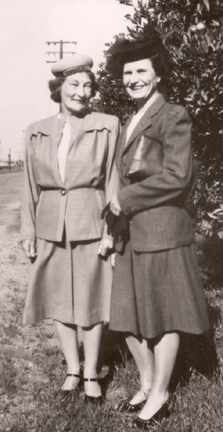 (Shown at right is Gertie in her advanced years. She’s the
one in the lighter outfit. The woman in the darker get-up is Alene Reid Branson, Blondy’s first wife. As
mentioned above, Gertie cherished her connection with Blondy. She also got along very well with Alene,
even after Alene had become the ex-Mrs. Herbert Raymond Branson.)
The dissolution of his marriage and the departure of his new girlfriend was part of a larger-scale
mid-1910s bad-luck streak for Jesse. The Auburn Automobile Company factory was forced to shut down due to
materials shortages caused by the war in Europe, and that was the end of Smith & Longwill as dealers.
Jesse fell back upon his oil-industry contacts and expertise, and that brought him to Tropico. Gertie was
two years younger still than Ted Okell, and a more cautious man would not have taken the risk of another
abandonment by a fleet-footed twentysomething-year-old, but somehow he quelled his doubts, and his
willingness brought him the best sort of reward. Gertie’s affections did not waver. Her sisters and even
her mother had over the previous fifteen years gone after men younger than themselves. Gertie apparently
was determined not to do the same. When she got to know Jesse, she found his maturity appealing. The
courtship was quick and decisive, and the paperwork was signed. Then, for as many years as Jesse had left
to live, Gertie was by his side.
Gertie and Jesse did not have children. This may even have been one of the reasons Gertie was attracted
to him. She may well have decided she did not want any, and by marrying an older man who had already
finished raising a set of kids, she did not have to worry she was letting a spouse down by choosing not
to be a mother. However, it is possible her childlessness was not by choice. Of the daughters of Reuben
and Louisa, the only one who ever produced offspring was Margaret. Mamie married in plenty of time to
have kids. The same was true of Mabel -- and that includes a pair of marriages to men who later had
offspring with their subsequent wives. It could be Mamie, Mabel, and Gertie were infertile, and that
suggests a common cause. It could have been something in their DNA, or perhaps all three sisters had
been hit by a severe bout of fever as children in the 1890s in the hills of Madera County. Such things
as typhoid fever were known to leave females infertile for life, and if one Branson girl contracted it,
the odds of multiple cases within the household would have been high.
It is worth asking if Jesse ever reconsidered the choice not to have kids with Gertie -- assuming it
was a matter of choice. His son Walter died childless in 1927 at only age thirty-five. Nell, as mentioned,
never had biological offspring. So by the time Jesse was an old man contemplating the grave, he was aware
his bloodline would all too soon be extinct.
Gertie and Jesse may perhaps have started their life together in Tropico. That has yet to be determined.
What is clear is that by the latter part of the 1910s, they had become based to the south in San Antonio
Township of Los Angeles County. The city limits would envelope the neighborhood and their address was
technically speaking simply “Los Angeles,” but their part of it is more often referred to these days as
Florence. At first they were renters -- the 1920 census shows them as lodgers in the home of Ulysses
Grant Isaacs and his wife Jennie on Florence Street. Later in 1920, or in 1921, Gertie and Jesse purchased
a home at 8003 Walnut Drive. Gertie’s mother shared this haven with them for a year or more, having finished
raising Blondy but not yet having married second husband Joe Eagle. In 1923 or 1924, Gertie and Jesse
purchased a different house one block south at 8101 Walnut Drive. At last they had found their long-term
situation. At about that time -- perhaps at precisely the time of the acquisition of the new
house -- Jesse decided he had had enough of the ups-and-downs and the unpredictability of oil-well
drilling operations, and he scaled back to something quite a bit more manageable and secure, a business
with only a tiny number of employees. He became the owner and operator of a service station. This was the
right course to pursue at that juncture. He was fast approaching sixty years of age and the new occupation
was more in keeping with his level of energy. Later the choice would pay unexpected dividends, as the
business remained viable even after the Great Depression began. People needed gasoline even in tough
times.
The 1940 census confirms that Gertie and Jesse were still in place on Walnut Drive, by which point Jesse
had retired (and this time it was retirement for good). Jesse was nearing the end of his time of Earth.
He died 12 February 1942. Though widowed at only age fifty-one, Gertie did not remarry. As far as can be
determined, she lived a quiet life thereafter, at first within the home she had known for so long. As she
became more frail -- a development of her late fifties rather than when she was elderly -- she depended on
members of her birth family as a support system. The 1950 census shows her and her sister Mabel in
Freewater, Umatilla County, OR as a pair of widows sharing a room at a Howard Johnson’s. Eventually Gertie
established a home on Menlo Avenue in Long Beach. Being there meant it was convenient for Blondy to look
in on her. He found himself doing so with greater frequency as she entered her seventies, but as far as
can be determined, Gertie was able to stay in her own home until she died 13 March 1963. Her remains were
interred six days later at Inglewood Park Cemetery, Inglewood, CA, where Jesse lay at rest.
Gertie, who was known after marriage as Gertrude B. Smith (“B” for Branson), is not to be confused
with Gertrude Ellen Branson, the daughter of her first cousin John Joseph Branson.
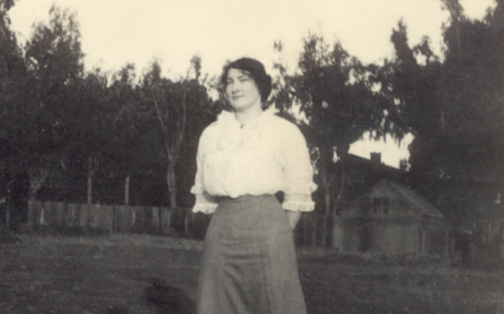
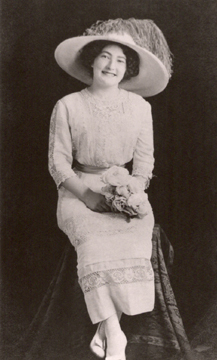
Gertie as a young woman, probably while living in Tropico.
To go back one generation, click here. To return
to the Branson/Ousley Family main page, click here.