John Geary and Ellen Moran
Welcome. This is a supplementary page of my “Family of John Sevier Branson and Martha Jane Ousley” website. I am privileged to descend from four Mariposa County Gold Rush-pioneer great great grandparents. Two couples. John and Martha are one set. The other set consists of John Geary and Ellen Moran. Their daughter Ella (Ellen Margaret Geary) married my great-grandfather Joseph Branson, third son of John and Martha.
I got ambitious with the story of John and Martha and devoted over 120 pages to the biographies and sidebar pages about them and their descendants. You would think I would put together a similar tribute for John and Ellen. Instead, there is just this one page right here. The reason? The ancestry of John and Ellen is a mystery, and they have no remaining descendants other than those who flow through Ella Geary Branson, a group that I’ve already honored in the main section. So one page is enough to say what I haven’t already said elsewhere.
If you have stumbled across this page without knowing about the Branson-Ousley site and what it has to offer about the Geary-Moran descendants, by all means click here to go to the main page.
Because the story of John and Ellen is so intimately tied to Mariposa County, this page also serves as a contribution to the website MariposaResearch.net, a resource I recommended to anyone wishing to learn more about the history and genealogy of Mariposa County in general. Click on the name to go straight to its main page. (Please note: the administrator has not updated the site since the mid-2010s; even so, what remains there is worth viewing.)
At this time -- the latest draft of this essay was composed in the year 2023 -- it remains impossible to be certain what families either John Geary or Ellen Moran sprang from. John and Ellen did not leave behind written material that would rectify this state of affairs. Incredibly, neither did any of their children or grandchildren. What did get saved was public-source items such as newspaper obituaries and photographs of headstones. Even such basics as dates of birth and marriage were not preserved, except in the sense of lists made by retroactively cobbling together the stats from the aforementioned public sources. Frankly, this is puzzling. In John and Ellen’s case, there is an understandable reason. They were unable to read and write. But a number of their daughters and granddaughters were one-room schoolteachers who prized their own literacy. One would think at least one family member of those early generations would have written down some family-history notes!
It was in 1973, as a teenager, that I made my first stab at putting together some sort of account. By that point, the only surviving grandchild of John and Ellen was my own grandmother, Grace Mildred Branson Warner (1885-1974). She was turning eighty-eight years old. Her mental faculties were still reasonably good, but as you might imagine, she didn’t recall every detail perfectly, and there were some things she had either never known, or had forgotten entirely. Most aggravating, she was a “teller of tall tales” sort of person. She was not a reliable source. Some of the details she provided were outright fiction.
Case in point: Some time in her fifties, sixties, or seventies, my grandmother had run across a newspaper article or two about the famous John Geary. The life story of that individual, John White Geary, bore little resemblance to the life of her own grandfather, but there were a handful of coincidental matching details. John White Geary had the name, John Geary. He had come to California early in the Gold Rush. He was, if one looks back far enough, of Irish extraction. That was enough for Grandma. She liked the idea of having a famous grandfather, so she claimed her grandfather and the well-known public figure were one in the same. These days, all it takes is a quick Google search and a perusal of John White Geary’s Wikipedia page to know he could not have been the John Geary who was married to Ellen Moran. John White Geary was a well-to-do Easterner of high pedigree who served as an officer in the (so-called) Mexican War, was the first mayor of San Francisco after California became part of the United States (and the last alcalde of San Francisco during the era of the California Republic), was a general for the Union Army during the Civil War, was a governor of Kansas Territory, and was the sixteenth governor of Pennsylvania. He was renowned in many ways, and is the person for whom Geary Boulevard in San Francisco is named, and for whom Geary County in Kansas is named -- only two of the many ways he and his legacy have been honored. Alas, Grandma didn’t know when to stop. Among the facts she had noted about the famous John Geary was that he had owned the parcel of land upon which San Francisco’s Phelan Building was erected. By the middle of the Twentieth Century this was an incredibly valuable piece of real estate. Grandma liked to go on about the path-not-taken. “If only Grandpa had kept that land instead of heading off to the Mother Lode. We’d all be rich today!”
Grandma -- Grace -- was already telling that story when her aunt Mary Jane Geary Bauer died in 1963 at one hundred years of age (almost 101), and the bit about the Phelan Building is in Mary Jane’s obituary. Grace supplied that detail to Mary Jane’s surviving daughters, Emelia Bauer and Eunice Fipps, and this “fact” was relayed to the writer of the obit. Whether Grace realized she was playing fast and loose with the truth is an open question; she may have reached the point where she “remembered it that way” and offered up what she thought was accurate information.
I had my doubts about the Phelan Building anecdote from the moment I heard it. I didn’t let it fool me. But that 1963 obituary contained one other fabrication or error that was far less easy to recognize as false -- the text stated John Geary had arrived in California in 1847. For over thirty years, I not only accepted that as truth, but repeated it to others. Unfortunately, seizing upon that lone statistic led me to make certain conclusions about John and Ellen’s entire destiny. If John had arrived in 1847, that would mean he was already in the state when gold was discovered at Sutter’s Mill, and was in a position to beat out all those 49ers and nab himself a good claim. The real John ultimately did acquire a worthwhile claim. It was easy to think it was because he just happened to be in the right place at the right time. It wasn’t true, though. John was not blessed with the sort of good luck I imagined when I was eighteen. One might even say he was jinxed. Whatever success he had came the hard way.
So...the real story:
What I can say, with utter confidence, is that John Geary and Ellen Moran were Irish. That implies they were natives of Ireland itself. This is what is stated in their obituaries and their daughters’ obituaries and is what seems certain to be true, but I have learned not to jump to conclusions. By the time John and Ellen were born, Ireland had become an extremely poor country subject to unfair policies enacted by outsiders, and flows of refugees were already abandoning their homeland to seek better situations elsewhere. Ellen was born in the late 1820s. One of the families she may have sprung from was based in Liverpool at that juncture. If she in fact fits into that family, she was not a native of Ireland in the literal sense. The same wrinkle may be true of John.
It’s best to start with what I do know for sure. Thanks to the internet and to more and more databases of old records becoming available, John and Ellen’s paper trail has emerged, the first document being the marriage register entry from 1847. So you see, the year 1847 was an important year in terms of John and Ellen’s destiny. It doesn’t surprise me that the date would linger in family lore until it was transformed into the year of arrival in California. But John and Ellen weren’t in California that year. They were in Australia.
The truth might not have surfaced if not for one clue. In the 1860 census, Ellen’s birthplace is entered as Australia. This is not true of any other census appearance, but having that one small “research hook” kept me alert to the possibility that evidence about John and Ellen might turn up in Australian records, as indeed finally happened. Suddenly the family history as described by my grandmother had to be modified so that John and Ellen were not simply natives of the Emerald Isle who magically appeared in Mariposa County as Gold Rush pioneers, but did so as players in a saga that applied to a great many Irish folk of their generation. They were poor souls who had probably been “transported” to Australia as part of the English Crown’s solution to the early Nineteenth-Century United Kingdom’s manifestation of the “homeless problem,” in which displaced people would be arrested for petty crimes (having no place of residence being one such crime) and be shipped off Down Under. Of course, it is possible both John and Ellen were free settlers who found some other means of getting to Australia, but if so, the chances are very high they were doing so in order to join family members who had earlier been forced to migrate.
John and Ellen married one another 15 June 1847 at St. Mary’s Church, St. James Parish, Cumberland County, New South Wales, Australia. The church still exists in the 21st Century both as a functioning house of worship and as a historic landmark. Its modern name is St. Mary’s Cathedral and it is now to be found within the city of Sydney, but in the middle of the 19th Century it was well outside of town along the main route a person would take to proceed to Parramatta, a major governmental center of the era, located some twenty-five kilometers from Sydney. Alas, the marriage register entry does not include the sort of detail common to such sources. The birthplaces of the bride and groom are not shown. No members of the wedding party are listed, be they parents, sponsors, or attendants. This is a frustrating lack, but at least there is no question this is the relevant marriage record, and it pins down an essential fact -- John and Ellen were in the main population region of New South Wales in 1847. The baptism of first child, Bridget, was held at the same church 23 April 1848, conducted by Reverend Mr. Sumner. John and Ellen are specifically listed on that record as Bridget’s parents, and their place of residence is shown as being on Parramatta Street.
Given their presence along Parramatta Street in the late 1840s, it is only logical to look for people named John Geary or Ellen Moran who landed in Sydney harbor in the previous couple of decades. Unfortunately both John and Ellen had common names. There are multiple candidates even when screening for approximate age. And of course it’s possible one or both of them arrived in some other Australian port and only later made their way by land to Sydney. Because of the doubts, I have yet to declare any of the choices to be “the” John and/or “the” Ellen, but these scenarios look promising:
The manifest of the H.M.S. Theresa reveals that the passengers who arrived at Phillips Bay 18 August 1840 included a set of apparent brothers, Owen Geary and John Geary. Their entries are identical except for the first names and their ages, 27 and 24 respectively. They are both described as illiterate laborers from County Cork, Ireland, of Roman Catholic faith, “bounty per head” eighteen pounds. This looks like the right John except that the age is not quite a match. The Mariposa County census entries and his obituary imply John was born in the early 1820s, not in 1815 or 1816. However, there are plenty of reasons why those sources might not be correct, and for that matter, there would have been plenty of reason why the captain of the Theresa would have characterized John and Owen as older than their true ages. For one thing, transporation of teenagers by force had a stink about it even in those times of harsh policies and rampant ethnic prejudice.
There are two best cases for Ellen’s origin. I am less inclined to believe the one that seems to be gaining adherents on Ancestry and other genealogical websites, which is that she was a daughter of a John Moran and Mary Melling, a couple of Irish extraction who were based in Liverpool. A more promising lead is that I am a distant DNA match for Ken Doolan of Queensland, Australia. His ancestors include a Patrick Moran who was transported to Australia with his wife Bridget Nangle and their brood of children in the late 1830s. A list of Patrick and Bridget’s known offspring does not include a daughter named Ellen, but it is quite possible “the” Ellen was some sort of other relative to Patrick, such as a niece or a first cousin, and perhaps in time enough pieces of evidence about that long-ago Moran clan will make clear where she fits.
As mentioned, Grandma stated John arrived in California in 1847 and old issues of the Mariposa Gazette characterize him as an early arrival. However, he does not appear in the 1850 census. This does not necessarily mean he was not there. Plenty of bachelor miners were living in tents and were never enumerated by censustakers. My sense, though, is that he was not quite there yet. I believe he arrived in 1851. He is widely credited as being one of the pioneers of the immediate area of the village of Mariposa. He was said to have been the first man to open a butcher shop in the village. There is a Geary Lane in Mariposa even now. If he had arrived much later than 1851, I don’t think he would have been described that way. Moreover, he became a naturalized citizen of the United States 13 October 1856. The citizenship process typically takes five years. If he initiated that process in the autumn of 1851, that would result in taking his oath on that 1856 date, as shown in county records.
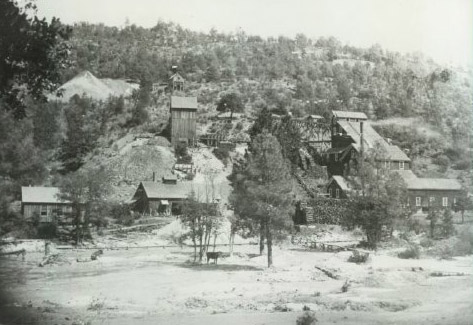
One thing is quite clear. John came alone. Ellen and young Bridget came later, only after John’s situation had become relatively secure and he could pay their fares to cross the Pacific. This fits well with an easily-verifiable part of John’s story. Some time in the early 1850s, but definitely by no later than 1853, he obtained a claim in the Whitlock District, also known as Whitlock's for the mining outpost located at its heart. This was within the part of the fragment of the county called “Township #3” in the censuses of 1860, 1870, and 1880. Old accounts seem to imply that Whitlock’s was sometimes considered to be part of the village of Mariposa, or at least under the administration of the village, though the outpost was actually located about five miles north, where the placer and quartz deposits of Whitlock Creek and Sherlock Creek yielded astonishing amounts of gold in the mid-1800s. Articles referring to John and Ellen and their children seem to interchangably refer to them as being from Whitlock’s or from Mariposa.
When Ellen and Bridget arrived, John was undoubtedly working his claim at Whitlock’s, the Geary Mine. The 1940 volume Mineral Resources Survey of the United States published by the U.S. Bureau of Mines included Geary Mine on the list of inactive Whitlock District mines. It was one of several smaller claims worked in the vicinity, but it was a worthy enterprise. John and Ellen were satisifed enough by their circumstances that they increased the size of their family at a steady pace characteristic of a healthy Irish Catholic couple, beginning with the birth of William Geary in late 1854 or early 1855 -- which is to say, approximately nine or ten months after John and Ellen were reunited. A couple of years later, John came along (not listed as a Junior in any record I’ve found thus far), to be followed by three more girls, Ellen Margaret (Ella), Mary Jane, and finally Elizabeth Ann (Lizzie). That said, prosperity is sometimes subjective. I do not get the sense John and Ellen accumulated much wealth above and beyond the level they needed to get by from year to year.)
The household was in place at Whitlock’s at the time of the 1860 census -- the one that contains the error about Ellen’s birthplace being Australia. That census record is a vital piece of evidence to paint in the true picture of the Geary-Moran family. The enumeration not only shows the configuration of the family -- names and ages and so forth -- but it shows a locale consistent with the oral histories supplied by descendants such as my grandmother. The document is an anchor that makes it possible to trace the family members’ whereabouts with precision from that year on through the rest of their lives. (When I say “household,” I am using the term broadly. Mary Jane and Lizzie had not yet been born and so they were not included in the 1860 census.)
In 1864 came a quick series of major developments. The first was a happy one -- a marriage. At the age of sixteen, Bridget became the bride of Robert McGreer, son of John McGreer and Susan Roberts. The ceremony took place 27 March 1864 at St. Joseph’s Church in Mariposa. It was one of the earliest weddings held at the church, which had been built during the fall and early winter of 1862 and had been dedicated 18 January 1863. The Geary family were surely among the founding parishioners and probably contributed to the church’s construction, either monetarily or with labor, or both.
Another, even more dramatic 1864 incident was reported in the July 12th edition of the Stockton Register. Three incidents were reported upon in the newspaper under the headline “Accidents in Mariposa.” The final paragraph reads in full:
“Mr. John Geary, of Whitlock’s, went out yesterday morning and returned to his house about 7 o’clock with his right hand shot completely off. It was done accidentally and is a serious loss.”
No further details are available, but there is no reason to think the incident did not happen. Which would mean John had no choice but to get by without a right hand for the rest of his life. What is truly eerie is that sixteen years later, his very first grandchild, John Joseph Branson -- my Grandma Grace’s eldest brother -- would be born without a right hand. The hand and wrist had never developed within the womb. Instead, the baby’s forearm ended partway along the limb.
Another tragedy struck toward the end of the year. Bridget passed away of typhoid fever 13 November 1864. The timing of her demise -- only seven and a half months after the wedding -- is almost certain to mean an unborn child perished with her. Seven years later, Robert McGreer married Elmira Woods and went on to have a number of children with her. Robert and Elmira and offspring settled as a farming family near the town of Napa, and survived into the 20th Century. Meanwhile, Bridget became the first of the original Geary family to be buried at St. Joseph’s Cemetery, making her one of the very first individuals of any family to be interred at the site. (There are headstones with earlier death dates etched upon them, but they represent reburials of people who had originally been interred elsewhere.)
The two sons of the family, William and John Geary the younger, also died just as they were starting to make their own mark upon the world. John was first, dying 25 November 1877 at home at Whitlock’s. Like Bridget, he was laid to rest at St. Joseph’s. The headstone of his grave lies just to the left of those of his parents. (See photo immediately below.) The age-at-death shown on that marker of twenty years, four months, and twenty-five days yields a birthdate of 1 July 1857 or the tail end of June of that year. He is listed as an occupant of his parents’ home as a child in the censuses of 1860 and 1870, and probably spent his entire life as a resident of Whitlock’s outpost. Grandma Grace stated that he was married to a woman named Jade Nile. Unfortunately any further information about Jade Nile has not surfaced. I have to wonder if Grandma was engaging in a euphemism. “Jade Nile” does not sound like a real name. It sounds to me like a veiled reference to a person of non-European extraction, the Jade perhaps indicating Asian heritage, the Nile perhaps indicating African heritage. The fact is, I don’t know. I have to wonder if John and Jade had offspring. As far as I can tell, the answer is no.
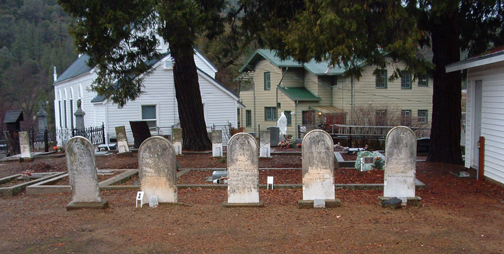
The five Geary graves at St. Joseph’s Church cemetery in Mariposa. Photo taken 4 January 2008 by Dave Smeds. The graves are marked with the tall, curved-top white headstones that stand in a row in the foreground of this image. The church is in the background. From left to right are the markers for Elizabeth Ann “Lizzie” Geary Arthur, Bridget Geary McGreer, John Geary (the younger), John Geary (the elder), and Ellen Moran Geary.
William Geary died the same winter as his brother, passing away 11 February 1878 of the same cause -- “quick consumption” being the way the obituary describes it. This is an old-fashioned way of referring to a case of tuberculosis that aggressively attacks the lungs and brings death much faster than the gradual and dismal wasting away of standard TB. It could be that William -- and John before him -- actually just had pneumonia. William was twenty-three when he died. Though he had not yet married, he had started to establish himself. In the mid-1870s, right after turning twenty-one, he acquired acquired 160 acres of land in Mariposa County. This does not mean he bought the land, only that he signed a mortgage and hoped to someday pay it off. He appears to have had difficulty dealing with that debt -- his name appears on a delinquent tax list published 10 February 1877 in the Mariposa Gazette. In order to increase his financial means, he went to Nevada. Whether he found a livelihood there is an undetermined question because he died before he had much chance to do so. He perished in Dayton, Lyon County, NV, not far from the Comstock Lode mine complex of Virginia City, a site that had just completed the most productive year of its entire history. Given that William died in the winter on the far side of the Sierra Nevada, his body was apparently not transported back to Mariposa for burial, so William’s grave is not among the others at St. Joseph’s. Instead he lies buried in the Dayton village cemetery.
By the late 1870s, having endured the heartache of those three early deaths, having grown poor again due to John’s advancing age and the lack of a right hand, John and Ellen might well have come to wonder if God had blighted them and their line. No grandchildren had been born. The Geary name was already doomed to die out given that both sons had perished without issue. A lonely phase developed. At the end of 1879, their daughter Ella was out of the house for good, marrying Joseph Branson and settling with him on a ranch near the mining outpost of Quartzburg near Hornitos. Mary Jane left to become a domestic servant out in the Great Central Valley in the town of Merced at approximately the same time. The 1880 census confirms that by the summer of that year, the only child still with the middle-aged couple was Lizzie.
Under ordinary circumstances even Lizzie might have departed. She was seventeen in 1880 -- old enough by the standards of the time to be married, as her sister Bridget had been. In fact, she had little choice but to stay. She was disabled. Her condition is described as “consumption” in the census in the column reserved for notations of permanent disablement. Given how many decades she lived with the condition, it was probably not tuberculosis, as one would ordinarily assume consumption was meant to refer to. However, the use of that word is a strong hint that her problem manifested in the lungs. Whatever she was dealing with, it was chronic and severe. She was too weak to leave the house on any regular basis, saving what energy she mustered for flower-gardening and attending church. She seldom partook of the social life of the community. She would depend on her parents as long as they lived.
Those lives fell a bit short of the Biblical “three score and ten” years, but by the standards of their era, and given the rigors they had endured, John and Ellen enjoyed a fair run. They made it through the 1880s. They were able to savor being an integral and well-known part of the community of Whitlock’s outpost. They regularly attended church in Mariposa. Money was not plentiful but chances are good that John managed to find ways to profitably pursue one or both of his trades, butcher or miner, on at least a part-time basis.
The early 1890s saw both husband and wife pass away in rapid turn. First came the death of John 23 March 1891. Ellen was young enough that she probably could have rallied and lived many more years, but she seems to have given in to grief. She fell ill toward the end of the year and declined over a period of several weeks, and then after one last good day, perished 23 January 1892, precisely ten months after her husband. Both deaths occurred at home at Whitlock’s.
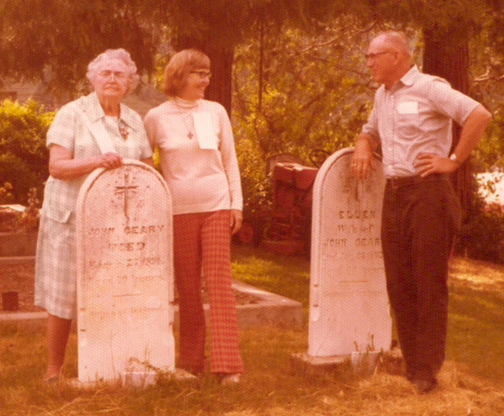
This is another view of John and Ellen’s graves. This photograph was taken (probably by my father, Alfred Smeds) in about 1973. The elderly woman is my grandmother Grace Mildred Branson Warner, daughter of Ella Geary Branson. The younger woman is my mother, Josephine Warner Smeds. The man is Harold Peterson, husband of Alice Thistle, who was a daughter of Grace’s sister Marguerite Branson Thistle.
With their deaths, Lizzie needed to find a new haven, because she was too much an invalid to get by on her own. She undoubtedly moved in with her sister Mary Jane, who was then residing in Hornitos. Mary Jane’s husband Michael Bauer was the owner and operator of the Hornitos livery stable. Though the relocation was born of necessity, it proved to be an opportunity for Lizzie. She caught the attention of a neighbor, Charles Roscoe Arthur. He was one of the many children of Robert Arthur and Belle (Isabella) Steele, who had come to Mariposa County from Indiana in the 1850s. Charles had been born in 1866 in Coulterville, not far north of Whitlock’s, and had by the early 1890s come to Hornitos to ply his trade as a blacksmith. He no doubt provided Michael Bauer’s stable with horseshoes and other hardware. Between home, business, and church, Charles had ample opportunities to interact with Lizzie in spite of her limited ability to get around, and must have become enamored of her deep introspection, her religious devotion, and a nature so mild and contemplative that birds would land on her open palms to eat the seed she offered them. Charles and Lizzie became man and wife on Christmas Eve, 1893.
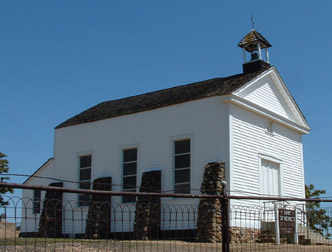
The wedding of Lizzie and Charles probably took place at St. Catherine’s, the local church. (This structure -- shown below right -- still stands. It was built in 1851 and is now a historic landmark. It is still used for the candlelight vigil on All Saints’ Day. Charles would ultimately be buried in the cemetery that is part of the grounds of St. Catherine’s, near the graves of his parents.) The couple resided in Hornitos during their twenty-seven-year marriage. In addition to earning money as a blacksmith, Charles was one of those local miners who refused to give up on the hunt for gold even after most others had conceded the remaining ore was not worth the trouble to dig up. Charles worked old claims in partnership with Hugh McErlane Branson, a nephew of Joseph. Hugh’s mother Frances Bauer was Michael Bauer’s sister. Among the last claims Charles worked was the one at Phillips Flat that had been the foundation of John Sevier Branson’s lifelong wealth. It was not as productive during Charles’s tenure, but was still regarded as having potential when the government seized it and a vast swath of adjacent territory in order to build Exchequer Dam and indundate the acreage, creating Lake McClure. In 1927, Charles’s heirs were able to obtain a $7500 judgment for the value of the claim thanks to the testimony of Joseph Branson, who pointed out that it had contained plenty of gold during the years his father had supported his whole family from the diggings (the 1860s) and its value when the waters covered it was surely not so low as the government had argued.
 Lizzie lived a surprising number of years for a person as frail as
she was, but she never did enjoy a truly
healthy period and was even hospitalized a number of times. Due to her condition, she and Charles never
had children. Finally she declined more severely and, no doubt as a side effect of being bedridden, developed
a fatal case of penumonia and passed away 12 March 1920 in Hornitos. As mentioned, she was buried beside her
parents and brothers. By that point Charles had at last given up on
mining and had obtained a job with Shell Oil in Santa Monica, CA. He had established a home in that city
and was preparing it for Lizzie’s arrival when she succumbed. Charles only survived her by a few years,
despite having much better health through the majority of his life than his wife had enjoyed. She died at
age fifty-six, he at fifty-eight. Born 19 March 1866, he passed away 17 September 1924 in Santa Monica.
It seems a little strange that his grave is located at St. Catherine’s rather than at St. Joseph’s with
Lizzie, but clearly whoever arranged for Charles’s burial felt his body should be placed in the same ground
as his blood kin.
Given the modest lifespan of Lizzie and the sharply truncated ones of Bridget, William, and Young John, the remaining two members of the family had good reason to imagine their own lives would be cut short. The truth was just the opposite. Ella would go on to become genuinely elderly. Mary Jane would survive more than a century.
Mary Jane Geary, born 5 March 1862, was out of the family home by age eighteen, going to work in Merced as a nanny and housekeeper for Phoebe Ann Branson McDonald and her husband William McDonald. Phoebe was a sister of Joseph Branson, so the job must have been obtained for Mary by her sister Ella. Phoebe, whose health was becoming tenuous, had recently given birth to her fourth child and needed assistance around the house. It is unclear just how long Mary worked there, but it was not more than four years. She began to be courted by Michael Bauer. He was known to her through the connection shared by the Branson and Bauer families. These two families had mined side by side in the 1860s along the Merced River at Phillips Flat. In 1872, Joseph and Phoebe’s brother Thomas Branson had married Michael’s sister Frances and settled in Hornitos. The wedding of Mary and Michael closed the circle of Branson/Geary/Bauer unions. The event occurred 30 November 1883 in Hornitos, where the couple immediately settled.
Mary and Michael produced children at a steady clip from the mid-1880s to the mid-1890s. The total came to five: Elizabeth Frances Bauer (8 Dec 1884 - 23 Feb 1939), Amelia R. Bauer (8 Jan 1887 - 7 Jun 1965), Eunice E. Bauer (26 Oct 1889 - 6 Jan 1976), Ethel May Bauer (31 Jul 1893 - 22 Mar 1902), and Harold John Bauer (9 Oct 1895 - 3 Jul 1959). The span from the mid-1880s to the late 1910s represented a time of great stability for the couple. Early in that period the Bauers took advantage of an opportunity that left them well-situated when McHenry Morrison, a Mariposa County pioneer, decided to off-load some of his property in Hornitos in order to fund a relocation to Orange County. Morrison had bought the A.T. Turner livery stable in 1884, and then had bought the A.N. Phelps residence in 1886. In 1887, he sold both stable and house to Michael Bauer. These two pieces of real estate were essential components of the village. Mary and Michael became ensconced within the community in every way -- family, business concerns, church, social life. It is a misfortune of their existence that Hornitos lost its vitality as the gold industry collapsed, or they surely would have remained there, and it is likely their descendants would be among the prominent citizens of the village today. Instead, over the 20th Century Hornitos withered away. Unlike some communities of the Gold Rush, it did not become a ghost town, but its glory days have not resumed.
But up through the 1910s, things went well for the Bauers, aside from the tragic loss of youngest daughter Ethel to pneumonia in 1902 at age eight. Mary and Michael were part of an extended net of family and in-laws. Some of these people have already been mentioned -- Lizzie and Charles Arthur, Thomas and Frances Branson, Joseph and Ella Branson. Perhaps the closest associates were members of the Reeb family. The patriarch of that family was George Reeb, a butcher and the proprietor of Hornitos Market, a famous meat market of the region. George Reeb may have received some of his training from John Geary, and/or been a partner with John in the 1850s. Two sons of George married into the Geary-Branson-Bauer clan. They were 1) Frederick William Reeb (born 1880), who married Alma Branson. Alma was a daughter of Thomas Branson and Frances Bauer, and so was Michael’s niece as well as being the niece of Mary Jane’s brother-in-law Joseph. And 2) George Manuel Reeb (13 November 1868 - 16 August 1961), who married Michael and Mary’s oldest daughter, Elizabeth Frances Bauer. The Reeb connection also tied in with the Morrisons. Though McHenry Morrison had departed for the southern part of the state, his son John Beauregard Morrison remained rooted in Hornitos. His wife was Kate Reeb. (One of Kate and John’s granddaughters, Jeanette Morrison, would grow up to become actress Janet Leigh. Her daughter, of course, is actress Jamie Lee Curtis.) This bond between the Bransons, Bauers, Gearys, and Reebs would be maintained after the exodus from the Mother Lode by a nucleus centered around Mary Jane and Michael.
That exodus took Mary Jane and Michael to Richmond, Contra Costa County, CA. As World War I heated up, industries boomed around San Francisco Bay, including Southern Pacific and Western Pacific railroad companies, the shipbuilding operation at Oakland and Alameda, and most relevant, the Standard Oil refineries at Richmond. By no later than 1917 the job opportunities had caused Mary Jane and Michael’s youngest child Harold to seek his fortune there. Mary Jane and Michael themselves moved about this time as well.
With the couple came a steady stream of kin. Among them was Michael’s first cousin Paul Adrian Bauer. Others included Alma Branson and her second husband Herbert Kibby Youd (Frederick Reeb had died in 1907 of typhoid fever) and Alma and Fred’s daughter Lila Reeb. Alma’s sister Inez Branson soon followed. Lila and Inez both taught school in Richmond. The occupation of school teacher among the younger adult females of the clan was almost universal. Also common was a lack of procreation and even more prevalent was the tendency for children to stay at home well into adulthood. This was true not only of Mary Jane and Michael’s brood, but that of Thomas Branson and Frances Bauer as well, of whom Alma and Inez were a part. True, Alma had given birth to Lila, but subsequently she had no offspring with Herbert Youd. The others had no babies except Elizabeth. When she was thirty-five years old, after years as a teacher and over a decade as George’s wife, she gave birth to a daughter, Marian Elizabeth Reeb. Marian was to be the only grandchild of Mary Jane and Michael. George had been over forty years old when he married Elizabeth, and so he was over fifty when Marian was born.
In the long run, Richmond became the “new Hornitos,” i.e. the family rooted in deeply and with an almost stubborn permanence. In point of fact, Michael and Mary Jane kept the very same house throughout their tenure, the one that they had moved into in the late 1910s at 1208 Barrett Avenue. Mary Jane would ultimately spend more years in that abode than she had in the Hornitos home. Michael would live out his remaining days there, perishing 23 February 1936.
With Michael’s death came a gradual die-off of the remaining family members. Elizabeth Bauer Reeb expired precisely three years later. She was fifty-four years old. Her obituary indicates she had been ill for quite a while, suggesting perhaps a death by cancer, but the fact that she died on precisely the same day of the year as her father makes one wonder if she didn’t aim for it -- as in a suicide. Arguing against that is that she was buried in St. Joseph’s Cemetery in San Pablo, a Catholic graveyard. Widower George Reeb survived more than two further decades.
Eunice was the longest-lived of the five Bauer/Geary offspring. She was the only one who did not treat Richmond as her base of operations. She perhaps had been drawn by the Morrisons’ presence down to Orange County, or perhaps she went there due to a teaching position. She became established there about 1912. She did not marry until the mid-1920s, when she was in her mid-thirties. Her husband was Charles Christopher Fipps (born 17 Dec 1888 in Bedford, IN - died 9 June 1957 in Orange County, CA), a plastering contractor. Charles had a number of nieces and nephews who were local. Between them and the school pupils, Eunice apparently had all the caring-for-youngsters fulfillment she needed, and never became a mother herself. She and Charles spent many years in Santa Ana and then in Newport Beach. Eventually in her widowhood Eunice ended up in Costa Mesa.
Amelia Bauer likewise dedicated herself to teaching. She did not marry at all. However, unlike her younger brother Harold, she did leave the bevy of her parents’ home for a spell, living on her own in Oakland and undoubtedly in other locales. She came back in the late 1930s after her father’s death, and shared the 1208 Barrett home with Mary Jane and Harold for several years, though she did so on an off-and-on basis. After her mother went into nursing care, Amelia remained in Richmond until the old lady had passed on, then went south to join her one surviving sibling, Eunice, in Orange County. By then, she was in her mid-seventies. She and Eunice had lived apart for well over fifty years and were probably deeply soothed to be able to spend time together again. That stretch of time lasted no more than two years before Amelia passed away.
Harold Bauer worked at an assortment of jobs -- refinery worker, shipbuilder, ceramic tile enameller, painter. He stayed single lifelong and never moved out of his parents’ house. It was probably with his death at the end of the 1950s that Mary Jane finally had to give up living in the home at 1208 Barrett Avenue. She spent her last three years at a rest home in San Pablo, Solano County, CA, where she passed away 28 January 1963 at the age of one hundred. Her obituary states that her health had remained good through age ninety-seven.
By the mid-1960s, the era of the extended family’s presence in Richmond and the East Bay had severely wound down. Mary was dead, Amelia had departed for Orange County. Alma Branson Reeb Youd had died in 1958 and then Inez Branson succumbed in late 1964. The survivors consisted only of Herbert Youd and his step-daughter Lila Reeb, who both would perish in the mid-1970s -- and one other. The last of all was Marian Reeb, daughter of Elizabeth and George. Born 28 October 1919, Marian was, as mentioned, the only granddaughter of Mary Jane Geary, and from the death of her aunt Eunice in 1976 onward she would be the only remaining descendant of that entire line. In the early 1940s, Marian had wed pharmacist Lawrence Raymond Regello (24 October 1908 - 25 February 1987), a Californian of Portuguese extraction, but as far as can be determined, the couple never had offspring. As one would expect, Marian was a teacher. With her death 18 February 2007, the line of Mary Jane Geary went extinct.
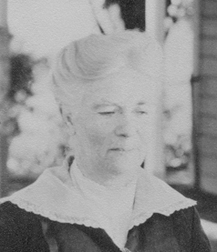 One line still flows from John Geary and Ellen Moran, and that is the
one descended through Ellen Margaret Geary Branson. As if to balance the lack of fecundity elsewhere, that
group is thriving, with well over a hundred descendants alive today. Details about her children and
grandchildren can be found in other parts of this website, inasmuch as they are Branson Family descendants.
For that matter, some facts about Ella are revealed in or inferred within the biography of her husband,
Joseph Branson. If you have not already done so, please refer to his page. Click
here to go straight there. Meanwhile, here is a bit more about the woman
herself:
Ella, born 2 February 1859, was shaped by her pioneer childhood. She was undaunted by rustic surroundings and hardships. Her schooling took place in a modest one-room facility, but she was always aware of its value, because her parents and her parents-in-law had not enjoyed even that much. Even in extreme old age, Ella’s penmanship was so perfect and her command of the English language so precise her letters could have been used as models for schoolchildren to copy. It was not surprising that both of her daughters and many of her nieces and husband’s nieces became teachers. It is possible she herself was a teacher for a year or two or three in Bear Valley, near Whitlock’s, at a school where her daughter Grace would one day teach.
Ella married at age twenty, the wedding taking place 28 November 1879 in Mariposa County. It had been fifteen years since a child of John and Ellen Geary had wed (not counting the rumored union of John Geary to Jade Nile). Bridget’s marriage had ended before it scarcely began as a result of her untimely death, and no issue had resulted. Ella enjoyed sharply contrasting fortune. The first child arrived less than ten months after the wedding, and within another five years she was a mother of four. After a gap of six more years, the brood was completed with the birth of twins. The six children were John Joseph, Marguerite Ellen, Alvin Arthur, Grace Mildred, Eldridge Geary, and Ernest Elton Branson. Ella was known to be somewhat strict and modest -- somewhat in contrast to her non-Catholic, peppery-tongued, and gregarious husband -- but was a nurturant and doting mother at the same time.
Ella had probably met Joseph in Bear Valley, where he engaged in cattle ranching in the 1870s, remaining a bachelor through his twenties. By the time he proposed to Ella, he had apparently managed to accumulate a nest egg. Selling the Bear Valley land, he and Ella purchased a parcel just across the road from his father and mother’s “Grasshopper Ranch,” which in turn was adjacent to the holdings of the Quartzburg mining outpost. Ella would never have to make a home elsewhere. The ranch was sufficient to run enough cattle to support the household. This would become increasingly true as Joe and Ella bought Grasshopper Ranch in 1897 and went on to make other purchases that increased their holdings to a grand total of 1300 acreas. In addition to the prosperity derived from raising cattle, the couple’s income benefitted further from the fact that subterranean portions of their land contained outstanding veins of gold-bearing quartz. Over the 1880s and 1890s the property was the site of not just the family residence, but a miners’ barracks, a blacksmith shop, a huge barn and stable, and a foreman’s house. Joseph’s parents and several siblings lived either across the road or only a short horse ride away in Hornitos, where Ella’s sisters Mary and Lizzie also dwelled. In terms of life and family, it was an idyllic time.
With the coming of the 20th Century, life was somewhat less tranquil and good fortune less plentiful. The first fly in the ointment was a natural development -- the children grew up and began to move away. Among the earliest was Alvin, said to be the apple of Ella’s eye. He perhaps felt a little too “mothered” and wanted to establish himself as an independent being. He began mining in northern Mexico and extreme southern Arizona in 1905, only to be killed when he fell down an elevator shaft at work on Christmas Eve that year. Ella was devastated by the tragedy. A few years later, after the yield from the mines grew so marginal that Joseph had shut down operations, Ella refused to let John or her other boys talk of reopening the tunnels, saying she was not about to let another son of hers die in a mine.
In 1920 Ernest Branson, who had remained on the ranch helping his parents with their cattle herd, chose to move to Fresno County and get married, and so the nest was empty. But Ella’s tenure as a mother figure was not yet over. Marguerite and her husband Guy Thistle found it a challenge to get by in the uncertain economic times, and Marguerite’s health was not always ideal -- she would die in 1933 at only fifty-one years of age -- so Ella regularly took charge of Marguerite and Guy’s three girls. This arrangement was frequent enough the eldest granddaughter, Alice, maintained a sentimental attachment to the property throughout her life, even after the land had ceased to be a home for anything but cattle and rattlesnakes.
By the 1930s, Hornitos was deep into its sharp decline. Quartzburg outpost would soon vanish altogether. Mariposa County had ceased to be the haven of the Branson and Geary families. Joseph and Ella were the lone holdouts. When Joseph died in the summer of 1934, logic might have dictated that Ella would abandon the ranch, perhaps to join her sister Mary and other relatives in Richmond. She did not. She might have been white-haired and growing a bit wobble-kneed, but she prided herself on self-sufficiency and was not about to give up her home. Her son John stepped in to keep her company, even though this meant devoting less attention to his wife and daughter. From time to time Ella may have spent long visits as John’s guest at his home along the Central Coast, but the ranch continued to be her main residence. This set of circumstances went on for a dozen years. All things considered, Ella probably imagined she would breathe her last gasp in her own home. In actual fact, she passed away at Mercy Hospital in Merced, the very facility where Joseph had perished. Her date of death was 29 June 1946.
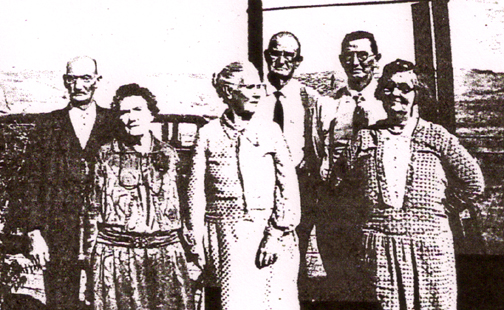
Here is an image from the late 1920s or early 1930s of the three surviving Branson brothers and their wives. This scan was made from a photocopy that was in the papers of Ivan Thorpe Branson; alas, the print from which the photocopy was made was missing from that material. From left to right, Alvin Thorpe Branson and his wife Mary Eliza Simmons Branson, Ellen Margaret Geary Branson and her husband Joseph Branson, and John Sevier Branson, Jr. and his wife Lillian Jane Guest Branson.)
To return to Joseph Branson’s page, click here. To return to the Branson/Ousley Family main page, click here.