Ethel Irene Brown
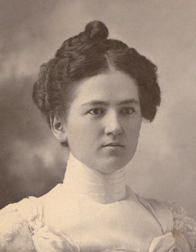 Ethel Irene Brown, third of the five children of Emma Ann
Martin and Cullen Penny Brown, was born 13 December 1880 in Martintown, Green County, WI. Her parents
were then living in a house only a stone’s throw east of the home of her maternal grandparents Nathaniel
Martin and Hannah Strader, and the household seemed incredibly rooted, yet by the time Ethel was a few
years old, she and her parents and her sisters were often to be found elsewhere. Cullen became
known as the go-to guy if someone wanted to set up a sawmill. He knew how they should be constructed,
knew just the kind of craftsmen to hire to staff the facilities, and knew how to arrange for lumber
contracts. Demand for his services as an overseer grew, and he was given better and better opportunities
to advance his career. Although Martintown continued to be the family’s official home, and although Ethel’s
parents held onto ownership of their residence in the village -- a house that was not sold until 1906 or
1907, in the wake of Cullen’s death -- for about half of Ethel’s childhood the Browns were to be found in
the southern United States. From 1883 to about 1886 they were quartered in West Plains, Howell County, MO.
Ethel’s sister Lulu was born there in the autumn of 1885. For a year or two after that, they lived in Kansas
City, MO. From 1889 into the early 1890s, they were in Fort Smith, Sebastian County, AR, where Ada
Brown, the tail-ender of the family, was born just before Christmas, 1889. Then in 1898, after several years
-- perhaps as many as seven years -- back in Martintown, the family settled in DeQueen, Sevier County, AR.
This was a new but fast-growing community, meaning that the lumber produced by the mill Cullen oversaw was
in high demand, putting the Browns in secure and highly prosperous circumstances. Ethel was on the verge of
turning eighteen at the time of the relocation, and was immediately one of the town’s most eligible young
ladies.
Ethel’s older sister Lena was already a married woman by the time of the 1898 relocation. Lena and her husband
Frank Hastings gave DeQueen a try for a few months. Their second child, Leland “Hap” Hastings, was born in the
autumn of 1898 during that sojourn. But Lena and Frank decided they would in the long run enjoy life more in
Martintown than in DeQueen, and so back they came, and they were never again tempted to settle in the South.
This means the Arkansas contingent of the clan was reduced to Ethel, her parents, and her two younger sisters.
This small family branch did not expand much with the succeeding generation and remained tight-knit and somewhat
insular, sharing a set of values that could fairly be described as church-oriented and traditional. At the same
time, the women of the family were literate, competent, and capable. They were not afraid to speak their mind,
nor were they afraid to show a progressive streak from time to time. Ethel stands out as one who let her sense
of humor rise to the surface. Important though it was to her to remain ladylike, she had a bold side. Fortunately
for her reputation, she found “proper” ways to express that side of herself through fashion, attendance of
musical and theatrical performances, and generally being seen “out and about.”
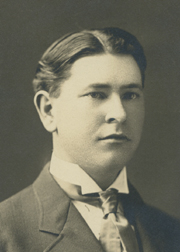 Another person lured to DeQueen in the year 1898 happened to be
Ethel’s future husband James Littlefield Cannon (shown at right). A son of Jessie Cannon and Elzira
Abbott, he had been born 29 October 1876 in Sevier County near the community of Lockesburg. He had come to
DeQueen, located about ten miles northwest of his hometown, after two years at the University of Arkansas. Upon
his arrival he purchased the local newspaper, the Bee, and served as its publisher and editor for many
years. (Eventually this would put James in the peculiar position of publishing, and probably authoring, the
obituary of his father-in-law, a document used as source material during the creation of this website.) The
wedding occurred 10 October 1900, shortly before Ethel turned twenty.
Over the course of the next decade Ethel and James became parents of two daughters, Hazel and Vae, the latter
often better known by her middle name, Nadine. The small size of their brood demonstrated the remarkable shift
in family structure that took hold in America after the turn of the century, when large farm families became
far less common, to be replaced by smaller, more urban households. And indeed, James fully embraced the role
of “town man.” He was extremely active in the commercial doings and political life of DeQueen. His position as
a commentator and publisher accounted for some of that involvement, but he went beyond that. He was a city
alderman for a number of years, is credited with the building of three houses and two business buildings, and
served on the school board, including during the period when the city’s Stillwell High School was built. (Among
the surviving family documentation is the Stillwell High School diploma of his sister-in-law Ada, which he signed
as president of that school board in May, 1907.) In late 1900, a few weeks after he had become a married man, he
was appointed by Arkansas Governor Dan W. Jones to fill the recently vacated post of DeQueen city clerk, and then
was elected to the office in 1902 and went on to serve a full term. He was also president of the local Rotary
Club chapter, and was active in the town’s Presbyterian church, including a stint as superintendent of the Sunday
school. The nature of Ethel’s daily life during the course of the marriage can easily be pictured. As the wife of
a civic leader, she would have been called upon to be a society hostess, church wife, a behind-the-scenes aide to
all her spouse’s endeavors -- all while raising their two daughters. It is not surprising the couple chose not to
have a big family.
In 1915, James sold his newspaper interests. He became the postmaster of DeQueen, a position he kept for the
better part of the next ten years. His social commitments continued strong, however. If anything, he had more
time to devote to the good of his community once he no longer had to deal with the logistics of a generating
a publication week in and week out. In one respect, however, he contradicted his urban identity. James was
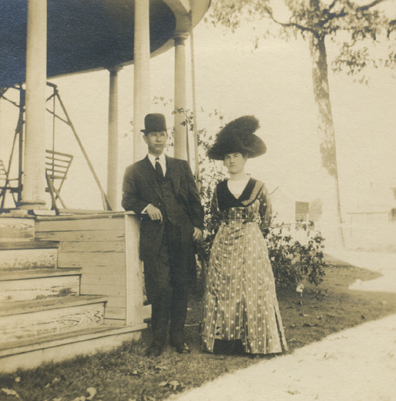
also a man of agriculture. Through much of the marriage the family home was not within the incorporated part
of DeQueen. It was beyond the city limits in Bear Creek Township, and stood on a parcel that included tilled
acreage. (That residence is shown below left, with Ethel and James standing beside its front steps.) While
it was true that farming was a sideline for James, the crop income was important to the household finances and
as a business interest, he gave it a full measure of his intellectual and political attention. Even as he began
his postmaster job, he became involved as an organizer of a network of farmers. Though this soon put him in the
position of being a fruit shipper and distributor, operating under the business name The J.L. Cannon Company,
what he was after was not to be an entrepreneur and make himself rich. James devoted himself to the
association -- formal name the DeQueen Growers Association -- as if it were a religious calling or a public
service that he was morally bound to pursue, as if to say the advancement of local farmers was the destiny he had
been put on the Earth to fulfill. The early Twentieth Century had been a full-frontal-assault to the age-old
profession of small family farmer. Across the nation, acreage was being consolidated into larger and larger farms
operated by tycoon-like figures who could out-compete The Little Guy. James recognized that certain kinds of
farming would soon be impractical for small farmers to depend upon, including many of the old standards such as
wheat, hay, potatoes, corn, and sugar cane. But garden and orchard produce had potential. Those crops -- James
specifically endorsed an array that included strawberries, peaches, radishes, cucumbers, sweet potatoes, cantaloupes,
and tomatoes -- took a lot of hands-on, timely, and even expert attention. The Big Guys tended not to have the
patience or skill to thrive in that portion of the agricultural sector. James saw that by banding together, the
small farmers could resolve one final handicap -- distribution -- and be competitive. Fresh fruit and vegetable
farms were known as “truck farms” because their highly perishable crops had to be harvested on an on-going basis
nearly every day and made available to the public at once. Not every farmer had a truck, or at least not a truck
large enough and dependable enough to haul a meaningful amount of produce dozens of miles -- or even hundreds of
miles -- to market. This was especially true of the dirt-road days of the mid-1910s when the DeQueen Growers
Association was in its infancy. One of the first things James did was to convince Sevier County farmers to loan
out or cheaply rent out trucks they owned on days and weeks when those trucks were not otherwise in use. The
association soon had contracts with wholesalers and large grocery retailers who might not have bothered with a
single small farmer -- even those who did own trucks -- but who liked the idea of being able to count on
filling their produce bins every day with the combined abundance of the co-op. Meanwhile James encouraged the
members to protect their investment and raise their potential profits by making the most out of the cutting-edge
farming wisdom stemming from the universities and the federal and state departments of agriculture. Some farms
were well-suited to one type of crop but not another, and needed to be planted accordingly no matter how “it had
always been.” Some needed better drainage. At nearly every farm, soil could be made more fertile with the right
enrichments such as manure or lime, or the right sort of crop rotation.
 Unfortunately, James threw himself into his calling more than
he should have. He worked tirelessly, often composing dozens of letters per day. As his reputation grew, he was asked
to do more and more lectures and meet more and more contacts at distant locations, until the travel alone became
tiring. Worst of all, however, was the financial stress. He had become a middle-man; effectively, he was a buyer. He
knew his farmer colleagues needed a certain price level and so he guaranteed to pay them minimums that would keep them
afloat, doing so in the form of cash on delivery, yet he wasn’t always able to sell the produce at good enough
prices to keep him afloat. The first big loss was in the early 1920s when he ended up having to dump train
carload after train carload of sweet potatoes that he had paid cash for, had cured, and stored over the winter
intending to sell in the spring when the price was high, but then was unable to the customers he needed. From that
point on, his operation ran in the red. Annual bank loans kept him in the game, but each year the yield was never
enough to cover the debt, and each year the debt grew more unmanageable. Ethel pleaded with her husband to explain
his situation to the growers of the association and to cancel some of the arrangements that were likely to cause the
Cannon family further losses -- a quarter century’s worth of household savings had already been entirely depleted -- but
he argued that their neighbors were depending on him and he didn’t want to cause them to worry about their livelihoods.
He maintained the faith that better times were ahead. He had long been well-to-do and was accustomed to things working
out moneywise, but he had become a sort of gambling addict, unable to acknowledge the desperation of his circumstances.
While on a trip to Avery, TX in February, 1926, James caught a bad case of the flu. As his recovery lagged, it became
clear that he was suffering from some sort of heart trouble. Dr. Charles Archer, the family physician, recommended that
he remain in bed. Technically speaking James followed this recommendation, but he also went right ahead and kept tending to
the operation of The J.L. Cannon Company and the DeQueen Growers Association. His only concession is that he now did the
work from home. In other ways he shouldered a heavier burden, taking on six new farmers, spending over $25,000 on the
seeds, tomato seedlings, canvas, fertilizer, etc. needed to support the growing effort of 1926, a figure equivalent to
approximately $350,000 at modern rates (i.e. in 2019). As the first of those crops came in during the early summer, he
filled his hours, often working until midnight -- arranging for the shipping, tracking, and billing of over two hundred
train carloads of produce. Finally his heart could not take the strain. He passed away in the very early morning hours
of Sunday, 26 July 1926. A measure of his dedication and workaholic nature is recorded in his obituary -- published in
the successor of the very newspaper he had once overseen -- which stated that on Friday, the 24th, he had dictated
replies to forty-five telegrams from his bed before his final collapse.
James had not yet turned fifty at the time of his death, gone so young that even his own father survived him. Ethel
by contrast would live to be almost ninety, yet she never remarried. While it is possible she simply did not get any
proposals she regarded as worthy, it is more likely she believed that staying single was the only choice she could
live with. Her mother had not remarried after the death of her father. Her sister Lulu had not done so even though
Lulu had been widowed at less than thirty years old. Later Lena and Ada would likewise chose not to become wives again
after the deaths of their husbands. Marrying twice was something Brown ladies just didn’t do. However, in following that
standard, Ethel cut herself off from the financial security that might well have developed had she gone down that road.
She would proceed into a phase of hardship unlike any she had known as the daughter of one successful man and then as the
wife of another. Naturally the very early part of her widowhood was especially trying, given that the debts of The J.L.
Cannon Company exceeded the assets and cash on hand. Ethel pressed hard to collect from customers who had already
received shipments and otherwise did what she could to keep the regular operation going for the duration of the 1926
season. Even so, by year’s end there was next to nothing left for her. She could not have managed to cover the bank loan
even in the best of circumstances, but she had hoped to finish paying the local growers and the company employees one
hundred percent of what they were due, and did not have enough to do so once four significant accounts declared bankruptcy
and she was unable to collect. She herself did not pursue bankruptcy, but with attorney help worked out an arrangement that
froze the debt and allowed her to try to keep making payments if possible rather than going into liquidation -- probably
the equivalent in modern terms of a Chapter 11 bankruptcy. This would only have made a difference had the business been
able to keep going in subsequent years -- Ethel’s intention was to do so with a hired manager -- but that did not pan
out.
Ethel retained ownership of the family home, along with just enough wealth to assist her daughter Nadine when the latter
headed off to Battle Creek College in the summer of 1927. Ethel was obliged to find some sort of employment. This was
no simple thing. She had only attended one year of high school and had no professional experience. However, she was
literate, willing to learn, and determined. For the time being, she became an insurance agent. Fortunately the household
already had a wage-earner in the form of Hazel, who despite being the older daughter was still unmarried and had come
back to live at home after obtaining her credential. Hazel was a public-school music teacher with a dependable income.
Resolute and capable though she was, Ethel struggled again once again when the Great Depression took hold of the
nation. Despite that, Ethel did not take advantage of a “port in the storm” that presented itself. A mere two weeks
after the Wall Street Crash, her daughter Nadine wed Donald Fruen of Minneapolis. Donald was the scion of a very wealthy
family. If Ethel had been willing to present herself as a charity case, she could have been added to Nadine and Donald’s
household in Minneapolis, MN. Naturally it would have been awkward of her to impose on a set of newlyweds, but really,
the prime reason Ethel chose not to take advantage is that Ethel was too proud to be seen as that desperate. She
likewise did not lean on any of her sisters, all of whom were in a position to take her in if need be. Instead, she
held her chin up and forged on. That said, her situation was in fact touch-and-go. In the late summer of 1930, when
Hazel abruptly received a job offer to become the music director and band instructor at Menard High School in Menard,
TX and was faced with an immediate relocation, Ethel did not hesitate to accept Hazel’s idea to come along.
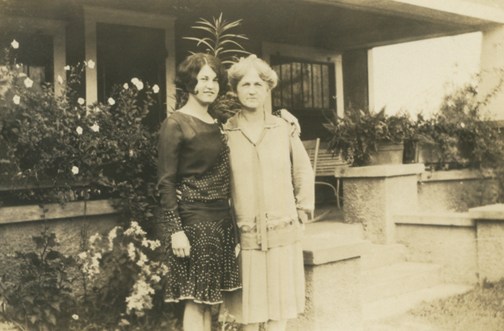
Ethel with daughter Vae Nadine Cannon Fruen in the summer of 1928. The latter was home for a visit. Other
images taken that same day reveal that Nadine brought a couple of her Battle Creek College classmates, Alberta Limbach
and Joan Reyburn. The family members then went on a vacation trip to such places as Hot Springs, AR.
Though Ethel had lived in DeQueen for over thirty years, leaving was probably not all that hard. Her parents were
dead. Her husband was dead. Her younger daughter was in Minnesota. Lulu had long since gone off to Arkadelphia, AR.
During the 1920s, Ada and her husband John Luton had settled in San Angelo, TX and were now establishing themselves
out in the boonies on a ranch in Real County. Moreover, Ethel’s reputation was afflicted by lingering local gossip
that suggested she had “willfully” failed to pay off the debts of The J.L. Cannon Company. Though her departure with
Hazel was not a case of “vanishing into the night” one step ahead of the bill collectors -- in fact, the news of the
two Cannon ladies settling into their rooms at the boarding house of Mrs. Will Nixon in Menard made the society pages
of the Bee, and likewise was mentioned in Menard’s newspaper, The Messenger -- it did kinda sorta amount
to a disappearing act. That became even more the case as mother and daughter proceeded through a whole series of moves
over the course of the next fifteen years. From 1930 onward, the only way DeQueen remained a part of Ethel’s destiny
was in the sense that she expected her coffin would one day be lowered into the ground to share the grave where James’s
remains had been placed.
The 1930s was a time when school budgets were under tremendous pressure, and often it was music and extracurricular
activities whose funding was most uncertain. Hazel was immensely qualified as a teacher, with a powerful set of
credentials -- this perhaps was to her disadvantage, because school boards could always say, “We could downgrade and
save some money.” This apparently happened at Menard High School after Hazel had been there for two to four years.
Hazel had no choice but to move on. She was licensed to teach within the whole state of Texas, which in theory gave her
a long list of schools she might approach. However, in those bleak economic times, she had to settle for a position at
an extraordinarily obscure locale, namely one in rural Motley County in the lower panhandle. This was, and still is, a
very lightly populated area (only 1200 people in residence as of the 2010 census) with no major distinctions except
that much of its territory is taken up by the huge Matador Ranch, and that in turn is known as a legacy piece of the
financial empire of the infamous Koch Brothers. When Ethel and Hazel were there, just prior to the exodus spurred by
the Dust Bowl event of 1940, it was a slightly more vibrant site, but not by much. Hazel taught there for perhaps
only one year, the 1934-35 year, but perhaps two, before returning to the very heart of the state, not to Menard
itself, but some twenty miles north of Menard in Eden in Concho County. Eden was so close to Menard that at least one
of the presentations of Hazel’s Menard High School pupils had been duplicated in an encore performance the following
weekend in Eden, and the Eden school board was familiar with the good work Hazel had done. (Motley County by
comparison had taken them 250 miles north of Menard.)
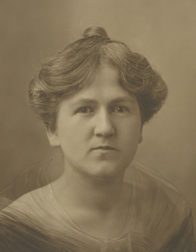 After a year teaching in Eden, Hazel’s situation changed. She decided
to add to her already-impressive academic credentials and go back to school. This suggests a source of funding popped
up. Perhaps it was a scholarship. Perhaps her aunt Ada, having been widowed and being childless, decided to dedicate
some of the money she had inherited from her late husband to her niece’s ambitions. In any event, Hazel moved to
Abilene and enrolled at Hardin-Simmons University, majoring in Music Theory and Piano. Once again, Ethel came along.
At some point in the 1930s, perhaps in the early years in Menard, or perhaps after coming to Abilene, Ethel became a
corsetiere, as in, she was a seamstress and fitter specializing in women’s support garments. Chances are high this
means she spent a period as a department-store employee, but when Hazel graduated from Hardin-Simmons in 1938, Ethel
was well enough established in the profession that she could work from home, wherever that home might be. After
Abilene, said home (a rental) was once again in an obscure locale -- the very small town of Post in Garza County. After
that, though, Ethel and Hazel relocated in February, 1941 to Conroe, TX, and this was a different kettle of fish. So
far in their lives the two Cannon ladies had almost always lived in sparsely-populated environments. This was true
even of DeQueen. But Conroe was not only the seat of Montgomery County, it lay just north of Houston, putting Ethel
and Hazel closer to an urban situation than they had ever been aside from the brief period in Kansas City when Ethel
had been a child, and the summers of music study Hazel had undertaken in Chicago and Cincinnati.
At the end of 1945, Hazel at last became a wife when she wed Rathbone Alden Rodgers. As near as can be determined,
it was when the newlyweds established their home in rural Medina County, TX, near the communities of Dunlay and
Castroville -- a bit west of San Antonio -- that Ethel finally began to live solo. She came to roost in San Angelo,
Tom Green County, TX. Her sister Ada had been widowed in 1936 and had chosen to give up on the ranch in Real County
in favor of returning to San Angelo. Ada is known to have shared her home there with Lulu for a brief spell in the
early 1940s and it is possible Ethel was yet another co-occupant during the late 1940s and/or early 1950s. However,
over the long haul, Ethel and Ada did not crowd in under the same roof. By 1954 at the latest, Ethel became established
at 1808 West Avenue K in the heart of San Angelo. Ada lived a fraction of a mile due north in the same neighborhood.
This was close enough that if Ethel wanted to visit, there was no need to drive over; she could just walk, but far
enough apart that the two widows could have their privacy from each other when needed.
The 1950s city directories of San Angelo serve as evidence that Ethel continued to work as a corsetiere -- representing
the Spencer Corsets line -- until she was nearly eighty years old, and maybe even a bit beyond that. Had she not
been an independent operator, she might have been pushed out by someone younger, but she was the one making the
call as to when she would retire, and in the meantime, could set her own schedule as well as determine the extent of
her workload. Finally she wrapped up her career, and then as decrepitude finally caught up with her, she gave up on
San Angelo as well. She went to live with -- or very near -- Hazel and Rathbone in Dunlay/Castroville.
In May, 1967, at age eighty-six, Ethel suffered a major health crisis -- most likely a stroke or heart attack. She
spent many weeks hospitalized in Castroville. It looked like she might not make it. The prospects seemed so dire
that relatives made a point to come and spend time with her even if it meant substantial travel on their part. Lulu
arrived from her home in Elgin, TX and spent four weeks. Nadine came down from Minnesota. However, Ethel gradually
improved. She was informed she would have to depend on full-time nursing care from that point on, but she was strong
enough to leave the hospital and be moved into Castroville Nursing Home. Over the next three years, that is where
she remained. Naturally it was not a pleasant phase of life for her, but she managed to hang in there, and did well
enough that on special occasions, Hazel would fetch her so that she could participate in the festivities at the
Rodgers residence. Ethel kept going long enough that she out-lived Lulu, who passed away in early 1970.
Due to a severe case of pneumonia she developed in late September, 1970, Ethel was admitted once again to
Castroville Hospital. She died there the following Sunday, the fourth of October, of complications of the
infection. As planned so long before, her remains were taken back to DeQueen and were interred in Redmen Cemetery
in her family’s section.
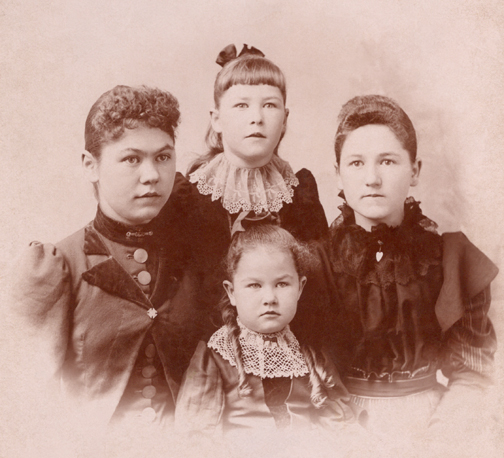
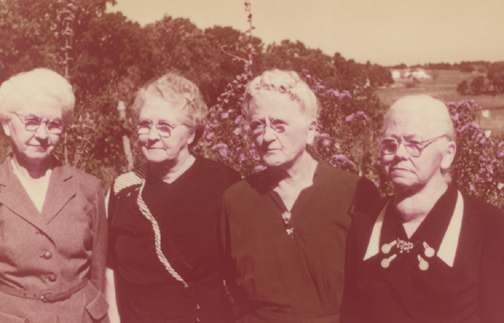
Above and below are two views of the four Brown sisters. (There would have been five sisters if Minnie Edna
Brown had lived past early childhood.) Above is a studio portrait taken in the mid-1890s. Lena is the
teenager on the left, Lulu is in back, Ethel is on the right, and a very young Ada is in the center front.
Below is the same quartet more than sixty years later at a family reunion in 1955. The scene is Martintown
or a spot near there. Left to right, youngest to eldest: Ada Vonner Brown Luton, Lulu Fay Brown Seay, Ethel
Irene Brown Cannon, and Mary Lena Brown Hastings.
Children of Ethel Irene Brown with James L.
Cannon
Hazel
LaReta Cannon
Vae Nadine
Cannon
For genealogical details, click on
the names.
To go back one generation, click here. To return to the Martin/Strader
Family main page, click here.