Esta Jane Fowle
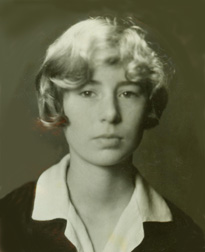 Esta Jane Fowle, daughter of Gifford Mecklenberg Fowle and Alice
Bretelle Johnson, was born 9 May 1911 in Berkeley, Alameda County, CA. She was the middle child of
three kids. Her older brother was Gifford Benjamin Fowle. Her younger brother was Voyle Johnson Fowle.
In childhood she was known within the family as Jane, a middle name passed down through generations of her
matrilineal ancestors, derived from her grandmother Mary Jane Branson, who had it from her mother Martha
Jane Ousley, who had it from her mother Phoebe Jane Longmire, whose mother Nancy Marshall might very well
have possessed the middle name Jane as well. However, she was called Esta in school and by the time she
was in the middle grades she had taken to introducing herself as Esta to new acquaintances. The name Jane
became more and more a family-only alternate. Her preference is demonstrated by the byline Esta Fowle on a
ten-paragraph Santa Claus short story that appeared in the Aunt Elsie’s Magazine of the Oakland
Tribune section of the 24 December 1922 edition of the Oakland Tribune when she was eleven
years old.
Even though she was a native of Berkeley, and even though Berkeley and other parts of the San Francisco
East Bay would figure prominently in her life at a number of points, many of Esta’s lingering
memories of early childhood would involve Santa Barbara County. Her father became dissatisfied with his
job with Southern Pacific Railroad and chose to become a produce broker in the Santa Inez Valley. As a
result, the family moved to Santa Maria, and then by the time Esta was five, went another fifteen miles
or so south to Lompoc. It was in Santa Barbara County that she attended first, second, and third grade.
When interviewed for this biography in 2006 at age ninety-five, Esta recalled the walk to school. The
family home in Lompoc was on the outskirts of town. The walk from there to her school was along a country
lane beside a ditch. Her parents warned her to be alert for German invaders while she was going to and
fro. It sounds odd to those of us in the 21st Century, but when America first entered World War I, there
was widespread concern that the German Navy would send its U-boats to harrass the coastal United States.
 Another bit of drama from her early school days
involved the great influenza pandemic. When it descended
upon the nation in the latter part of 1918, classes were sometimes cancelled and at other points, the
children had to wear masks over their faces to limit the chance of spreading the virus. Esta fortunately
did not get sick, but her father was among those so stricken that his doctor declared him as good as
dead. In the end, Gifford survived. His doctor, however, did not.
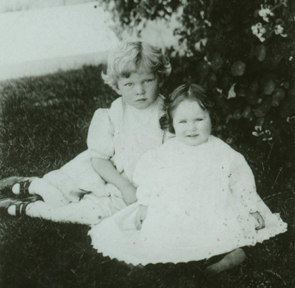
(Esta is shown at right as a toddler, sitting outside on a blanket with her older brother
Gifford B. Fowle.)
Esta’s father had not finished high school because of his parents’ divorce. Instead, Gifford had set
out as a teenager from his original home in Calistoga, Napa County, CA -- where his Mecklenberg
grandparents had been pioneers -- and found employment with Southern Pacific Railroad in Merced, CA,
where he had met Bretelle. Unfortunately the lack of a high school diploma had prevented him from
advancing within S.P., and in his frustration, he left. However, by the end of the
1910s he decided he’d had enough of being a produce broker. He started taking night classes so that he
could get the qualifications he needed to apply for an auditor/accounting clerk position with S.P. In
the 2006 interview, Esta recalled her father studying beside her at the dining room table. The house in
Lompoc featured a large chandelier over that dining table that Esta much admired.
Gifford succeeded in his quest and was rehired by Southern Pacific in late 1919. He moved back to the
Bay Area ahead of Bretelle and the kids, who followed him north in early 1920. The family settled into a
house at 6065 Claremont in Oakland, convenient to
Gifford’s workplace at S.P.’s Oakland headquarters. If the dwelling had been located a fraction of a mile
farther north, it would have been in Berkeley, so one could say that Esta was from that point on back
to being a Berkeley girl, though she would be in her mid-teens before the household was reestablished
at 1028 Merced Street within Berkeley itself. There was one other locale she considered to be “home,”
though. Her grandmother Cora Mecklenberg Fowle, with the assistance of her brother Joseph Hooker
Mecklenberg and with the financial help of Gifford, was making one last go at maintaining the old
family ranch outside Calistoga. This interval would last until the financial stress of the Great
Depression made it impossible to keep the property. Esta spent many a summer day in the 1920s at the
ranch, enjoying walks along
the low hills of what was in that era a quiet, getaway nook of the state, Prohibition having dampened
the vigor of the local wine industry. (Esta’s grandfather Joseph Mecklenberg had been an associate
of Charles Krug, founder in 1861 of Napa County’s first winery.) In the Twenties, Calistoga was known
mostly for its resort aspects centered around the mud baths, hot springs, and its own Old Faithful
geyser.
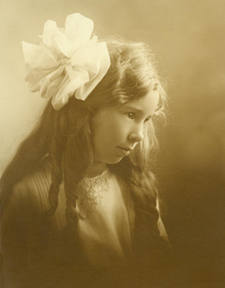 Esta greatly enjoyed writing. She produced poems,
short stories, and a plethora of non-fiction articles
from her elementary-school years on up through her college days. Her publication venues included school
newspapers and further appearances in Aunt Elsie’s Magazine of the Oakland Tribune.
Esta would ultimately spend a large portion of her life on her own or with only one or two other people in
her household, so she looked back at the 1920s as a rich “family time.” The Fowle holiday get-togethers
were often quite large because many close relatives were based in the East Bay -- even though, oddly
enough, none of the adult members of the clan were originally from the East Bay. The kinfolk
included her father’s brothers Allen and James Fowle and their families (along with
Grandma Cora when she was not at the Calistoga Ranch) and her mother’s Alameda-based first cousin Mary
Josephine Harrington McDonald and her family, Josephine being the oldest girl of the six Harrington
first cousins with whom Bretelle had shared a home in Merced during the 1890s. But rising above
these in importance was her mother’s brother George Johnson and another of her mother’s Merced-native
first cousins, Nancy McDonald Price. The gatherings Esta recalled most vividly when she wrote a memoir
for her granddaughter in 1988 were the regular parties held in alternation by a trio of hosts. Bretelle
and Gifford would welcome everyone into their home. The next time the site would be the Alameda home
of George Johnson and his wife Bessie. The time after that, Nancy and her husband Roy Price would have
everyone over to their place in Oakland. Though Nancy was Bretelle’s cousin, she was regarded with so
much affection she was called Aunt Nan by Esta and her brothers. Esta would ultimately inherit quite a
few of Nancy’s “female” heirlooms such as a china cabinet and porcelainware because Nancy and Roy had no
children and none of Nancy’s siblings had produced female offspring, so she had no daughters or actual
nieces to whom she could pass these items. So Bretelle ended up with various heirlooms which came to
Esta after Bretelle’s death in 1962. Some of Aunt Nan’s former possessions were still adorning Esta’s
apartment ninety years after the earliest of those 1920s holiday gatherings.
(For more about the 1920s holidays, click here to see the full text
of the relevant portion of her “Grandma Remembers” 1988 memoir. It is a treat to have it available as
an example not only of family history, but of her writing style.)
Esta would occasionally spend intervals in Merced with relatives there, sometimes with “Aunt Trese,”
meaning Nancy’s sister Teresa McDonald Garibaldi, and with Nan and Trese’s stepmother, Agnes Dunn
McDonald. On one visit, Esta found herself reading the “Boy Allies” series of boys adventures set in
World War I, left by Teresa’s son Donald Garibaldi. For some reason those books stuck in Esta’s memory,
though she ended up with only a few memories of Donald himself.
 At other times, Esta was part of visits to her uncle Clarence
Johnson’s in Manteca. The family would go for Fourth of July, and the children, Esta included, would get
to take turns at the crank, helping make the ice cream. In the mid-1920s Clarence’s oldest daughter Ruth
Martha Johnson came to stay in Berkeley with the Fowles. Esta recalled her as a pretty, vivacious girl with
a flighty nature. Her parents must have hoped that removing her from certain friends in Manteca would keep
her out of trouble. Apparently the visit was not long enough. Soon after her return to Manteca, Ruth became
a pregnant teenager.
As the 1920s progressed, Esta attended University High School in Berkeley. There she became editor of
the school newspaper, and won an award for her work. She began to consider journalism as a profession.
This was an age when forward-thinking girls directed their minds to upper education and possible careers
rather than assuming they would become housewives and mothers. To help earn money for college, she worked
as a telephone operator for a credit union.
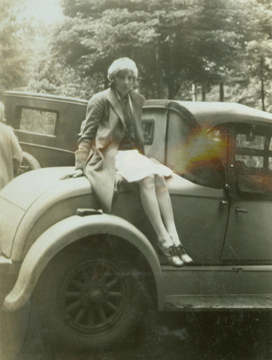
Esta entered UC Berkeley at the end of the 1920s. (At right, Esta at eighteen years old in 1929 atop
a Chrysler roadster.) As she had planned, she did indeed take some journalism classes. However, she
was distracted by the appeal of geology, particularly after an inspiring summer course spent in the field
at Yosemite Valley. She was also distracted by a fellow student she met on that summer excursion. He was
Robert Kennedy Service, a son of Robert Roy Service and Grace Josephine Boggs. Born 8 May 1911, he was
just one day older than Esta, and this was symbolic of their compatability. Robert
and Esta grew closer as they continued as classmates, and were wed 15 September 1932. Esta dropped out of
UC Berkeley at that point to help support Robert as he earned his degree in Forestry. They resided
at 2232 Haste Street just south of the campus, over a mile away from 1028 Merced Street, where her
parents continued to reside until later in the 1930s.
Robert’s background was extraordinary. He was a grandson of John Service, who is credited with being the
founder of Ceres, Stanislaus County, CA. Back in the 1870s John farmed wheat on a thousand acres of land
only ten miles or so southwest of the Mariposa County ranch of Esta’s great-grandparents John and Martha
Branson. Robert Roy Service and Grace Josephine Boggs met at UC Berkeley. By the time they graduated in the
early 1900s, they were both enamored of the YMCA missionary program. The idea of spreading knowledge of
U.S. culture out to the world without the fervent religiosity of other types of missionary endeavors
appealed to them. What was being asked of them was extreme -- a commitment to essentially dedicate three
or four decades to being overseas, i.e. the venture was meant to consume nearly all of Robert Roy’s
working life. Undaunted by this prospect, they pair set out in the winter of 1905/06 for their assignment
deep within mainland China.
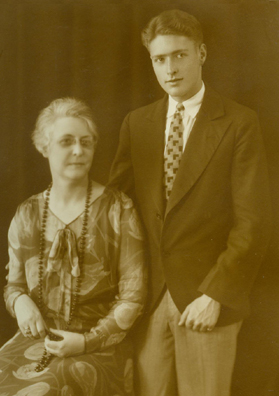 Grace Boggs Service (shown at left with son Robert in
a photo taken for his 1934 graduation) was a writer. Some of her poetry was published, but probably
her biggest achievement as an author came from material she had not originally composed for publication.
She maintained a journal throughout most of her life. In her retirement years she made use of this
material to create a memoir. The memoir was originally intended for family and close friends, but it
was an anthropological trove that lent itself to a wider audience. Most books in the English language
about China were written by men and focussed upon wars, politics, industry, and geography. Grace’s
account was, as she put it, a woman’s book, revealing what day-to-day domestic existence was like in
China in the early Twentieth Century, both for American visitors and for the native Chinese. Many
years after Grace’s death, the University of California Press (associated with UC Berkeley) enlisted
the help of Robert Kennedy Service’s older brother John Stewart Service to edit and annotate the memoir.
It was published in 1989 as the hardcover volume Golden Inches: The China Memoir of Grace Service,
which can be found in used-book stores and college libraries today. Even in this edited form the
work still qualifies as an autobiography and is a rich source of family history. Esta is even mentioned
in the latter section as Grace’s new daughter-in-law.
To cover the first quarter century of Robert Kennedy Service’s life in brief: Grace and Robert Roy, with
their infant daughter Virginia, arrived in Shanghai in early 1906 and proceeded up the Yangtze River on
a “houseboat.” Little Virginia became ill and died along the way -- a tragedy that made the grieving
parents consider if they had risked too much by moving away from the comforts and medical infrastructure
of America. They overcame these doubts and helped establish what was perhaps the most remote YMCA outpost
in the world at Chengdu in Szechuan Province in western China. It was there that Robert Kennedy
Service was born, preceded by his brother Jack in 1909 and followed by his brother Richard Montgomery
Service (Dick) in 1914. In boyhood he was often called Young Bob or Small Bob to distinguish him from his
father. His middle name had been selected to honor J.L. Kennedy, a dear friend of Grace and Robert Roy
from their days at UC Berkeley. Fortune smiled on the family. Unlike poor little Virginia, all three
Service boys grew up healthy and strong.
Political unrest flared up within China on several occasions during Young Bob’s upbringing, more than once
requiring his family -- or at least his mother and brothers -- to flee to places other than Chengdu for
safety. The first instance was during his infancy when the Services went all the way back to coastal
regions to Nanking, the former capital. In
1915, he finally got his first taste of America when at long last and after various false promises, the
YMCA powers-that-be granted Robert Roy a furlough and the family came home for a year. Young Bob was small
enough on that occasion to end up with less than perfect memories of the trip, but given how different
America was compared to his usual environment, certain things remained vivid. He had far more lasting
memories of the second furlough, which lasted from the summer of 1924 to the summer of 1925. The
family rented a house on Spruce Street in Berkeley not far from the homes of two of Robert Roy’s sisters
and their husbands and kids. The chance to
get to know the many cousins -- Robert Roy was one of eleven children, eight of whom had reached adulthood
and had offspring -- was a novel and exciting experience. Excursions were made to the legacy ranch in Ceres,
the property having been taken over by Robert Roy’s older brothers Bert and Roscoe.
Not counting various absences, Chengdu was home to Robert until he was ten years old. His father was then
asked to found a new Y in Chungking. The latter city was a place of residence Robert did not come to know
well because by the time he was eleven he was old enough to send on to the boarding school in Shanghai that
his brother Jack was attending. He was reluctant to be parted from his parents, but for his own benefit he
needed to be in an environment where he could have the example and encouragement of English-speaking peers.
Any protest he might have made soon became irrelevant. Chungking became a perilous place to stay after a rebel
warlord became active in the area. Soon plans changed and even his younger brother Dick was to be sent along.
Before the boys departed, the reality of the danger was reinforced by an incident in which Robert Roy was
nearly killed. Hearing the approach of rebel soldiers one night, the family turned out the lights and sought
the safest parts of the house in which to crouch down, but the soldiers’ conversation made it clear they were
going to
attempt to enter. Robert Roy went toward the entrance to shout at them that he was personally acquainted
with their general -- a true claim -- and that said general would be displeased if they harmed anyone in the
house (also the truth). But before he could begin speaking, a gun was fired. The bullet shattered the window
panel of the front door. The bullet missed Robert Roy, but glass dust struck him in the eyes. He was
temporarily blinded. The injury went on to cause bouts of eye swelling and over-sensitivity to light.
In the wake of the incident, the boys were quickly sent to Shanghai. Grace followed as soon as she could. By
the latter part of 1923 Robert Roy came as well and they waited out the interval until the furlough began.
The family returned to China in the late summer of 1925. Going back to western China was judged to be out of
the question due to the political turmoil, so the Service family remained based in Shanghai. Robert spent
four years there, the span coinciding with his high school days. He was then sent back to Berkeley, where
he began his college years. By the time he met Esta in the summer of 1930, he had only been a resident of
America an aggregate of three years. Understandably, he felt a bond with China and inasmuch as his parents
were still based there, it was his plan to return. Esta understood that by marrying him, she was agreeing to
a life far away from California. She did not back out. After Robert completed his studies, off they went.
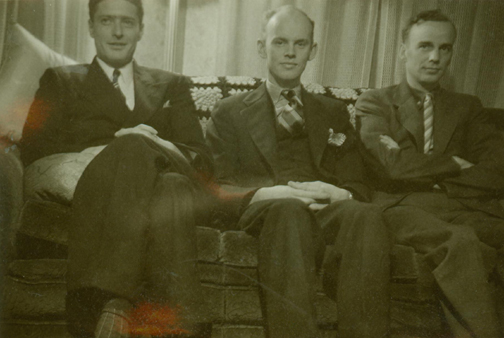
Robert Kennedy Service, left, with Esta’s brothers Gifford Benjamin Fowle, center, and Voyle
Johnson Fowle, right.
Esta and Robert reached Shanghai in November, 1934. Robert began working for Pomona Pump Company. This was
his father’s employer as well, the YMCA having for less-than-admirable reasons placed him on a two-year
leave from his
normal position, possibly as a maneuver to eventually deny him his retirement benefits. Esta began writing
articles for the North China Daily News, an English-language newspaper. The young couple had hardly
arrived before the FDR Administration’s decision to drop the silver standard inadvertently sent China’s
economy into freefall. China had managed to avoid being sucked into the Great Depression at earlier points,
but now it hit with full force. Robert’s job ceased to exist. He and Esta moved to
the Portuguese colony of Macao near Hong Kong so that he could take a job as a civil engineer for a
waterworks company. At this time, Pan Am Airlines was building an airport in Macao to serve the “China
Clipper” route of commercial airline flights from the United States. Esta found a position as administrative
assistant with the construction company that was building the airport, handling payroll, decoding, and
various clerical tasks.
Several months into 1935, Robert’s dad’s liver began giving out on him. After a lingering decline, he
passed away on the 29th of September. Robert and his brothers Jack and Dick were all able to be there, Dick
having also just recently returned to China after university years in the U.S. The death marked the end of
an era for the family, but in spite of the loss there was no expectation it would mark the end of the
family’s presence in China. It was the place they knew best. Had it not been for the War of the Pacific and
the subsequent takeover of mainland China by Communist forces, this sentiment might well have won out. Esta
and Robert might have made their home in the Far East for good, or at least for the rest of the active
period of their lives, making the bulk of Esta’s life wholly unlike that of any other member of the
Branson/Ousley clan. But that was not how things played out. By 1936, it became clear that Shanghai was not
a safe place for Westerners, both because of internal Chinese unrest and the threat of Japanese invasion.
Esta and Robert returned to California. In the end all of the Services departed, though Jack and Dick
stayed involved with the region, if at a physical distance, for quite a few years in the form of business
connections and consulate work, their bilingual and bi-cultural backgrounds qualifying them for roles few
others could fill.
It had looked for a while that Robert’s degree in Forestry might be irrelevant to his job situation, but
now he made use of it, going to work for the U.S. Forest Service. This would be his employer for the
remainder of his life. That said, his specific duties changed a bit over the years, as did the geographical
specifics of his postings. By the end of the 1930s he and Esta were in Calaveras County, where he was a
fire warden. They lived in the tiny community of Arnold. The mountains of California were a
new environment for Robert, but the region had beckoned to him ever since he had gone along on the
extended-Service-family excursion to Tuolumne Meadows in the summer of 1924.
Esta and Robert’s only child, a son, was born during these early-1940s Calaveras County years. Though she was
already in her thirties, Esta was the first of Bretelle Johnson and Gifford M. Fowle’s offspring to present
them with a grandchild. However, by the time her son was born, her sisters-in-law were both pregnant. Esta and
her brothers therefore got to experience being new parents at the same time.
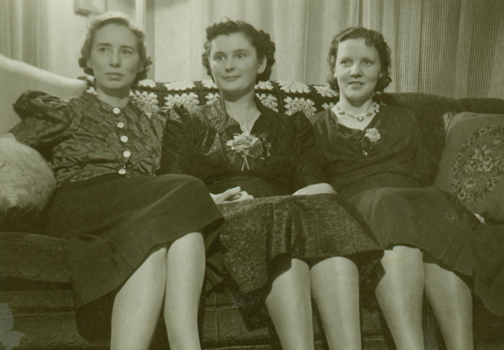
By the time Esta and Robert established themselves in Calaveras County, both of her brothers were
married men. Shown here is Esta, left, with her sisters-in-law Evelyn and Louise Fowle.
In 1943 or 1944, Esta and Robert moved to Pondosa, Siskiyou County, CA, where Robert was a surveyor.
This was an extremely remote posting, one that would have been impractical had their son been old enough
to need a school. Soon they shifted to Susanville, Lassen County, CA and then by the end of the decade
they became based in Chester, Tehama County, CA on the shore of Lake Almanor. Both Susanville and Chester
were small communities but they were substantial enough to have schools and certain vestiges of urban
infrastructure. Chester for example possessed its own newspaper. Esta obtained a job as a freelance
reporter with the periodical, enabling her to indulge her passion for writing and her desire
to contribute income to the household while at the same time leaving her schedule flexible enough to be
a mom and housewife. Chester was a convenient base for Robert, whose assignments sent him out into
various parts of the surrounding Plumas National Forest.
Life in the far northeast corner of California put Esta at some distance from her family members and
old acquaintances, albeit it may not have seemed like much of a distance compared to what she was used
to from her China sojourn. Writing undoubtedly loomed large in helping fill the void. One happy exception
to the isolation was the somewhat nearby presence of her good friend Ruth E. Culbertson Frazier. Esta
and Ruth had become friends as classmates at UC Berkeley. Ruth had in fact been the very person who
had introduced Esta to Robert during that summer excursion in Yosemite. (Being five years
older than Esta and already married, Ruth couldn’t go after Robert herself.) Ruth’s husband Alfred E.
Frazier had become an attorney based in Red Bluff, and so when Esta and Bob ended up in
Chester, the two couples were neighbors of a sort. Red Bluff is located forty miles west of Chester.
This may not seem like a neighborly distance under normal circumstances, but even today any Chester
resident who needs to travel to the main part of California, or who needs to make a major
shopping trip, heads to Red Bluff. Getting together with the Fraziers was certainly more
convenient for Esta and Bob than the six-hour jaunt to the Bay Area to see other familiar faces.
Robert, being well-travelled and having seen a lot of the world (not just China and northern
California -- the family trips back to the U.S. had involved stopping in such places as Washington,
Iowa, New York, Tennessee as well as southern California, the latter place being where his Boggs
grandparents spent the latter part of their lives), was interested in politics, both at the world level
and local. In Chester, he participated in community endeavors and was on the school board. As their
son grew older Esta became increasingly active outside the home, including school functions and
putting in more hours at newspaper reporting.
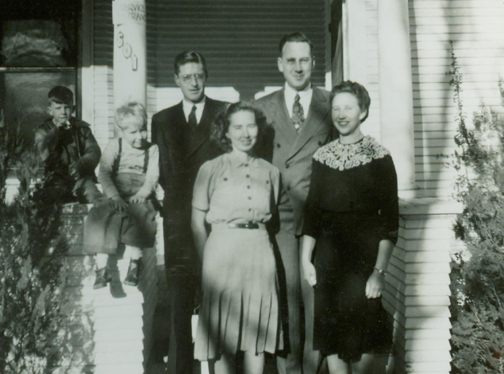
Esta and Robert and son with their good friends Al and Ruth Frazier and son in the late
1940s. Note the “Service Entrance” handmade sign above the address number.
Robert got to see his son grow up and head off to attend UC Berkeley just as his parents and grandparents
had done, but then tragedy struck. In late May of 1964, one of the remote roads in Plumas
National Forest near the boundary of Plumas County and Lassen County was blocked by a fallen tree.
Though clearing it was technically the responsibility of the logging company at work in the area,
road, Robert and his Forest Service colleague got out their chainsaws and began dealing with it.
Suddenly the log split and Robert was struck so hard in the chest that he was killed by the impact. The
date was the 28th, meaning he was only twenty days past his fifty-third birthday. Esta
would remain a widow for forty-six years.
Esta had lost her parents only twenty months earlier. It would have been understandable if Robert’s death
caused her to sink into a state of listlessness. Instead, she found the wherewithal to become a new version
of herself. Having bowed out of college during the early 1930s, she decided she would complete her
education. Her brothers were still in the East Bay. Her son was living in Berkeley while his fiancée worked
toward her own
degree. Back to Berkeley Esta came, sharing an apartment with her son and re-enrolling at the
university. Naturally the campus environment had evolved considerably during the decades she had
been gone. The experience instilled in her a lively interest in contemporary matters -- though it is
safe to say she didn’t take as radical an approach as some 1960s Berkeley students. She graduated in
1967 in the same class with her son’s girlfriend, who soon after that commencement became her
daughter-in-law.
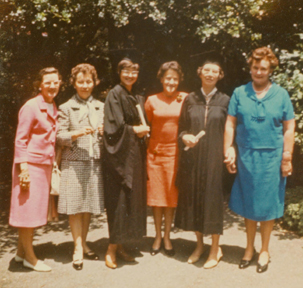 (Shown at right, Esta and her daughter-in-law in
their graduation caps and gowns. Three of the other four women are Esta’s sisters-in-law,
including her brother’s wives at far left and far right and Jack Service’s wife Caroline
Schulz Service second from the left.)
Having acquired a degree in English, Esta was armed with the right qualifications when her old friend
Ruth Frazier recommended Esta apply for a teaching position at the high school in Corning, a small
town south of Red Bluff, where Ruth had worked for a dozen years until retiring in 1965. Esta got the
job. She taught at Corning High School for seventeen years -- well into her seventies. Along the way
she earned a credential as a librarian and served a number of years as the high school’s librarian as
well as one of the teachers -- in this, she was again following in Ruth’s footsteps. After retirement,
she served on the county library commission in Corning until past ninety years of age.
When Esta first settled in Corning she probably could not dream that her stay would stretch on as it
did. The period ended up consuming a third of her long lifetime. It was a strikingly “solo” phase. Her
son and daughter-in-law departed for Europe and then in the early 1970s settled in Bloomington, IN,
where he was a college professor and she a museum curator and author. The two did not reside within
California again until the year 2000, when they moved to Eureka, Humboldt County, CA.
Esta remained in Corning until 2006. She was still there in the spring of that year
when she was interviewed for the first draft of this very biography. But that autumn she agreed that it
would be better, considering her age and her osteoporosis, to be closer to her son and daughter-in-law in
Eureka. Given her long habit of independence, she still did not actually move in with them. Instead, she
occupied an apartment a block or so away. She was ninety-five years old and was still doing well in terms
of mental acuity, but a year or so after the relocation her lucidity began giving out, either from tiny
strokes or from Alzheimer’s-like deterioration, or both. Her memory grew dim. However, because she was
inclined toward a quiet and orderly lifestyle -- i.e. she was not the sort of old person likely to wander
off at random or try to climb ladders or other risky things-- and because she was still robust enough to
get around the apartment, she did not enter a convalescent home. She did need to be checked on every day,
of course. By late 2009, her son and daughter-in-law gained some help in that regard when Esta’s
granddaughter -- her one and only grandchild -- and husband also became residents of Eureka. That meant
Esta had her whole clan around her at the very end, including her two young twin great-grandchildren. In
some ways this togetherness was a minor miracle given the many years she had spent on her own.
Esta died 12 October 2010 in Eureka, Humboldt County, CA. She was ninety-nine years and five months
old. This
is a lifespan so far unmatched within the Branson/Ousley clan, surpassing the ninety-nine years and ten
weeks reached by her second cousin Edgar Robert Gaver (1907-2007). (Together Esta and Edgar are the only
two members of the clan to make it to ninety-nine. They are also, as it happens, the only two members of
the clan who spent intervals as residents of mainland China.)
Children of Esta Jane Fowle with
Robert Kennedy Service
Details of Generation Five, the great-great-grandchildren of John Sevier Branson and
Martha Jane Ousley, are kept off-line to guard the privacy of living individuals; however, we can say
that Esta’s descendants consist of one child, one grandchild, and two great-grandchildren.
To go back one generation, click here. To return
to the Branson/Ousley Family main page, click here.