Ernest Elton Branson
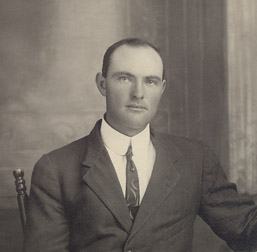 Ernest Elton Branson, a twin of Eldridge, was born 4 September
1891 at the home of his parents, Joseph Branson and Ella Geary Branson. Along with Eldridge, he was the
last of a brood of six children raised on the cattle ranch a few miles north of Hornitos, CA, near the
mining outpost of Quartzburg. When he was six years old, the ranch expanded and the family moved into a
new home. The new acreage included a pair of working gold mines, and as a boy, Ernest was
able to observe as gold ore came up from a shaft in the hillside only few hundred yards away.
Ernest attended Quartzburg District School. This was a one-room rural elementary school. He and Eldridge
sat together on a bench their own father had constructed. At one point, their teacher was their own elder
sister, Marguerite Ellen Branson. However, given a truncated schedule and the tendency for children of
the Mother Lode to scoff at book learning, the twins were still there at nearly eighteen years of age to
be part of the 1908-09 academic year. They were by no means unique. A photograph survives of that year’s
student body with their teacher, Ada Cress. The group of seventeen pupils includes half a dozen who are
clearly in their late teens. One of them was Gertrude Branson, a first cousin who was half a year older
still than the twins.
The veins of the Mother Lode were exhausted about the time Ernest came of age, collapsing the
mining-based economy. This did not hurt his parents in the direct sense, as cattle formed the main
basis of their prosperity, but it did cause the region to empty out, and by the end of the 1910s it was
far more lonesome than it had been at the beginning of the decade. Nevertheless Ernest lingered a bit
longer, living at home and helping look after the stock. This describes his circumstances all the way
to the year 1920, which is to say, until he was twenty-eight or twenty-nine, and to a point in time
well after his siblings had established homes of their own.
Joe Branson was an enthusiastic hunter who regularly went after all sorts of game, often meeting with
success when he did so. Ernest was a
chip off the old block in that regard. He loved to hunt. He became a crack shot, able even to take down
tiny targets such as the ground squirrels who bedevilled the terrain of the ranch. (The squirrels were a
true menace because the cattle would sometimes step on a burrow or tunnel and end up with a broken leg,
and would have to be slaughtered prematurely. The hazard to the family horses was even more of a
consideration.) Given his level of skill, Ernest decided he would be a real asset to the war effort. He
and a buddy, James Dulcich, left to enlist in the U.S. Army 17 June 1918 (as reported in the
following Saturday’s edition of the Mariposa Gazette, though the article mistakenly claims
the young men were aiming to join the Navy).
Ernest’s talent was recognized and the Army arranged for him to be part of a sharpshooter unit.
However, before he could be deployed, the first wave of the great flu epidemic reached his training
base. Ernest developed a case so severe his doctors concluded he was as good as
dead. He was so tall that his sergeant didn’t think he’d fit in a standard coffin. He was measured and
an extra-long casket was brought in and placed by his bedside. His belongings were sent home to his
parents. And then he surprised everyone and recovered. By the time he was fit for duty, the war had
ended and he was never sent overseas.
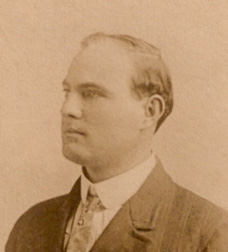 On the fifth of June of 1920, Ernest wed Alice Elizabeth
Thistle, daughter of Oscar William Thistle and
Elizabeth Euphemia Bedell, born 6 May 1893 in Victoria Corners, New Brunswick, Canada. The wedding took
place in Fresno, Fresno County, CA, but it was Mariposa County connections that had brought the pair
together. Alice’s brother LeBaron Guy Thistle was the husband of Ernest’s sister Marguerite. He had long
been a resident of Mariposa County, and in 1913 or 1914, this fact had lured Alice out to the area as
well. She had thereafter supported herself as a teacher, first at the school in Quartzburg, and then in
the period immediately preceding the marriage she had been on the faculty of a school in Kerman, Fresno
County, CA. At age twenty-seven, she was somewhat of an “old maid” bride. Ernest had no concern about
that, though. His own sisters had both been in their mid-twenties when they had become wives.
Despite the Hornitos connection, the couple chose to make their home in Fresno County. They settled in
Kingsburg at the southern boundary of the county, right where it touches Tulare County. During the first
two-thirds of his thirty-five years in Kingsburg, Ernest was an automobile mechanic at a
garage. During the World War II years, he became a warehouseman employed by Zellerbach Paper Company of
Fresno. Alice found an extremely steady employment situation as a teacher at, and eventually as pincipal
of, Harrison Elementary School two and a half miles from Kingsburg. This was not as tiny as the school
at Quartzburg had been, but it was still on the small side, with a student body of three to four
dozen pupils and only two teachers. When Alice retired in June, 1944, the school was absorbed within
Kingsburg Joint Union District.
Oddly, despite staying put for so many years and having a dual income, Ernest and Alice chose to be
renters, not homeowners. One consequence of this is that they changed neighborhoods a couple of times
during their first ten or so years in Kingsburg, starting out at 1248 Union Street, moving to 1096 Lewis
Street in the late 1920s, and not until the early 1930s finding a long-term situation at 1367 Smith Street.
Ernest and Alice had no children. Their surrogate kids were their three mutual nieces, Alice, Emily, and
Imogene Thistle, the daughters of Guy and Marguerite. There was a symmetry to this arrangement, because
Guy and Marguerite both perished in the mid-1930s, and the girls needed parent figures as much as
Ernest and Alice needed members of younger generations to cleave to. Ernest was an excellent cook. His
grand nieces still recall
with fondness the excellent persimmon pudding with lemon sauce he would make for holiday gatherings. Ernest
and Alice made Alice, Emily, and Imogene their main heirs, in part because due to Marguerite’s struggles with
leukemia, the girls had not been left with a large inheritance upon their parents’ closely-spaced
deaths. However, Ernest and Alice’s plan for their estate ran into difficulty as early as the end of
the 1940s, as Ernest, to use his phrase, “wore out” early and took increasingly long interruptions from his
employment. Alice began being plagued by arthritis, and her somewhat weak general constitution began catching
up with her -- this was quite probably a key reason why she left Harrison Elementary in 1944, wrapping up her
career there at the twenty-two year mark when she had probably intended to hang on for thirty or more. These
factors, combined with having no equity in their place of residence, meant their financial wherewithal was
not as robust as it might have been as their sixtieth birthdays slipped into history.
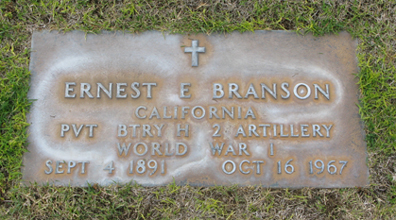 Alice never really got to enjoy her senior-citizen phase.
She died 6 January 1956 at only sixty-two. This proved to be one of the great misfortunes of Ernest’s life,
even more so than it normally would be, because his life was not structured well enough to leave him able
to cope with the loneliness. He needed the sense of purpose Alice had given to his existence. As a
consequence, his alcoholic tendencies got the better of him.
Upon becoming a widower, Ernest moved to Sanger, Fresno County, CA -- about ten miles north of
Kingsburg -- to a neighborhood shared by his sister Grace (Mrs. A.F. Warner). His final years were less
than ideal. His niece Josephine Warner Smeds in later decades vaguely recalled that Ernest married a
gold-digger younger woman (whose name Josephine did not recall), who bilked him of what financial
resources he had retained, and then left him. However, no marriage record has turned up. What
is clear is that Ernest was destitute at the end of his life, apparently by his own doing. This
included having spent the money generated by the sale of his twenty-percent legacy share of the Hornitos
ranch to Horace Meyer, the rancher who was running cattle on the property and had earlier purchased
the share of Ernest’s older brother John Joseph Branson. Ernest had given the deed
into the keeping of his niece Imogene at one point, swearing that she keep it safe from him because it
was meant for her and her sisters to inherit, but when he later came begging for it, she could not resist
his pleas.
Ernest was completely alone at the end. His body was found a number of days after his death inside
the backyard “mother-in-law” cottage he had been renting in Sanger. He was found on the evening of
Monday, 16 October 1967. The last time he had been seen by others was Friday evening, the 13th.
It is unclear at what point during that seventy-two hour span he actually expired. The death date was
recorded as the 16th. He was buried with Alice in Kingsburg Cemetery.
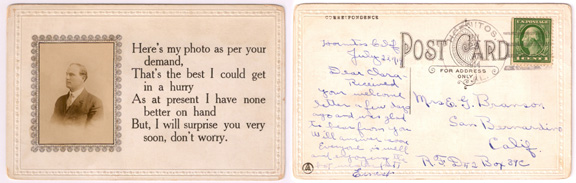
The postcard shown here was sent by Ernest to his new sister-in-law Clara Jackson Branson,
wife of Eldridge, in the summer of 1914. Clara apparently did not have a current photograph of Ernest,
and must have wanted to have one in order to show her friends, neighbors, and relatives down in San
Bernardino how much the twin brothers resembled one another. The original card was listed on eBay in
August 2006, where it was seen by Clayton Guest, a descendant of John Sevier Branson’s cousin Irena
Branson Scott, who alerted Dave Smeds to the auction. Dave was the only bidder and now owns the item.
The seller was an antiques dealer who had probably acquired the postcard through a series of estate
sales.
To go back one generation, click here. To return
to the Branson/Ousley Family main page, click here.