James Donald
Garibaldi
 James Donald Garibaldi, son of -- and only child
of -- Teresa McDonald and James Joseph Garibaldi, was born 27 July 1906 in Merced, Merced County, CA.
He was known within his birth family as Donald or Don, probably in order to distinguish him from his
father, and is referred to as such in this biography. In his professional life, he was known as James
D. Garibaldi. Informally, colleagues sometimes called him Gari.
This website includes Don because of his mother’s connection to the Branson and Ousley families. This
is a resolutely colonial-American heritage, largely English in distant origin. On his mother’s father’s
side, the heritage was Scots (the surname having been changed from MacDonald). But by the time of
Don’s birth, the various Branson, Ousley, and McDonald relatives had departed his home town of Merced
for places such as Manteca, Stockton, and the San Francisco Bay Area. Don was much more cognizant of
his paternal heritage, and must have identified himself, at least in his own mind, as Italian-American.
The Garibaldi side also brought to him an urban and merchantile perspective. His grandfather Giacomo
Garibaldi had come from Genoa, Italy to the Mother Lode of California late in the Gold Rush, and had
almost immediately forsaken his initial ambition to be a miner and had founded a grocery store instead,
a business which in the early 1870s had become based in Merced. The store was, in fact, one of the first
ten businesses established in Merced upon that community’s founding by Central Pacific Railroad. Over
time, the family had prospered. Don’s
father James Joseph Garibaldi had been able to attend college, had shifted from the grocery business to
running a hotel, and would go on to be a long-time county tax collector. As a Garibaldi, Don was exposed
to a thoroughly different upbringing than most of his schoolmates and neighbors. Merced was something
of a “sleepy” community in the midst of a region dedicated to agriculture. The citizenry was made up
largely of farmers, farm workers, former miners, and railroad workers -- the town being a significant
base for Southern Pacific Railroad. From the beginning, Don was “cut from a different cloth.” His
background was urban, cosmopolitan, upper-class -- by local standards, he was a rich kid.
Even while he was still a teenager, Don was operating in a stratum of society made up of “movers and
shakers.” Among the Garibaldis’ associates was A.P. Giannini of Bank of America. A rarified group of
peers supplied Don with connections that would prove critical to his career successes. One key
friendship was the one he shared with Clarence Ray Robinson, two years Don’s senior, who would become
head of a Merced law firm while only in his twenties. Robinson was in turn a friend of Earl Warren. Don
got to know this future governor of California and future Chief Justice of the United States Supreme
Court when Warren made his regular visits to go duck hunting in lakes near Merced with Robinson. Another
pal near Don’s own age was Hugh Morrison Burns, who decades later would become President Pro-Tem of the
California State Senate. Hugh was only an employee of the Garibaldi
grocery store when Don first developed a friendship with him, Hugh having come down to Merced from San
Francisco to build up a nest egg before starting a family. By the end of the decade, as a newly married
man, Hugh went on to the city of Fresno, where he was an undertaker -- a career he might have retained
lifelong, had he not come to travel in the same circles Don did.
By the time Don was reaching the end of high school and needed to choose a career direction, he had
plenty of learned and influential men of whom to ask advice. Thinking he might like to go into
banking, perhaps with an emphasis on setting up trusts, Don asked A.P. Giannini (Amadeo Peter
Giannini) what he should do. Giannini recommended attending law school, because setting up trusts
required a legal background. So Don went off to Stanford University, where he completed his bachelor’s
degree. (The photograph at the upper left of this biography is from the 1928 Stanford University
yearbook.) However, instead of remaining at that institution for his graduate work, he transferred
to the University of California at Berkeley, to Boalt Hall Law School. In an interview Don gave in 1989
for the California State Government Oral History Program, Don
explained that the switch was spurred by two factors. First, the Great Depression had begun and Boalt
Hall was markedly cheaper than Stanford. Second, Don had found it impossible not to idle away precious
study hours playing as much baseball as he could -- something he apparently was quite good at -- and he
was afraid that if he remained with all his teammates in Palo Alto, he would fail to evolve into a
conscientious grad student and would not concentrate on his courses enough to complete his law degree.
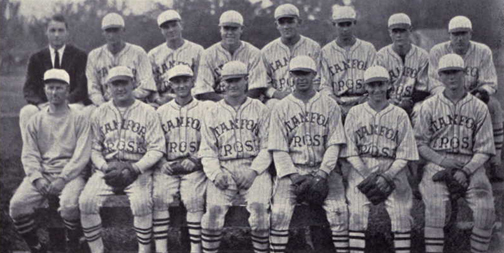
The Stanford University Class-of-1928 baseball team (the so-called freshman team) as shown in the
1926 Quad Yearbook. Donald is at the far right in the front row.
The fact is, he still would go on to play a lot of baseball even while at Cal (for the Olympic Club among
other teams), even while succeeding in doing sufficient work to obtain his diploma. He would then pass his
bar examination in early November, 1932. In the meantime, while still a college man, he started working
part-time for C. Ray Robinson. He had the comfort of knowing that a position as one of
the firm’s attorneys greeted him upon his year-round return to Merced. Robinson’s firm did general law,
providing Don with the chance to become acquainted with a variety of legal work, but the effect of that
experience paled in influence compared to the introduction to the ins-and-outs of the state political
process he picked up from his employer. Robinson had been elected Assemblyman for the Merced region in
1930. Don tagged along with his boss to Sacramento as an assistant for the 1931 session,
which acquainted him with various legislators and other key government officials. After
becoming a full-fledged lawyer, Don received another taste of life at the Capitol during the 1933 session.
(In those days, even though assemblymen were elected for a two-year term, they generally only had to
show up for a session in the odd-numbered year. The idea was that this was enough to take care of
the necessary business, and no session would be held in the even-numbered year.) Because of the turmoil
of the Great Depression, the legislature had more to do than ever before. This meant Robinson had to
devote more hours and days to this part-time responsibility than he had intended to carve out of his law
career. So when the matter of reelection came up in 1934, rather than run as an incumbent, he convinced
Don to run in his place as the Democratic Party candidate.
Don faced another Don as an opponent -- Don C. Mayes, a district attorney. Perhaps this was one reason
he chose to run as James D. Garibaldi rather than as Donald or Don Garibaldi. If so, it was not the only
way in which the names on the ballot may have affected the outcome. For the previous twenty years, Don’s
father had been on the ballot as an incumbent. In 1934, James J. Garibaldi chose not to run --
perhaps in order to increase his son’s chances. Without doubt, there must have been some voters who cast
their ballots for James D. Garibaldi assuming they were voting for the same man they were familiar with.
They may have seen that the office in contention was assemblyman instead of tax collector, but failed to
notice that the middle initial of the candidate was not the same as it had been in previous elections.
So, despite Don being a new and untested political figure, he beat Mayes, the Progressive Party candidate,
in a 60/40 landslide.
Don arrived in Sacramento to a job far different from those of modern-day holders of the office. In the
1930s, the operation of the California Assembly was still a modest matter. Individuals earned the majority
of their income from their “day jobs,” and put in their time in the legislature in part out
of a sense of public service, with far less concern over reelection than is typical today. Don did not
even have a private office awaiting him. Like his peers, what he had was a desk on the open floor of the
Assembly, which did not
even have lockable file cabinets or drawers. He had no secretary of his own, but had to depend on whomever
was sent over from the secretarial pool elsewhere in the building. (There was no guarantee it would be
the same secretary who had come the time previous, nor would come the time after.) It was understood that
each man was there simply to represent their district’s concerns just long enough to debate matters and
cast votes. In the case of Merced, Don’s duty was mostly to look out for his constituents’ agricultural
interests such as irrigation projects or price supports for milk and beef. Don did what he was asked,
thinking at first of the whole experience as being a part-time side venture of his career. He did not
maintain a residence in Sacramento; he stayed at the Hotel Senator, a popular choice of legislators.
But part-time or not, his role was meaningful, and the potential was there for more. He began making friends
and setting the stage that would keep him in Sacramento for much of his working life. The informal nature
of the political scene in the 1930s made much of this possible. Legislators and lobbyists and community
leaders could mingle and talk and relax without fear of violating the sort of regulations crafted in later
years to curb the practice of “doing business behind closed doors after hours,” a prime way old-time
government could be corrupted. Whether those latter-day regulations actually worked is debatable, but it
definitely changed the style
of government to one that involved less camaraderie. Don would later lament the comparative frostiness
of the legislative social milieu of the 1980s, and was glad to have been spared that in his era.
In point of fact, Don’s service was not as part-time as intended even in the early days. Governor Frank
Merriam called for a special session -- a so-called “extraordinary” session -- in 1936 because of the
depletion of the state’s unemployment fund. Yearly sessions would soon become the standard.
In 1936, Don ran for a second term. He not only won for Democratic candidate, but because primaries were
open in those days and voters could vote for whatever candidate they wanted whether he was a member of
their party or not, Don also took the majority of the votes from Republican voters and so did not have
to face a run-off candidate in the November general election. Instead of having to concern himself with
his own campaign, he was able to lend support, advice, and funds to his buddy Hugh Burns. Though
Hugh had moved on to Fresno and become a mortician, he and Don continued to be acquainted through their
membership in the 20/30 Club, a social organization for young adults -- Don belonging to the Merced chapter,
and Hugh to the Fresno chapter. Hugh succeeded in being elected to the Assembly, representing the Fresno
district. He and Don would go on from there to be lifelong best friends.
The 1937 session was busy. Don served on several committees, and chaired the Building and Loans Associations
committee. “Building and Loans Associations” are what we today call “Savings and Loans.” These institutions
were rapidly cutting into the traditional banking business, a process that spurred a number of legislative
issues in the 1930s. (Things never change, do they?) In 1938, another extraordinary session was called. At
the end of that, Don had decided four years of service in the legislature was enough. He set his sights on a
different role, giving up on seeking a third term in the Assembly.
The goal he was reaching for was the state Superior Court judgeship for Merced County. This was one of
those offices that was technically an elected position, but typically was filled by appointment of the
governor whenever the holder of the seat died or retired. The elections of such men tended to be public
affirmations of the appointed incumbents, rather than genuine competitions between candidates. However,
at this time the judge currently holding the office was E.N. Rector, who had been in place for years and
years. Rector was someone whose age had come to affect his ability to serve, yet he did not want to step down
voluntarily and had placed his name on the ballot for reelection. Don, like many residents of Merced, felt
it was time for a younger man to take over. Don certainly had many qualifications for the office, including
having served as a part-time traffic court judge back in 1933-34. The voters agreed. Don was elected for a
six-year term to commence 8 January 1939. In so doing, he became the youngest sitting superior court judge
in the state.
Having dealt with the campaign, Don took a quick trip out of state to take care of a personal matter. He
and his fiancée flew to Las Vegas, where they were married 3 December 1938. The lady putting an end to
Don’s bachelorhood was Marion Hardy Jahns. Born in Los Angeles, CA 22 May 1908, Marion was the daughter
of automobile piston manufacturer William Herman Jahns and Margaret Jane Jeffrey. For Don to end up with such
a bride is a measure of just how different his life was compared to his Manteca-based cousins. Marion had
recently been the wife of Gregson Edward Bautzer. Bautzer, who had only just graduated from law school in
1936 during the midst of his brief marriage to Marion, was fast becoming one of the most celebrated and
easily the flashiest attorney ever to work within the circles of Hollywood and the entertainment industry.
He would go on to become the lover of actress Lana Turner -- he is credited with having claimed Turner’s
virginity. Over the decades to come he was variously a lover, fiancé, or even husband to such starlets as
Joan Crawford, Ginger Rogers, Patricia Chapman (aka Buff Cobb), and Dana Wynter. As a lawyer, Bautzer’s
client list was similarly flocked with celebrities, including billionaire Howard Hughes. Anyone
wishing to learn about Gregson Bautzer in depth should consult the major biography published in 2013,
The Man Who Seduced Hollywood : The Life and Loves of Greg Bautzer, Tinseltown’s Most Powerful
Lawyer by B. James Gladstone.
Marion largely escaped the notoriety of having been a wife of Bautzer and was seldom mentioned in
biographical material about him until long after she was deceased, meaning she was able to peacefully
settle into her life in Merced with Don. She was still able to socialize with the rich, powerful, and
famous stratum of society, but did not have to spend the decades dodging paparazzi every time she
went out in public, a freedom she could not have enjoyed had she lingered in Bautzer’s immediate sphere.
Newspaper articles about her in the late 1930s and early 1940s describe her simply as “Mrs. James D.
Garibaldi,” and the only reason she rose to the level of newworthiness at all was due to such activities
as competing in women’s golf tournaments with the Turlock Country Club. (During this same era, Don was
still an active athlete as well, though preferring baseball and tennis to golf.) For his part, Bautzer
was seemingly pleased to have sloughed Marion off. He was an only child whose father had died when he was
ten years old and he did not have the means to “dress the part” of the up-and-comer lawyer he was attempting
to portray. His marriage to Marion and to her parents’ money gave him the means to outfit himself with a
truly sartorial wardrobe and let him begin dipping into the lifestyle he required, as well as granting
him entrée into the company of those who shared that lifestyle. He never looked back. Marion
was well rid of him. It is less easy to understand what doomed her earlier marriage. She was wed in 1928
at age twenty to James Houston Jones, a scion of the family that owned the well-known and prosperous
James Jones Brass Works, founded by James’s grandfather in the 1890s. It would be fair to characterize
her choice of Don as spouse as an instance of “third time’s the charm.”
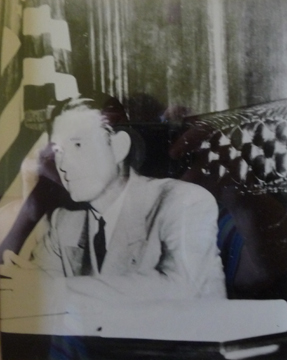 (Don is shown at left on the job in his judge’s box. This
photograph still hangs, as it has for seventy years, in the old Merced County courthouse.) Don’s tenure
on the bench was not long, but one of his rulings would leave a prominent mark in central
California political history. His decision led to San Francisco gaining the right to use the waters behind
Hetch Hetchy dam as the metropolis’s primary supply of drinking water. This “resource grab” remains
a controversial matter even in the 21st Century. Central Valley residents are quick to argue the water should
be used locally. Environmentalists would like to see the reservoir eliminated, so that the gorge that was
inundated by the erection of the dam, reputed to be a “second Yosemite,” might be
restored to its natural beauty. The basis for Don’s ruling was that local jurisdictions did have a “riparian”
right to the water -- the principle that those who live along a waterway have first claim to it -- but
that inasmuch as communities and counties along the river were not, in fact, making use of it as
of the 1930s, San Francisco had a right to step in and acquire control, because they could demonstrate a
way in which the resource could be used to benefit citizens of the state. This decision eventually withstood
final appeal, and became policy.
Don and Marion loved to travel, often with friends. In mid-July, 1941, they were on a vacation in
Mexico with Mr. and Mrs. Lee W. Bering of Los Angeles when their small plane failed to take off
successfully from the airport at Tepic in the state of Nayarit, landing upsidedown in the Santiago
River. Fortunately all escaped alive, the two women sustaining minor injuries.
As the United States became heavily involved in World War II, Don decided to enter the military. He was
beyond the age of the typical soldier and furthermore could easily have obtained a deferment due to his
position as a
public official, but he wanted to do his part. He accepted a commission as an officer in the U.S. Army
Reserves 20 June 1942 and was called to active duty in the Air Corps two weeks later -- appropriately
enough on the Fourth of July. He ceased serving as a judge that month. He was stationed in Hobbs, NM in
October, 1942, where he spent the remainder
of the war. He never went overseas. He also never attempted to transfer into the judge advocate department;
he was regular Air Corps throughout. However, his superior officers understood the sort of asset he
represented, so at any given time he was on assignment on judicial matters. His first case involved an
incident where a military plane and a commercial plane had collided in mid-air, resulting in the death
of over thirty people.
His entry into the Army meant his seat on the bench was essentitally empty, so the governor appointed
Ranse Sischo to the office. A court case decision, People ex rel. Happell vs. Sischo rendered 23
December 1943, reveals that Sischo wished to be confirmed as the permanent replacement. The judgment was
that Don was still the official holder of the office (though he received no pay during the time he was
absent, nor did he ask for any), and would get his job back if able to return to it before the natural
expiration of the term on 8 January 1945. In fact, the war went on beyond that point. It is clear Don
did not put his name in the running for the post during the election of 1944. He chose never to be a
judge again. However, the affectionate nickname “Judge” would be attached to him for the rest of his
life.
For the final months of his hitch, Don was transferred from Hobbs, NM to Santa Ana, CA. This acquainted
him with southern California. For Marion, it was a homecoming, and this perhaps swayed Don to agree that
the couple would make their home in southern California. The stage was set for one other big change.
By the end of the decade, he and Marion finally became parents -- a last-minute opportunity, as Marion
was over forty when the child was born. Given that, there were no subsequent offspring. (Nor does
Marion appear to have had offspring earlier while married to James Jones or Gregson Bautzer.)
With the looming prospect of becoming a family man, Don needed to ensure he could be a breadwinner. He
rededicated himself to
his career as an attorney, setting up a practice in L.A. He modelled his firm after that of C. Ray
Robinson, which is to say, a general law firm, handling a wide variety of legal matters. His experience
as a trial lawyer and his family contacts -- A.P. Giannini again being the most prominent -- allowed
him to build up an enviable amount of business. Don represented some of Giannini’s interests, such as
Pepsi-Cola and First Bank of California, along with a number of insurance companies like Argonaut and
Industrial Indemnity. In 1952, Warren J. Lane joined the team; eventually the company name evolved into
Garibaldi & Lane. (Don would be deprived of his partner in 1973, when Lane passed away in his early
fifties.) During this building-of-the-firm phase, Don and Marion lived in Bel-Air.
Don did not intend to return to Sacramento, but forces steered him in that direction. At first, he came
up just to visit Hugh Burns on a social basis. Then he came in order to take care of some matters for
one of his big clients, Signal Oil Company. People frequenting Sacramento noticed him and recalled him
from his days as an assemblyman, and also took note of the fact that he was no longer an elected official
and so was free to represent private interests. Soon Don was asked to be the lobbyist for Hollywood
Park Race Track and associated gambling interests, the owners of which because were negotiating with the
state how much of the revenue the government would get.
Don had fallen into his natural career niche. He was gregarious, social, easy to get along with, and
loved to spend time with colleagues, whether it be as part of college baseball teams, fraternal
organizations, fundraisers, hunting trips, or even shared vacations. (He and Hugh Burns went all the
way to Europe to see the Vatican and other sights. The pair also enjoyed taking train trips just because
they loved trains -- Don commented in his 1989 interview how fortunate he felt himself to be because the
Sacramento area had such a wonderful railroad museum.) He would be unfailingly pleasant and unfailingly
helpful to those he associated with, the perfect sort of person who could therefore, once in a great
while at just the right moment, call in a favor. Don also knew how to get information legislators would
need, thanks to his experience on committees and his contacts with court reporters whom he had known as a
jurist. This was a vital aspect of Sacramento politics at the time. The legislators had limited numbers
of staff people. They were dependent on lobbyists to bring in the detailed data necessary to make decisions
about issues.
Don maintained a personal style throughout his career. Aside from a secretary who could take messages
while he was out of his office, he did his work himself, eye-to-eye and handshake-to-handshake. His
client list grew and grew over a course of decades. He became a power-behind-the-throne in California
government. He acted on behalf of many industries. Among the first were liquor interests, which often
involved the same clients who were part of the gambling interests. In this, Don could have been said to
be following family tradition. His grandfather and uncle had been familiar with liquor distribution as
part of their grocery store and hotel. Don’s great uncle Peter Harrington had been a liquor dealer in
the 1870s and 1880s.
Among the clients Don came to represent was Leslie Salt Company. Don was instrumental in pushing through
legislation in 1970 that removed the tidewater fringe of San Francisco Bay from local jurisdiction, putting
it under state control -- and then he put his influence behind a bill that preserved large stretches of
those tidewaters as salt ponds, nearly 100% of which were maintained and harvested by Leslie Salt. Don got
credit for not only serving his client well, but establishing a policy that ultimately saved key wetlands
around the bay from irreversible types of development. It is still possible to restore those areas, and
as the 21st Century progresses, this is in fact being pursued.
By the time Don was a senior citizen, yet still actively serving as a lobbyist, there was no one
in his league. In an article in the 16 June 1980 issue of New West magazine, writer Jeff Gillenkirk
called Don the most powerful lobbyist in Sacramento. This was an accurate assessment, yet Don was quick
throughout his career to downplay any power he had, not only due to a characteristic sense of modesty, but
because he was sharp enough to avoid the trap that a predecessor, Artie Samish, had fallen into when he
bragged too openly about his degree of influence. While a reputation of corruption dogged Samish and
brought him down, Don was praised for his integrity. In his time, Don had the ear of such California leaders
as Jesse Unruh, Governor Pat Brown, Governor Ronald Reagan, and countless speakers, state senators, committee
heads, and jurists. It is no surprise that Don was tapped to provide one of the interviews for the Oral History program. His perspective was unique.
Naturally, anyone in Don’s position could not entirely escape controversy. He probably felt a bit under
siege in the mid-1970s. In April, 1974 -- only four months after the unfortunate and untimely death of
his partner Warren Lane -- Don was accused of making a practice of supplying legislators with prostitutes.
The charge was levelled by a San Francisco doctor who had treated a number of Sacramento-area ladies of
the night for alcoholism. The accusation emerged as a political reform group was attempting to get a bill
through the legislature limiting the influence of lobbyists. The doctor’s statements were largely dismissed
as mudslinging. Two years later another matter came up, and this time there was no sloughing off the
embarrassment. Don’s son, a small-plane pilot, was caught in the act of transporting two tons of marijuana
from Mexico into southern Arizona. A plea bargain was made, but only to the extent of reducing the number
of charges. The young man still had to plead guilty to two felony counts. Naturally the newspaper
coverage of the case mentioned the fact that the accused -- and later, the felon -- was the son of
James D. Garibaldi, a former superior court judge.
 Lacking any siblings or any first cousins on his mother’s
side, Don did not particularly keep in contact with the extended
Branson family and knowledge of his personal life is therefore somewhat blank in the correspondence and
genealogical notes that went back and forth among the branches. This is somewhat ironic, given that in
the public sense, Don may have been the best known of the entire clan. One of the only instances of his
name turning up in a memoir is when his cousin Esta Jane Fowle recalled staying in the spare bedroom at
the Merced home of Don’s step-grandmother, Agnes Dunn McDonald, and looking through books that had been
left there by Don in the late 1910s and early 1920s -- specifically the Boy Allies series of boys
adventure books set in World War I.
Don was the subject of the 1992 “roast” by the Capitol Focus branch of the California Center for
Civic Participation and Youth Development -- a tribute usually reserved for governors, state senators,
assemblymen, or other high officials. Among his other honors, Don’s name was attached to an annual
scholarship awarded by the California Highway Patrol Foundation. (The CHP had been one of his lobbying
clients.)
Don seems to have always kept title to a residence in southern California, but spent the bulk of his
time in Sacramento, where he also owned a home. It is assumed, but not definitively known, that he and
Marion remained married until she passed away (in Sacramento) 22 July 1983. The year after her death,
Don married a much younger woman, who as of this writing is still alive. She had been married before
and had four kids, the youngest pair of whom were still in high school, so for the next few years Don
had the pleasure of being a day-to-day parent again. It had only been a couple of years before Marion’s
death that Don had finally become a grandfather.
Don ultimately made it into
his late eighties, perishing 10 September 1993 in Sacramento. He was memorialized in a number of
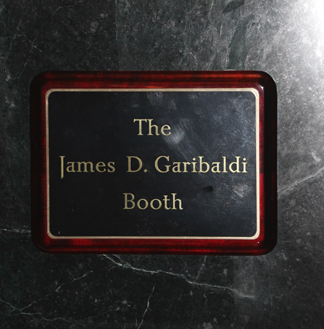
ways. A bronze plaque bearing his name and nickname was attached to the wall of a corner booth at Frank
Fat’s, a Chinese restaurant near the Capitol frequented by politicians and lobbyists, one of Don’s
favorite places to conduct his persuasive conversations. (The plaque is shown above right, as
photographed by Elliott Smeds 12 September 2013. The Speaker of the California Assembly got up from
the booth so that this picture could be taken.) His protégé, John R. Wendt, went on to keep
alive the example of friendly, effective, behind-the-scenes lobbying in Sacramento for another dozen
years, until he, too, passed away. And among the earliest tributes was the following article, written
by news columnist Dan Walters and published in the Sacramento Bee four days after Don’s death:
JUDGE’S DEATH CLOSES AN ERA
The Judge, who had a fine sense of humor, would have appreciated the tidy irony of his passing.
James D. Garibaldi died on the final day of the 1993 legislative session, nearly a half-century after
coming to Sacramento as a lawyer/lobbyist.
For years, Garibaldi -- the judicial honorific derived from his brief service on the bench before World
War II -- had been the dean of the Capitol lobbying corps, exemplifying a political era that is rapidly
fading.
As state government expanded along with the state’s population after World War II, Artie Samish perfected
the lobbying style that Garibaldi and others practiced for decades: befriend legislators, entertain
lavishly, and help out your “friends” with timely campaign checks.
Samish called it “select and elect,” but went to prison after becoming a little too boastful about
his power during the 1950s (he allowed himself to be photographed for a magazine article with a puppet
on his knee, describing it as the Legislature). Garibaldi, himself a former legislator, and a few others
picked up the cudgel.
Garibaldi, who represented liquor and horse-racing interests for the most part, was a familiar patron
of taverns and restaurants near the Capitol, where real decisions are often made. And before political
reform laws intervened, Garibaldi allowed his political friends to simply sign his name on bar and
restaurant tabs even when he wasn’t present.
It was, of course, influence-peddling of the most outrageous sort, but it paid off for Garibaldi’s
clients in the form of laws that gave them special marketing arrangements and tax breaks. It took the
courts, for example, to get rid of California’s infamous and ill-named “fair trade” liquor pricing laws,
which were no more than officially sanctioned price-fixing. Even after fair trade laws were wiped off
the books, Garibaldi continued to push bills that would create government-enforced liquor monopolies.
The Judge was just as effective on behalf of the horse-racing interests he represented, once winning
approval of a multimillion-dollar state tax reduction for horse-racing tracks after the passage of
Proposition 13. Then-Gov. Jerry Brown approved the horse track bill while almost simultaneously vetoing
a direct appropriation of the same size to keep public libraries from closing their doors. At the time,
Garibaldi’s lobbying practice was an adjunct of the law firm headed by Brown’s father, ex-Gov. Pat Brown.
Garibaldi’s successes were due in part to the fact that both liquor and horse-racing bills are handled
by the same committees, Assembly Governmental Organization and Senate Governmental Organization.
Legislators sell their mothers’ souls to gain seats on the “GO” committees, as they are called, because
of the lavish campaign checks that flow from liquor and gambling operators.
Garibaldi cultivated members of the committees assiduously, especially their chairmen.
Ralph Dills, who was first elected to the Legislature in 1938 and has chaired the Senate GO Committee
for eons, was presiding over the Senate Friday when Garibaldi’s death was announced, and he began
sobbing.
“He was as close to me as any man in public life because he was a real brother,” said Dills, who carried
many of the Garibaldi-generated bills for liquor and horse-racing clients.
Dills was not being facetious. The friendship was a genuine one that spanned decades. But the era of
legislation being written among friends over drinks and dinner is rapidly ending. The 1993 session also
was the first for a new generation of lawmakers elected under term limits, and the rapid turnover is
changing the dynamics of lobbying, too, for better or worse.
Descendants of James Donald Garibaldi and Marion Hardy
Jahns
Details of Generation Five, the great-great-grandchildren of John Sevier Branson and Martha Jane
Ousley, are kept off-line to guard the privacy of living individuals. However, we can say that Don’s
(biological) line of descent consists of his son, one grandchild, and two great-grandchildren. These
four individuals are at present (2021) the only surviving descendants of Phoebe Ann Branson.
To go back one generation, click here. To return
to the Branson/Ousley Family main page, click here.