Donald Huntington
Branson
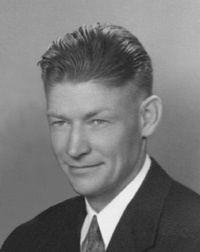 Donald Huntington Branson, son of Robert Lee Branson
and Mary Etta Cowsert, was born 3 February 1909 in Huntington Beach, Orange County, CA. His middle name
came from his place of birth. His parents had temporarily come to Huntington Beach from their somewhat
isolated part of California because Etta had already had one pregnancy go astray and wanted to be in an
area where doctors were readily at hand. Orange County and Los Angeles County had no shortage of
professionals of all sorts because the area was doing well economically thanks to the burgeoning oil
industry, whereas many other parts of the nation were not doing well at all. The young family would spend
only a matter of months in Huntington Beach after Donald’s birth, and then an even shorter span in Burbank.
For the most part his childhood was spent in the Indian Wells Valley region of the Mojave
Desert of California, where Robert maintained the water system for Yellow Aster Mining Company,
an infrastructure that also served the needs of Yellow Aster’s “company town” of Randsburg. Randsburg
lies just west of the Kern/San Bernardino County border not far south of the southern edge of Inyo
County, and these days is in the swath of civilian land situated between China Lake Naval Weapons
Center, Edwards Air Force Base, and Fort Irwin Military Reservation.
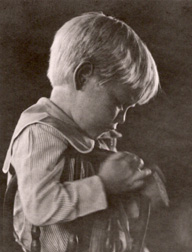 (At right, Donald is shown at age four.) No
later than 1917 the family moved a bit north to
Keeler in Inyo County, on the shore of Lake Owens. That year Donald’s only full sibling, Marjorie,
was born. Marjorie was still an infant, and Donald about nine, when Robert and Etta’s marriage began
crumbling. Robert began working at Diaz Lake, near Lone Pine. Etta obtained a job as a cook at Spark
Plug Mine at Jeffrey Ranch, closer to Bishop. Don lived mostly with his mother, though he did attend
school at Diaz Ranch. The martial separation evolved over a couple of years into a full rift. There
were hints that Etta had not been the most faithful of
spouses for some time -- including gossip that raised doubts about Marjorie’s conception -- but
her straying became undeniable when she moved in with lover William Thomas Ray. Robert petitioned
for divorce, doing so over the state line in Nevada in order to speed up the process. Judge C.J.
McFadden of White Pine County granted the petition 9 Jun 1920. According to the court records,
Etta had been cohabitating with Mr. Ray for over three months by then, sufficient grounds for the
judge to rule in Robert’s favor. Robert was granted permanent custody of Donald. Custody “until so
ordered otherwise” of Marjorie was given to Etta due to Marjorie’s tender age -- it was not an era
when small children were separated from their mothers without extreme cause.
Despite the judge’s decision, Donald did in fact live with his mother a great deal during his
remaining childhood, especially during school terms -- though school terms became a thing of the
past about two years after the divorce, because Donald ceased attending school upon graduating eighth
grade. Donald was in Robert’s care in the summers. As Donald became an adolescent he was instilled with
the legacy of self-reliance and the need
to be a man early if that’s what it took to get by. This was the nature of Robert’s own youth as
the son of a father who, when he did get involved in his sons’ lives, did so as a coworker and
mentor at physically demanding occupations -- usually mining. Family genealogical notes say that
when Donald was fourteen or so, Robert obtained a job for him in Aberdeen in northern Inyo County
getting fresh produce ready to distribute to markets. (Though on a late 1940s list of Donald’s
work experience, the locale of this job is given as Grand Junction, CO, near where he lived when
he was with his mother.) Donald dealt with fruit and sugar beets, out in the fields and at the
loading docks, for room and board and clothes and a dollar per day. Another job his father got
for him was driving a tractor in Goler Heights, not far from Randsburg, where it was necessary
to repair and add levies to keep the flow of flash-flood water from eroding the local wells. The
owner was reportedly impressed that Donald could manage to get the tractor started, because it had
been stored in a shed barely big enough to house it, which did not leave much room for anyone to
perform mechanical repair, nor make it easy to apply proper leverage to the starting crank.
In 1923 Robert married his second wife, Nellie Reed, and they started a new family. This put Donald
in a somewhat tentative position. When he lived with his mother in her home in Rolapp, Carbon County,
UT, his life was complicated by the presence of his step-father. (Though it must be stated that
William Ray was not good about staying home with the missus and the kids and was not necessarily
there at any given time.) Once Nellie came into the picture Donald also had a step-parent in
California, one who could not help but look at him as a vestige of a marriage gone sour -- a
marriage “best forgotten.” A resolution of sorts occurred by the mid-1920s, as Etta’s relationship
with William Ray disintegrated, and she moved back to California with Marjorie and an additional
child, James Ray, born in 1922. She found a haven in Taft, Kern County, CA, becoming a cook at a
hotel and residing next door to her brother Jack Cowsert. When Donald spent time as part of his
mother’s household, he was surrounded by a bevy of close relatives. Jack Cowsert was his uncle two
ways, being not only his mother’s brother, but the husband of his father’s sister, Margaret Branson.
Which naturally meant that Margaret was his aunt two ways. Jack and Margaret’s household included
Donald’s first cousins Oliver Heitkemper, Edgar Robert Gaver, and Margaret Gaver, and double first
cousin Louise Cowsert. For the rest of the 1920s the Taft home was Donald’s home base, and Taft was
where he attended high school.
Little Jimmy Ray admired his older half-brother so much he eventually changed his name to James Ray Branson
so as to have the same surname -- cherishing that bond much more than the one shared with his biological
father William Ray, who had by 1925 completely vanished from his offspring’s life.
Donald’s heart was in the desert. In the mid-1920s, at age seventeen and a half, he began spending
a greater proportion of his time there, doing grunt-level work in a gold mine near Randsburg. The
welcome Donald received when he showed up at his father’s place to launch this phase of his life was
less than perfect. Family accounts give somewhat conficting versions of what happened, but the gist
seems to be that either Nellie did not want her husband’s son from his first marriage disturbing the
harmony of the new family -- which included Donald’s half-siblings Gloria, Norma, and Daniel -- or
Robert believed that he needed to protect his wife from such worries. In any case, Donald had to spend
at least his first night, if not longer, sleeping in a mine Robert was excavating rather than in the
family home. This may be the same mine listed in his résumé later in life -- i.e. his father was his
boss.
Father and son eventually ceased to have any daily-life contact. In decades to come Donald’s sons would
come of age assuming that their father’s father had passed away before their own births, even though
Robert in fact lived to age ninety-eight and was dwelling not all that many miles from them throughout
their childhoods. Despite this rift, Donald and Robert were very much alike in one respect -- they both
felt at home in the desert triangle of California that lies east of the high peaks of the Sierra Nevada
range. By 1930 Donald stopped spending sojourns back in Taft, though the April 1930 Federal Census does
show him as an occupant of his mother’s household in South Taft, his occupation given as laborer in the
local oil fields like his uncle Jack. There was less and less reason to stay in western Kern County. His
male cousins, both of whom were slightly older, departed to begin their adult lives in other places,
Oliver becoming a jeweller in Los Angeles County, Edgar joining the Navy. His mother would soon head to
Los Angeles County in the hope of getting treatment for Marjorie’s leukemia, a disease that would kill
her in 1932 at age fifteen.
By the early 1930s Donald’s mining aspirations grew. He became self-employed, leasing a gold and
tungsten mine near Randsburg. Earnings were enough to keep going but not enough to build upon -- about
$125/month. In early 1933 he decided being his own boss was something he could do in his spare time,
and took a regular wage-earning job with a general contracting firm in Lone Pine, Mount Whitney Sales
& Service, owned by W.V. Skinner. He worked as a journeyman carpenter at eight dollars a day, which
with six-day weeks came to about $200/month, a definite step up even given the idle periods associated
with construction work. In addition to general tasks he came to specialize in plastering and cement
finishing.
Donald was coming into his own as a jack-of-all-trades. Old-time prospectors -- his father being one of
them -- had to know how to do a little of everything, and Donald reflected this heritage. He cooked,
baked, gardened, and hunted. He was a talented mechanic and “tinkerer.” Over the years he would do such
things as build a ski lift out of parts from an old Model T Ford automobile. And of course, whenever
possible, he did a little mining on the side.
In early 1940 he began working for a long-time acquaintance and co-worker, Rudie Henderson, who had
founded his own business, Lone Pine Lumber and Supply Company. Here Donald was free to made use of his
full range of capabilities to perform repairs, install appliances, and in addition to regular carpentry,
install and maintain plumbing. Soon he was showing up at the elementary school in Lone Pine to deal with
plumbing issues there, and he got to chatting there with the kindergarten teacher. The young woman was
in her late twenties -- about four years Don’s junior. She had moved to the area in 1938. One thing led
to another and the pair were married 2 April 1942 in Reno, Washoe County, NV. Her name and most of her
biographical information are being kept in reserve at this time because she is still alive.
Right at the onset of America’s involvement in World War II, Donald spent a short period in Seattle, but
was called back to his permanent address in early 1942 in order to report for a physical as part of a
draft summons. He was designated 4-F. Nothing apparent in his known history indicates he was unhealthy,
but this was nevertheless the designation he received. He did end up working for the government, though.
He was a civilian plumber at the infamous Japanese internment camp, Manzanar. This facility, located
quite close to Lone Pine, was the first of some ten such concentration camps built in isolated locales
in the American West during the war to house a total of about 110,000 Japanese and Japanese-Americans.
Manzanar held about ten thousand residents. Donald was one of many white American employees who drove
in from town to work each day within the camp. Donald supervised a crew of up to fifteen detainees,
most of them young men wanting to learn useful skills while their lives were otherwise on hold, the
rest consisting of older men who had been plumbers before becoming swept up in the relocation. Donald’s
role there was apparently regarded as necessary to the war effort because it kept him out of the Army
again in the summer of 1943 when, like many men originally designated 4-F, he received another draft
summons. In 1973 Donald was interviewed about his Manzanar experiences as part of the Japanese American
Project of the Oral History Program of California State University Fullerton. This interview takes up
the whole of chapter nine of Camp and Community -- Manzanar and the Owens Valley, edited by
Jessie A. Garrett and Ronald C. Larson.
As the war wound down and less construction and repair was needed at Manzanar, Donald resumed working
for W.V. Skinner part-time. He also formed a partnership with his uncle Jack Cowsert to exploit a talc
deposit, a venture they called the Cookie Talc Mine, named for Jack’s granddaughter Jacqueline, who was
then a toddler. Cookie was Jacqueline’s nickname -- a name she embraced as she grew up and by which she
is still known today. The main customer was Sierra Talc Company. In calendar years 1945 the net profit
was $160.09 for each of the two partners. But miners have to be optimists, and Donald and Jack kept at
it for another year until the price of talc collapsed and they decided to sell out to the mining
division of Gladding, McBean Corporation.
With the talc mine gone, Donald dedicated himself to his own contracting business, at first solo and
by the summer of 1947 with partner Ernest Lasky as Branson & Lasky, specializing in plumbing and wiring.
The stage was set for parenthood. Two sons were soon born. Donald could not have been more settled now
in Lone Pine, and this would not change for the next fifty plus years.
In the course of his continuing business life Don managed the Lone Pine Water Company, built the
Willow Motel (now the Lone Pine Budget Inn) using salvage material from Manzanar, and
of course dug for gold and silver when he could. His wife remained a teacher for over four decades.
In the late 1950s came the founding of a legacy business when Donald -- again in tandem with partner
Ernie Lasky -- started a cable television
service. Over-the-air broadcast reception was a very iffy thing in Lone Pine due to the isolation of
the region and the obstacle of the Sierra Nevada to the west and White Mountains to the east, so
there was a definite demand for the service. This company, Lone Pine Television, was so successful it
continues today, overseen by his eldest son.
Even after reaching an age when other people either retire or drop dead, Don remained active. He
and his wife loved to hike and enjoy the natural beauty of their region. They enjoyed contributing to
the community and were valued citizens. Don was a scoutmaster, built backstops for the local Little
League, and was a decades-long member of the Lone Pine Gun Club. Both spouses remained involved in Lone
Pine Television Company into their twilight years. Those years stretched on, lending support to the
local belief that the upper desert is extraordinarily good for longevity. Don’s father Robert did
not die until age ninety-eight. His mother lasted to age ninety-five. Don split the difference,
almost reaching the age of ninety-seven before he succumbed 20 January 2006. (The timing meant he
was the first of all the individuals profiled on this website to pass away after the website was
launched.) His memorial was held at the Mount Whitney Baptist Church in Lone Pine, Pastor Terry Randolph
officiating. His remains were interred in the Sunset Lawn section of Rose Hills Memorial Park in Whittier,
Los Angeles County, CA.
After Don’s death, his widow, eldest son, and daughter-in-law formed a foundation in his honor to
promote environmental, educational, and social progress in America. It is known as the Branson
Foundation. For more information click here.
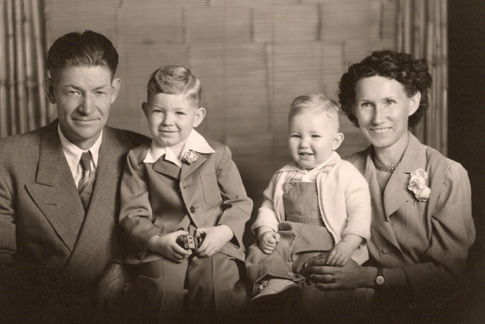
Donald Huntington Branson with his wife and sons in 1952.
Descendants of Donald Huntington
Branson
Details of Generation Five, the great-great-grandchildren of John Sevier Branson and
Martha Jane Ousley, are kept off-line to guard the privacy of living individuals. However,
we can say that the archive contains up-to-date information on Donald’s line, which
includes two children and three grandchildren. His widow survives.
To go back one generation, click here. To return
to the Branson/Ousley Family main page, click here.