Beverly Orwin Branson
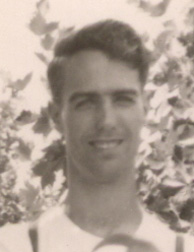 Beverly Orwin Branson, son of Henry Jefferson Branson
and Ada Crane, was born 9 August 1917 in Madera, Madera County, CA. Within just a few years of his
birth, parents across America ceased giving male babies such names as Beverly and Shirley. Beverly
therefore inevitably appears in certain references as female. (His accurate gender has, however,
always been reflected here on this website and in genealogical records originating from within the
John Sevier Branson clan.) Beverly was the first of the three children to spring from the union of
Henry and Ada. The next child was a brother who lived only four hours and apparently was never given
a name. The one full sibling he knew was his sister Betty Joella Branson, born at the end of 1920.
While Beverly was an infant, his father was a clerk in Madera, but the lumber industry was in his
blood. In 1919, Henry accepted a position as night supervisor at the Yosemite Falls Lumber Company
complex in Merced Falls, Merced County, CA. At first, he spent his work week there while Ada and little
Beverly remained in Madera. He stayed in worker barracks -- the mill outpost at Merced Falls was huge,
with many boarding facilities, both company-owned and privately-owned, in the immediate vicinity. After
an arrangement had been found that was suitable to a young family, Ada and Beverly moved to Merced
Falls as well. In so doing, they were in a sense coming full circle in terms of Branson family history.
In the 1860s Henry’s
grandfather John Sevier Branson had panned gold from the Merced River only a few miles upstream from
the spot where the mill now stood, and the long-time family estate, Grasshopper Ranch, had sprawled less
than ten miles to the east. Henry would never get to share the tale of that history with
his son. On the night of 11 April 1921, Henry was killed by injuries sustained after his overcoat
became entangled in mill machinery, flinging him violently to the floor. Beverly was not yet four.
In later years he would retain only a wisp of memory of his father.
After the tragedy, Beverly, his baby sister Betty, and their mother Ada sought the comfort and shelter of
Henry’s parents John Sevier Branson, Jr. and Lillian Jane Guest at their residence on Washington Avenue,
Madera, Madera County, CA. (Ada had become an orphan early in her life and did not have parents of her
own to turn to.) When she could manage it, Ada moved herself and her little ones to a rental home nearby.
With John and Lillian near to help with childcare, Ada turned to being a laundress to make ends meet.
Several of her brothers made their living in the laundry business, so this was a natural occupation for
her to pursue. Meanwhile, the local Oddfellows chapter donated labor in order to build a house for the
young widow and her offspring on Vineyard Avenue, just around the corner from John and Lillian’s place.
At this juncture, Beverly’s uncle Joseph William Branson and his wife Mildred also lived on Vineyard
Avenue.
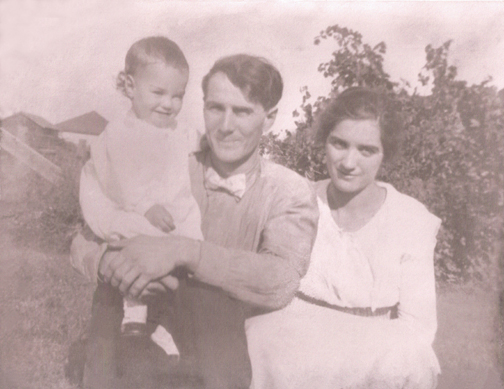
Beverly as an infant with his parents
Ada’s partner in her laundry enterprise was her brother William Crane -- Bill. Unfortunately the
business was marginal. It was difficult for Ada to maintain a separate home for herself and her
kids. A temporary solution presented itself in the mid-1920s when the home of John and Lillian burned
down. Since they had to rebuild anyway, they added an extra room, connected to the main house by a
causeway. Ada and the kids took up occupancy there, which reduced Ada’s expenses. Even so, she was
keen for a better situation. The agent for this change was a romantic interest. The fellow’s name
was Matt Huddleston. Formally, he was Matthew J. Huddleston, son of Matthew Huddleston and Julia
Canty. Born 23 February 1879, the first of five children, Matt had been raised since infancy (and
probably from birth) in San Francisco. His father had been long been a teamster -- i.e. a hauler of
goods back and forth through the city, “teamster” stemming from the days when that occupation
depended upon teams of draft animals to haul wagons through the streets -- and Matt had grown up
in this trade, even as the industry said farewell to its beasts of burden and resorted to motorized
trucks for transport.
During the 1910s, Ada’s brother Bill Crane had lived in San Francisco with his first wife Jennie
Serradel. When Jennie had passed away, Bill had married Charlotte Adaline Huddleston. Lottie was a
sister of Matt Huddleston. Bill and Lottie would eventually move back to San Francisco, where the
economic prospects for a laundry business were brighter, but in the mid-1920s, while still in
Madera, Matt paid them a visit, and thereby met Ada. Matt and Ada hit it off well, and soon were
married. Given that Matt was running a thriving trucking business in San Francisco, the marriage
meant Ada and her kids were obliged to relocate.
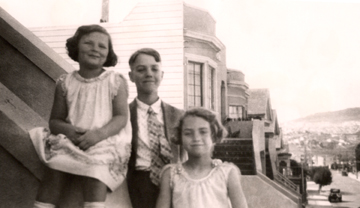 Beverly succeeded in adjusting to big city life,
and would spend much of his lifetime residing and working either within the city itself or in its
immediate suburbs on the peninsula. The family home during much of his remaining childhood was
located on Lowell Avenue where San Francisco blends into Daly City. His playmates of course included
his sister, and also his younger female cousin Lowell Lorrine Branson, daughter of his uncle Joseph
William Branson, during an interval in the late 1920s when Joseph worked for Matt Huddleston. (Shown
at right, Lowell, Beverly, and Betty Branson in about 1928.) The girls in turn were the right age
to be full contemporaries of
Matt Huddleston’s grandchildren, the offspring of Matthew M. Huddleston, his son from his earlier
marriage to Margaret Smith. Beverly, being older, was able to establish a connection with Adaline
and John Quinn, the offspring Lottie Huddleston had produced during her first marriage. This pair
were doubly related to Beverly, being his step-father’s niece
and nephew while simultaneously being his uncle Bill Crane’s step-children. As Beverly himself put
it when interviewed for this biography, they were his “shirt-tail cousins.” He knew them better
than some of his blood relatives.
Though San Francisco loomed large in Beverly’s existence, Madera was not forgotten. Ada often
visited her siblings in the San Joaquin Valley, and did not ignore John and Lillian Branson’s
eagerness to have their grandchildren come stay with them. Beverly and Betty were there regularly,
particularly after the 1931 birth of Eugene R. Huddleston, the one child Ada and Matt had together.
As Beverly came of age, the Great Depression was in full swing. Conscious that jobs were hard to find,
and aware of the financial stress his mother and stepfather were under with a new youngster in the
home, Beverly decided in 1935 that he would take advantage of an offer made by his aunt, Dorothy
Branson Stefanelli, back in Madera. Dorothy had just wed second husband Paul Armando Stefanelli and
with him had bought a retail ice business -- ice still being a major commodity in the era when many
households still had ice boxes rather than refrigerators. The shop doubled as an ice-cream parlor,
with drive-up service. Dorothy and Paul needed “car hop” waiters. Along with a younger brother of Paul,
Beverly became one of those employees. This meant he spent his senior year of high school in Madera,
boarding with his grandparents, and it was Madera High School from which he graduated in June, 1936.
The ice cream shop job was not much to brag about, nor was the business doing well, so Beverly
returned to San Francisco. He began working as a machinist. After a short period with an initial
employer, he landed a job with Cyclops Ironworks, a company making such things as cranes for heavy
lifting, commercial refrigeration equipment, and stoves, as well as some items for the retail
trade. As it happened, this was the launch of Beverly’s main career, though it would be more than
a decade until he could pursue it in an uninterrupted fashion.
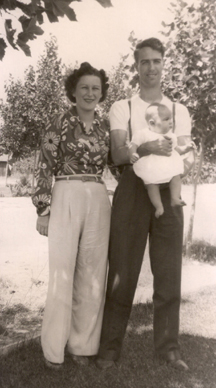 In 1939, Adaline Quinn, now in her late twenties
and living in the Fresno/Madera area, came up to San Francisco for a visit with a group that included
Harrietta Beverly Stapp, a niece of Adaline’s good friend Ethel. Adaline asked Beverly to be their tour
guide, since he knew the city and -- more important -- had an automobile. Bev agreed. He and Harrietta
became friendly over the course of the weekend. She surprised him by reminding him that they had
been in the same kindergarten class in Madera as young children. He didn’t recall such long-ago
history, but he would find Harrietta far more memorable this time. They got along so well that at
the end of the weekend he mentioned that he often was in Madera in order to visit his grandparents
and other relatives, and asked if he could call Harrietta next time he came down. Harrietta agreed
that would be to her liking. Beverly visited Madera the very next weekend. And the next weekend
after that. And the next weekend after that. In fact, he spent every weekend except one in Madera
over a six-month span, culminating in his marriage proposal to Harrietta, which she accepted. They
quickly made arrangements to go to Reno, where they could get a license right away. They picked up
a couple of her female relatives along the way to serve as witnesses, and the deed was done. (On
the way back, they spent their first night back in California in a hotel in Woodland, Yolo County,
CA. Ironically, Woodland would be where Beverly and his subsequent wife would eventually retire.)
The date of the ceremony was 3 June 1940.
About a year later Harrietta became pregnant. During the next few months, it became apparent to her
doctor that she must have suffered a case of rheumatic fever during childhood. The case had been
undiagnosed at the time, but it had weakened her heart. The strain of carrying the fetus was
putting her at risk of death. For a time it looked as though she and her unborn child might succumb.
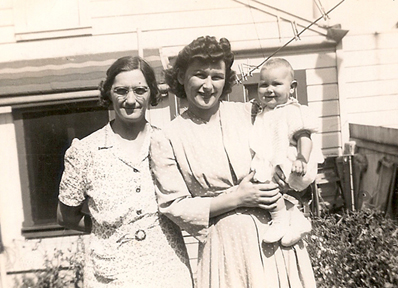
Fortunately Harrietta made it through, and a healthy daughter came into the world in early 1942. (At
left, Beverly and Harrietta with their new baby.)
However, her heart having been stressed, Harrietta’s health was precarious from then on. She seemed
particularly vulnerable when she would get colds, which was all too common in the foggy climate
of San Francisco. So Beverly took her and the baby down to Fresno, where her family and his
family helped look after her. He gave up his job at Cyclops in order to do so. He also remained out
of the war effort, despite a desire to serve his country, because Harrietta’s condition required
him to claim an exemption. Through the rest of the 1940s the couple and their little girl would
move between Fresno and the San Francisco peninsula a number of times. During the middle of the war
years Beverly worked at the Navy shipyard. After the war, he resumed working for Cyclops. These were
the hopeful times, when the family was able to be in the Bay Area. But eventually Harrietta’s condition
proceeded into chronic congestive heart failure, an inevitable consequence of her affliction. She
passed away 23 April 1950 in Fresno.
 That sad turning point meant Beverly was now a single
father. Some sort of living arrangement was
needed that would see to the needs of his daughter, left motherless at eight years old. Bev’s
parents-in-law and his sister-in-law Bernice were always willing to help and in fact did continue to
play host to their granddaughter/niece during chunks of summer vacations throughout the rest of her
childhood. During the school year, the girl remained with Bev, who moved in with his mother. Ada
Crane Branson Huddleston had the extra space in her Daly City home, having been widowed again in
1947, and having finished raising her youngest child, Eugene. (Ada is the middle-aged woman in the
1942 photo at right, shown with her daughter-in-law Harrietta Stapp Branson and new baby
granddaughter.)
During the later stages of Harrietta’s decline, Beverly had been forced to leave Cyclops again, but his
employer welcomed him back for a a third time -- his bosses had always been impressed with his work
and had never wanted him to leave. This time Beverly would stay with the company until they shut down
in 1967. He was literally the last man out the door. (For a while his half-brother Gene Huddleston was
also employed at Cyclops, a tenure that ended in 1962 when Gene became a policeman.)
After Beverly had proceeded through his period of grief, he became open to the prospect of starting over
with a new wife. He met Shurya Norma Bohny. A daughter of Leo Bonkowski and Juliana Baldauf, Shurya had
recently established herself on her own in Daly City. Born 29 August 1929 in Wheaton, Dupage County, IL,
Shurya had been raised in San Francisco and in Monte Rio, Sonoma County, CA, where her mother and her
stepfather Alfred Frederick Bohny operated a Catholic girls camp. Bev and Shurya were married 9 April
1952 in San Francisco. Ada Huddleston moved out of the Daly City home, turning it over to Bev and Shurya by
moving into the apartment that Shurya had occupied as a single woman. Soon Ada relocated to Merced County so
that she could be near kinfolk who resided just outside Winton. She began working at a doctor’s office
in Atwater, the town adjacent to Winton on the other side of Highway 99.
Beverly and Shurya’s first child was born sixteen months after the wedding. They would become parents of
four more over a ten-year stretch. When the third baby arrived, the house was getting a little crowded.
Bev’s eldest, now sixteen, had a solution to offer. She had gone to a lot of schools during the tumultuous
years of her early childhood, and liked the idea of staying with her aunt Betty and uncle Bert Smith so
that she could graduate from Madera High School, just as her father had -- a little bit of much-appreciated
continuity. She also liked the idea of living on a farm, which seemed exotic and fun given her urban
upbringing. Betty and Bert were keen on the idea, so the arrangement was made. The young woman came back at
eighteen, just after Shurya had given birth for a fourth time, but was soon off on her own and was married
at nineteen. (Her first child was born before the last of Beverly and Shurya’s five.)
Beverly’s choice to have a second family contains a degree of genealogical significance, as it
ensured the Branson surname would live on. By the 1950s, things had not looked good in that regard.
John Sevier Branson and Martha Jane Ousley had produced five healthy sons and gone on to welcome
sixteen Branson grandsons into the world -- more than a third of the total number of grandchildren
they would ever have. Yet one way or another, only five great-grandsons who bore the name happened
to produce male offspring, Beverly being the last to begin doing so.
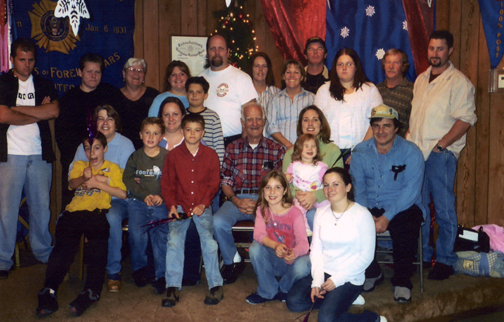
Beverly Orwin Branson at not quite ninety, at a gathering in Woodland, CA of the majority
of his children, children-in-law, and grandchildren.
Beverly remained a machinist until retirement. When Cyclops Ironworks closed its doors, he shifted
to his next and last employer, Coen Manufacturing. (The name was an abbreviation for Combustion
Engineering.) The firm specialized in burners/boilers for large buildings and industrial uses. Beverly
worked for Coen until he turned sixty-five. He completed that month (August, 1982) and made his exit
on the first of September.
During the time he worked for Coen, the household was situated not in Daly City, but a few miles to
the south in Pacifica, San Mateo County, CA. Beverly and Shurya remained there until 1990. By then
their kids were long gone. Looking for a cheaper, less frantic, more sunny part of the state to live
in, they retired to Woodland. (Pacifica is one of the foggiest places
in all of California. Because the Branson home had sat on the ridge above the town, they had been
spared some of the gloom, but not all.) Shurya died in Woodland 5 October 2001.
For a few years after Shurya’s death, Beverly was able to continue to dwell in the house he and Shurya
had moved into in 1990, but at about ninety he entered an assisted-care facility in Woodland. He was
regularly looked after in these twilight years by several children but particularly by the two daughters
whose homes were in Woodland. Though his age showed in his appearance and he moved slowly, he did well
in a lot of ways considering his years until a stroke suffered in July, 2010 sent him into his final
decline. After a few weeks in a Sacramento hospital, by mid-August he was back at his care facility in
Woodland. He would never again leave the place.
Several days before he died, retaining a clear mind even at this late point, Beverly
summoned his children for a final talk and told them all precisely how he wanted his hospice to proceed.
He repeated his instructions to the staff at the facility so that there would be no miscommunication.
Things proceeded rapidly from there until he succumbed in the early hours of 23 August 2010.
For decades, Beverly had gone deer-hunting in Plumas National Forest. The area near Greenville
was a favorite every-summer vacation spot for him and Shurya and all his kids. For that reason, his
and Shurya’s ashes are to be buried in a family section at Greenville Cemetery. The spot is already the
site of the grave of son-in-law Brian Keith Baker, who passed away in 2006.
Descendants of Beverly Orwin
Branson
Details of Generation Five, the great-great-grandchildren of John Sevier Branson and
Martha Jane Ousley, are kept off-line to guard the privacy of living individuals. However,
we can say that Beverly’s descendants include six children (one child with his first wife
Harrietta Beverly Stapp and five with his second wife Shurya Norma Bonhy), fifteen grandchildren,
at least six great-grandchildren, and at least one great-great-grandchild.
To go back one generation, click here. To return
to the Branson/Ousley Family main page, click here.