Betty Joella Branson
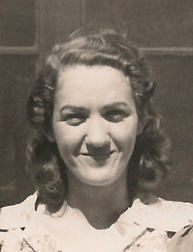 Betty Joella Branson, daughter of Henry Jefferson Branson
and Ada Crane, was born 14 December 1920 in Madera, Madera County, CA. Her first name really was Betty,
i.e. it was not an abbreviation of a longer name. She was the third and last child born to Henry and Ada.
However, this tally includes a brother who passed away in 1919 at four hours of age. The one full
sibling Betty would know all her life -- one who would ultimately survive her -- was her brother Beverly
Orwin Branson, three years her senior.
At the time of Betty’s birth, her father had recently become a night supervisor at the Yosemite Lumber
Company mill complex at Merced Falls, on the Merced River at the boundary of Mariposa and Merced Counties.
He was killed in an accident there in April, 1921, shortly before Betty reached four months of age.
She therefore grew up with no memory of him.
After the tragedy, Betty, her brother Beverly, and their mother Ada sought the comfort and shelter of
Henry’s parents John Sevier Branson, Jr. and Lillian Jane Guest at their residence on Washington Avenue,
Madera, Madera County, CA. When she could manage it, Ada moved herself and her little ones to a rental
home nearby. With John and Lillian for support, Ada turned to being a laundress to make ends meet.
Several of her brothers made their living in the laundry business, so this was a natural occupation for
her to pursue. Meanwhile, the local Oddfellows chapter donated labor in order to build a house for the
young widow and her offspring on Vineyard Avenue, just around the corner from John and Lillian’s place.
At this juncture, Betty’s uncle Joseph William Branson and his wife Mildred also lived on Vineyard
Avenue.
Ada’s partner in her laundry enterprise was her brother William Crane -- Bill. Unfortunately the
business was marginal. It was difficult for Ada to maintain a separate home for herself and her
kids. A temporary solution presented itself in the mid-1920s when the home of John and Lillian burned
down. Since they had to rebuild anyway, they added an extra room, connected to the main house by a
causeway. Ada and the kids took up occupancy there, which reduced Ada’s expenses. Even so, she was
keen for a better situation. The agent for this change was a romantic interest. The fellow’s name
was Matt Huddleston. Formally, he was Matthew J. Huddleston, son of Matthew Huddleston and Julia
Canty. Born 23 February 1879, the first of five children, Matt had been raised since infancy (and
probably from birth) in San Francisco. His father had been long been a teamster -- i.e. a hauler of
goods back and forth through the city, “teamster” stemming from the days when that occupation
depended upon teams of draft animals to haul wagons through the streets -- and Matt had grown up
in this trade, even as the industry said farewell to its beasts of burden and resorted to motorized
trucks for transport.
 During the 1910s, Ada’s brother Bill Crane, before
returning to Madera and reacquainting himself
with the laundry business, had lived in San Francisco with his first wife Jennie Serradel. When
Jennie had passed away, Bill had married Charlotte Adaline Huddleston. Lottie was a sister of
Matt Huddleston. In about 1926, when Matt came to Madera to visit Lottie and brother-in-law Bill,
he met Ada. The pair hit it off well, and soon were married. Given that Matt was running a thriving
trucking business in San Francisco, Ada’s choice to marry him naturally meant she and her kids had
to relocate.
Betty successfully made the adjustment to being a “big city
girl” and would have a lifelong affection for San Francisco. The family home was located on Lowell
Street at the boundary of the city proper and Daly City. Her playmates included her brother, a plethora
of Huddleston step-kin, and for a while in the late 1920s, her younger first cousin Lowell Lorrine
Branson, daughter of her uncle Joseph William Branson, during an interval when Joseph worked for Matt
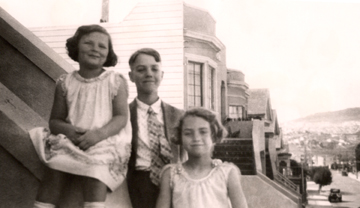
Huddleston. (Shown at right, Lowell, Beverly, and Betty Branson on Lowell Street in about 1928.)
The connection to Madera was not severed, though. Betty and Beverly often stayed with their grandparents.
This was particularly true after the 1931 birth of Eugene R. Huddleston, the one child Ada and Matt had
together. (Matt already had a son, Matthew M. Huddleston, from his first marriage to Margaret Smith.
Born in 1901, the younger Matt had already acquired a wife and started a family before his father and
Ada had wed. Betty was not much older than her step-nieces and step-nephews.)
After high school, Betty was urged to move in with her grandparents in Madera, a “killing two birds
with one stone” arrangement that moved her halfway toward an independent life while simultaneously
providing the elderly couple with some help at home. This was a welcome development for them inasmuch
as John Sevier Branson, Jr. had just reached seventy years of age and Lillian was in her late sixties
and was not in the best of health. Betty was reluctant to leave her accustomed urban existence behind,
but she saw the arrangement as temporary, and had always been emotionally close to John and Lillian,
so she made the best of it. It was during this interval that she met the man who would become her
spouse for nearly sixty-five years. Her suitor was Bert Sylvester Smith. The pair
were wed 22 October 1941 in Reno, NV.
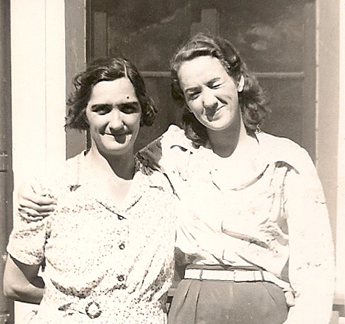 At left, Betty with her mother in 1942.) Bert was only
slightly older than Betty, born 21 March 1919 in Junction, Kimble County, TX. His parents were Ira
Edna Smith and Docia Alma Robertson, who had moved themselves and their kids (sons Bert, Louis
Kenneth, and Donald) from Texas to California in the early-to-mid 1920s. They had lived on a farm
near Hanford, Kings County, CA until the late 1930s, so Bert was only newly acquainted with the
Madera County area when he met Betty. Bert was a farmer, but Betty had no desire to become a farm
wife. She wanted to get back
to San Francisco, so that was where she and Bert went as newlyweds. Steady employment was a challenge,
though. They found jobs where they could. They were briefly employed by Betty’s cousin Ivan Thorpe
Branson, whose catering business, Morning Glory Sandwiches, founded early in the Great
Depression, was doing a booming business in these World War II years because one of Ivan’s
accounts was the U.S. Navy, whose sailors were often in port in huge numbers. In the genealogical
material Ivan gathered while assembling his book, Bones of the Bransons, he noted with
amusement the time when Betty was asked by Ivan’s wife Marion to add a couple of eggs to the ricer
to put in a salad. Marion meant hardboiled eggs, but Betty was less accustomed to kitchen skills than
many young women of her generation. She put in raw eggs.
Among Ivan’s surviving papers is a short autobiography Betty wrote in the late 1970s, during a time
when Ivan was soliciting such contributions from relatives. (Only three relatives responded to Ivan’s
request, the other two being Dorothy Branson Stefanelli and Emily Thistle Christensen.) Betty describes
the decision to leave San Francisco like so: “Several jobs later found us in Fresno, and finally back
in Madera. The farm eventually won out; we bought some cows, leased a place, and later bought ninety
acres in Merced County. We were in the dairy business.”
Betty’s memoir entirely skips over a subject she clearly found too distressing to mention -- the
loss of two children. The first of these was a son, Melvin Bert Smith, who came along during the
Fresno chapter of Betty and Bert’s lives. Born 24 October 1943, little Melvin only survived half a
month, perishing 9 November 1943. The next pregnancy was even less successful. A daughter was born
prematurely -- so short of full term, in fact, that it would appear the family doctor categorized the
baby as a late miscarriage and no birth (or death) record was created for her.
Betty and Bert were informed any further attempts to have natural children would meet with equally
unfortunate results. The couple gradually warmed to the idea of becoming adoptive parents. Meanwhile,
they settled into their agricultural existence. The acreage Betty referred to in her autobiography
was in the vicinity of the communities of Winton and Atwater, near some of her maternal kinfolk.
(Beginning about 1953, her mother Ada Crane Branson Huddleston herself would be among the local
relatives, having decided to leave Daly City and San Francisco in favor of Winton/Atwater now that
she was done raising all her children and was a widow again.) The dairy farm provided a stable milieu
that the adoption agencies agreed was suitable, and in 1950 Betty and Bert were
given custody of a five-year-old boy. The boy remained aware of his birth heritage and later in life
would choose to take his original surname back, but for the rest of his childhood he was a Smith, and
Betty and Bert were if anything better than natural parents, because they did not take for granted
the presence of offspring in their household.
 In late 1954, as Betty put it, she and Bert “had a very
special Christmas.” A baby girl was born that immediately became their adoptive daughter, one that
would never know any parents but them. At the end of the 1950s Betty and Bert would get to be
surrogate parents in yet another way when they took in Beverly Branson’s eldest daughter, who
liked the idea of living on a farm, having spent most of her upbringing in highly urban circumstances
in the Bay Area. (The arrangement helped make Beverly’s home a little less crowded. Now married to his
second wife, he was siring further children at a steady pace.) The visit lasted two years, encompassing the
youngster’s last two years of high school.
By the time Betty’s niece joined the household, the family home was back in Madera. The move had occurred
in 1956 after Bert had obtained a position with Madera Irrigation District, a job he would keep until
retirement. The dairy farm had been sold within his family (a nephew still has it today). The quarter
century from the late 1950s to the early 1980s became the prime of Betty and Bert’s lives. During this
stretch the children grew up and set out on their own. Though Bert fulfilled the role of steady breadwinner,
Betty did not remain simply a homemaker. As the children became older and needed less care, she and
Bert bought a Madera County grape and almond farm near Chowchilla. Betty handled much of its daily
management, with Bert contributing during evenings and weekends.
By the early 1980s, Betty and Bert’s son was gone to the Pacific Northwest, which meant the couple had
limited opportunity to see their grandchildren. Their daughter remained local. Looming large in the
couple’s lives in their twilight years was Bert’s nephew, the one who had taken over their dairy farm
in 1956, and his wife.
In early retirement, Betty and Bert kept their farm going, but gradually settled into an elderly
lifestyle. Bert passed away 27 June 2006. Betty did not care to live on her own, nor was she
doing well enough healthwise to risk it. Though her daughter was involved in her care,
Betty spent much of the last two years of her life on the dairy farm with Bert’s nephew
and his wife, where she had lived so many decades before. She remained alert and full of personality
even in her final year, though bothered by poor hearing and general loss of vigor. She was able to
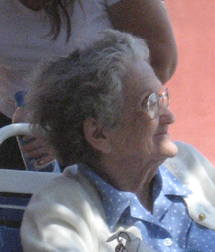
make it to a May 2007 mini-reunion of the Branson clan to tour the resting places of long-gone
family members. (The photo of her at right was taken that day.) She finally expired
29 April 2008. Her body was cremated, as Bert’s had been. The ashes of both were placed at
Arbor Vitae Cemetery in the city of Madera, the resting place of many members of the Branson clan.
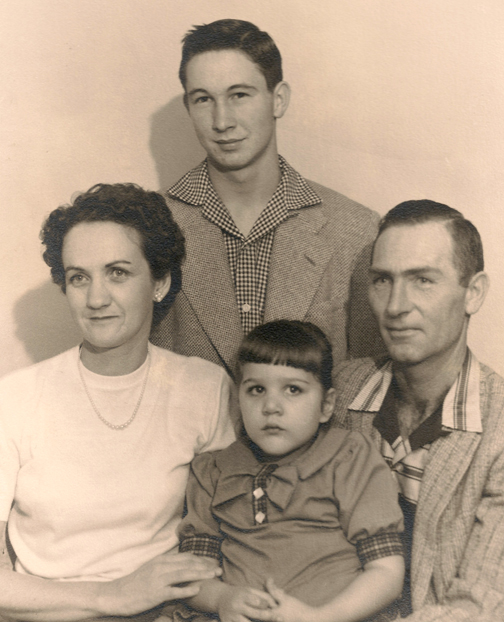
Betty and Bert with their kids about 1960.
Children of Betty Joella Branson
with Bert Sylvester Smith
Details of Generation Five, the great-great-grandchildren of John Sevier Branson and
Martha Jane Ousley, are kept off-line to guard the privacy of living individuals. However,
we can say that the archive contains information on Betty’s descendants, which include
the two natural and two adoptive children mentioned above, three grandchildren, and six
great-grandchildren.
To go back one generation, click here. To return
to the Branson/Ousley Family main page, click here.