Arletta Pearle Bucher
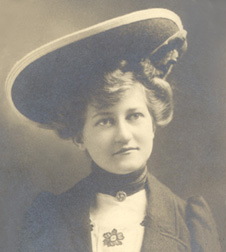 Arletta Pearle Bucher, second child and eldest daughter of Mary
Lincoln “Tinty” Martin and Elwood Byron Bucher, was born 5 February 1885 in Martintown, Green County,
WI. She was best known throughout life as Arley. This name seems to have been difficult for census
takers and newspaper obituary writers to deal with and they would use Arlie or some other variation.
Even her formal name presented this challenge -- in the 1920 census, for example, she is Ardetta.
Arley spent her first ten years or so in Martintown, the village founded by her grandparents Nathaniel
Martin and Hannah Strader, meaning she was one of many of her extended family to be educated in modest
little Martin School, just across the Pecatonica River from the town’s landmark mills. (She is no
doubt one of the schoolchildren in the picture shown on the “Martintown” page of this website. Click
here to visit that page.) When she was an adolescent the family home
shifted slightly south, across the state line, to Winslow, Stephenson County, IL, where she attended
Winslow High School. In 1902, after she had graduated from the latter institution (which operated
on a two-year program in those days), Arley’s mother passed away. As the eldest surviving female of her
family, she surely helped her widower father deal with the aftermath of that tragedy. However, by then
her career as a schoolteacher had begun. She was no longer a member of her birth household and it does not
appear she moved back in. Any help she gave was in addition to taking care of her job responsibilities.
The school -- or perhaps the series of schools -- that Arley taught at is not available. However, she is
known to have been based in 1903 in Freeport, not far south of Winslow. That may or may not mean she taught
there. Freeport was (and still is) the seat of Stephenson County and by the turn of the 20th Century was
urban enough that Arley could count on finding a room to rent near the train depot, which in turn would
have made it possible for her to commute to her workplace no matter what small rural school in the region
happened to hire her. The site of her job for the 1904-05 and 1905-06 academic years may well have been
Lanark, Carroll County, IL, about twenty miles southwest of Freeport. The biggest hint that this was the
case is that one of her suitors was Frank B. Ritter, a young man of that community.
One of her suitors, yes, but he was by no means the only one. A perspective into Arley’s lifestyle during
her young career-woman phase is preserved in a letter written 24 April 1961 by Hazel McMillen Granger, who
had been a classmate, neighbor, and good friend while she and Arley were growing up, and who then kept in
regular contact when they were both based in Freeport. Hazel went through an extended single-gal period
herself -- so extended, in fact, that she was in her fifties before she finally wed for the first and
only time in her life. In 1961, several years into her widowhood, Hazel made a trip from her home in Darien,
WI to tour California and while there, made it a point to drop by and visit some of the people she had
known in Martintown, Winslow, and Freeport. For part of this experience she was accompanied by Arley’s
elderly first cousin Emma Warner Hastings. One of the stops was to see Arley at her home in Van Nuys. As
Hazel reported in the letter (sent to Emma’s sister-in-law Grace Branson Warner), she and Arley had laughed
and laughed as they reminisced about all the various men Arley had gone out with back-in-the-day. In the
car on the way back, Emma asked Hazel in astonishment, “Did she really go out with all those fellows?”
Hazel’s reply: “Yes. And many more!”
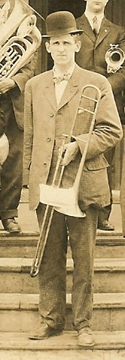 Ultimately, as Arley reached twenty-one years of age,
it was Frank Ritter who won out over the competition. Frank, born 14 July 1883, was a son of William H.
Ritter and Susan McNair, a couple from Franklin County, PA who had settled in Lanark as newlyweds in the
late 1870s. Frank’s father was in the lumber business, which suggests an alternate way that Frank and
Arley may have come to meet. It is a virtual certainty William Ritter was a customer and/or supplier from
time to time of the Martin family sawmill. It is therefore easy to imagine that Arley and Frank became
acquainted when Frank, as a young man, was in Martintown either delivering timber to the mill or picking
up sawn lumber from it on his father’s behalf. In any case, meet they did. The wedding, conducted by
Justice of the Peace Wilbur F. Goddard, took place 2 April 1906 at the county courthouse in Freeport.
Family and friends acknowledged what a promising match it was. A capable young man, less than two years
older than his bride, poised to make something of himself in the world. A healthy young woman, capable of
supporting herself if need be and nevertheless welcoming the transition to being half of a couple. Fate
was to be unkind to the union, but who would have guessed that given such a decent start?
The pair spent their newlywed season in Winslow, but soon they departed for Rusk County, WI, considerably
to the north in timber country, where Frank could ply the family trade. They are known to have been
residing there when their first child, Thelma Eileen Ritter, was born in the early summer of 1907, and to
have stayed at least through the birth of son Harold L. Ritter in October of the following year. (The
photo of Frank at right shows him while in Ladysmith, standing with his trombone amid members of a local
brass band. The photo below left shows Arley with baby Thelma.)
During the first decade of the 20th Century an alarming number of the Martin-Strader clan came down with
tuberculosis. Those afflicted included Arley’s uncle Horatio Woodman Martin, who with the death of
Nathaniel Martin in early 1905 had become the family patriarch, and who for decades prior had been
the one who actively supervised the family mills. Several of Arley’s first cousins and/or their
wives caught TB as well. Horatio died of the disease in the spring of 1906, just two days after
Arley and Frank’s wedding. It was a time of upheaval. Arley’s aunt Nellie Martin Warner and all her
family -- a long-time mainstay presence in Martintown -- departed for Fresno County, CA, where it was
hoped the arid climate would preserve the life of Arley’s cousin Cullen Clifford Warner. Things did
not settle down again until Arley’s father Elwood married Horatio’s widow Laura Hart Martin in early
1907. Elwood took over custodianship of the mills, and he and Laura lived in the home just above the
mills, combining their families -- though in the case of the Buchers, this meant only Arley’s
seven-year-old brother Ralph. Arley and her other siblings were old enough that they had already
established independent lives.
 Frank Ritter unfortunately was one of those who caught
TB. It first manifested in the bones of an arm, with the initial diagnosis being made in February, 1908.
Over the months to come it progressed into the more commonly-seen pulmonary form. He was in bad shape
by the summer of 1909; if he and Arley had not already given up on Ladysmith by then, they did so at
that point. Frank returned to Lanark to be cared for by his kinfolk. Arley and the children
stayed in Martintown. Arley visited Frank on a regular basis, and sometimes brought along the kids, but
for the sake of the health of the little ones, they minimized the hours they spent in one another’s
company and their degree of contact. Arley’s aunt Juliette Martin Savage wrote of “Poor Frank” in a 1947
letter about genealogical matters sent to her niece Mary Emma Warner Hastings. Juliette had been a
supporter of the match between Frank and Arley. She enjoyed Frank’s spiritedness. According to her
account, Frank was confident he would beat the disease. That optimism faded after he journeyed to the
newly-founded Mayo Clinic of Rochester, MN at the end of August, 1909, and was told his case was too
advanced and there was, in fact, no hope of a cure. Frank perished 1 January 1910. The place of death
has not been confirmed, but it was probably Lanark. Certainly the funeral was there; his grave lies in
the Ritter section of the Lanark cemetery. In her widowhood, Arley remained in Martintown, residing only
a shout and a jump away from her sister Rose and family, her grandmother Hannah, her aunt Juliette, and
other relatives, possibly in the house her father purchased in early 1910 from Arley’s first cousin
John Martin Warner. (Along with the house and its land, Elwood also purchased the Martintown general
store from John, who had opted for a sudden departure for California because his wife, Anna Lueck
Warner, was the latest family members to come down with tuberculosis. Alas, Anna was to have no better
luck fending off the disease than Frank Ritter, and she would perish in the spring of 1911.)
Arley was an independent sort of person with more than enough strength of will to have forged on as a
single woman. However, her children were both very small when they became semi-orphans and it is no
surprise she remarried fairly quickly. Her new spouse was Charles Henry Ames, son of Harmon Ames and
Elizabeth G. “Libby” Edson. The wedding took place 15 March 1912 in Chicago, Cook County, IL. Charles
had been born 14 August 1882 on a farm in Wilmington Township, DeKalb County, IN, near the town of
Butler. He had been raised partly there and partly back in his parents’ original stomping grounds in
or near Hicksville, Defiance County, OH. In 1904, he had married Vesta Herman Sewell, daughter of
William D. Sewell and Maggie Herman, with whom he produced two daughters, Thelma Yetive Ames and Laura
Margaret Ames. This marriage, however, had catastrophically fallen apart in the autumn of 1908. The
divorce petition cites a number of negative things about Charles, including drunkenness and failure to
support; however, this must be taken with a grain of salt. Back then, in order to be divorced, one
spouse had to be shown to be “at fault” and sometimes that spouse’s transgressions were exaggerated in
order to get the whole business over with. The timing of the break-up suggests the rift became
unrepairable during the second pregnancy. The divorce filing happened only weeks after the birth of
Laura Margaret Ames (that birth taking place 19 August 1908).
As was standard in that era, custody of the children went to the mother. Whether this was justified is
questionable. By 1910 Vesta gave up care of then-five-year-old Thelma Ames to a middle-aged couple,
Henry Sechler and Dora Cole Sechler, residents of Butler. By 1911, Vesta married Jesse Crawford, but
this union proved to be as fleeting as her first. By 1920, she was a nanny in Mt. Vernon, NY, and
younger child Laura Margaret was still back with her Sewell grandparents in Butler. Margaret, as she was
known within the family, would eventually share a dwelling with her mother in Lakewood, OH (a suburb
of Cleveland) prior to her 1934 marriage to James A. Stinehart, but all-in-all, Vesta did not “keep it
together” for her girls, who unquestionably would have had a steadier upbringing had they remained with
their father. Vesta did eventually have a long-lasting marriage, but not until becoming the wife of Carl
Edwin Haas (1895-1989) in the 1930s after both girls were grown. Vesta, born 2 December 1886 in Butler,
died 21 September 1977 in Mayfield Heights, Cuyahoga County, OH.
 (Shown at right is Charles as he looked about the time his
romance with Vesta began, a good ten or twelve years before Arley ever laid eyes on him.) Regardless
of the degree of blame that may or may not have deserved to fall on Charles for the divorce, the reality
was that he had been ripped from his daughters’ lives. He did keep in contact with the pair -- even in
the 1940s, during the final few years of his life, he was visited by both Thelma and Margaret in
southern California -- but he was not a regular part of their lives after the split. He understandably had
been left with no desire to remain in Butler, IN. He had worked for a short period in a ladder factory
in Goshen, Elkhart County, IN, then apparently had “gotten away” by moving to Illinois, meeting Arley
either in Stephenson County or in Chicago. Moments he shared with Thelma and Margaret Ames were mostly
limited to occasions when he journeyed to Indiana. His surviving photo and postcard collection shows that
someone in his daughters’ family, probably Vesta’s mother, kept Charles informed of them in between
visits. Also, Harmon Ames, who continued to dwell in Butler as a widower, helped keep the bond active. On
a happier note, Charles was able to be a constant and nurturing presence to his son, Glenn Charles Ames,
to whom Arley gave birth 28 March 1913. Charles also participated fully in the raising of his Ritter
step-children.
Together Arley, Charles, Thelma (Ritter), Harold, and Glenn resided in Winslow for the next ten to fifteen
years. Charles was a harness maker during the 1910s, an occupation rapidly on the wane as the automobile
increasingly became the main mode of personal transportation. He shifted to more general leather work and
then into shoe repair. In the summer of 1925 or 1926, by which time both Thelma and Harold Ritter had
become old enough to work outside the home, the family moved into the larger town of Freeport, the seat of
Stephenson County. Alas, not long after this move, on 27 October 1926, the family was stunned by the
sudden death of Harold. The youth, only six days past his eighteenth birthday, was heading to a
Halloween dance in nearby Waddams Grove with a buddy. As they crossed a set of railroad tracks on foot,
they did not realize until too late that a passenger train was bearing down on them at full speed. The
other young man leaped clear, but Harold was killed by the impact.
As the 1920s concluded, Arley and Charles were gradually becoming better situated in
Freeport, though naturally the Great Depression made financial security a challenge. Thelma Ritter moved
out during those years, though it is unclear when she did so -- it may have been as early as 1926, or as
late as the summer of 1929, when she departed for Chicago. During the 1926-29 span, Thelma was a teacher
at a rural schoolhouse in the village of Lena. She resided in Freeport -- the only question being whether
she did so as a single lodger in town or was still at home with her mother and step-father. The 1930
census shows the make-up of the household as it was for a couple of years after Thelma’s departure,
consisting of just Arley, Charles, and Glenn. The document shows Arley and Charles were still only renters
at that point. They are known to have become homeowners some time during the 1930s. Charles is listed
as a mechanic at a shoe shop. This may have been a reference to the shoe repair shop on North Van Buren
Avenue he is known to have owned and operated for a good stretch of years, but it
may be he was still employed by others in 1930. Arley had entered (or returned to) the professional
workforce as well, and was a bookkeeper for an “oil company,” which does not mean oil
company in the way we think of it today, but refers to either a service station or a gasoline and
diesel oil distributor.
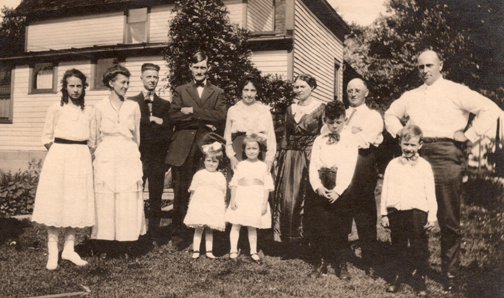
This photo, probably taken in the spring of 1921, shows some of the Winslow-based members of the
Bucher clan. Arley, then in her mid-thirties, is second from left. Her daughter Thelma Eileen Ritter,
only thirteen but looking a bit older, is on the far left. The two small girls in the center are Arley’s
nieces Phyllis Irene Claus (the littlest girl) and Evelyn Lois Claus, children of her deceased sister
Blanche. The boy with the dark curly hair -- apparently a wig because his natural hair is known to have
been blond or light brown in hue -- is Harold Ritter, while the smaller blond boy is Glenn Charles Ames.
The other adults are, left to right, Tecumseh Edgar Claus (father of the little girls), Ralph Byron Bucher
(Arley’s younger brother, looking very much like a young version of his father), T.E.’s new wife Mabel
Zimmerman Claus, an older couple so far unidentified, and on the far right, Charles Henry Ames. Though he
was only in his late thirties, Charles had gained a great deal of weight and hardly resembles the version
of himself shown higher on this page. (Part of this is illusion, though -- the photographer apparently was
using a custom lens meant for wide shots, and it created a distortion. Individuals on the far right and far
left appear taller and wider than they were in reality.)
Glenn was out of the house by the early 1930s. Graduating high school at only sixteen, Glenn set his
educational goals high. He attended the University of Illinois at Urbana, Champaign County, IL,
and then did post-graduate work at the University of Southern California. In 1937, degree in hand, he
set up his law practice in Hollywood, sharing a house with his law firm partner up in Benedict Canyon. His
presence on the west coast tempted Arley and Charles to move as well. They resisted the impulse until the
winter of 1940/41. At that point they came out to
attend the wedding of their son to his bride, June Marie Jones, an event held 2 November 1940 in Hollywood.
They lingered through the winter, to give themselves a chance to get to know their new daughter-in-law
and to luxuriate in sunshine and mild temperatures rather than the frost and snow back in Freeport. By
spring, California had won them over, and would be their home for the rest of their lives.
For three years Arley and Charles lived in Reseda in what was at that time a rural area, a landscape of
orange groves rather than tract housing developments, a place they affectionately referred to as their
“chick’n ranch.” (The photo of Arley, Charles, and Glenn shown slightly below right was probably taken
at that property.) Here they were briefly joined in 1943 by Thelma -- who had divorced her husband
Harold Welch. Arley and Charles served as hosts for a number of months to Thelma and her
two children until they could get settled in their own place. Thelma would also remain a southern
California resident for the rest of her life, her initial long-term residence being located in North
Hollywood. In August, 1944, not long after Arley and Charles had been left on their own again, they
downsized to a house on Hatteras Street in Van Nuys. This would be Arley’s place of residence for about
a quarter of a century, except for a brief span in the mid-1950s when she gave in to her daughter’s
pleas to live with her in North Hollywood. The last of Thelma’s children had moved out and Thelma
claimed she wanted company. In fact, Arley was treated more like just a housekeeper by her career-woman
child and went back to her Van Nuys place for another dozen years or so, until old age began catching up
with her.
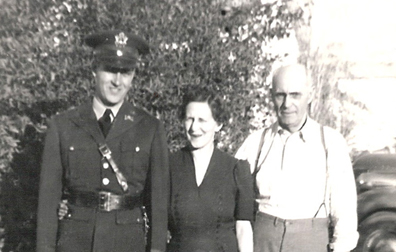 As he had in Illinois, Charles worked as a cobbler. He was
however nudged into a somewhat early retirement in approximately 1946 because of failing health. In May,
1948, his more generalized deterioration shifted into crisis mode as he developed a bleeding peptic
ulcer. This led to a massive gastrointestinal hemorrhage on the 28th of that month, and to his admission
to Los Angeles County General Hospital, where he died on the afternoon of 2 June 1948 of shock brought on
by the blood loss. His funeral was held three days later.
Where some women would view double widowhood as a blight upon their personal history, Arley (after a
suitable period of mourning) treated it as a kind of liberation. She does not appear to have resumed the
sort of prolific dating life she had pursued during her late teens and early twenties, but neither did
she board up her house and become a hermit, either. Arley was gregarious and would have been at a loss
if she could not have been actively out and about. She loved meeting new people, hearing their stories,
entertaining them and being entertained by them. In 2008, grandson Richard Boos recounted how he had
accompanied Arley on a cross-country train trip in the summer of 1955, and was amazed and impressed how
easily she slipped into the role of queen-bee social instigator, inviting people to play cards, stirring
up conversations, and brightening the whole trip for everyone present. Arley knew how to make people
laugh and would not allow those around her to stay stuck in “dull mode” if she could help it.
One of the factors that kept her social life lively was the contribution of her daughter-in-law June and
of June’s mother Laura nee Davidson. Before marrying Glenn Ames, June had been a secretary at
Warner Brothers studios and
during another interval had been the personal secretary of a radio celebrity. Though June had become a
housewife according to her husband’s preference, she still ran with an interesting group of
people, and inasmuch as she and Glenn did not have children, had the time to maintain those bonds. Laura,
too, was part of a network of intriguing and influential folk. Her second husband Fred Baumann was a close
friend of Donald Wills Douglas of Douglas Aircraft, a major mover and shaker of industry in southern
California. But even when the three women were on their own, they had a blast
together -- a typical excursion being when June would invite mom and mom-in-law for a day at the racetrack
for some low-stakes gambling and high-fun conversation. Arley and Laura were barely two years apart in
age and “had each other’s number,” and would constantly kid and joke with one another. Given how much Arley
adored June, it must have been a shock to her when, after thirty years, her son moved on to
another spouse.
For all her antics, Arley did have a conservative and sedate side that would come out at the appropriate
junctures -- among other things she remained a devout church-goer lifelong.
By the latter part of the 1960s, Arley had reached her eighties. She went into a gradual decline. She
moved in with Thelma, then spent the very last portion of her life in a Van Nuys nursing home, where
she passed away 25 June 1973. Her remains were interred beside those of her husband Charles in Forest
Lawn Memorial Park, Glendale, Los Angeles County, CA. (Space 3, Block 1120, Liberty Section.)
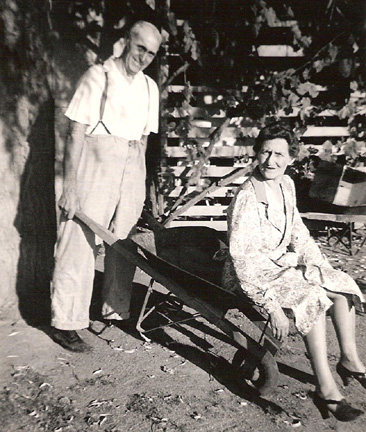
Arley was famous in family circles for her humor. In characteristic fashion, here she is
pretending to be hauled away to the dump by husband Charles Ames. This photograph was no doubt taken
at the couple’s “chick’n ranch” near Reseda, where they lived from early 1941 to mid-1944.
Children of Arletta Pearle Bucher
with Frank B. Ritter
Thelma Eileen
Ritter
Harold L.
Ritter
with Charles Henry Ames
Glenn Charles
Ames
For genealogical details, click on the names.
To go back one generation, click here. To return to the Martin/Strader
Family main page, click here.