Alvin Franklin
Corkins
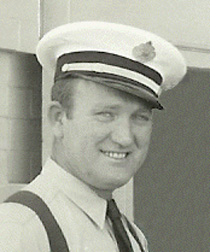 Alvin Franklin
Corkins, son of Florence Winnie Branson and Ernest Lee Corkins, was born 15 December 1913 in Calaveras
County, CA, on a cattle ranch near the adjacent communities of Altaville and Angel’s Camp. His parents,
along with his older sister Mildred, had temporarily moved to the locale from Stockton, and would return
to Stockton while Alvin was a baby. Alvin was named for his grandfathers, Alvin Thorpe Branson and
Franklin Corkins. He was sometimes called Al and known to his buddies as Cork.
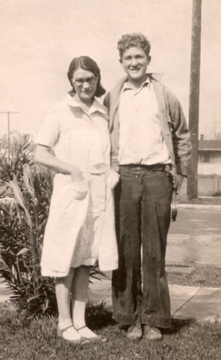
As Alvin entered his teens (shown at right during those years, standing with his mother outside the
family home), the family was not doing well financially. This led to Alvin quitting school
as soon as, or just before, completing eighth grade. In his generation young men admired peers who followed
this path. Staying in school was regarded as less manly than working. And if Alvin had not done it anyway,
the coming challenges of the Great Depression would have eventually pressured him to do so. However,
in Alvin’s case, there is some indication he felt he had no choice but to help generate income for the
household, and that he hoped to eventually get a high school diploma. Unfortunately, the hard times went on
for a while, stemming in great part from the collapse of his parents’ marriage. By the late 1920s, his
mother pushed his father out of the house in favor of Charles Dumont, whom she would eventually marry. The
divorce was declared final in the late spring of 1929. Shortly afterward, Ernest Corkins reacted by
attempting to murder Charles with a pistol. By a stroke of fortune matters were resolved without a fatality.
A certain kind of peace was restored, but the family home had unquestionably been disrupted. When things
settled down a bit, Alvin’s siblings, who included not only Mildred but a younger brother and sister, Daniel
and Alice, spent their remaining period of dependency with Florence. Alvin bucked the trend, and maintained
the bond with his father, sharing a home with him in Stockton even in the mid-1930s when, as an adult, he
could easily have been out on his own.
 Given the difficulty of earning a wage in the 1930s,
Alvin went from one job to another. One of his main
gigs was as a truck driver/deliveryman. His employers included Stockton Dry Goods and Pacific Fruit
Exporters. As far as can be determined, he stayed put in Stockton throughout this phase. His father had
a somewhat steadier situation -- one that had been a long time coming by the time it happened -- and
worked throughout this period maintaining equipment for Milk Producers Association of Central California.
Alvin became a husband at twenty-three. His bride, Priscilla Jewell Gilmore, was twenty-one. Those ages
are old enough to imply the couple waited until they were ready for something as momentous as establishing
a household together. That would be a false impression. Jewell was about ten weeks pregnant, and so
Alvin eloped with her to Reno, NV. They wed 10 April 1937. Their daughter Barbara Ellen Corkins was born
that autumn. Far from being a carefully planned launching of a relationship, it was in many ways a disaster.
Priscilla Jewell Gilmore was a daughter of farmer Joseph Lorenzo Gilmore and Minnie Ethel Jewell. Born 13
October 1915 on the family ranch between Manteca and Ripon in the southern part of San Joaquin County, she
she had come into the world not long after the deaths of both of
her mother’s parents and was named in honor of them -- Priscilla for her grandmother Priscilla Fifield, and
Jewell for her grandfather John C. Jewell, a carpenter. Jewell’s upbringing had been somewhat unusual.
Her father, forty when Jewell was born, was set in his ways and hated to be away from his ranch and his
cattle. Minnie, age thirty-three when Jewell was born, was equally set in her ways and was determined
not to forego the comforts of a town existence. The pair nevertheless had a successful marriage. Joseph
would spend most of his time at the ranch, including staying overnight often as not. Minnie
would hold down the fort at the family home at 1239 E. Clay Street in Stockton. Alvin and Jewell may have
met through the Fette family, close neighbors of the Gilmores. A son of that family, Richard Jay Fette, had
married Alvin’s first cousin Doris Margaret Curtis in 1931.
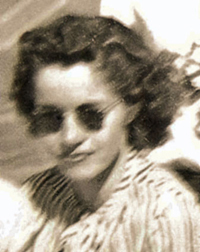 Alvin and Jewell (shown left) remained spouses for
nearly three decades and ultimately had three kids. This is remarkable, because in practical
terms the couple did not even successfully complete their first year together, not in the sense of
sharing a household together as a nuclear family -- husband, wife, and baby. Unfortunately, Jewell
was a schizophrenic -- meaning in the clinical sense, not as a personality quirk. The pregnancy
and then having to care for a newborn created enough stress to cause her initial breakdown. (It is
often characteristic of schizophrenics that they manifest their psychosis in their twenties in the
form of a sudden breakdown.) In years to come Jewell would be institutionalized a number of times and
she spent other portions of her life at home but under medical treatment for her disorder. Any other man
probably would have cut Jewell out of his life at the very earliest opportunity. That Alvin did not
do so says a great deal about his character. Time and again it was impossible to keep a stable home
situation going. Jewell would retreat to the sanctuary of her parents’ home. This at least had the virtue
of providing their child with a caregiver during non-school hours while Alvin was at work. It is safe to
say that Alvin’s offspring, especially Barbara, would have had far more difficult childhoods had they not
been able to depend on their grandmother Minnie. (Joseph Gilmore did his part as well, but he died in 1943
and Minnie bore the brunt of the ordeal.)
Alvin did not personally move in with the Gilmores. He resided in a series of other of dwellings -- at
least five different ones over the years, all in Stockton. This had a big disadvantage. Alvin would get
to missing Jewell during those times when she was institutionalized and would end up checking her out of
the mental facility to bring her to live with him. He would have to have been extraordinarily unselfish
to have resisted this temptation. But his pride got the best of him. He was enough of a man’s man to tell
himself, “I want my wife around, dammit!” He didn’t want doctors, nurses, and in-laws in his face telling
him how to interact with her. But the fact was, Jewell was at her most stable when being supervised by
her birth-family members or by medical professionals. In his better moments, Alvin acknowledged this.
While Alvin’s domestic circumstances could be described as regularly in upheaval, the opposite was true
of his employment picture. In 1939, he was able to begin what turned out to be his main career. He became
a firefighter for the Stockton Fire Department. In this he was following the example of his uncle Walter
Henry Branson, who had by then already served as a Stockton FD firefighter for over twenty years. In fact,
in a certain way, Alvin was literally replacing Walter, because Walter was among nine members of the
department who had been injured in a collision of two fire engines, and it would take five months before
Walter was able to go back to work. Other colleagues were likewise injured long-term, and Alvin was among
the four recruits brought in as replacements. The temp job became a permanent position. Jewell gets part
of the credit for this. Alvin needed to pass written tests, and so she tutored him in the evenings to help
him compensate for his inadequate schooling.
 Alvin would spend a total of thirty years with the fire
department, including about fifteen years working side by side with his uncle. For most of this span he
was a member of Engine Company No. 8, which served the Fair Oaks neighborhood. Alvin was raised to the
rank of captain only eight or so years after joining
the force -- achieving that distinction at a younger age than anyone in the history of Stockton FD. He was
known as “Chef Cork” because he was also the cook at the station. He became renowed for his sauce and was
known to prepare a wonderful pot of beans. The latter was a family tradition, as his grandfather Alvin
Branson and great-grandfather John Sevier Branson had habitually kept pots of beans simmering at their
gold-mining camps.
In the early 1950s, things with Jewell were going fairly well. At long last the couple expanded their
family, adding a second child, Carol Ethel Corkins, in 1950. A few years later Jewell went through a
period bad enough that she sought shelter yet again with her mother, who by then was a resident of
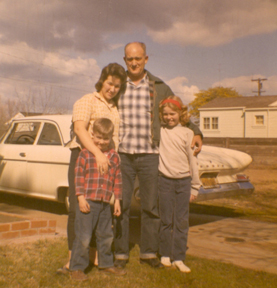
Modesto, but the couple weathered this and yet another baby soon arrived. (Alvin is shown at right
with his three kids in the early 1960s.) By the time of the latter birth, Alvin and Jewell were
already grandparents. The event also coincided with a change of residence from 1306 E. Worth Street
to 11 W. Ingram Street -- a couple of miles farther north, but still in the city of Stockton.
Unfortunately the marriage eventually could not withstand the stresses brought on by Jewell’s condition.
The couple separated in the early 1960s. Jewell passed away 18 June 1982 in Stockton.
Alvin might have procrastinated longer obtaining a divorce, but by 1965 he finally had a reason to take
care of the paperwork. By then a romance had blossomed with Joy Thomas, a Stockton divorcée. They decided
to become husband and wife. Unfortunately, Jewell was not cooperative. As a temporary solution, Alvin and
Joy headed down to Tijuana, where he was able to obtain a divorce decree in short order. The pair were
married in that city 20 January 1965. Jewell eventually saw that her stonewalling would accomplish nothing
positive. Once the divorce was finalized, Alvin and Joy proceeded to obtain their U.S. marriage
certificate by heading off to Reno to renew their vows 4 September 1965.
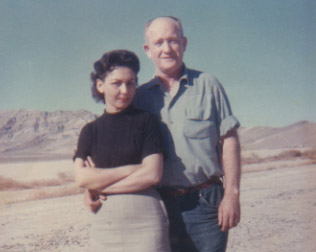
Alvin had finally found domestic bliss. (Alvin and Joy are shown at lower left in a snapshot taken
during their wedding/honeymoon excursion.) It was the same for Joy. Born Mafalda Joy Battilana 16
May 1925 in rural Stockton, she was a daughter of Antone J. Battilana and Helen M. McCutchen. (She
hated her first
name and did not use it in adulthood except in the sense of using the “M” as a middle initial.) Joy
had endured three unsuccessful marriages. As a teenager she had wed Gene F. Harvey. At the end of the
World War II years, at age twenty, she had given birth to her only child, Kathleen Jane Harvey. Two
other marriages, a brief one to Joe Torres and then a longer one to John Thomas, had followed. By
the time she wed Alvin, her daughter Kathy was married and had a two-year-old. By the time of the
Reno renewal-of-vows, Kathy had given birth again. So Alvin was now not only a stepfather, but a
step-grandfather as well. His bond with Kathy was very strong even though he had not had the chance
to help raise her. He was a big part of his step-grandchildren’s lives and was immensely popular with
them in turn. Their pet name for him was “Papa.”
 Alvin was a jack-of-all-trades, a bright man despite his lack of
formal education. He repaired his cars,
did home improvements, fixed appliances. He was quick with a joke, and enjoyed playing practical jokes.
One of his greatest pastimes was deer hunting. In the 1960s and 1970s, he would regularly head up to
Shasta County to do some hunting, that being one of the ways he kept in touch with his sister Alice and
her family, Alice having long since become based in the Mount Shasta area.
In 1968, the final full calendar year of his career, Alvin was involved in dealing with a large chemical
fire. One of his men did not have a functioning mask, so Alvin loaned him his. Unfortunately this meant
Alvin ended up inhaling too many toxic fumes that day. His lungs were damaged, leading to a degenerating
condition that eventually proved fatal.
During early retirement, while Alvin was still relatively hale, he and Joy moved to Eugene, Stanislaus
County, CA, in the foothills east of Stockton, where he built them a beautiful three-bedroom home. The
couple were only able to spend a few years there until his health grew worse, and they decided to relocate
somewhat closer to Stockton. They chose the town of Farmington, where Kathy could
be close at hand to help. Even this was too far from the hospital -- a twenty-five-minute drive. Toward
the end Alvin had such trouble breathing that he needed to be rushed to the hospital on multiple occasions.
Each time the ride seemed longer and longer. On the last such occasion, he stopped breathing on the way
over, and Kathy had to pull into the firehouse at Escalon and have the paramedics resuscitate him. At that
point, Alvin gave in to the suggestions of his loved ones and agreed to stay where he could be cared for
round the clock. He spent the last month of his life in Doctors Hospital in Modesto, where he expired 8
December 1983, just short of seventy years old. His body was cremated, and after the funeral in Lodi, the
ashes were scattered outside San Andreas, Calaveras County, CA, near his birthplace.
Joy survived Alvin by nearly twenty-eight years. She never married again, but she had one further major
relationship. In the early 2000s she reconnected with her first husband, Gene F. Harvey. They both
realized that whatever they had argued about back in the 1940s had been something inconsequential and it
had been an overreaction on their part to get divorced. Though they stopped short of remarrying, they
became a couple again. Kathy, who had barely had contact with her biological father for most of her
life, finally had the chance to starting getting to know him as she approached sixty years old. Joy died
10 November 2011.
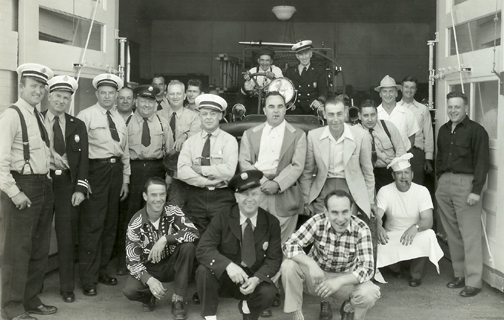
Alvin and the rest of the Stockton Fire Department Engine Company Number Eight in the late
1950s or early 1960s. Alvin is on the far left.
Children of Alvin Franklin
Corkins with Priscilla Jewell Gilmore
Details of Generation Five, the great-great-grandchildren of John Sevier Branson and
Martha Jane Ousley, are kept off-line to guard the privacy of living individuals. However,
we can say Alvin’s descendants include three children and four grandchildren, one stepdaughter, two
step-grandchildren, and five step-great-grandchildren. His daughters Barbara Ellen Corkins Summers
(30 October 1937 - 26 November 2013) and Carol Ethel Corkins Fabionar (25 December 1950 - 26 September
1994) have passed away. Kathleen Jane Harvey McCarty (28 September
1945 - 15 August 2010) is also deceased. A few years before her death, Kathy contributed photos and
information to this website, and was particularly helpful providing material needed for this biography.
To go back one generation, click here. To return
to the Branson/Ousley Family main page, click here.