Alice Marjorie
Corkins
 Alice Marjorie Corkins, daughter of Florence Winnifred
Branson and Ernest Lee Corkins, was born 4 February 1919 in Stockton, San Joaquin County, CA. She
was the youngest of four children, following Mildred, Alvin, and Daniel. According to her mother’s
account, her birth was an incredible ordeal. Reportedly, she weighed in at ten pounds, fourteen
ounces! Florence’s jokes about her daughter’s “big head” began with that event. The jokes were
repeated as time went on because Alice proved to be a bright child -- she would go on to graduate
high school a year early despite a number of interruptions in her education. However, the jokes may
also have been Florence’s way of covering up how worried she was about her little girl and her head.
Alice was periodically a victim of seizures that a doctor attributed to her brain growing faster
than her skull. Fortunately the seizures became a thing of the past by the time Alice reached age
seven or so.
While Alice was still in gradeschool, her parents’ marriage ended. Her father moved out, and
her mother’s paramour Charles Dumont, formerly a lodger, became a “co-habitant.” Also at about
this time, Mildred Corkins, the oldest child of the family, married at age seventeen, produced
a child, Donald Burkett, and soon ended up as a single mother. Adding to the complications was
the onset of the Great Depression. The family had already been struggling financially, and now
things grew so bad eldest son Alvin quit high school and went to work.
Alice was young enough while this was going on that an attempt was made to shield her from some
of the turmoil. She was sent for an extended visit -- or a series of visits -- to live with her
uncle Ivan Thorpe Branson and his wife Marion in the San Francisco Bay Area. Ivan and Marion were
childless and were glad to have a youngster around the house. As a consequence Alice was not
on-hand when one of the more dramatic events of her childhood occurred -- her father approached
Charles Dumont outside the latter’s workplace and put a gun to his face. Charles grabbed the gun
away and no bullets were fired. However, it was a mark of the strong feelings involved in the
break-up of the marriage.
In the summer of 1930 Florence married Charles Dumont. A period of truce began, and Alice came back
to Stockton full-time. The early 1930s being an era when children of divorced parents stayed with
their mothers, Alice was part of the household of her mother and stepfather. Alice would have preferred
not to be under the latter’s supervision, but she did not have a lot of choice at the time. Her
rebelliousness expressed itself in such ways as taking dance lessons over her mother’s objection --
lessons that Ernest Corkins encouraged and paid for. (Alice at one point had serious
dreams of becoming a dancer as a profession, though this hope never was realized.)
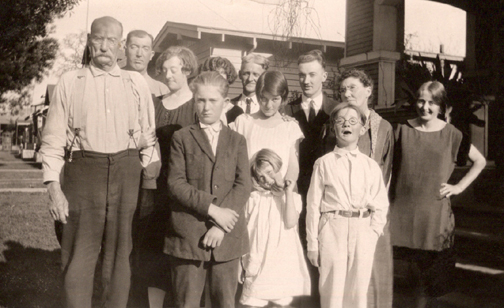
The Branson/Corkins clan of Stockton, CA in the mid-1920s. The four kids in the center are Alice
and her siblings. Alice is the little girl in front. The other three are, left to right, Alvin
Franklin Corkins, Mildred Elaine Corkins (behind Alice), and Daniel Francis Mackey Corkins. The
adults arrayed beside and behind the children are, left to right, Alvin Thorpe Branson, Walter
Henry Branson, Maude Ethel Branson Curtis, Florence Winnie Branson Corkins (face obscured behind
her son Alvin), Ernest Lee Corkins, Ivan Thorpe Branson, Mary Eliza Simmons Branson, and Marion
Christian Branson.
In 1934, Florence and Charles decided to move to Pollock Pines, El Dorado County, CA. Alice, still
only fifteen, was part of this relocation. So was her brother Daniel for a brief time. Nephew Donald
Burkett stayed over often enough that it was almost as if Alice had a younger brother. Donald called
Alice by the pet name Lally, something Alice would recall lifelong with fondness. Sadly, Donald
perished at age twelve when his step-father’s boat exploded and caught fire in the middle of Lake
Tahoe in 1941.
In her late teens Alice attended University of the Pacific in Stockton, a two-year college. She finished
various courses but did not obtain a degree. She met William Otis Ashmun in Placerville when she was twenty
or twenty-one. They were married 17 October 1940 in Virginia City, NV. William, born 10 August 1898 in
Grand Rapids, Kent County, MI, was more than twenty years her senior. He had come of age in Washington
state, where his parents Chester Arthur Ashmun and Henrietta Middleton had settled on a ranch in
Snohomish County. He had remained in Washington during his early adulthood, where he engaged in such
professions as apple-picking and logging. All his later life he suffered from a bad knee and leg as the
result of the accident that ended his logging career.
In William’s late teens he had married Vivian Anderson, who perished in the great flu epidemic while
eight months pregnant. William, who had driven ambulances during the crisis yet somehow had managed
not to succumb to the virus himself, had been left stunned by the tragedy. He had not only lost a wife
and an unborn daughter, but as things played out, he also was deprived of the chance to enjoy being a
father in his twenties and thirties. His lack of offspring during that time was not, however, from
lack of further wives. In 1924 he had wed Beulah Godfrey, with whom he moved to California by the end
of the 1920s, and then in the 1930s he had acquired a third wife, whose name is not available. The
marriage ended when Alice became a part of William’s existence, and in fact the technicalities of the
divorce meant that Alice and Wiliam eventually had to reaffirm their union.
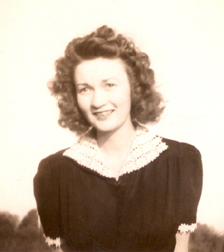 Alice and William’s existence was highly mobile over the
course of their first two decades together. At
first Stockton served as a kind of base of operations, and was where the couple’s first two children
were born in the early 1940s, but it was difficult to say that town was still “home.” William was a
field-labor contractor specializing in melon picking and shipping. Among the crops he typically dealt
with was cantelope. To maintain this career, he needed to stay in whichever major region was
experiencing its harvest season. Whenever possible, Alice and the kids went along. Generally the
household would stay in about four spots per calendar year. Among the main places they lived was
Mendota, Fresno County, CA, where William was hired year after year by the same grower(s). Other
frequently occurring locales were Yuma, AZ and the Imperial Valley.
In 1946, William and Alice came to Redding, Shasta County, CA. That year or the next they bought the
Judge Ross property on Walker Mine Road outside of town toward Buckeye and Lake Shasta. The
labor-contractor job was bringing in enough money each year that
William could afford to devote a meaningful chunk of his off-season to gold-mining. He never did
find his bonanza, but a welcome side effect of the venture was that the
family ended up with a spot that they could henceforth treat as their “permanent address.” The timing
was right, as the third and last of the children came along at this point. The older two had reached
school age and it was best to stay in one school district as much as possible.
As a home, the place was decidedly rustic, even downright primitive at first. The property had come
without a house to speak of, so William and Alice purchased the buildings of the Walker Mine outpost a
quarter mile away and moved the structures to their land. The acquisitions included a house,
but the outlay of money had been so dramatic the couple decided it would be in their best financial
interest to rent it out while they and the kids lived in a one-room shed. At first they had
no electricity. William set to work converting another building -- the old mine office -- into a
residence. That task was accomplished during the first year. However, the 1950s were in progress
before the household could enjoy an indoor toilet. Two bedrooms were eventually added
so that the elder kids could have their own quarters.
In the summers, William continued to follow the melon
harvests. Alice and the kids went along when school was not in session -- and sometimes even when
it was, though William and Alice tried not to interrupt the children’s schooling. For the most part
all three Ashmun kids were able to get their education via their familiar Shasta County teachers
and institutions. Reinforcing the idea that the Redding area
was home was the fact that Alice’s mother and stepfather moved to the town not long after Alice and
William had. Alice’s sister Mildred would also spend a number of years in the vicinity. The offspring
of the sisters reached adulthood with the sense that they had “grown up together,” a bond of greater
depth than they were able to know with Alice’s brothers’ children, who grew up in the Stockton area.
William’s final season as a labor contractor came at the end of the 1950s, with his nearly-grown son
as his colleague. He was forced to give up his career when he began to fall victim to dementia. In
that era people did not use the term Alzheimer’s Disease, but in hindsight, this appears to have been
what have suffered from. The disease, particularly the rapid-onset form, has a tendency to be afflict people
regularly exposed to pesticides and herbicides, and also shows up in miners. However, at this point it
is impossible to say if William’s case stemmed from anything other than genetics.
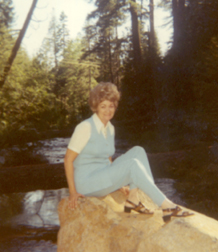 The end of the mobile-lifestyle era was in some ways welcome.
Alice, for one, had grown tired of uprooting
the family. Nor did she want to interrupt her Redding-area employment situation. Inasmuch as the
youngest of the children had reached adolescence, she was less interested in temporary jobs and wanted
to hold on to something with greater security at better wages, which was not easy to achieve when she
had to leave for several months each summer. However, William’s gig had long been the mainstay source of
household funds, and that was not easily replaced. Fortunately Alice was a capable manager of
money -- a trait which she appears to have handed down, as a number of her descendants have resorted
to accounting and
tax preparation as the basis of their income -- and made every dollar stretch. William and his son
were excellent hunters and so meat could be had “at wholesale” so to speak. One way or another, the
family dealt with the financial challenge.
The emotional challenge was a different thing. The marriage turned rocky. William, though he may have
had blemishes in his past, had always possessed a dynamic personality that regularly won people over,
and he had always thought the world of Alice. Now he was not the same person. Unfortunately, at first
it was not clear that dementia was the culprit. Equally unfortunate was that there was no getting
around the fact that less money in the household meant more stress. As the youngest of the children
reached the point where she could be on her own, Alice decided to leave her husband. William moved
in with one grown child to the next over a period of several years, spending the longest period with
his eldest daughter, Sharon, whom he called “Shine,” as in the sunshine of his life, a pet name he had
come up with when she was small. Finally he was so deep in dementia that he had to be sent to a
convalescent home. He passed away 21 April 1972.
One of the developments that closed the book on the past occurred when the Walker Mine Road property
was condemned through eminent domain because the state decided to erect high-tension electrical lines
across the site. Alice began living in an apartment in the town of Redding itself. Her main income
source became her job at an S&H Green Stamp redemption store. After taking accounting courses she became
capable of doing the bookkeeping and became manager of the business.
After the divorce from William (effective August, 1967), Alice became romantically involved with Wayne
Eugene Confer (14 May 1933 - 10 January 2015), whom she wed 25 September 1971. Wayne was nearly
fifteen years younger than Alice. Though originally from Ontario, CA, he and his parents and sister had
long been based in Shasta County -- Wayne’s brother-in-law Owen T. Lyon was renowned as a Redding police
officer who had died in the line of duty in 1967. The couple moved to a large rental home along the
Sacramento River in Redding, then after a year, moved to a townhouse apartment. Wayne proved to be an
alcoholic and the marriage ended in divorce in the late 1970s (final 17 January 1979). About the time
of the divorce, the Green Stamp store closed. The era of Green Stamps had wound down and there wasn’t
enough business to justify the continued operation of the store.
With Wayne Confer out of her life, Alice moved out to a home
outside Redding in the direction of the town of Anderson. She had reached a point of retirement, but
was not able to quit working entirely. She did not have much of a retirement nest egg to call upon and
her Social Security payments would not be large. The shortfall was filled by taking up a semi-volunteer
position as a “Foster Grandparent” in the local school system. This was a program that paid retirees modest
amounts to help out schoolkids who for one reason or another could not fully participate in regular classroom
sessions, freeing regular teachers to concentrate on the main student body and the core curriculum.
 Getting approved for the position was possible in part due to
Alice having gone through a stint as a foster mother -- one of the ways she had made
the household money stretch in the 1960s, when William was in decline. One of her youngest daughter’s
friends had run away from an abusive home situation as a teenager, and Alice had agreed to acquire
custody of the girl in response to her daughter’s pleading. She had done well in the role, and now
as she entered the 1980s she thrived at the Foster Grandparent gig. She deliberately signed up for
the more challenging assignments of the program aimed at students who were more likely to be “troubled”
rather than “slow.” For much of her first twenty years, Alice was
kept busy in the pregnant minors program. Though the initial idea of Foster Grandparents was to
provide counselling, companionship, and basic emotional support, the program had succeeded in growing
into a way in which to provide actual schooling in academic subjects. Alice went from simple aid such
as correcting tests, recording grades, compiling report cards, and helping principals with crossword
puzzles to teaching/tutoring English,
math, algebra, and drivers’ education. By the late 1990s she was transferred into a continuation
high school program, where she could help some of the youngsters who were most in need of getting
back on track. Over the course of more than a quarter century, she won numerous awards and received
letters and citations from various U.S. presidents, California governors, and other officials. After
the kids she had tutored grew up, they would regularly greet Alice with warmth when they encountered
her at restaurants, at the supermarket, at weddings, etc. Many called her “Grandma.” She remembered nearly
all their names, even though in some cases ten years or more had passed since she had last seen them.
Early in this semi-retirement phase of her life, Alice became involved with Alfred Leonard Campbell,
who moved into the Anderson house with her. He had been born 20 July 1913 in Pennsylvania. This means
he was over five
years senior to Alice, but by her standards he was a contemporary -- he was the only spouse she
ever had whose age was within a decade of her own. Unlike Wayne Confer, the match was an excellent
one and Al was popular with Alice’s kids and grandkids. Unfortunately he was a part of her life
for a relatively short time -- only five years or so. He contracted cancer. This development
led to the couple finally formalizing their union. They were wed 8 November 1985. Al passed away
just two months later on the seventh of January, 1986.
Having watched two older husbands fall victim to extended declines in health, Alice
felt optimistic she would not have to go through such an ordeal with her fourth husband, Dale Sherman
Campbell (no relation to Alfred), whom she married 20 May 1989 in Reno, NV. Born 19 August 1934, he
was even younger than Wayne Confer had been, and was her junior by over fifteen years. It is true the
pair were able to enjoy more than a decade together, but then Dale, too, developed cancer. He passed
away 3 June 2002.
In her final years, Alice presided as matriarch of a large clan, most of whom resided within easy driving
distance of her home. Deep into her old age she remained spirited and determined to stay involved in life,
though back pain, a broken hip (suffered on her 88th birthday), and other debilitation forced her to give
up her tutoring job and required her to stay in a nursing care situation from late 2006 until early
January, 2008. At that point she had regained enough strength to insist she be allowed to move back home.
Unfortunately the attempt lasted only seven weeks, until congestive heart failure got the best of her. She
held on at Shasta Medical Center in Redding until the morning of 28 February 2008. With her passing, the
tally of surviving great-grandchildren of John Sevier Branson and Martha Jane Ousley fell to only ten.
Within another half-dozen years, only four would remain. It was the closing chapter of a generation.
However, thanks to her longevity, Alice was one of the rare descendants of the couple to be able to
directly provide autobiographical detail for the website.
Children of Alice Marjorie
Corkins with William Otis Ashmun
Details of Generation Five, the great-great-grandchildren of John Sevier Branson and Martha Jane Ousley,
are kept off-line to guard the privacy of living individuals. However, we can say that Alice’s descendants
include three children, ten grandchildren, twenty-four great-grandchildren, and a rapidly-increasing quantity
of great-great-grandchildren. These numbers include not only biological descendants but several others who
were adopted in infancy, but do not reflect all of the step-descendants and foster descendants who Alice
“laid claim to.” Her daughter Sharon Magdalene Ashman Stevenson (8 April 1941 - 26 June 2015) is deceased, as
is granddaughter Deborah Diann Kinkade (22 September 1967 - 16 November 2008).
To go back one generation, click here. To return
to the Branson/Ousley Family main page, click here.