Alice Branson
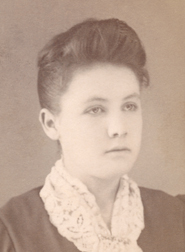 Alice Branson, fourth child and second daughter of Thomas
Henry Ousley Branson and Frances Bauer, was born 7 August 1879 on her parents’ rural property at the
mining outpost of Quartzburg (often alternately called Washington Mine in the late 1870s and early 1880s)
a couple of miles north of the village of Hornitos, Mariposa County, CA.
Alice spent all or nearly all of her childhood in Mariposa County. Her father did have a business presence
fifteen miles away in the town of Merced. This could mean Alice was raised partly in that community as
well, but as far as can be determined at this time, Thomas boarded with relatives on those occasions
when he needed to be in Merced while Frances and the children stayed year-round in Quartzburg. In 1897,
Thomas sold his land -- which may have been a portion of his parents’ “Grasshopper Ranch” -- to his
brother Joseph. Thomas and Frances acquired a house along Burns Creek in the “Chinese” section of Hornitos.
This dwelling may have been purchased from Frances’s brother Michael Bauer and family, who had moved some
years earlier into the core of the village, but who may have retained title to the Burns Creek property.
Thomas and Frances would keep this residence until 1911.
Alice and her siblings treasured the opportunity to remain under their parents’ roof and with the possible
exception of Mabel, demonstrated outright reluctance to move on to the next phase of their lives. Alice
was no exception. She lingered until the brink of age twenty-three, i.e. until 1902, except that a couple
of years before that she accepted a short-term job as a domestic servant in Merced with Alfred Clough and
his wife, the former Mary McDonald. Alice is enumerated in the Clough home in the 1900 census -- though
she is also enumerated with her family in Hornitos, a clear sign that she had not changed her permanent
address yet, she had simply accepted an opportunity to earn a bit of money in a place that was too far to
commute to every day. In doing so, she wasn’t really stepping out from under the supervision of close
family. Not only were the Cloughs closely associated with the Branson clan, but they resided in near
proximity to Alice’s Merced-based aunts, Nancy Branson Harrington Napier, Mary Branson Johnson, and
Theresa Branson Moore, to say nothing of William McDonald, the widower of her late aunt Phoebe
Branson.
Finally Alice spread her wings in the form of her marriage to John Henry Williams. He was a son of
William Henry Williams and Mary Oliver, a couple who had immigrated to the Far West from England. John,
born 20 July 1876, was the eldest of thirteen children. His birthplace was probably Hunter’s Valley,
Mariposa County, CA. Certainly his parents had been based there earlier in the year 1876. However, William
and Mary had then relocated to Nevada for about three years. In later years, informants provided
conflicting information about the location of John’s birth. The 1880, 1910, and 1920 censuses say Nevada.
The 1900 census and his obituary state it was Hunter’s Valley, where the family had settled for good at
the end of the 1870s. Either way, John spent most of his childhood in Hunter’s Valley, and thought of it
as his place of origin.
John and Alice were married 10 June 1902 in Mariposa County, probably at Mt. Bullion Mine, where John
worked. After becoming Alice’s husband, John continued to pursue mining at Mt. Bullion. The mine and the
support complex that surrounded it employed many relatives of both Alice and John during this era. For
example, Alice’s cousin Martha Branson Peard, a widow, was a housekeeper of one of the miners’ barracks.
Alice and John occupied a house in the open countryside a fraction of a mile from the outpost itself.
Presently it became a true family home with the birth of son Vernon Aubrey Williams in 1904, and then a
second son, Ray Burton Williams, in 1907. Things went well at first. Elsewhere in the Mother Lode, the
gold-mining industry had already collapsed or was in the process of collapsing, but the Mt. Bullion
formation still had a worthy amount of metal in the quartz deposits below the surface. In 1902, a major
infusion of funding on the part of The Mariposa Commercial and Mining Company, also known as the Grant
Company, had resulted in four shafts being brought to full production, along with the attendant
stamping mill(s). Hundreds of workers had come on board at that time. Thomas Branson was one of them,
at least sporadically when his tinsmith and machining skills were of use, though he did not spend
enough time there to justify acquiring a house. Instead, he would find quarters in the barracks. Sometimes
Frances and the couple’s youngest two kids, Alex and Inez, would accompany him while the older (now
mostly adult) kids looked after the Burns Creek house. Surely the visitors occasionally squeezed in with
Alice and John -- for example when Vernon and Ray were newborns and the presence of Frances to shoulder
some of the baby-holding and diaper-duty may have been vital to Alice retaining her sanity.
By the end of the decade, the economic conditions turned grim. Mt. Bullion could no longer be counted on
to produce enough gold to be worth the effort of seeking it out. For Alice and John, an extra bit of
misfortune came along to discourage them. On 3 February 1910, the family residence burned down. Fortunately
no one was hurt. The incident happened during the day while John was off at work and Alice, boys in tow,
was shopping and/or running errands. Still, it meant the loss of not only a dwelling, but of much of the
couple’s sentimental attachment to the general locale. John came to the decision he would abandon the
mining profession -- a question not of having to do so, but of when. Some time following the January, 1911
birth of a daughter, Ruth Evelyn Williams, Alice and John moved to the Central Valley, ending up in San
Joaquin County in the vicinity of the small town of Manteca, perhaps following in the wake Alice’s parents,
perhaps getting there at the same time or even little ahead of them, but in any case arriving by no later
than the winter of 1911-12. The area was a booming agricultural zone where Alice’s aunt Nancy Anne Branson
Harrington Napier and half of her six children had set up households earlier in the 1900s, having vacated
Merced, where Nancy had run a boarding house while raising her offspring.
John became a farmer. According to lingering family recollection, his efforts included breeding horses
for racing at the track in Stockton. In the early Manteca years, with his boys still young, he was
assisted in his farm work by Alice’s brother Hugh McErlane Branson (though it would probably be more
correct to say, John and Alice extended room and board and a job to Hugh). Hugh’s World War I
draft registration card places him with the Williamses in 1918. However, he moved on soon after. The
1920 census shows a household made up of just John, Alice, and their children. The latter included
their fourth and final child, Frances Bernice Williams, who was by then five years old. Another who
had moved on was Thomas Branson, giving up on Manteca in favor of a return to Hornitos. In 1920 Thomas
was four years a widower. Frances Bauer Branson had perished of chronic kidney disease and breast
cancer in 1916, earlier on the very day that her son William Proctor Branson -- who had never established
a home apart from his folks -- finally succumbed to his case of tuberculosis.
John Williams passed away 16 April 1923 when a bout with the flu led to a fatal case of pneumonia. Alice
probably kept the farm going as a widow, no doubt helped by the fact that her sons were reaching
adulthood. Over the next few years a suitable marital prospect would develop in the form of a close
neighbor, Milton James Henry, often best known as M.J. Henry.
M.J.’s history to the mid-1920s can be summed up like so: Born in Missouri 6 February 1873, he was the
eldest child of David Henry and Martha A. Hall. The family left Missouri behind in the mid-1870s in favor
of a life in California. At first they dwelled near Little River, Mendocino County, CA. As a young adult
M.J. and his siblings and widowed mother Martha came to San Joaquin County, where they shared a household
with Martha’s sister Louisa, also a widow. The locale was Nightingale Precinct, sometimes known as O’Neil
Township. These descriptive names are no longer in use and seldom turn up on modern maps. The spot was
just east of Stockton. Louisa’s next door neighbors were the Early family, headed by Michael and Louisa
L. Early. One of the daughters of that family was Lena Viola Early, born September 1879. In about 1902,
M.J. married Lena, and as newlyweds the couple acquired the farm near Manteca. They produced two
children, Lola Henry in 1903, and Lloyd L. Henry 7 December 1908. In about 1921 Lena developed a terminal
condition. She was more than a year into that illness when John Williams died. She suffered nearly three
years more, finally passing away 12 November 1925.
Alice and M.J. kept their respective status as widow and widower for a few years, then found in each other
the solution to their loneliness. They were married during the final weekend of October, 1928 in Reno, NV,
and during the subsequent week were feted in Manteca by family and by local lodge members. Alice was an
active member and sometimes an officer of Manteca’s Rebekah and Oddfellows lodges. Several of Alice’s
female Branson-clan Manteca-area relatives belonged to one or both of these lodges. This had also been
true of Lena Henry, and was at that point still true of Lola Henry Ballou, though the latter would perish
of surgical complications less than a year after Alice became her stepmother. The newlyweds settled at
once on M.J.’s farm on Louise Avenue. If Alice had not already sold her farm, she surely did so then.
By the time Alice and M.J. became a couple, their kids were adults with the exception of Alice’s two
daughters. Ruth was already gone to art school and even though she would come back on a temporary basis,
was not often a presence on the farm due to her job in Stockton and her artistic pursuits. Frances was
the only kid who would spend any sustained period as a member of the new household, and even she was
pushing fifteen by the time it was established. By contrast, Alice and M.J. were not left to themselves
even after reaching what would might have otherwise been an empty-nest chapter of their lives. Hugh
Branson lived with them. He had
stepped in to help Alice out during her widowhood, and once she found a new situation, he was “part of
the package.” And that did not change. Hugh lived with Alice and M.J. for the rest of his life, aside
from a few days of hospitalization at the very end. Hugh lived upstairs. Alice and M.J. occupied the
downstairs section. Hugh would spend much of his time each day out in the garden, having complete
oversight of an acre or so of the 38-acre parcel. Hugh helped with the rest of the land as well, of
course, just as he had done for John Williams. It was necessary to have two men about because the farm
was maintained the old-fashioned way, with horses instead of a tractor to pull the plows.
 As the 1930s progressed, Alice eased into
her role as “Grandma Alice” while her husband became “Grandpa M.J.” to an increasing number of grandchildren
and step-grandchildren. The farm was a fine place for kids to romp. Surviving grandson Kenneth Williams
recalled fondly in a January, 2011 interview that the onions Hugh grew in his garden were so sweet they
could be eaten like apples without causing tears, and how lively the farm was with its many chickens,
its multiple horses, and its pigs. Kenneth was also amused by how M.J. would find ways to sneak a sip of
whiskey on a regular basis even though having it on hand meant hiding bottles in various spots outside
the main house, such as in his workshop and under a piece of tin patching in the floor of the outhouse.
(Indoor plumbing was becoming more common but as with other old-fashioned touches, the outhouse was a
feature of the farm right into the 1940s. On the plus side, said outhouse was a well-built and ample
affair featuring three seats at different levels -- one for the men, one for the women, and one for the
kids.) M.J. had to hide his booze because Alice had a low opinion of liquor-drinking, having witnessed
too much over-indulgence in the mining camps and in old Hornitos. Alice was also a favorite babysitter
because of her culinary skills. With a mother like hers, it was inevitable she had grown up to be a good
cook, and thanks to her family’s close association with Chinese neighbors in Hornitos such as Ah Sing and
Ah Fong, she was adept at preparing Chinese dishes.
One of the things Kenneth implied in the 2011 interview was that Alice remained with M.J. for good.
Indeed, that seemed to be the case and her biography here reflected that apparent fact until 2022 when
the 1950 census was released to the public. In that survey, the couple are not enumerated together.
M.J. is shown still on the farm, but is categorized as a widower, sharing the house with three middle-aged
male lodgers. Alice meanwhile is shown in Richmond, Contra Costa County, CA as a widow (apparently in both
cases this means “widowed by divorce”) in the home of her sister Inez Branson, another household that
includes three male lodgers. This revelation triggered a second look at the obituary of Hugh Branson,
showing that while he had remained on the Manteca farm until just before his death in November, 1949,
Alice had already moved out, because she is described as a resident of Richmond, not Manteca. Further,
M.J.’s own obit does not mention a widow. Assuming that is a tell-tale omission, he and Alice must
have remained separated -- they may never have formally divorced -- for the final few years of his
life. M.J. perished 25 September 1953 in Lodi, San Joaquin County, CA, the locale meaning he probably
expired at a hospital. Three days later his remains were interred at Park View Cemetery of Manteca.
Given the rift, Alice did not live out the final fragment of her life on the farm. It was sold. Whether
she inherited a share is an open question, but she was granted consideration by her stepson, Lloyd Henry
-- this arrangement being another of the details gleaned from the 2011 interview with Kenneth Williams.
Lloyd, a prospering dentist, had acreage of his own in rural Manteca and gave over the small house on
that property to Alice to use as her home. This was a fine arrangement for a lady entering her
mid-seventies and it kept her in good stead for several years. Inevitably, though, she became frail and
could no longer live by herself. Accordingly she was taken in by her daughter Frances, whose home was in
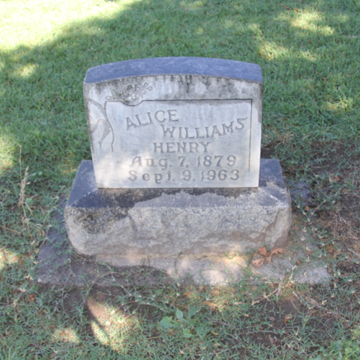
Delano, Kern County, CA. Alice passed away in Delano 9 September 1963. Her body was brought back to San
Joaquin County and was interred in Stockton Rural Cemetery. In other words, she was not buried with M.J.
The way the marriage ended may have been a factor in this decision. However, it is just as likely
Alice’s offspring preferred that her remains be placed with those of their father, John Henry Williams.
And indeed, his grave is just to the left of hers. The
graves of her daughter Ruth and son-in-law Edwin Carlson are in close proximity as well. Other sections of
Stockton Rural Cemetery contain the mortal remains of Alice’s parents and many other Branson relatives
including siblings William, Hugh, Alex, and Inez.
Alice’s children all survived her. For more about their lives, click on the links below. Her stepdaughter
Lola died 13 August 1929 at St. Joseph’s Hospital in Stockton, only seven months after the death of her
two-year-old son Lyle Franklin Ballou. Stepson Lloyd L. Henry, who remained a Manteca dentist until
retirement, died 30 October 1980. His wife was Winifred Black. They produced children Lloyd Milton Henry
(3 April 1939 - 13 September 1993) and Carola Henry. One of the latter’s daughters is Roxanne Sohns Klein,
who became world-famous as a prominent advocate and spokesperson of the Raw Food movement.
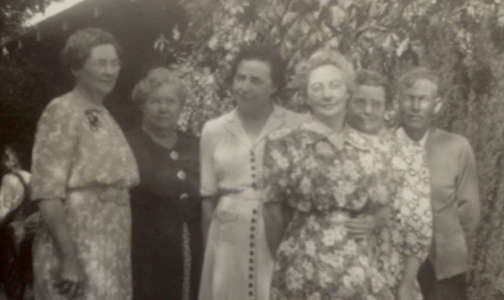
Alice and the other surviving children of Thomas and Frances Branson, a photo taken in 1943
outside her home on the Manteca farm she shared with M.J. Henry. From left to right, Mabel, Alice, Inez,
Alma, Evalena, and Hugh.
Children of Alice Branson
with John Henry Williams
Vernon Aubrey
Willaims
Ray Burton
Williams
Ruth Evelyn
Williams
Frances
Bernice Williams
For genealogical details, click on
each of the names.
To go back one generation, click here. To return
to the Branson/Ousley Family main page, click here.