 Alexander Hamilton Branson, youngest son of
Thomas Henry Ousley Branson and Frances Bauer, was born 29 January 1888 near Hornitos, Mariposa County,
CA. In adulthood he was often known as Alex.
Alexander Hamilton
Branson
Alexander Hamilton Branson, youngest son of
Thomas Henry Ousley Branson and Frances Bauer, was born 29 January 1888 near Hornitos, Mariposa County,
CA. In adulthood he was often known as Alex.
Alex was raised entirely in Mariposa County, but went through some slight changes of venue. During his early childhood, the household was based at Quartzburg -- sometimes better known during the 1880s and 1890s as Washington Mine after the outpost and quartz-ore stamping mill located there -- next to his paternal grandparents’ 160-acre Grasshopper Ranch. In 1897, his uncle Joseph Branson expanded his own holdings to include Grasshopper Ranch and apparently bought out Thomas’s acreage as well, so Thomas and Frances moved a couple of miles southward to a house and garden along the bank of Burns Creek in the so-called Chinese section of the village of Hornitos. (The garden is given special mention because it was so ample. Frances’s father Egide Bauer had been well known in the community as a vegetable grower and his daughter kept the tradition alive.) This house remained in the family until 1912; however, there may have been a period (or two) in 1902-08 when the family actually lived in the barracks at Mt. Bullion Mine, where Thomas was employed. Despite these small shifts, Alex’s upbringing was remarkably stable and dependable. His mother was an exceptional homemaker and cook. (She often prepared Chinese dishes, a legacy of her own upbringing. Back when both she and Thomas had been kids in the placer-gold mining camps along the Merced River, a great many of the meals they had eaten had been the work of male Chinese cooks. Her mother and Mrs. Branson and the handful of other women in those camps were occupied with childcare, and even if they had not been, could not have been reasonably expected to prepare all the meals all the time for a group of workers whose numbers sometimes reached sixty or seventy.) His father was employed variously as a tinsmith, miner, translator (of Chinese), and employee of the local courthouse, and served as one of the town trustees of Hornitos. The family home was so welcoming and secure that Alex’s older siblings tended to stay put, lingering at home long into adulthood. This was particularly true of his eldest brother, William Proctor Branson. The first members of the brood did not depart to begin independent lives until Alex was on the brink of being a teenager.
As Alex himself became old enough to venture into the world it was only natural that he take up mining. However, by the time he was in his early twenties the local gold-extraction industry collapsed. By 1910, even while still in Hornitos, he was doing odd jobs as an alternative. A 1911 issue of the Mariposa Gazette reveals the nature of one of those jobs -- Alex was a government inspector assigned to count how many California ground squirrels were still in the county after the first wave of a major eradication program.
In the latter part of 1911, Alex’s parents moved to Manteca, San Joaquin County, CA. Alex had not yet established a home of his own, so he moved with them. He would never live in Hornitos again. However, Manteca was only his place of residence for a matter of months. In 1912, he obtained employment at the Mariposa/Merced County boundary at the huge sawmill at Merced Falls. The lumber company maintained a large boarding facility at the site, and that is undoubtedly where Alex lodged during his tenure. This working-and-living arrangement lasted until late 1916 or early 1917, whereupon he moved to Merced. That town, seat of the county of the same name, was where his father’s tinsmith shop had been during the mid-1870s to the mid-1880s. Merced was one of the main destinations for young men of Hornitos and Merced Falls when they were attempting to forge a new life for themselves. Alex was ready to be his own boss. He leased a bus and carried passengers around town.
Apparently Alex did not make enough from his fares to be worth it. Some time in the second half of 1917 or the very early part of 1918, he joined the army. However, his back was weak due to some sort of injury he had sustained earlier in life, and after a number of months, the army decided he wasn’t in good enough shape to remain in the service. He was given a medical discharge. He never made it overseas, spending most of his brief hitch at Camp Kearny near San Diego. (This is the installation that would later be given over to the Navy and then the Marine Corps and become Marine Corps Air Station Miramar.)
Upon his return to civilian life, Alex was eager to again be his own boss, but experience had taught him that carrying passengers was not the way to prosperity. He decided that delivering packages rather than people might be sufficiently profitable. He acquired a truck and went into business as an “expressman,” which was the term then in use to describe indivdiuals who offered short-haul quick-delivery service -- or to again use a term of that era, Alex became the owner and proprietor of a “transfer business.” His main employee, with whom he shared a dwelling at 630 E. Worth Street in Stockton, was his first cousin Arthur Ervin Bauer, formerly of Hornitos.
Stockton was a much larger town than Merced, presumably one with a decent customer base, but somehow Alex and Arthur were not able to make a go of the venture. Alex returned to Merced County, taking a job by no later than the spring of 1919 as a farm hand on the acreage of R.R. Phillips.
Mr. Phillips turned out to be Alex’s final employer, because Alex died all too young. On the twelfth of September, 1919 he underwent a wisdom tooth extraction. In that pre-antibiotic era, that could sometimes be a dicey procedure, and so it was with him. He developed an abscess in his jaw -- or perhaps he had already been suffering from an abscess and the extraction did not succeed in alleviating the problem. The infection evolved into a fatal case of blood poisoning. While there was still hope, he sought out the help of his sister Alma Youd of Richmond, Contra Costa County, CA. A nurse, Alma had had formerly worked at Merced Sanitarium, which had functioned among other things as an emergency-care clinic, so it is certain she knew exactly what treatment Alex needed and who could provide it. Unfortunately, Alex could not be saved. He died 24 September 1919 in Richmond, twelve days after the removal of his problematic lower right third molar.
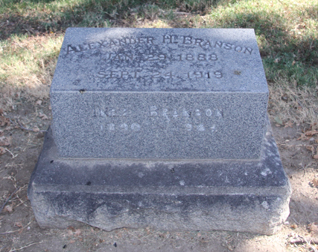
Alex only reached thirty-one years of age. Like the other sons of Thomas Branson and Frances Bauer, he did not marry and did not have children. He was buried 25 September 1919 in Stockton Rural Cemetery, section 37 a dozen paces or so from the graves of his mother and his brother William. Forty-five years after his death, section 37 of the cemetery having long since filled up, his sister Inez would be buried with him so as to accommodate her desire to be laid to rest in proximity to her immediate family members.
To go back one generation, click here. To return to the Branson/Ousley Family main page, click here.