Ada Vonner Brown
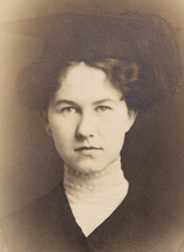 Ada Vonner Brown, fifth of the five children of Emma Ann Martin
and Cullen Penny Brown, was born 22 December 1889 in Fort Smith, Sebastian County, AR. The locale was a
temporary haven. For half a dozen years, Ada’s father had been developing lumber mills on a hired basis.
His first major contract to do so had been in Howell County, MO half a dozen years earlier, and that had
been followed by another employment situation in Kansas City, MO. Whenever he was engaged in a project, the
whole family came along, even to the extent that he and Emma would purchase homes or cause them to be built,
and make some of their income from these real-estate investments. The details of the Fort Smith opportunity
are vague in surviving memorabilia, but the offer was attractive enough to bring them down to Arkansas, where
neither Cullen nor Emma had ever lived before. How long they stayed is likewise vague. Perhaps only until the
year 1890, and certainly not as long as five years total, because in the paperwork having to do with the 1894
sale of a remaining piece of property in Howell County, Cullen and Emma are described as residents of Martin,
WI. This means that by no later than that date, Cullen and Emma had returned to their long-held residence in
the Green County, WI village founded by her parents, Nathaniel Martin and Hannah Strader. (The village was
at that point, in the early 1890s, just beginning to become known as Martintown rather than as Martin.)
The Brown residence was the easternmost of a series of three houses along the north bank of the Pecatonica
River where the Martin mills were located. The westernmost house belonged to Nathaniel and Hannah themselves,
while the middle one was the home of Emma’s brother Horatio Woodman Martin and family. Once back, the family
would stay put for most of the 1890s, during which time Ada began her formal education by attending the
village’s one-room elementary school, which was only a short walk across the bridge and then along the
opposite bank of the Pecatonica. The other students included quite a number of her relatives, the closest to
her own age being her first cousins Blanche Bucher, fifteen months her senior, and Fay Martin, three months her
junior. Her school experience was only one of the ways during that period of her life that Ada had the chance
to become thoroughly acquainted with her kinfolk on her mother’s side, even though she had been born hundreds
of miles away and would all too soon leave Martintown behind for good.
Ada’s middle name surely came from her paternal grandmother. However, there is a mystery in that regard.
Her grandmother’s maiden name was Mary Varner, not Vonner. Certainly, the name reappears among many of her
other descendants as Varner. Perhaps there was no consistent spelling in the 1800s, or perhaps Cullen, having
never seen the name written down, assumed it was Vonner due to the way the family pronounced it. For
several months during 2008, this website used Varner in the belief it was the “real” spelling. Since that
time, documents have been found showing that Ada herself, along with her sisters and her parents, used the
Vonner spelling. These documents include her high school and college diplomas. Therefore the name now appears
here as Vonner. (The photo at left is Ada’s college graduation photo.)
 In 1898 (or the tail end of 1897), the Martintown sojourn came
to an end. Cullen Brown was contracted to establish and supervise a large sawmill in the newly-founded and
rapidly-growing community of DeQueen, Sevier County, AR. The arrangement was very much to his liking and the
setting immediately appealed both to him and to Emma, so they soon committed to their relocation in a profound
way, setting aside any intention of ever returning to Martintown. They even tried to persuade their eldest
daughter Lena and son-in-law Frank Hastings to join them. The younger couple gave it a go and were based in
DeQueen from the spring of 1898 to the early autumn, but their impression of the locale was negative. They
missed “home” and chose to return to Martintown. For the rest of her life, Ada would see Lena on a far less
regular basis than she saw her other two sisters.
In late 1906, Cullen Brown was killed in a sawmill accident. His girls and their mother cleaved to DeQueen
even though they had only been there eight years at that point. Ada finished high school half a year after
her father’s demise, graduating from Stillwell
High School 24 May 1907. In late 1908, her sister Lulu married Edgar Gardner Seay. As a result, Ada became
the only child left to share the house with her mother, because her sister Lena was was already more than a
dozen years into her marriage to Frank Hastings and Ethel eight years into her marriage to James L. Cannon.
Ada was perhaps reluctant to leave her mother alone, or perhaps she preferred to stay at home and remain
unmarried for the time being in order to focus upon a career as a music teacher. This artistic passion led
to her admission to Valparaiso University in Indiana, where she went on to obtain a Bachelor of Music 15
August 1912. The culmination of this course of study was a session at that institution’s convervatory of
music, at which she was a soloist at a recital 25 July 1912, one of only two students so honored. Her main
instrument was the piano.
At age twenty-four, Ada finally became a wife. This would mean the end of her career in music and the
teaching of music (though of course she continued to own and play a piano). That appears to have been a
concession she embraced, and from the first year of the marriage onward she dedicated herself to furthering
her husband’s income-producing ventures. The object of her affection was John Bryant Luton. The wedding took
place 21 January 1914 in DeQueen.
Ada had undoubtedly known John for a number of years. The only son of Nicie A. Arnold and an unidentified
Mr. Luton, John had been born 2 January 1881 in Boydsville, Clay County, AR. From early childhood, he had
been the stepson of James Yates. The Yates/Luton family had come to DeQueen in its early days (prior to
1900). Nicie had long run a hotel there. It had been her own venture, while James Yates had worked outside
the home as a machinist. James Yates had died in the early part of the 20th Century. Nicie had forged on,
eventually handing the role of hotel proprietor on to John, whom she assisted and guided in its operation.
With such a well-established source of income and lifestyle already in place, Ada had an immediate
replacement career for the one she was forsaking. She was not relegated to being a mere housewife.
Instead she was groomed as Nicie’s successor. In fact, her participation may have been what prompted her
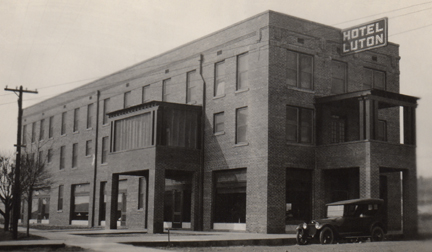
husband to proceed with the building of a much larger, completely modern version of the hotel, the one
you see on the left. This three-story brick structure, which was completed some time during the 1910s, was
a prominent feature of the town, a landmark of sorts. Locals were proud to counter the sentiment that
DeQueen was a backwater by touting the urban scale and design of the hotel and citing the famous guests who
stayed there, a list that included Princess Catherine Radziwill, the Polish aristocrat.
 Ada and John remained in DeQueen as hotelkeepers into the 1920s.
For a few years during this stretch, Ada was however less involved with the day-to-day operation of the
business due to her focus on motherhood. In the summer of 1916 she gave birth to daughter Marjorie Ione
Luton. Unfortunately the little girl survived less than four years, passing away from a prolonged illness in
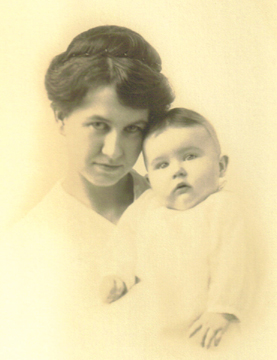
the spring of 1920. (The photo above right is Ada as a young mother, with Marjorie.) In 1921, Nicie
passed away. Perhaps these tragedies soured Ada and John’s affection for DeQueen. Later in the 1920s the
couple moved to San Angelo, Tom Green County, TX and took over management of the Walker Hotel. Their
relocation was the precursor of a shift of most of Ada’s immediate kin from Arkansas to various parts of
Texas.
In the 1930s, the couple gave up hotel work in favor of ranching in Camp Wood, Real County, TX. This put
them out in the semi-wild where various critters sometimes broke into the barn or the hencoop. John went
out before sunrise on the morning of 23 September 1936 with a pistol and a flashlight with the goal of
eliminating a polecat that had been making a nuisance of itself. Ada heard two gunshots. When John did
not return to the house, she went out and found him at the base of a grassy slope, dead from a bullet
straight through his heart. The gun and the flashlight were higher up the slope. She and the coroner
agreed that he must have seen the polecat, shot at it, and then slipped on the wet grass as he attempted
to get in position for a second shot. The gun ended up pointing at his chest during the fall, and
accidentally discharged. Death was instantaneous.
If the above scenario seems to you like it might represent a tall tale used to conceal a suicide, you would not
be alone in that suspicion. Perhaps a case of a widow who did not want it known her fellow had done such a
thing to himself? Perhaps a coroner who sympathized and wanted to be sure the widow was able to collect from
the life insurance policy? Could be. But no evidence survives that would refute the “official” version of
events. The certainty is that John met his end in that before-dawn darkness. His body was shipped back to
DeQueen, where it was interred 25 September 1936 at Redmen Cemetery.
Ada never married again. She remained in Texas. She retained ownership of the Camp Wood ranch for a
number of years, but did not personally reside there for long. She began leasing the property by no later
than 1940. She returned to San Angelo. For many years she occupied the same residence in the heart of San
Angelo at 1618 Shafter Street, renamed 1618 Live Oak Street in the late 1950s. In the early 1940s her sister
Lulu spent a brief period living with her. Then in the late 1940s and/or early 1950s, her sister Ethel may
have done the same, though only long enough to acquire her own house at 1808 West Avenue K. That address
was in Ada’s neighborhood, but was a fraction of a mile south. The sisters were therefore close enough to
one another that they did not need to drive over for visits. One or the other of them could simply walk the
distance. They were however far enough apart that they could maintain a measure of privacy.
Ada was officially a resident of San Angelo through the end of her life, but as she grew feeble in her
eighties she spent time living with her niece Mary Seay Abel and family in Elgin, Bastrop County, TX. And
then toward the very end of her life, she must have been obliged to seek the assistance of another niece,
Hazel Cannon Rodgers. Hazel had settled just west of San Antonio in Medina County, and it was at the
Medina Memorial Hospital (probably in Hondo) that Ada expired away 24 October 1978 at almost eighty-nine
years of age. Her grave is at Redmen Cemetery in DeQueen.
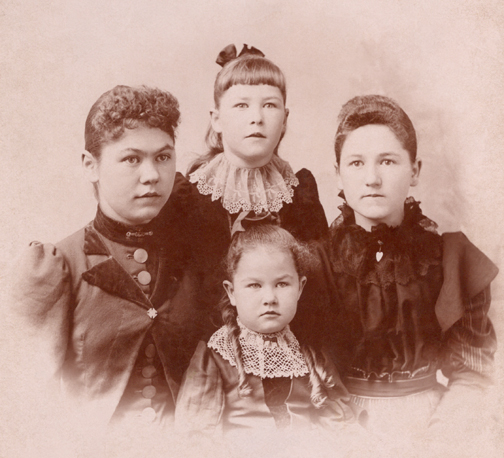
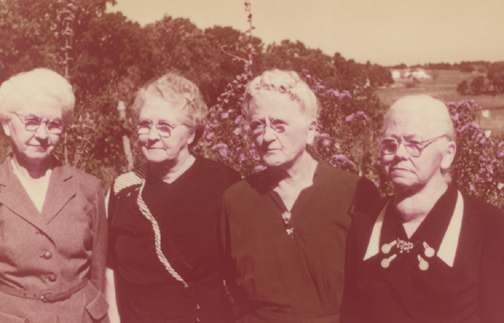
Above and below are two views of the four Brown sisters. (There would have been five sisters if Minnie Edna
Brown had lived past early childhood.) Above is a studio portrait taken in the mid-1890s. Lena is the
teenager on the left, Lulu is in back, Ethel is on the right, and a very young Ada is in the center front.
Below is the same quartet more than sixty years later at a family reunion in 1955. The scene is Martintown
or a spot near there. Left to right, youngest to eldest: Ada Vonner Brown Luton, Lulu Fay Brown Seay, Ethel
Irene Brown Cannon, and Mary Lena Brown Hastings.
Child of Ada Vonner Brown with John Bryant
Luton
Marjorie
Ione Luton
For genealogical details, click on Marjorie’s
name.
To go back one generation, click here. To return to the Martin/Strader
Family main page, click here.